
PMP-120 · Lesson 11 of 12 · 31 min
Performance management and difficult conversations
Most team members want to do good work, and most performance problems have causes that a project manager can help fix: unclear expectations, missing skills, poor tools, overload or personal difficulties. Sometimes, though, a team member's performance or behavior does not improve despite support, and the project manager must address it directly. These conversations are among the hardest parts of leadership. Avoided, they damage the project and the rest of the team, who see poor performance tolerated. Handled badly, they damage the person and the relationship. This lesson covers how to set expectations, give feedback, diagnose performance problems, hold difficult conversations and work within the organizational and legal framework, especially in a matrix where the project manager may not be the person's line manager.
Performance starts with expectations
People cannot meet expectations they do not know. Before judging performance, check that expectations were clear: the role and responsibilities (the RACI from lesson 4), the quality standard (for example the definition of done), the deadlines and the behavioral norms in the team charter. Many apparent performance problems turn out to be misunderstandings about what was expected.
Good expectations are specific and observable. "Be more proactive" is hard to act on; "flag any task likely to slip by more than a day at the next stand-up" is clear. For knowledge work, expectations often cover both results (what is delivered) and behaviors (how it is delivered, such as collaboration and communication).
Feedback as a continuous practice
Feedback works best as a regular, two-way habit rather than an annual event. Frequent, small pieces of feedback, both positive and constructive, keep people on course and make occasional difficult messages less shocking. A common guideline is to give far more positive than corrective feedback, not as a formula but because recognizing what works shows people what to repeat.
Several models help structure feedback so it is specific and free of blame.
| Model | Structure | Example |
|---|---|---|
| SBI (Center for Creative Leadership) | Situation, behavior, impact | "In yesterday's client demo (situation), you interrupted the client three times while she was asking about pricing (behavior). She seemed frustrated and cut the meeting short (impact)." |
| SBII | SBI plus intent: ask what the person intended | "…What were you hoping to achieve?" |
| DESC | Describe, express, specify, consequences | "The test reports have been late three times (describe). I'm concerned because the sponsor relies on them (express). Please send them by noon Friday (specify), so we can include them in the steering pack (consequences)." |
| Feedforward (Goldsmith) | Suggestions for the future rather than critique of the past | "For the next demo, it might help to let the client finish each question before responding." |
Worked problem
Turning a judgment into SBI feedback
You want to tell a team lead, Marcus, that he is "dismissive". Rewrite this as SBI feedback, then add a question about intent.
Show solution
- Replace the label with a situation: "In this morning's design review…"
- Describe observable behavior: "…when Lina proposed caching the results, you said 'that's obviously wrong' and moved to the next item without asking her reasoning."
- Describe the impact: "Lina didn't speak for the rest of the meeting, and we lost a chance to discuss an option that might have helped performance."
- Ask about intent: "What was going on for you at that point?" Perhaps he was worried about time.
- Agree next steps together: for example, Marcus will ask for reasoning before responding, and the review will allow time for alternatives.
Answer: "In this morning's design review, when Lina proposed caching, you said 'that's obviously wrong' and moved on. She didn't speak again and we lost a useful discussion. What was going on for you?" Then agree what will change.
Feedback should flow in all directions. Project managers should ask for feedback on their own leadership ("What should I do more of, or less of?") and act on it visibly. Retrospectives provide a team-level feedback loop, and some teams use peer feedback or 360-degree reviews to give people a fuller picture.
Diagnosing performance problems
When performance falls short, resist the urge to conclude that the person is lazy or incompetent. Diagnose first. A widely used approach asks whether the problem is one of ability (can they do it?), motivation (do they want to?) or environment (does the situation allow them to?). Thomas Gilbert's behavior engineering model makes a similar point: most performance problems stem from the environment, such as information, resources and incentives, rather than from the individual.
| Possible cause | Questions to ask | Possible response |
|---|---|---|
| Unclear expectations | Do they know what good looks like and by when? | Clarify expectations in writing |
| Skills or knowledge gap | Have they done this before? Have they been trained? | Training, coaching, pairing |
| Resources or tools | Do they have access, time and working tools? | Remove impediments |
| Overload or conflicting priorities | How many projects are they on? Who else is asking for their time? | Negotiate priorities with functional managers |
| Motivation | Does the work matter to them? Are they recognized? | Lesson 6 strategies; discuss interests |
| Personal circumstances | Has something changed in their life? | Empathy, flexibility, referral to support |
| Fit or attitude | Persisting after the above are addressed | Formal performance management with the line manager |
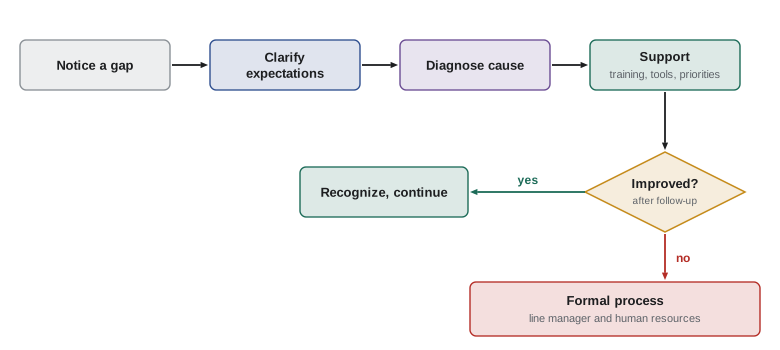
Holding a difficult conversation
Difficult conversations are those where stakes are high, opinions differ and emotions run strong, the definition used by the authors of Crucial Conversations. On projects they include telling someone their work is not good enough, addressing behavior that is upsetting the team, or telling a person they are being moved off the project. A structured approach makes them more likely to go well.
- Prepare: get the facts, decide the outcome you want, consider the other person's perspective and choose a private setting and time. Do not do it by email.
- Open clearly: state the purpose early. Long small talk before bad news increases anxiety.
- Describe the facts: use SBI or a similar model. Stick to observable behavior and results.
- Listen: ask for their perspective and genuinely consider it. You may learn something that changes your view.
- Agree the problem and a plan: what will change, what support you will provide, how progress will be measured and when you will meet again.
- Document: write a short summary of what was agreed and share it, especially if the issue may need escalation later.
- Follow up: recognize improvement promptly; if there is none, move to the next step.
Worked problem
A difficult conversation about missed commitments
Kofi, a developer assigned to your project at 60 % by his functional manager, has missed three sprint commitments in a row, and the team is frustrated. You have not discussed it with him yet. Plan the conversation.
Show solution
- Prepare: check the board history (three stories carried over, each estimated at two to three days); check whether his allocation has changed; consider possible causes.
- Open: "Kofi, I want to talk about the last three sprints, because the stories you took on weren't finished, and I want to understand what's happening and how I can help."
- Facts: name the three stories and their status, without judgment.
- Listen: Kofi explains that his functional manager has been pulling him onto urgent production support, so he is at about 30 % on the project, but he did not want to let the team down by saying so.
- Plan: you will talk to his functional manager about the allocation; Kofi will take on fewer stories until it is resolved and will tell the team at stand-up when he is pulled away.
- Document and follow up: email a short summary; check in after the next sprint.
Answer: The diagnosis revealed an allocation problem, not a capability problem. The fix involves the functional manager and an agreement about transparency, not discipline.
Some conversations are about behavior rather than results: a team member who belittles colleagues, ignores agreed processes or behaves unprofessionally with stakeholders. The same structure applies, but be clear that the behavior must change. If the behavior could amount to harassment, discrimination or a safety or ethics breach, follow organizational policy immediately and involve human resources (lessons 4 and 8).
Performance management in a matrix
In functional and matrix organizations, team members usually report to a functional manager who conducts their formal performance reviews, decides pay and handles discipline. The project manager's role is to provide input and to manage performance on the project. Good practice includes agreeing at the start how the project manager will contribute to reviews; sending regular, balanced written feedback to functional managers, both positive and constructive; raising serious concerns early rather than surprising the functional manager at review time; and never threatening consequences you have no authority to impose.
In a projectized organization, or where contractors report to the project manager, the project manager may have more direct authority. Even then, involve human resources early on any formal performance process, because organizations have procedures that protect both the employee and the employer.
| Step | Typical owner in a matrix | Project manager role |
|---|---|---|
| Day-to-day feedback | Project manager | Give regular SBI feedback and recognition |
| Coaching and support | Project manager, with functional manager | Diagnose causes; provide training, tools, clarity |
| Informal improvement plan | Project manager and functional manager | Agree expectations and support in writing |
| Formal performance improvement plan | Functional manager with human resources | Provide documented input |
| Performance review and pay | Functional manager | Provide balanced written input |
| Discipline or termination | Functional manager and human resources | Provide facts if asked; follow policy |
| Release from project | Project manager, agreed with functional manager | Request a replacement or rescope |
Employees and contractors
Project teams often mix employees and independent contractors. The distinction matters for how you manage performance. With employees, you manage the person, using feedback, coaching and the organization's performance processes. With independent contractors, you generally manage the deliverables under the contract: performance problems are addressed through the contract terms, the statement of work and the contract administrator, not through employee performance processes. Treating a contractor like an employee, for example by controlling their hours and methods in detail, can create legal risk that the person is legally an employee.
In the United States, worker classification depends on which law applies. The IRS uses a common-law test grouped into behavioral control, financial control and the relationship of the parties; the Department of Labor applies an economic-reality test under the Fair Labor Standards Act, the agency stopped applying its 2024 rule in enforcement in 2025 and in March 2026 proposed rescinding it in favor of a test closer to its 2021 rule, which emphasized control over the work and the opportunity for profit or loss (check the current status); and some states, such as California, use a stricter ABC test. Project managers should follow procurement and human resources guidance rather than make their own determinations.
Team metrics and individual performance
Agile teams track metrics such as velocity (the amount of work completed per iteration), cycle time and throughput. These are useful for planning and for spotting team-level problems: a sudden drop in velocity may signal impediments, illness, unclear stories or low morale. They are dangerous when used to judge individuals. Velocity is a team measure based on relative estimates that the team itself makes, so comparing it across teams or using it to rank people distorts it. Goodhart's law applies: when a measure becomes a target, it ceases to be a good measure. People will inflate estimates or avoid helping others to protect their numbers.
Worked problem
Reading velocity as a people signal
A team's velocity over six sprints is 32, 34, 31, 33, 22, 21 story points. A director suggests comparing each developer's completed points to find the "weak performers". How should the project manager respond?
Show solution
- Compute the change: the first four sprints average (32 + 34 + 31 + 33) ÷ 4 = 32.5; the last two average (22 + 21) ÷ 2 = 21.5, a drop of about 34 %.
- Treat the drop as a team signal: ask the team in the retrospective what changed. Possible causes include a new team member, a hard technical problem, more unplanned support work or low morale.
- Explain to the director that individual points are not a valid performance measure: estimates are relative and team-owned, and work is shared through pairing and reviews.
- Offer better measures of individual contribution, such as peer feedback, quality of work and behavior against the team charter, handled through normal performance channels.
Answer: Velocity dropped about 34 %. Investigate it as a team problem and decline to use points to rank individuals, offering more valid alternatives.
Releasing someone from the project
Occasionally the right answer is to move someone off the project: the skills do not match, the relationship with the team has broken down, or performance has not improved despite support. Do this respectfully and in coordination with the functional manager or human resources. Focus on fit rather than blame where honest, arrange knowledge transfer, explain the change to the team without sharing confidential details and make sure the person's contributions are acknowledged. How a project manager handles a release is watched closely by everyone else on the team.
Common mistakes
MistakeJudging performance before checking that expectations were clear.
InsteadConfirm roles, standards, deadlines and norms first.
MistakeUsing labels such as "lazy" or "dismissive" in feedback.
InsteadDescribe the situation, behavior and impact.
MistakeAssuming poor performance is a motivation problem.
InsteadDiagnose ability, motivation and environment; most causes are environmental.
MistakeRaising performance concerns for the first time at review time.
InsteadGive feedback early and keep functional managers informed.
MistakeManaging a contractor like an employee.
InsteadManage deliverables through the contract and follow procurement guidance.
MistakeUsing velocity to rank individuals.
InsteadUse team metrics for team learning; assess individuals through valid, normal channels.
Summary and key terms
- Clear, specific expectations about results and behaviors come before judging performance.
- Feedback should be frequent, specific and two-way; SBI, DESC and feedforward help.
- Diagnose performance problems by ability, motivation and environment before acting.
- Difficult conversations need preparation, a clear opening, facts, listening, a plan, documentation and follow-up.
- In a matrix, functional managers own formal reviews; project managers provide early, balanced input.
- Contractors are managed through the contract; classification follows legal tests that differ by jurisdiction.
- Team metrics such as velocity are signals for team learning, not measures of individual performance.
- SBI model
- A feedback model describing the situation, behavior and impact.
- Feedforward
- Suggestions for future behavior rather than critique of past behavior.
- Performance improvement plan
- A formal written plan setting expectations, support and a timeline for improvement.
- Difficult conversation
- A conversation with high stakes, differing opinions and strong emotions.
- 360-degree feedback
- Feedback gathered from a person's manager, peers, reports and others.
- Velocity
- The amount of work a team completes per iteration, usually in story points.
- Goodhart's law
- When a measure becomes a target, it ceases to be a good measure.
- Independent contractor
- A self-employed person engaged to deliver work under a contract rather than as an employee.
- Statement of work
- A document describing the work, deliverables and terms for a contractor or supplier.
- Functional manager
- The manager responsible for a department and, usually, its staff's formal performance reviews.
Practice problems
Work each problem on paper first, then reveal the answer to check.
Rewrite "You're always late" using SBI.
Show answer
For example: "At the last three stand-ups you joined ten minutes late, so the team repeated updates and ran over time."
Name three broad causes of performance problems.
Show answer
Ability, motivation and environment.
Who usually conducts formal performance reviews in a matrix?
Show answer
The functional manager.
What should follow a difficult conversation?
Show answer
A short written summary of what was agreed and a follow-up meeting.
Velocity goes 40, 41, 39, 28. Average of first three and drop?
Show answer
Average 40; drop of 12 points, or 30 %.
Why not compare velocity across teams?
Show answer
Story points are relative and team-specific, so comparisons are not valid and encourage gaming.
How are contractor performance problems usually addressed?
Show answer
Through the contract, statement of work and contract administrator.
What does DESC stand for?
Show answer
Describe, express, specify, consequences.
A team member's output dropped after a family bereavement. First response?
Show answer
Show empathy, discuss temporary adjustments and refer to support such as an employee assistance program.
What should a project manager never do in a matrix performance situation?
Show answer
Threaten consequences they have no authority to impose.
Lesson quiz · 5 questions
Score 60% or more to complete this lesson.
Create a free account to save your progress, take quizzes and earn a certificate.