
PMP-120 · Lesson 7 of 12 · 28 min
Coaching and mentoring
One of the clearest signs of a mature project leader is that the team gets better over time, not just the project. Coaching and mentoring are the main tools for that growth. They help individuals build skills and confidence, help teams solve their own problems and reduce the project's dependence on the leader. The ECO lists mentoring as an enabler under aligning stakeholder expectations ("organize and act on mentoring opportunities"), and coaching runs through the "Lead the project team" task. This lesson distinguishes coaching from mentoring and related roles, introduces practical coaching models and shows how to set up mentoring on a project.
Coaching, mentoring, training and managing
The terms are often blurred. They share a goal, helping people improve, but differ in approach, focus and relationship.
| Role | Main approach | Focus | Typical relationship |
|---|---|---|---|
| Training | Teaching specific knowledge or skills | A defined curriculum | Trainer and learners, often short term |
| Coaching | Asking questions to help the person find their own answers | Performance and specific goals, now | Coach and coachee; can be the manager, a peer or an external coach |
| Mentoring | Sharing experience, advice and networks | Career and long-term development | Usually a more experienced person outside the reporting line |
| Managing | Directing, setting expectations and evaluating | Delivering the work | Manager and direct report |
| Counseling | Helping with personal difficulties affecting work | Wellbeing | Often a professional, for example through an employee assistance program |
A project manager may play several of these roles with the same person at different times: training a new analyst on the reporting tool, coaching her through a difficult stakeholder meeting, mentoring her about a career in project management and managing her deliverables. The skill is to know which hat you are wearing and to tell the person. "I'm going to coach rather than give you the answer here, because I think you can work this out" makes the shift explicit and avoids frustration.
Counseling is the one role project managers should generally not attempt beyond basic support. If a team member discloses serious personal difficulties, such as mental health problems, family crises or addiction, listen with empathy, consider workload adjustments and refer them to professional resources such as an employee assistance program or human resources. Do not try to diagnose or treat.
What coaching is
The International Coaching Federation defines coaching as partnering with clients in a thought-provoking and creative process that inspires them to maximize their personal and professional potential. In plain terms, a coach helps someone think more clearly about a goal and how to reach it, mostly by asking good questions rather than giving advice. The underlying belief is that people often have, or can find, better answers for their own situations than anyone can hand them, and that answers people find themselves are more likely to be acted on.
Coaching is particularly powerful for capable people who are stuck, for developing judgment rather than following procedures, and for building the self-reliance that servant leadership aims for. It is less suitable when someone lacks basic knowledge (train them), when there is an emergency (direct them), or when the issue is a policy breach (manage it). In situational leadership terms (lesson 2), coaching behavior is strongest in the S2 and S3 styles.
The GROW model
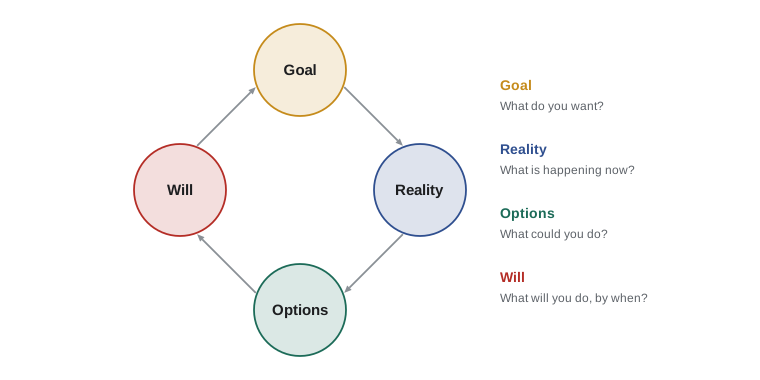
The most widely used coaching framework is GROW, developed by Graham Alexander and popularized by Sir John Whitmore. It structures a coaching conversation in four stages.
| Stage | Purpose | Sample questions |
|---|---|---|
| Goal | Agree what the person wants to achieve, in this conversation and beyond | What would you like to get out of this conversation? What would success look like? |
| Reality | Explore the current situation without judgment | What is happening now? What have you tried? What is getting in the way? |
| Options | Generate possible ways forward | What could you do? What else? What would you advise a colleague in this situation? |
| Will (or Way forward) | Commit to specific actions | What will you do, and by when? What support do you need? How will you know it worked? |
Worked problem
A GROW conversation
Daniel, a capable developer, has been asked to lead the technical design of a new module. He tells you he is struggling because two senior colleagues keep overriding his ideas in design meetings. Outline a short GROW conversation.
Show solution
- Goal: "What would you like to come out of today?" Daniel: "I want a way to run the next design meeting so my proposals get a fair hearing."
- Reality: "What happens in the meetings now?" He explains that he presents a design and the seniors immediately propose alternatives. "What have you tried?" He has tried defending his design point by point. "What do you think is going on for them?" He suspects they feel the module overlaps their area.
- Options: "What could you do differently?" Daniel suggests meeting the seniors individually beforehand, asking for their concerns, sending the design in advance, and framing the meeting around agreed criteria. "What else?" Asking you to attend the next meeting as an observer.
- Will: "Which will you do, and by when?" He will meet both seniors this week and circulate the design with evaluation criteria two days before the meeting. "What support do you need?" A quick review of his criteria. "How will we know it worked?" Agreement on a design with their input by the end of the next meeting.
Answer: Daniel leaves with his own plan, specific commitments and a measure of success. The project manager asked questions, offered little advice and agreed a follow-up.
Other coaching models exist, including OSKAR (outcome, scaling, know-how, affirm and action, review), CLEAR (contract, listen, explore, action, review) and solution-focused approaches that concentrate on what is already working. They share the same core: a clear goal, honest exploration, the coachee's own options and a commitment to act.
Coaching skills
Coaching depends on a small set of skills that improve with practice.
- Active listening: giving full attention, not interrupting, noticing tone and body language, and checking understanding by paraphrasing ("So the main concern is…").
- Powerful questions: open questions that start with what, how and when rather than closed yes/no questions; avoid "why" questions that sound accusatory ("Why did you do that?") in favor of "What led to that choice?"
- Silence: allowing pauses after a question so the person can think. Most new coaches fill the silence too soon.
- Reflecting and summarizing: helping the person hear their own thinking.
- Feedback: sharing observations clearly and kindly when they will help (lesson 11 covers feedback models).
- Holding back advice: resisting the urge to solve the problem, while still offering ideas when the person is truly stuck and asks for them.
| Instead of | Try |
|---|---|
| "Have you tried talking to the vendor?" | "Who else could help with this?" |
| "Why didn't you raise this sooner?" | "What made it hard to raise this earlier?" |
| "You should break the work into smaller pieces." | "How could you make the work more manageable?" |
| "Is the deadline realistic?" | "How confident are you in the deadline, on a scale of one to ten? What would make it a ten?" |
| "That won't work." | "What might get in the way of that option?" |
Coaching the team
Coaching is not only one-to-one. Agile coaches and team facilitators coach whole teams, helping them improve their own processes. The retrospective is the main venue: rather than telling the team what to fix, the facilitator asks questions that help the team identify problems and choose experiments. Team coaching uses the same skills as individual coaching, applied to group dynamics: noticing patterns ("I see we often run out of time before discussing risks"), asking powerful questions to the group, and helping the team commit to actions it owns.
Lyssa Adkins, in her book on coaching agile teams, describes a progression in the coach's stance: teaching when the team does not yet know a practice, coaching when it knows the practice but needs help applying it, mentoring when it wants to learn from experience, facilitating when it needs a neutral guide through a discussion, and stepping back entirely when it can manage itself. This mirrors situational leadership at team level.
Worked problem
Coaching a team through a retrospective
For three sprints the team has failed to finish stories because testing piles up at the end. Each retrospective produces the action "test earlier", but nothing changes. How might a team coach approach the next retrospective?
Show solution
- Share the pattern neutrally: "This is the third retrospective where testing at the end has come up. What's different this time?"
- Explore reality with data: look at the board history together to see when stories reach testing.
- Ask the team what makes testing earlier hard. Perhaps testers are shared with another team, or stories are too big to test in pieces.
- Help the team design one concrete experiment, such as a work-in-progress limit on the development column or splitting stories so each can be tested within two days.
- Agree how the team will know whether the experiment worked and check at the next retrospective.
Answer: Move from a vague intention ("test earlier") to a specific, owned experiment with a measure, by asking questions and using data rather than imposing a fix.
Mentoring on projects
Mentoring is a longer-term relationship in which a more experienced person shares knowledge, perspective and networks to support someone's development. Mentors are often outside the mentee's reporting line, which allows more open conversations about careers, organizational politics and mistakes. Reverse mentoring, in which a junior person mentors a senior one, for example on new technology or the perspectives of younger customers, is increasingly common.
Project managers can use mentoring in several ways: pairing new team members with experienced colleagues; arranging mentors for people taking on stretch roles, such as a first-time technical lead; mentoring junior project staff themselves; and seeking mentors for their own development. Mentoring also supports knowledge transfer (lesson 5), because mentors pass on tacit knowledge that never appears in documents.
| Element | Good practice |
|---|---|
| Matching | Match on development goals, not just seniority; let mentees have a say |
| Agreement | Agree goals, frequency, confidentiality and duration at the start |
| Meetings | Regular, mentee-led conversations, for example monthly for an hour |
| Boundaries | The mentor is not the mentee's manager; performance issues go through the normal channels |
| Review | Check progress against goals after three to six months and close or renew the relationship |
The ECO's placement of "organize and act on mentoring opportunities" under stakeholder alignment is a reminder that mentoring also builds relationships across the organization. A project manager who mentors a junior analyst in the finance department or arranges for a senior engineer to mentor a client's staff is building trust and understanding that help align expectations.
Professional bodies offer structured mentoring. Many PMI chapters across the United States run mentoring programs for members, as do engineering societies and other professional associations. These can supplement mentoring within your organization.
Coaching the coachable
Coaching works only when the person wants to improve and trusts the coach. If someone is defensive or disengaged, start by building the relationship and understanding their perspective. Ask permission: "Would it help to talk this through?" Respect confidentiality: what is said in a coaching conversation should not appear in a status report. And be honest about the limits: if performance does not improve despite coaching, the conversation may need to move to performance management (lesson 11), which is a different process with different expectations.
Finally, measure the effect. Good coaching shows up in observable changes: the developer who now runs design meetings well, the team that has fixed its testing bottleneck, the analyst who now handles stakeholder pushback alone. If nothing changes after several conversations, revisit the goal, the approach or whether coaching is the right tool.
Common mistakes
MistakeGiving advice and calling it coaching.
InsteadCoaching mainly asks questions that help the person find their own answers.
MistakeCoaching someone who lacks basic knowledge.
InsteadTrain first when knowledge is missing; coach once the person can apply it.
MistakeAsking "why" questions that sound like accusations.
InsteadUse "what" and "how" questions to explore without blame.
MistakeEnding coaching conversations without commitments.
InsteadClose with specific actions, dates, support and a measure of success.
MistakeActing as a counselor for serious personal problems.
InsteadListen, adjust workload where possible and refer to professional resources.
MistakeLetting the mentor double as the mentee's performance manager.
InsteadKeep mentoring separate from the reporting line so conversations can be open.
Summary and key terms
- Training teaches, coaching asks, mentoring shares experience, managing directs and counseling supports wellbeing.
- Coaching helps capable people find their own answers and builds self-reliance.
- GROW structures coaching: goal, reality, options and will.
- Key skills are active listening, powerful questions, silence, reflection and holding back advice.
- Team coaching uses retrospectives to help teams design their own improvements.
- Mentoring is a longer-term relationship focused on career development and tacit knowledge.
- The ECO links mentoring to aligning stakeholder expectations as well as developing people.
- Coaching
- A partnership that helps a person achieve goals mainly through questions and reflection.
- Mentoring
- A longer-term relationship in which an experienced person shares knowledge and advice.
- GROW model
- A coaching framework: goal, reality, options and will.
- Active listening
- Listening with full attention and checking understanding by paraphrasing.
- Powerful question
- An open question that prompts reflection and new thinking.
- Reverse mentoring
- A junior person mentoring a more senior person.
- Employee assistance program
- A confidential service providing counseling and support to employees.
- Team coaching
- Coaching a whole team to improve how it works together.
- Coachee
- The person being coached.
- Retrospective
- A regular meeting in which a team reflects on how it works and agrees improvements.
Practice problems
Work each problem on paper first, then reveal the answer to check.
What do the letters in GROW stand for?
Show answer
Goal, reality, options, will (or way forward).
Turn "Did you call the client?" into a coaching question.
Show answer
For example: "What contact have you had with the client so far?"
When is coaching not the right approach?
Show answer
When the person lacks basic knowledge, in an emergency, or when there is a policy breach.
How does mentoring differ from coaching?
Show answer
Mentoring is longer term, focuses on career development and involves sharing experience and advice.
Why are mentors often outside the reporting line?
Show answer
So mentees can speak openly about careers, mistakes and organizational issues.
What should a project manager do if a team member discloses a serious personal crisis?
Show answer
Listen with empathy, consider workload adjustments and refer them to professional resources such as an employee assistance program.
Name two coaching skills besides questioning.
Show answer
For example, active listening and allowing silence.
What is reverse mentoring?
Show answer
A junior person mentoring a more senior person, for example on new technology.
What should end every coaching conversation?
Show answer
Specific commitments: actions, dates, support needed and how success will be measured.
Which ECO task lists mentoring as an enabler?
Show answer
Align stakeholder expectations.
Lesson quiz · 5 questions
Score 60% or more to complete this lesson.
Create a free account to save your progress, take quizzes and earn a certificate.