
PRIN-140 · Lesson 10 of 12 · 25 min
The project initiation documentation
The last activity of initiating a project is to assemble the project initiation documentation (PID). The PID brings together everything initiation has produced into the basis on which the board will decide whether to authorize the project, and, once approved, the baseline against which the project will be managed and its success assessed. This lesson looks at what the PID contains, how it is assembled and checked, how it relates to the project brief, how it is used during delivery, and the common ways PIDs fail to do their job.
What the PID is for
In plain terms, the PID has two jobs. Before approval, it gives the board the information it needs to decide whether the project should go ahead: what will be delivered, why, how, by whom, when, at what cost, with what risks and under what controls. After approval, it is the project's reference point: the version of the plan, business case, approaches and controls that everyone agreed to. When the project manager later prepares end stage reports, exception reports or the end project report, they compare performance against what the PID set out. At closure, the end project report reviews the project against the original PID.
Because it is a baseline, the PID is not a living document in the sense of being edited freely. Parts of it, such as the project plan and the business case, are updated at each stage boundary and the updated versions are approved by the board. Other parts, such as the management approaches, change only through change control. Many organizations keep the originally approved PID unchanged and maintain later versions alongside it, so that the end project report can compare the project's outcome with what was first agreed.
What the PID contains
| PID element (common usage) | Where it comes from |
|---|---|
| Project definition: background, objectives, scope, exclusions, constraints, assumptions, interfaces, tolerances | Project brief, refined in initiation |
| Project approach | Project brief, confirmed in initiation |
| Business case (detailed) | Refine the business case |
| Project management team structure and role descriptions | Starting up; confirmed in initiation |
| Management approaches: risk, quality, issue, communication, commercial, digital and data, sustainability, benefits | Prepare the management approaches |
| Project plan, including the project product description | Create the project plan |
| Project controls | Set up the project controls |
| Tailoring decisions | Agree the tailoring requirements |
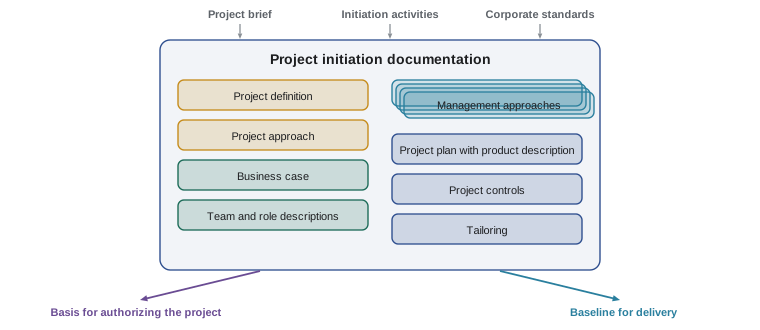
Some elements come straight from the project brief and are refined: the project definition and the project approach. Others are created in initiation: the detailed business case, the management approaches, the project plan and the project controls. The PID is therefore not a new document written from scratch but an assembly of products, most of which have been reviewed individually as they were produced. Assembly is the moment to check that they fit together and tell a consistent story.
Project brief and PID compared
| Aspect | Project brief | PID |
|---|---|---|
| Produced by | Starting up a project | Initiating a project |
| Supports the decision to | Authorize initiation | Authorize the project |
| Business case | Outline | Detailed |
| Plan | Initiation stage plan (separate) | Project plan (included) |
| Approaches and controls | Not yet defined | Fully defined |
| Status after approval | Input to initiation; superseded by the PID | Baseline for delivery; reference at closure |
| Typical size at Ridgeline Water | About 12 pages | About 45 pages plus registers in the project tool |
Assembling and checking the PID
Assembly is more than stapling documents together. The project manager checks that the products are consistent: that the project plan's costs match the business case, that the controls match the tolerances agreed with the business layer, that the approaches' escalation arrangements match the controls, that the project product description's acceptance criteria are reflected in the quality approach, and that the roles named in the approaches match the team structure. Project assurance usually reviews the assembled PID before it goes to the board.
PRINCE2 also expects the project manager to consider whether the PID is proportionate. A PID that nobody will read is not doing its job. For a small project, a few pages may be enough. For Ridgeline Water, the PID is a single document of about 45 pages, with management approaches as sections and the registers held in the utility's project tool, referenced from the PID rather than printed in it.
| Consistency check | What to compare | Ridgeline Water finding |
|---|---|---|
| Costs | Project plan stage budgets against business case costs | Match: 9,600 thousand |
| Tolerances | Controls against business layer's project tolerances | Match: +5 %, +8 weeks, −10 % benefits |
| Escalation | Approaches against the board's response time | Fixed in drafting: issue approach changed from 20 to 5 days |
| Quality | Acceptance criteria against the quality approach's methods | Billing accuracy criterion had no test method; added end-to-end billing test |
| Roles | Names in approaches against team structure | Match, with external senior supplier still to be appointed |
| Benefits | Business case benefits against benefits approach measures | Leak saving measure and pilot threshold included |
A PID checklist validator
The code below automates part of the consistency check. It holds a simplified version of Ridgeline Water's draft PID, checks that every required section is present, and applies three cross-checks: costs match between the plan and the business case, stage tolerances nest within project tolerance, and every acceptance criterion has a quality method.
pid = {
    "sections": ["project definition", "project approach", "business case", "team structure",
                 "management approaches", "project plan", "project controls", "tailoring"],
    "plan_stage_budgets": [160, 1450, 3700, 4290],
    "business_case_cost": 9600,
    "project_cost_tol": 0.05,
    "stage_cost_tols": [0.10, 0.05, 0.04, 0.03],
    "acceptance_criteria": {
        "98 % daily reads": "field read-rate test over 30 days",
        "under 1 in 1,000 bills corrected": None,
        "80 % understand leak alerts": "usability test with 40 customers",
        "portal accessibility": "accessibility audit",
    },
}
required = ["project definition", "project approach", "business case", "team structure",
            "management approaches", "project plan", "project controls", "tailoring"]
problems = []
missing = [s for s in required if s not in pid["sections"]]
if missing:
    problems.append("missing sections: " + ", ".join(missing))
if sum(pid["plan_stage_budgets"]) != pid["business_case_cost"]:
    problems.append("plan and business case costs differ")
stage_tol = sum(b * t for b, t in zip(pid["plan_stage_budgets"], pid["stage_cost_tols"]))
if stage_tol > pid["business_case_cost"] * pid["project_cost_tol"]:
    problems.append("stage tolerances exceed project tolerance")
untested = [c for c, m in pid["acceptance_criteria"].items() if not m]
if untested:
    problems.append("no quality method for: " + "; ".join(untested))
print("PID ready for the board" if not problems else "Fix before submitting:")
for p in problems:
print(" -", p)Fix before submitting: - no quality method for: under 1 in 1,000 bills corrected
The validator finds one problem, the same one the manual review found: the billing accuracy criterion has no quality method. The fix is to add an end-to-end billing test on sample accounts to the quality management approach and to the pilot stage plan. Everything else is consistent. Automated checks like this are useful on large projects with many products, but they supplement, not replace, an assurance review by people who understand the project.
Requesting authorization to deliver
When the PID is assembled and checked, and managing a stage boundary has produced the plan for the first delivery stage, the project manager sends a request to deliver the project to the board. The board then uses its authorize the project activity, covered in lesson 7. Ridgeline Water's request goes to the board at the end of week 8, with the PID, the pilot stage plan and a short covering note highlighting the key uncertainty (the leak benefit), the external dependency (the billing upgrade) and the pilot's role in resolving both.
Because Ridgeline Water's pilot stage spending is within the general manager's delegated authority, the board can authorize the project and the pilot stage without a council vote. The council or utility board will receive the PID summary for information, and its approval of the main installation contract will be sought at the end of the pilot, as shown in the project plan. Some US cities require council appropriation of the whole project budget at the outset; the project controls should reflect whichever rule applies.
Using the PID during delivery
After approval, the PID is used constantly, even if nobody reads it cover to cover again. Team managers use the product descriptions and quality approach. The project manager uses the controls to decide when to escalate. Project assurance uses the approaches to check that the project is doing what it said it would do. At each stage boundary, the project plan and business case in the PID are updated, and the board approves the updated versions. At closure, the end project report compares what happened with the original PID.
| Moment | How the PID is used |
|---|---|
| Authorizing work packages | Product descriptions, quality criteria and tolerances come from the PID's plan and approaches |
| Deciding whether to escalate | Controls and tolerances in the PID |
| Assurance reviews | Approaches in the PID are the yardstick |
| Stage boundaries | Project plan and business case updated and re-approved |
| Changes to baselines | Issue management approach in the PID defines change control |
| Closure | End project report compares outcomes with the original PID |
Worked problem
Reviewing a PID
A project assurance reviewer reads a draft PID and notes: (a) the project plan totals 2.4 million but the business case uses 2.1 million; (b) the risk approach says the board reviews the risk register monthly, but the controls show quarterly board meetings; (c) there is no communication approach; (d) the document is 180 pages for a 2.4 million project. What should the project manager do?
Show solution
- (a) Reconcile costs: update the business case with the plan's figures and recheck the investment appraisal and justification.
- (b) Align the approach and controls: either monthly reviews by correspondence or a change to the meeting schedule, agreed with the board.
- (c) Add a communication management approach, even if brief, since stakeholders must be kept informed.
- (d) Tailor the PID: summarize approaches, move detail to appendices or the project tool, and record the tailoring decision.
- Resubmit the PID to assurance before sending it to the board.
Answer: Reconcile costs, align approaches with controls, add the missing approach and make the PID proportionate before it goes to the board.
Version control of the PID
Because the PID is a baseline, it needs simple version control. A common arrangement is to give the approved PID a version number such as 1.0, record the date and the board decision that approved it, and store it where it cannot be edited by accident. At each stage boundary, the updated project plan and business case become version 2.0, 3.0 and so on, each linked to the board decision that approved it. Changes to management approaches through change control produce minor versions, such as 1.1, with the issue reference that authorized the change.
| Version | Date (illustrative) | Reason | Approved by |
|---|---|---|---|
| 0.1–0.9 | Weeks 3–8 | Drafts during initiation | Not approved; reviewed by assurance |
| 1.0 | End of week 8 | Original PID | Project board: authorize the project |
| 1.1 | Week 15 | Issue approach: added a route for customer complaints about installers | Project manager under change authority |
| 2.0 | Week 37 | Updated project plan and business case after the pilot | Project board at the stage boundary |
The product register, which PRINCE2 7 uses to track the version and status of products, can hold this history. Whatever tool is used, two questions should always be answerable in seconds: which version of the PID is current, and which version did the board originally approve? If either takes an afternoon of searching through email, the project's baselines are not under control.
Common mistakes
MistakeWriting the PID from scratch at the end of initiation.
InsteadAssemble it from products developed and reviewed during initiation.
MistakeLetting the PID become a doorstop that nobody reads.
InsteadKeep it proportionate and use it actively during delivery.
MistakeEditing the approved PID freely.
InsteadUpdate plan and business case at stage boundaries; change approaches through change control.
MistakeSubmitting the PID without checking consistency between its parts.
InsteadCheck costs, tolerances, escalation, quality methods and roles agree.
MistakeDiscarding the original PID once updates are made.
InsteadKeep it so the end project report can compare outcomes with the original baseline.
Summary and key terms
- The PID supports the decision to authorize the project and becomes the baseline for delivery.
- It contains the project definition, approach, detailed business case, team, management approaches, project plan, controls and tailoring.
- It is assembled from products developed in starting up and initiation.
- Assembly includes consistency checks and an assurance review.
- The project brief supports authorizing initiation; the PID supports authorizing the project.
- After approval, plan and business case are updated at stage boundaries; approaches change through change control.
- The end project report compares the project's outcome with the original PID.
- Project initiation documentation (PID)
- The assembled products of initiation that support authorizing the project and form the baseline for delivery.
- Request to deliver
- The project manager's request to the board to authorize the project.
- Project definition
- The part of the PID describing background, objectives, scope, constraints, assumptions, interfaces and tolerances.
- End project report
- The report at closure comparing the project's performance with the PID.
- Consistency check
- Comparing related products to ensure they agree before approval.
Practice problems
Work each problem on paper first, then reveal the answer to check.
Name the two jobs of the PID.
Show answer
Support the decision to authorize the project; serve as the baseline for delivery.
Which process assembles the PID?
Show answer
Initiating a project.
Which elements of the PID come from the project brief?
Show answer
The project definition and project approach, refined.
Which board activity uses the PID?
Show answer
Authorize the project.
What did the validator find in Ridgeline Water's draft?
Show answer
The billing accuracy criterion had no quality method.
Which parts of the PID are updated at stage boundaries?
Show answer
The project plan and the business case.
How are management approaches changed after approval?
Show answer
Through change control.
Why keep the original PID?
Show answer
So the end project report can compare outcomes with what was first agreed.
How long is Ridgeline Water's PID, and where are its registers?
Show answer
About 45 pages; registers are held in the project tool and referenced.
Which other product accompanies the PID in the request to deliver?
Show answer
The stage plan for the first delivery stage.
Lesson quiz · 5 questions
Score 60% or more to complete this lesson.
Create a free account to save your progress, take quizzes and earn a certificate.