
PRIN-140 · Lesson 2 of 12 · 26 min
Before the project: the mandate and pre-project
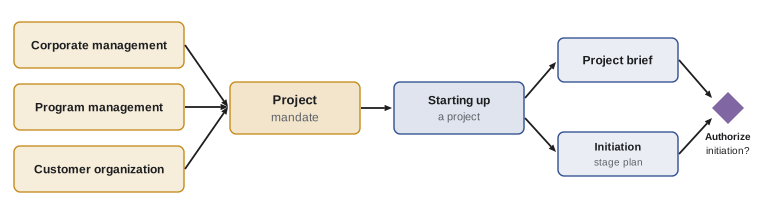
Every PRINCE2 project begins with a trigger from outside the project: a request, an instruction or an idea from the business layer that something should be done. PRINCE2 calls this trigger the project mandate. This lesson looks at what a mandate is, what it should and should not contain, who issues it, how good mandates differ from poor ones, and why the period before a project is authorized needs its own deliberate, lightweight management. It sets the scene for starting up a project, which turns the mandate into a project brief.
What a project mandate is
A project mandate is the external information that triggers starting up a project. It comes from whoever has the authority to commission the project: corporate management, a program management team, or a customer organization. It may be a formal document such as a strategy decision, a council resolution or a program's project definition, or it may be as informal as an email or a conversation recorded in a meeting note. PRINCE2 does not prescribe a format for the mandate, because by definition it is produced outside the project and before the project exists.
What matters is that the mandate gives enough information to identify at least the prospective executive and the reason the project is being considered. Everything else can be developed during starting up. A mandate that tries to be a full business case is usually a sign that someone has already decided the answer and wants the project to rubber-stamp it. A mandate that contains only a solution, with no problem or purpose, is a sign that the starting up process will need to work hard to establish why the project exists.
| Information a mandate may contain | Why it helps starting up | Ridgeline Water's mandate |
|---|---|---|
| Reason or problem | Starts the outline business case | Manual meter reading is costly, error-prone and gives no leak information |
| Objectives or desired outcomes | Shapes the project product description | Accurate monthly bills; earlier leak detection; lower non-revenue water |
| Proposed executive | Allows the first activity of starting up | Director of finance and operations |
| Constraints | Shapes options and approach | Capital plan of about 10 million over two years; council approval required |
| Time expectations | Shapes the initiation stage plan | Recommendation to council within six months |
| Known stakeholders | Starts the communication approach | Council, customers, billing staff, meter readers, the union |
| Interfaces and dependencies | Starts risk identification | Billing system upgrade planned by IT next year |
| Standards that apply | Starts the quality and tailoring work | Utility procurement rules; provincial or state metering rules |
Who issues the mandate
In a single organization, the mandate usually comes from corporate management: a senior executive, a management committee, a board of directors or, in the public sector, an elected council or its delegate. In a program, the program management team issues a mandate, often with more detail, because the program has already decided why the project is needed and how it contributes to program benefits. In a customer–supplier situation, the mandate may come from the customer, and the supplier may run its own project to meet the customer's needs.
The source matters because it defines the business layer for this project: who sets the project tolerances, who must be consulted about project-level exceptions, and who will receive the closure notification. If starting up cannot identify who has issued the mandate and with what authority, the project has no clear escalation route, and that gap will reappear the first time a forecast breaches project tolerance.
For a US municipal utility such as Ridgeline Water, the business layer is typically the general manager or city manager acting on behalf of the city council or utility board, with the council or board approving capital spending above a threshold set in the municipal code and capital improvement plan. Federal agencies work under OMB guidance and their own capital planning rules; a federal project would align its PRINCE2 stage boundaries with those approval points rather than invent new ones.
Good and poor mandates
The quality of a mandate varies enormously. A good mandate is short, says why change is needed, names who will own it, and states the constraints that really matter. A poor mandate is either so vague that nobody can say what success would look like, or so prescriptive that it closes off options before anyone has examined them. Neither is fatal. Starting up exists precisely to turn whatever arrives into a project brief that the board can decide on. But a poor mandate tells the project manager where the effort in starting up will need to go.
| Mandate wording | Weakness | What starting up should do |
|---|---|---|
| "Improve customer service." | No problem, no measure, no owner | Identify the executive; establish which service problem matters and how it would be measured |
| "Buy 40,000 Brand X meters by June." | Solution decided; no reason given | Establish the reason; check whether other options were considered; record the constraint honestly |
| "Fix billing." | Problem stated, but scope unclear | Agree the boundary of the project with the executive and senior users |
| "Reduce non-revenue water by 20 % within three years, within a 10 million capital envelope; director of finance to lead." | Good: purpose, measure, constraint and owner | Move quickly to options and the project approach |
When the mandate already names a solution, the project manager should not simply ignore it, nor treat it as unchallengeable. The outline business case in the project brief records the options considered, and if the business layer has genuinely ruled options out, that becomes a stated constraint with its reason. If it turns out that nobody can explain why the named solution was chosen, the executive should take that question back to the business layer before money is spent on initiation.
Why pre-project needs managing
Before a project is authorized, nobody has a budget, a plan or formal authority. Yet work is already happening: people are talking to suppliers, sketching solutions and forming opinions. If this period is unmanaged, two things go wrong. Some ideas drift into full-scale work without anyone ever deciding that they are worth it. Others are killed by enthusiasm in the wrong direction, because a solution was chosen before the problem was understood. Starting up a project gives this period a light structure and a clear end point: a decision about whether to invest in initiation.
PRINCE2's principle of continued business justification applies even here. The question in starting up is not yet 'is this project definitely worth doing?' but 'is it worth spending the money and time to find out properly?' That is a much smaller question, and it deserves a much smaller answer. Many organizations waste effort by writing what is effectively a full business case before initiation has been authorized, only to rewrite it once the project plan exists. PRINCE2 keeps the early version deliberately outline.
| Question | Starting up (pre-project) | Initiation stage |
|---|---|---|
| Business justification | Is it worth investing in initiation? (outline business case) | Is the whole project worth doing? (detailed business case) |
| Plan | Plan for the initiation stage only | Project plan for the whole project, plus the first delivery stage plan |
| Team | Executive, project manager, then the rest of the project management team designed and appointed | Roles confirmed and described in the PID |
| Controls | Minimal; the board has not yet authorized spending beyond starting up | Full project controls and management approaches |
| Typical effort | Days or a few weeks | Weeks; proportionate to the project's size and risk |
Projects that should not start
One of the most valuable outcomes of starting up is a decision not to proceed. The executive may find that the problem is better solved by a change to business as usual, that the organization lacks the capacity to run another project this year, or that the idea duplicates work already under way elsewhere. Stopping at this point costs very little. Stopping halfway through delivery costs a great deal, both in money and in the credibility of the people who championed the idea. A board that never refuses to authorize initiation is not directing; it is approving.
Ridgeline Water's mandate asks for options. During starting up, the project manager discovers that IT is planning a billing system upgrade next year that will change the interfaces any metering system must use. This does not stop the project, but it becomes a key dependency recorded in the project brief, and it influences the project approach: the metering project will build its billing interface against the new system, and the initiation stage plan includes time to agree the interface with IT.
Checking a mandate before starting up
The code below checks a mandate's content against the minimum that starting up needs to begin: a reason, an executive, and at least one constraint or objective. It also flags mandates that contain a solution but no reason. The check is deliberately simple; its purpose is to show the project manager where the gaps are before the first conversation with the executive.
mandates = {
    "Ridgeline Water": {"reason": "Manual reading costly; no leak data", "executive": "Director of finance and operations",
                        "objectives": ["Accurate bills", "Earlier leak detection"], "constraints": ["About 10 million capital"],
                        "solution": None},
    "Fleet telematics": {"reason": None, "executive": None, "objectives": [], "constraints": ["By June"],
                         "solution": "Install Brand Y trackers"},
    "Records digitization": {"reason": "Paper archive full", "executive": None, "objectives": ["Searchable records"],
                             "constraints": [], "solution": None},
}
for name, m in mandates.items():
    gaps = []
    if not m["reason"]:
        gaps.append("no reason")
    if not m["executive"]:
        gaps.append("no executive")
    if not m["objectives"] and not m["constraints"]:
        gaps.append("no objectives or constraints")
    if m["solution"] and not m["reason"]:
        gaps.append("solution without a reason")
    status = "ready for starting up" if not gaps else "clarify first: " + "; ".join(gaps)
print(f"{name:21} {status}")Ridgeline Water ready for starting up Fleet telematics clarify first: no reason; no executive; solution without a reason Records digitization clarify first: no executive
Ridgeline Water's mandate is ready. The fleet telematics mandate names a solution and a deadline but no reason and no executive, so the first job is to find out who wants it and why. The records digitization mandate has a clear problem but nobody accountable; starting up cannot properly begin until someone agrees to be executive, because the executive is the first appointment and the project manager is appointed by the executive.
Worked problem
Responding to a solution-led mandate
A regional transit authority's board minutes say: 'Management will procure an app for real-time bus arrival information from Vendor Z by spring.' The chief operating officer is asked to lead. As the newly appointed project manager, what should you do with this mandate in starting up?
Show solution
- Confirm the chief operating officer as executive, since the minutes name them as lead.
- Ask the executive what problem the app is meant to solve, for example missed connections or complaints about unreliability, and how success would be measured.
- Find out whether Vendor Z was chosen for a reason (an existing contract, a pilot, a policy) and record it as a constraint with that reason if it is genuine.
- In the outline business case, list the options considered, including the mandated one, so the board can see the choice is informed.
- If nobody can explain why Vendor Z was chosen, have the executive take that question back to the authority's board before initiation is authorized.
Answer: Treat the mandate as the trigger, establish the reason and the executive's measures of success, record genuine constraints with their reasons, and escalate unexplained ones before money is committed to initiation.
Common mistakes
MistakeExpecting the mandate to be a complete business case.
InsteadThe mandate is a trigger; starting up develops it into an outline business case.
MistakeTreating a solution named in the mandate as beyond question.
InsteadEstablish the reason, record genuine constraints, and escalate unexplained ones.
MistakeStarting detailed work before initiation has been authorized.
InsteadKeep pre-project work to what the decision about initiation needs.
MistakeNot identifying who issued the mandate.
InsteadThe issuer defines the business layer and the escalation route for project tolerances.
MistakeAssuming every mandate should lead to a project.
InsteadA decision not to authorize initiation is a valid and valuable outcome.
Summary and key terms
- The project mandate is the external trigger for starting up a project.
- It comes from the business layer: corporate management, a program or a customer.
- PRINCE2 does not prescribe its format; it must at least identify the reason and the prospective executive.
- The source of the mandate defines who sets project tolerances and receives escalations.
- Starting up turns the mandate into a project brief and an initiation stage plan.
- Pre-project work should be just enough to decide whether initiation is worth investing in.
- A decision not to proceed is a legitimate and cheap outcome of starting up.
- Project mandate
- The external information that triggers starting up a project.
- Commissioning organization
- The part of the business layer that issues the mandate and sets project tolerances.
- Program
- A temporary structure that coordinates related projects to achieve outcomes and benefits.
- Outline business case
- The early, high-level justification produced during starting up.
- Constraint
- A restriction the project must work within, such as a budget ceiling or a fixed date.
- Dependency
- A relationship in which one product or activity relies on another, possibly outside the project.
Practice problems
Work each problem on paper first, then reveal the answer to check.
What triggers starting up a project?
Show answer
The project mandate.
Name three possible sources of a mandate.
Show answer
Corporate management, a program management team, a customer organization.
What is the minimum a mandate should identify?
Show answer
The reason the project is being considered and the prospective executive.
Why does the source of the mandate matter?
Show answer
It defines the business layer, who sets project tolerances and receives escalations.
Does PRINCE2 prescribe the format of a mandate?
Show answer
No; it is produced outside the project and may be formal or informal.
What should you do if a mandate names a solution without a reason?
Show answer
Establish the reason with the executive, record genuine constraints and escalate unexplained ones.
What is the key question in starting up?
Show answer
Is it worth investing in initiation?
Which business case version is produced in starting up?
Show answer
The outline business case.
Is a decision not to authorize initiation a failure?
Show answer
No; it is a cheap and valid outcome if the idea is not worthwhile.
Which dependency did Ridgeline Water's starting up identify?
Show answer
IT's planned billing system upgrade, which changes the interfaces.
Lesson quiz · 5 questions
Score 60% or more to complete this lesson.
Create a free account to save your progress, take quizzes and earn a certificate.