
PRIN-140 · Lesson 3 of 12 · 26 min
Starting up a project I: people and lessons
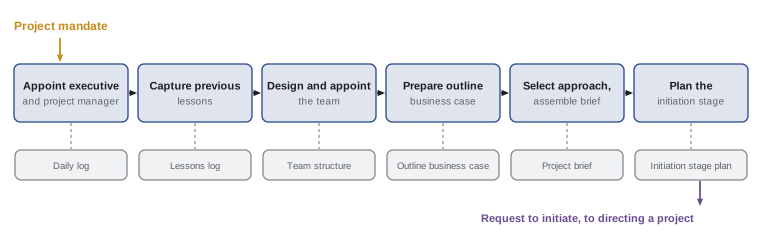
Starting up a project has six activities in common PRINCE2 7 usage. This lesson covers the first three, which are about people and experience: appointing the executive and the project manager, capturing previous lessons, and designing and appointing the project management team. Lesson 4 covers the next two, which produce the outline business case and the project brief, and lesson 5 covers the last, planning the initiation stage. The activities are presented in order, but in practice they overlap and the project manager often works on several at once.
| Activity (common PRINCE2 7 naming) | Main output | Lesson |
|---|---|---|
| Appoint the executive and the project manager | Executive and project manager role descriptions; the start of the daily log | 3 |
| Capture previous lessons | Lessons log | 3 |
| Design and appoint the project management team | Project management team structure and role descriptions | 3 |
| Prepare the outline business case | Outline business case; project product description | 4 |
| Select the project approach and assemble the project brief | Project approach; project brief | 4 |
| Plan the initiation stage | Initiation stage plan; request to initiate | 5 |
Appoint the executive and the project manager
The first activity establishes accountability. Someone in the business layer, often the person who issued the mandate, appoints the executive. The executive is the single person ultimately accountable for the project, owns the business case and chairs the project board. PRINCE2 insists on a single executive because shared accountability tends to become no accountability: when two directors jointly own a project, each can assume the other is watching the business case.
The executive then appoints the project manager. The project manager will do most of the work of starting up, but cannot do it without someone who can answer the questions only the business can answer: why are we doing this, what would make it worthwhile, and how much are we willing to spend to find out? This is why the executive is appointed first. A project manager appointed without an executive will either stall or start making business decisions that are not theirs to make.
Both appointments should be confirmed with role descriptions, tailored from the standard PRINCE2 role descriptions to fit the project. PRIN-120 and PRIN-130 described the roles; in starting up, what matters is that each person has agreed to the role, understands what it involves and has the time to do it. An executive who will be on leave for three of the next six months, or a project manager who is already running two other projects, is a risk that should be recorded now, not discovered at the first missed board meeting.
| Check | Why it matters | Ridgeline Water |
|---|---|---|
| Executive has authority to commit the resources the project will need | Otherwise every decision must be referred upward | Director of finance and operations controls the capital plan within council limits |
| Executive has time to chair the board and review reports | Absent executives create decision delays | About half a day a month, more at stage boundaries |
| Project manager has the capacity to run starting up and initiation | Starting up is short; delays here push everything back | Utility's senior project manager, released from other work for this project |
| Both have accepted written role descriptions | Avoids later disputes about who decides what | Tailored role descriptions filed in the project file |
| Daily log opened | Records informal issues and actions from the start | Opened by the project manager on day 1 |
The daily log is usually created now. It is the project manager's diary of informal issues, actions and observations that do not yet need formal treatment. In PRINCE2 7 it forms part of the project log, alongside the lessons log, risk register, issue register, quality register and product register that later processes create. During starting up, the daily log is often where the project manager records early concerns, such as a stakeholder who seems opposed, until the risk register exists in initiation.
Capture previous lessons
The second activity puts the principle of learning from experience to work at the earliest possible moment. Before designing the team, choosing an approach or estimating anything, the project manager looks for lessons from previous projects, from other organizations, from corporate standards and from the experience of the people involved. The lessons go into a lessons log, which the project will keep adding to throughout its life.
Lessons are most useful when they are specific, when they say what happened and why, and when they suggest what to do differently. 'Communication was poor' is not a usable lesson. 'The previous meter replacement project informed customers by letter only, received over 400 complaints about unannounced installers, and recommended door hangers two days before each visit' is. During starting up the project manager is looking for lessons that affect the decisions about to be made: team structure, approach, estimates and the initiation stage plan.
| Source of lessons | How to use it in starting up |
|---|---|
| Lessons reports from previous projects | Search for projects with similar products, suppliers or customers |
| Corporate or program lessons libraries | Check whether the organization has a central register and what it says about this type of work |
| People who worked on similar projects | Short interviews; ask what they would do differently |
| Suppliers and other organizations | Ask for references and case studies; look at published reviews of similar projects |
| Audit and assurance reports | Look for recurring findings about governance, estimates or benefits |
| Industry and professional bodies | Published guidance on common failure modes in this kind of project |
PRINCE2 also expects the project to record lessons it learns itself, not just lessons it inherits. In starting up, the lessons log may already contain entries about the process of getting the project going, for example that the mandate took three months to arrive because nobody knew who owned the problem. Such entries are valuable for the organization even if they do not change this project.
Searching the lessons log
Ridgeline Water's project manager finds a lessons library from previous capital projects at the utility and a short report shared by a neighboring utility that installed smart meters three years earlier. The code below searches the combined list for lessons relevant to the decisions in starting up, using simple tags, and shows which ones should influence the project brief and the initiation stage plan.
lessons = [
    ("L01", "Meter replacement 2019", "Letters alone led to 400+ complaints about unannounced installers", {"communication", "installation"}),
    ("L02", "Nearby utility AMI", "Radio coverage survey before contract avoided costly redesign", {"approach", "supplier", "estimating"}),
    ("L03", "Pipe renewal 2021", "Board met only quarterly; decisions waited up to 11 weeks", {"governance", "team"}),
    ("L04", "Nearby utility AMI", "Billing interface took twice the estimate; integrate early", {"estimating", "it", "approach"}),
    ("L05", "Office move 2022", "Catering supplier late", {"facilities"}),
    ("L06", "Customer portal 2020", "Accessibility testing left to the end caused a 6-week delay", {"quality", "it"}),
]
decisions = {
    "team design": {"governance", "team"},
    "project approach": {"approach", "supplier", "it"},
    "initiation estimates": {"estimating"},
    "communication": {"communication"},
}
for decision, tags in decisions.items():
    hits = [lid for lid, _, _, t in lessons if t & tags]
    print(f"{decision:21} -> {', '.join(hits) if hits else 'none found'}")
unused = [lid for lid, _, _, t in lessons if not any(t & tags for tags in decisions.values())]
print("Not relevant to starting up decisions:", ", ".join(unused))team design -> L03 project approach -> L02, L04, L06 initiation estimates -> L02, L04 communication -> L01 Not relevant to starting up decisions: L05
Five of the six lessons bear on a starting up decision. The quarterly board lesson (L03) shapes team design: Ridgeline Water's board will meet monthly during delivery and be available for decisions by email between meetings. The coverage survey and billing interface lessons (L02 and L04) shape the project approach: a radio coverage survey and an early interface agreement with IT go into the initiation stage plan. The office move lesson is not relevant here, and recording that judgment is itself useful: the lessons log is a working tool, not an archive.
Design and appoint the project management team
The third activity designs the rest of the project management team: the senior users and senior suppliers who join the executive on the board, project assurance, any change authority, project support and, where they are already known, team managers. PRIN-130 covered the organizing practice in depth, including role combinations and the rules about which combinations are acceptable. In starting up, the project manager applies those rules to produce a structure, gets agreement from the executive, and confirms that each person has accepted their role.
Three questions dominate this activity. First, does the board represent all three interests: business, user and supplier? Second, is project assurance independent of the project manager? Third, does each person have the authority and the time to do their role? Starting up is also the moment to decide whether some roles are combined, which is common on smaller projects, and to record the reasons. Combining the executive and senior user can work for an internal project; combining project assurance with project support should be avoided because it removes independence.
| Role | Ridgeline Water appointee | Reason for the choice |
|---|---|---|
| Executive | Director of finance and operations | Owns the capital plan; accountable to the general manager |
| Senior users | Manager of customer operations; billing manager | Represent the people who will use the meters' data and handle customers |
| Senior suppliers | Meter supplier's delivery director (once contracted); utility IT manager | External and internal suppliers both represented |
| Business assurance | Utility's internal audit analyst | Independent of the project manager |
| User assurance | A customer service team lead not involved in delivery | Close to the users and independent |
| Supplier assurance | IT architect from the shared services team | Checks technical approach for the internal supplier |
| Change authority | Project manager up to 10 thousand per change, 50 thousand per stage | Matches PRIN-131's delegation |
| Project support | Project office coordinator | Separate from assurance |
One complication is common: the external supplier has not yet been selected. Ridgeline Water cannot appoint the meter supplier's delivery director until a contract exists. The project manager records this in the team structure as a role to be filled, notes the gap in the project brief, and ensures the IT manager can represent the supplier interest in the meantime. The commercial management approach prepared in initiation will explain how the external supplier joins the board once appointed.
In a US municipality, appointing staff from different departments to the project board may need the agreement of each department head and, for represented employees, attention to the collective bargaining agreement's provisions on duties and out-of-class work. Starting up is the right time to secure those agreements.
Worked problem
Spotting problems in a proposed team
A hospital's starting up proposes: executive, the chief operating officer and the chief nursing officer jointly; senior user, the chief nursing officer; senior supplier, the software vendor; project assurance, the project manager's assistant, who also maintains the logs. Identify the problems and suggest fixes.
Show solution
- Two joint executives: PRINCE2 expects a single executive. Choose one, probably the chief operating officer, and make the other a senior user.
- The chief nursing officer as senior user is reasonable, and now no longer combined with executive.
- Only an external supplier is represented. If the hospital's IT team must integrate the system, add the IT director as a second senior supplier.
- Project assurance performed by the project manager's assistant is not independent, and combining it with project support removes independence twice. Appoint assurance from outside the project team, for example internal audit for business assurance and a ward manager for user assurance.
- Record the final structure and the reasons for any combinations in the project brief.
Answer: Single executive; add the internal supplier; make assurance independent of the project manager and separate from support.
Common mistakes
MistakeAppointing the project manager before the executive.
InsteadThe executive is appointed first and appoints the project manager.
MistakeHaving joint executives.
InsteadUse a single executive; others can be senior users or senior suppliers.
MistakeRecording vague lessons such as 'communication was poor'.
InsteadRecord what happened, why, and what to do differently.
MistakeCapturing lessons but not using them in the decisions of starting up.
InsteadApply lessons to the team design, approach and initiation estimates.
MistakeCombining project assurance with project support or with the project manager's role.
InsteadKeep assurance independent of the project manager.
Summary and key terms
- Starting up has six activities; the first three deal with people and lessons.
- The executive is appointed first, by the business layer, and appoints the project manager.
- Role descriptions confirm that each person accepts the role and has the authority and time for it.
- The daily log is usually opened in the first activity and forms part of the project log.
- Previous lessons are captured in the lessons log and applied to starting up decisions.
- The project management team is designed using the organizing practice's rules on representation, independence and combinations.
- Unfilled roles, such as a supplier not yet contracted, are recorded with a plan to fill them.
- Executive
- The single individual with overall accountability for the project, who owns the business case.
- Role description
- A tailored description of the responsibilities, authority and commitment of a project role.
- Daily log
- The project manager's record of informal issues, actions and events.
- Lessons log
- The record of lessons captured from previous experience and learned during the project.
- Project management team structure
- The chart and description of who holds each project role.
- Project log
- In PRINCE2 7, the collection of records such as the daily log, lessons log and registers.
- Project assurance
- Checks carried out on behalf of the board, independent of the project manager.
Practice problems
Work each problem on paper first, then reveal the answer to check.
Which role is appointed first in starting up?
Show answer
The executive.
Who appoints the project manager?
Show answer
The executive.
Why does PRINCE2 require a single executive?
Show answer
So that one person is clearly accountable for the business case and decisions.
Which log is usually opened in the first activity?
Show answer
The daily log.
Where are previous lessons recorded?
Show answer
In the lessons log.
Name two sources of previous lessons.
Show answer
Lessons reports from earlier projects; corporate lessons libraries; people with experience; suppliers; audit reports.
Which three interests must the board represent?
Show answer
Business, user and supplier.
Why should project assurance not be combined with project support?
Show answer
It would remove the independence assurance needs.
What should you do if a supplier is not yet contracted?
Show answer
Record the role as unfilled, cover the interest meanwhile and plan how the supplier will join.
How did Ridgeline Water use lesson L03 about quarterly board meetings?
Show answer
It designed monthly board meetings plus decisions by email between meetings.
Lesson quiz · 5 questions
Score 60% or more to complete this lesson.
Create a free account to save your progress, take quizzes and earn a certificate.