
PRIN-140 · Lesson 5 of 12 · 25 min
Planning the initiation stage
The last activity of starting up a project is to plan the initiation stage. Initiation is not free: it takes the time of the project manager, the board, assurance and specialists, and it may need surveys, supplier discussions or early procurement work. The board needs to know what it is being asked to authorize, how long it will take, what it will cost and what it will produce. The initiation stage plan answers those questions. Together with the project brief, it forms the request to initiate the project that starting up sends to the board.
What the initiation stage must produce
The purpose of the initiation stage is to establish solid foundations for the project so that the organization understands the work required before committing to a significant spend. Its main product is the project initiation documentation (PID), which lessons 8 to 10 examine in detail. Toward the end of initiation, managing a stage boundary also produces the stage plan for the first delivery stage. So the initiation stage plan must include the time and effort to produce both, plus any specialist work needed to make the estimates in the project plan credible.
| Initiation output | Why it is needed | Effort drivers at Ridgeline Water |
|---|---|---|
| Management approaches (risk, quality, issue, communication, commercial, digital and data, sustainability, benefits) | Define how the project will be controlled | Mostly adapted from utility templates; commercial approach needs procurement input |
| Project controls | Define stages, tolerances, reporting and escalation | Agree with the board; align with council reporting cycle |
| Project plan | Whole-project timeline, costs and stages | Depends on a radio coverage survey and supplier market information |
| Detailed business case | Confirms the project is worth doing | Needs leak data from the network team and refined costs |
| Project product description (refined) | Final acceptance criteria | Workshops with customer operations and billing |
| Stage plan for the first delivery stage | Lets the board authorize the next stage | Prepared in managing a stage boundary near the end of initiation |
The initiation stage plan
The initiation stage plan is a stage plan like any other, but its products are mostly management products. Product-based planning, covered in PRIN-130, applies: the project manager identifies the products initiation must create, writes simple product descriptions where helpful, works out the dependencies, estimates effort and duration, schedules the work and calculates the cost. It should also state the stage tolerances the project manager proposes and the reporting arrangements: for a short initiation, a highlight report every two weeks is usually enough.
Initiation often includes some specialist work. Ridgeline Water's initiation stage includes a radio coverage survey of the pilot district, because the lessons log showed that a similar project avoided an expensive redesign by surveying coverage before contracting. It also includes early market engagement with meter suppliers, so the cost estimates in the project plan are realistic, and an interface workshop with IT about the billing upgrade. These are not delivery work: they reduce uncertainty in the plan and the business case.
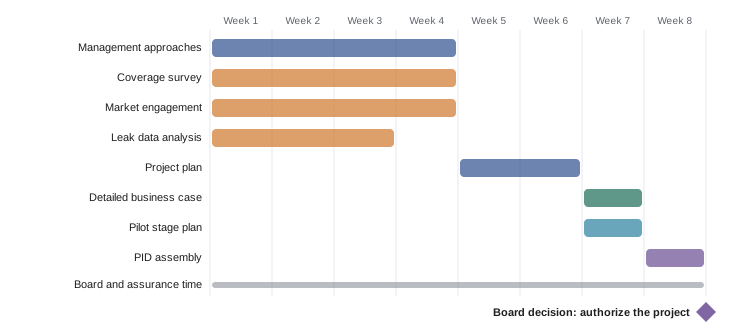
Rolling up the cost and duration
The code below takes Ridgeline Water's initiation products, their effort estimates, the people involved and the external costs, and rolls them up into the cost and duration the board will be asked to authorize. It uses a simple forward pass through the dependencies to find the earliest finish of each product.
products = {
    # name: (duration_weeks, depends_on, internal_days, external_cost_thousand)
    "Management approaches": (4, [], 18, 0),
    "Coverage survey": (4, [], 6, 42),
    "Market engagement": (4, [], 8, 0),
    "Leak data analysis": (3, [], 12, 0),
    "Project plan": (2, ["Coverage survey", "Market engagement"], 10, 0),
    "Detailed business case": (1, ["Project plan", "Leak data analysis"], 6, 0),
    "PID assembly": (1, ["Management approaches", "Detailed business case"], 4, 0),
    "Pilot stage plan": (1, ["Project plan"], 6, 0),
    "Board and assurance time": (8, [], 14, 0),
}
day_rate = 0.95  # thousand per internal person-day (blended, illustrative)
finish = {}
def ef(name):
    if name not in finish:
        dur, deps, _, _ = products[name]
        finish[name] = dur + max((ef(d) for d in deps), default=0)
    return finish[name]
for p in products:
    ef(p)
days = sum(v[2] for v in products.values())
external = sum(v[3] for v in products.values())
internal = days * day_rate
pm = 8 * 5 * day_rate   # project manager full time
cost = internal + external + pm
print(f"Duration: {max(finish.values())} weeks (critical path ends with '{max(finish, key=finish.get)}')")
print(f"Internal effort: {days} person-days plus project manager ({internal + pm:,.1f} thousand)")
print(f"External costs: {external} thousand")
print(f"Initiation stage cost: {cost:,.1f} thousand")Duration: 8 weeks (critical path ends with 'PID assembly') Internal effort: 84 person-days plus project manager (117.8 thousand) External costs: 42 thousand Initiation stage cost: 159.8 thousand
The critical path runs through the coverage survey, the project plan, the detailed business case and PID assembly, giving eight weeks. The stage costs about 160 thousand, which matches the figure in the outline business case and is less than 2 % of the 9,600 thousand the project would commit to delivery. The project manager proposes stage tolerances of ±10 % on cost and +1 week on time: generous in percentage terms, but small in absolute terms, which is appropriate for a stage full of investigation.
Proportionality
How big should initiation be? PRINCE2's answer is: as big as the risk and size of the project justify, and no bigger. A two-week initiation might suit a small internal project with a clear approach. A large public infrastructure project might spend several months in initiation, including formal procurement. A useful test is to ask what decision the board will make at the end of initiation and what it would need to know to make that decision confidently. Work that does not contribute to that decision probably belongs in a delivery stage.
| Project | Typical initiation | Why |
|---|---|---|
| Small internal process change | A few days; brief and PID combined | Low cost, low risk, familiar approach |
| Ridgeline Water smart metering | About eight weeks | Large capital spend; key uncertainties in coverage, costs and leak benefits |
| New hospital wing | Several months, including design and procurement work | Very high cost and risk; regulatory approvals |
| Agile product development | Short initiation, with a product vision, initial backlog and release plan | Detailed scope emerges during delivery; controls focus on time, cost and benefits |
Proportionality also applies to the products. A small project might produce its management approaches as a few paragraphs in the PID rather than separate documents. An agile project might express its project plan as a release roadmap. What must not be lost is the purpose: the board should be able to see how the project will be controlled, what it will produce, what it will cost and why it is worthwhile.
The request to initiate
When the project brief and the initiation stage plan are ready, the project manager, with the executive's agreement, sends a request to the board to authorize initiation. In many organizations this is a short covering note or a board meeting agenda item. The board then begins directing a project, and its first decision is whether to authorize the initiation stage: lesson 6 examines that decision. Before sending the request, the project manager checks that the board members have been appointed and are available to decide, and that assurance has reviewed the brief.
Ridgeline Water's general manager has delegated authority to approve spending of up to 250 thousand without council approval, so the 160 thousand initiation stage can be authorized by the project board within that delegation. Council approval will be needed later for the main contract, and the project plan will show it as a stage boundary decision. Delegations like these vary between US municipalities and are set out in each city's purchasing code or council resolutions.
Common problems with initiation stage plans
Initiation stage plans fail in predictable ways. Some are too thin: the project manager plans only document writing and forgets that credible estimates need surveys, supplier engagement or data analysis, so initiation overruns. Some are too thick: specialist delivery work creeps in because people are keen to start, and the board finds itself authorizing initiation but effectively committing to the solution. Some forget the board's own time: if the executive cannot attend the end-of-initiation meeting for six weeks, the plan should say so.
| Problem | Symptom | Fix |
|---|---|---|
| Too thin | Initiation overruns because estimates cannot be produced | Plan the investigations that estimates depend on |
| Too thick | Delivery work starts before the project is authorized | Move delivery products into the first delivery stage |
| No tolerances | Board cannot tell when to expect an exception | Propose stage tolerances in the plan |
| No reporting | Board hears nothing for weeks | Set a highlight report frequency |
| Ignores lessons | Same surprises as last time | Link plan activities to relevant lessons in the lessons log |
| Board unavailable | PID waits weeks for approval | Schedule the decision meeting in the plan |
Worked problem
Right-sizing an initiation stage
A city library wants to replace its booking system. The project brief shows a budget of about 300 thousand, a familiar commercial product and a clear approach. The project manager's draft initiation stage plan is 14 weeks and includes configuring the new system for one branch. What should be changed?
Show solution
- Ask what the board must decide at the end of initiation: whether the project as a whole is worthwhile and how it will be controlled.
- Configuring a branch is delivery work. Move it into the first delivery stage.
- Keep only work that informs the decision: confirming costs with the vendor, agreeing acceptance criteria and a short project plan.
- Reduce the plan to perhaps three or four weeks and combine smaller management approaches into the PID.
- Propose stage tolerances and a highlight report frequency suited to the shorter stage.
Answer: Remove delivery work, keep only what supports the decision to authorize the project, and shorten initiation to a few weeks.
Estimating initiation itself
Estimating the initiation stage uses the same techniques as any other estimate, but the products are less familiar to most estimators because they are management products. Three habits help. First, estimate from products, not from a calendar: list each approach, each investigation and each plan, and estimate the effort for each. Second, use the organization's history: if the last three capital projects of similar size spent six to ten weeks in initiation, an estimate of three weeks needs a strong reason. Third, include the effort of other people. The executive, senior users, senior suppliers, assurance and specialists all contribute to initiation, and their time is a real cost even if it is not charged to the project.
| Contributor | Typical initiation effort at Ridgeline Water (illustrative) |
|---|---|
| Project manager | Full time for eight weeks |
| Executive | About two days in total, mostly reviewing the business case and attending the decision meeting |
| Senior users | About four days each for acceptance criteria workshops, benefits and reviews |
| Senior supplier (IT manager) | About five days for the interface workshop and technical review |
| Project assurance | About four days reviewing approaches and the PID |
| Specialists (procurement, privacy, network, environmental) | Between two and eight days each |
Making these contributions visible in the initiation stage plan does two things. It lets the board see the true cost of initiation, which is usually higher than the project manager's time alone. And it gives the project manager a basis for asking department heads to release their staff, because the request is part of a plan the board has approved rather than an informal favor.
Common mistakes
MistakePlanning initiation as document writing only.
InsteadInclude the surveys, supplier engagement or data work that credible estimates require.
MistakeStarting delivery work in initiation.
InsteadInitiation reduces uncertainty; delivery products belong in delivery stages.
MistakeMaking initiation the same size for every project.
InsteadScale it to the size and risk of the project.
MistakeOmitting tolerances and reporting from the initiation stage plan.
InsteadPropose stage tolerances and a reporting frequency.
MistakeForgetting the stage boundary work at the end of initiation.
InsteadInclude time to produce the first delivery stage plan.
Summary and key terms
- The last activity of starting up plans the initiation stage.
- Initiation produces the PID and, through managing a stage boundary, the first delivery stage plan.
- The initiation stage plan is built with product-based planning and includes needed investigations.
- It states the stage's cost, duration, proposed tolerances and reporting arrangements.
- Initiation should be proportionate to the project's size and risk.
- The project brief and initiation stage plan form the request to initiate sent to the board.
- Initiation stage plan
- The stage plan for the initiation stage, produced at the end of starting up.
- Request to initiate
- The request from starting up to the board to authorize the initiation stage.
- Stage tolerance
- The permissible deviation for a stage, set by the project board.
- Highlight report
- A time-driven report from the project manager to the board on stage progress.
- Critical path
- The longest chain of dependent work, which determines the shortest duration.
- Proportionality
- Scaling management effort to the size, risk and complexity of the project.
Practice problems
Work each problem on paper first, then reveal the answer to check.
What are the two main products of the initiation stage?
Show answer
The PID and the first delivery stage plan.
Which planning technique is used for the initiation stage plan?
Show answer
Product-based planning.
Why does Ridgeline Water's initiation include a coverage survey?
Show answer
To make the project plan's estimates credible, following a lesson from a similar project.
How long and how costly is Ridgeline Water's initiation stage?
Show answer
About 8 weeks and about 160 thousand.
What stage tolerances does the project manager propose for initiation?
Show answer
±10 % on cost and +1 week on time.
What two products form the request to initiate?
Show answer
The project brief and the initiation stage plan.
How do you decide how big initiation should be?
Show answer
Ask what the board needs to decide at its end and plan only work that supports that decision.
Give one symptom of a too-thick initiation plan.
Show answer
Delivery work starts before the project is authorized.
What reporting is usually enough for a short initiation stage?
Show answer
A highlight report every two weeks, or similar.
Which process takes over once the request to initiate is sent?
Show answer
Directing a project.
Lesson quiz · 5 questions
Score 60% or more to complete this lesson.
Create a free account to save your progress, take quizzes and earn a certificate.