
ROB-360 · Lesson 4 of 12 · 27 min
Testing robot software
Testing is how a team turns hope into evidence. For robot software it is harder than for most software: behavior depends on time, on noisy sensors and on the physical world, and the most important failures happen rarely. Yet the same principles apply, and a well-designed test suite lets a team change code with confidence, catch regressions within minutes and show customers and regulators that requirements are met. This lesson covers the levels of testing, the test pyramid, techniques for testing code that talks to hardware and time, ROS 2 testing tools, coverage and the problem of flaky tests. Simulation-based testing is developed further in lessons 5, 6 and 8.
Levels of testing
Unit tests check a small piece of code, a function or class, in isolation, quickly and deterministically: does the inverse kinematics function return the right joint angles for a known pose, does the velocity limiter clamp correctly at the boundary? Integration tests check that several components work together: does the localization node, given a recorded scan and odometry, publish poses in the right frame at the right rate? System tests exercise the whole robot or its full software stack, usually in simulation or on a test track, against system requirements: does the robot navigate a 200 m route without collisions? Acceptance tests are system tests agreed with the customer, run against the acceptance criteria in the contract.
Each level catches different defects. Unit tests catch logic errors where they are cheapest to diagnose. Integration tests catch interface mismatches: units, frames, timing, QoS incompatibilities, message ordering. System tests catch emergent problems that only appear when everything runs together: CPU overload, latency chains, interactions between behaviors. Field tests catch what the simulation and the test track did not model.
The test pyramid
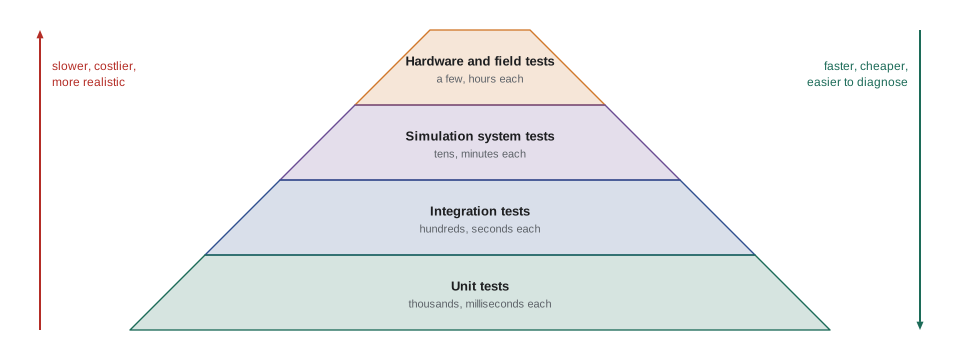
The test pyramid is a guideline for proportions: many fast, cheap unit tests at the base, fewer integration tests in the middle and a small number of slow, expensive system and field tests at the top. The reasoning is economic. A unit test runs in milliseconds and points directly at the broken function; a full simulation test may take minutes, may fail for many reasons and needs investigation to locate the fault. A suite shaped like an inverted pyramid, mostly slow end-to-end tests, is slow to run, flaky and hard to diagnose.
Worked problem
What the pyramid buys in run time
Suite A has 2000 unit tests at 5 ms, 200 integration tests at 3 s and 20 simulation tests at 4 min. Suite B, built mostly end to end, has 200 unit tests, 50 integration tests and 120 simulation tests at the same durations. Compare total run time on one machine.
Show solution
- A: units \( 2000 \times 0.005 = 10 \) s; integration \( 200 \times 3 = 600 \) s; simulation \( 20 \times 240 = 4800 \) s; total 5410 s, about 1.5 h.
- B: units 1 s; integration 150 s; simulation \( 120 \times 240 = 28\,800 \) s; total about 8.0 h.
- A can run unit and integration tests on every commit in about 10 minutes and the simulation tests in parallel or nightly.
Answer: About 1.5 h against 8 h, and suite A localizes failures far better. Parallel runners shorten both, but the shape of the suite is what keeps feedback fast.
Unit testing robot code
Robot code is easiest to unit test when algorithms are separated from middleware. Put the maths of a controller, a planner or a filter in plain functions or classes that take inputs and return outputs, and keep the ROS 2 node as a thin wrapper that converts messages and calls them. The core can then be tested with ordinary frameworks, GoogleTest for C++ and pytest for Python, both of which integrate with colcon test and the ament build tools.
Good unit tests are fast, deterministic, independent of each other and focused on one behavior each. They test boundaries and failure cases, not just typical inputs: zero, negative and maximum values, empty point clouds, NaN readings, angles near ±π. Floating-point results are compared with tolerances. Each test name states the behavior checked, for example test_velocity_limiter_clamps_at_max_speed, so a failure report is self-explanatory.
import math, random
def wrap(a):                      # wrap an angle to (-pi, pi]
    a = math.fmod(a + math.pi, 2 * math.pi)
    if a <= 0: a += 2 * math.pi
    return a - math.pi
def limit(v, vmax):               # clamp a velocity command
    return max(-vmax, min(vmax, v))
# example-based tests
assert abs(wrap(3 * math.pi) - math.pi) < 1e-12
assert abs(wrap(-math.pi / 2) + math.pi / 2) < 1e-12
assert limit(2.0, 1.2) == 1.2 and limit(-5, 1.2) == -1.2
# property-based tests: check invariants on many random inputs (seeded)
rnd = random.Random(7); n = 0
for _ in range(10000):
    a = rnd.uniform(-1e4, 1e4)
    w = wrap(a)
    assert -math.pi < w <= math.pi                         # range invariant
    assert abs(math.sin(w) - math.sin(a)) < 1e-6           # same direction
    v, vmax = rnd.uniform(-10, 10), rnd.uniform(0.1, 3)
    assert abs(limit(v, vmax)) <= vmax                     # never exceeds the limit
    n += 1
print(f"{n} random cases passed all invariants")10000 random cases passed all invariants
The second half of that listing is property-based testing: instead of choosing examples by hand, state invariants that must hold for every input and check them against many generated inputs. Libraries such as Hypothesis for Python and RapidCheck for C++ automate the generation and, when a property fails, shrink the input to a minimal counterexample. Property tests are excellent for geometry, transforms, filters and planners, where invariants such as 'a wrapped angle stays in range' or 'a planned path never enters an obstacle' are easy to state.
Mocks, fakes and hardware interfaces
Code that talks to hardware, the network or the clock is hard to test directly. The solution is to depend on interfaces and substitute test doubles. A fake is a working but simplified implementation, such as a simulated motor that integrates commanded velocity into position. A mock is a test double that records how it was called, so the test can check, for example, that the driver sent a stop command when the watchdog expired. A stub returns canned answers. With ros2_control, a mock hardware component lets the controller manager and controllers be tested without any real motors.
Time deserves special care. Code that calls the system clock directly cannot be tested deterministically. ROS 2 nodes use a clock abstraction that can follow simulated time (the use_sim_time parameter), so a test can advance time explicitly and check behavior at each step, such as a timeout firing after exactly 0.5 s of simulated time regardless of how fast the test machine is.
Worked problem
Testing a command timeout with a fake clock
A base controller must stop if no velocity command arrives for 0.5 s. Design a deterministic test.
Show solution
- Create the controller with a fake clock at t = 0 and send a command of 1.0 m/s.
- Advance the clock to 0.40 s and call the update: output should still be 1.0 m/s.
- Advance to 0.51 s with no new command and update: output should be 0.
- Send a new command at 0.60 s and update: output should resume, confirming recovery.
Answer: Four steps on a fake clock test the timeout at both sides of the threshold and the recovery, and the test runs in microseconds with no sleeps, so it can never be flaky because of machine speed.
Integration testing in ROS 2
ROS 2 provides launch_testing, which starts a set of nodes from a launch description and then runs test cases against the live graph: checking that a node publishes on a topic within a time limit, that its outputs match expected values, that processes exit cleanly. Recorded data replayed from rosbag2 files is a powerful integration input: a bag from a real robot run, replayed into the localization or perception stack, tests the code against real sensor data repeatably. Teams build up a library of 'golden' bags covering difficult cases (glare, crowds, featureless corridors) and run them on every change, comparing outputs against stored reference results with tolerances.
# test_localization_launch.py  (listing; launch_testing)
import unittest, launch, launch_ros.actions, launch_testing.actions, pytest
@pytest.mark.launch_test
def generate_test_description():
    loc = launch_ros.actions.Node(package="my_loc", executable="localizer",
                                  parameters=[{"use_sim_time": True}])
    bag = launch.actions.ExecuteProcess(cmd=["ros2", "bag", "play", "golden/aisle_glare", "--clock"])
    return launch.LaunchDescription([loc, bag, launch_testing.actions.ReadyToTest()])
class TestPoseOutput(unittest.TestCase):
    def test_pose_published_within_5s(self, proc_output):
        # in a real test: subscribe to /pose and assert a message arrives in 5 s
        pass
Coverage
Code coverage measures which parts of the code the tests execute: statement (line) coverage, branch coverage (whether each decision has gone both ways) and, for safety-critical code, modified condition/decision coverage (MC/DC), which requires showing that each condition in a decision independently affects the outcome. Tools include gcov and lcov for C++ and coverage.py for Python, and colcon can aggregate results. Coverage reveals untested code, which is valuable; it does not show that the tested code is correct, because a test can execute a line without checking its result.
# Branch coverage by hand: which of the 2*3 = 6 branch outcomes do the tests exercise?
def speed_cmd(dist_m, person_seen, battery_low):
    v = 1.2
    if person_seen:            # decision 1
        v = 0.3
    if dist_m < 0.5:           # decision 2
        v = 0.0
    if battery_low:            # decision 3
        v = min(v, 0.6)
    return v
tests = [(5.0, False, False), (5.0, True, False), (0.2, False, True)]
hit = set()
for d, p, b in tests:
    hit |= {("person", p), ("close", d < 0.5), ("battery", b)}
    print(f"speed_cmd{(d, p, b)} = {speed_cmd(d, p, b)}")
total = {(k, v) for k in ("person", "close", "battery") for v in (True, False)}
print(f"branch outcomes covered: {len(hit)}/{len(total)}; missing: {sorted(total - hit)}")speed_cmd(5.0, False, False) = 1.2 speed_cmd(5.0, True, False) = 0.3 speed_cmd(0.2, False, True) = 0.0 branch outcomes covered: 6/6; missing: []
Here three tests happen to cover all six branch outcomes, yet they never check a person seen at close range with a low battery, the combination that matters most for safety. Coverage tools would report 100 % branch coverage. This is why coverage is a floor, not a goal: requirements, scenarios and risk analysis decide which combinations must be tested.
Flaky tests
A flaky test sometimes passes and sometimes fails without any change to the code. Robot test suites are prone to flakiness because of timing (a message arrives a few milliseconds late on a busy CI machine), concurrency, random seeds, network ports shared between tests and simulation nondeterminism. Flakiness is corrosive: when failures are often false alarms, engineers stop trusting the suite and real regressions slip through.
# If each of N independent tests is flaky with probability p, how often does a clean
# commit fail CI?  P(at least one failure) = 1 - (1 - p)^N
for N, p in ((100, 0.001), (500, 0.001), (500, 0.005), (2000, 0.001)):
    print(f"N={N:5d}, p={p:.3f}: spurious CI failure rate = {1 - (1 - p) ** N:.1%}")
# Retrying a failed test once reduces each test's effective flake rate to p^2:
p = 0.005
print(f"with one retry, N=500, p={p}: {1 - (1 - p**2) ** 500:.2%}")N= 100, p=0.001: spurious CI failure rate = 9.5% N= 500, p=0.001: spurious CI failure rate = 39.4% N= 500, p=0.005: spurious CI failure rate = 91.8% N= 2000, p=0.001: spurious CI failure rate = 86.5% with one retry, N=500, p=0.005: 1.24%
Retries hide flakiness rather than fix it, and can also hide real intermittent bugs, which in robots are often race conditions that will eventually appear in the field. Better practices: use simulated time instead of wall-clock sleeps, wait for conditions rather than fixed delays, seed all random generators, isolate tests with separate ROS domain IDs, quarantine a flaky test with an issue to fix it, and track the flake rate of each test over time.
Common mistakes
MistakeTesting algorithms only through full simulation runs
InsteadSeparate algorithms from middleware and unit test them directly.
MistakeUsing sleep(1.0) to wait for a message in a test
InsteadUse simulated time or wait for a condition with a timeout.
MistakeTreating 100 % coverage as proof of correctness
InsteadCoverage shows code was executed, not checked; choose cases from requirements and risks.
MistakeAutomatically retrying failed tests until they pass
InsteadFind and fix the cause; quarantine with an issue if necessary.
MistakeTesting only typical inputs
InsteadTest boundaries, NaNs, empty data and angle wraparound, and use property-based tests for invariants.
Summary and key terms
- Unit, integration, system and acceptance tests each catch different kinds of defects.
- The test pyramid favors many fast unit tests, fewer integration and simulation tests and a few hardware and field tests.
- Separating algorithms from ROS 2 nodes makes them easy to test with GoogleTest and pytest.
- Property-based tests check invariants over many generated inputs and shrink failures to minimal cases.
- Fakes, mocks and simulated clocks make hardware- and time-dependent code testable deterministically.
- launch_testing and golden rosbag2 recordings provide repeatable integration tests on real data.
- Coverage reveals untested code but not correctness, and flaky tests must be fixed rather than retried.
- Unit test
- A fast, isolated test of a small piece of code.
- Integration test
- A test that checks several components working together.
- System test
- A test of the whole system against system requirements.
- Test pyramid
- A guideline favoring many unit tests and fewer, slower high-level tests.
- Property-based testing
- Testing invariants against many automatically generated inputs.
- Mock
- A test double that records how it is called so the test can check interactions.
- Fake
- A simplified working implementation used in place of a real dependency.
- launch_testing
- The ROS 2 framework for testing nodes started from a launch description.
- Branch coverage
- The fraction of decision outcomes exercised by the tests.
- Flaky test
- A test that passes or fails nondeterministically without code changes.
Practice problems
Work each problem on paper first, then reveal the answer to check.
Which test level catches unit and frame mismatches between nodes?
Show answer
Integration tests.
Why should most tests be unit tests?
Show answer
They are fast, cheap and point directly at the fault.
What invariant could you property-test for an angle wrapping function?
Show answer
The result always lies in (−π, π].
What is the difference between a mock and a fake?
Show answer
A mock records calls for checking; a fake is a simplified working implementation.
Which ROS 2 parameter makes a node follow simulated time?
Show answer
use_sim_time.
What is a golden bag?
Show answer
A stored recording of a difficult case replayed in regression tests.
What does MC/DC require?
Show answer
Showing each condition independently affects the decision outcome.
With 500 tests each flaky at 0.2 %, roughly how often does CI fail spuriously?
Show answer
About 63 %.
Why are retries a poor fix for flaky tests?
Show answer
They hide the cause, which may be a real race condition.
Name two ways to reduce timing flakiness.
Show answer
Use simulated time and wait for conditions instead of fixed sleeps.
Lesson quiz · 5 questions
Score 60% or more to complete this lesson.
Create a free account to save your progress, take quizzes and earn a certificate.