
SLS-150 · Lesson 4 of 12 · 18 min
Consumer protection and the cooling-off rule
▶ Video coming soon A video version of this lesson is on the way.
In October, Bev Halvorsen brought an idea to Juniper & Pine's owners: an in-home design service. A designer would visit customers' homes, measure rooms, suggest furniture and take orders on a tablet on the spot. Tessa Yellowbird, who runs the store's e-commerce and marketing, liked it immediately. Marcus Dube, who handles operations, asked a question nobody had considered: "When we sell in someone's living room, are we still a store?" The answer, it turned out, was no. Selling away from the store's permanent premises brings different legal rules, including a license or registration in some places, special contract paperwork and a right for the customer to cancel.
Consumer protection law exists because consumers and businesses rarely bargain as equals. The business writes the contract, knows the product, and does the same deal hundreds of times; the consumer does it once. Every province and state has laws that ban unfair practices, require certain disclosures and give consumers rights to cancel some kinds of contracts. These laws protect individuals buying for personal, family or household use. They generally do not protect businesses buying for business use, which is why Ridgeline's contracts with clinics and schools are governed mainly by contract law, while Juniper & Pine's sales are governed by consumer protection law as well. This lesson covers the rules most relevant to sellers in your jurisdiction.
Federal and state consumer protection
Consumer protection in the United States works at two levels. At the federal level, section 5 of the Federal Trade Commission Act bans unfair or deceptive acts or practices in commerce, and the FTC enforces it along with specific rules such as the Cooling-Off Rule and the Mail, Internet, or Telephone Order Merchandise Rule. At the state level, every state has its own law against unfair or deceptive practices, often called a UDAP law. South Dakota's is the Deceptive Trade Practices and Consumer Protection law in chapter 37-24 of the South Dakota Codified Laws, enforced by the state attorney general. State laws often let consumers sue directly, which the FTC Act does not.
What counts as an unfair practice
The FTC treats a practice as deceptive if it involves a representation, omission or practice that is likely to mislead a consumer acting reasonably in the circumstances, and that is material, meaning likely to affect the consumer's decision. A practice is unfair if it causes or is likely to cause substantial injury that consumers cannot reasonably avoid and that is not outweighed by benefits to consumers or competition. State UDAP laws use similar ideas and often list specific banned practices, such as misrepresenting the price, quality or origin of goods. In South Dakota, knowingly using a deceptive act or practice in connection with a sale is a misdemeanor, the attorney general can seek injunctions and civil penalties, and a person who suffers actual damage can sue. Taking advantage of elderly or vulnerable consumers is treated especially seriously by regulators and courts in every state.
| Practice | Example on a sales floor |
|---|---|
| False claims about the product | "This sofa is solid oak" when it is veneer over particleboard |
| Misleading omissions | Not mentioning a mandatory delivery fee until the customer is at the till |
| False urgency | "This price ends today" when the same price runs all month |
| Exploiting vulnerability | Selling a second mattress protection plan to a confused elderly customer who already has one |
| Pressure tactics | Refusing to let a customer leave to think about it, or repeatedly calling them at home |
| Misrepresenting rights | "All sales are final, so you can't return it even if it's defective" |
Selling in the customer's home: the Cooling-Off Rule
Bev's in-home design idea fell under the FTC's Cooling-Off Rule, which applies to sales of 25 dollars or more made at the buyer's home, workplace or dormitory, and to sales of 130 dollars or more made at a seller's temporary location, such as a hotel room, fairground or convention center. It does not apply to sales made entirely online, by mail or by phone, to sales negotiated at the seller's permanent place of business, or to goods bought mainly for business use. Many states, including South Dakota, have their own home-solicitation laws as well, and where state rules give the buyer more protection, the seller must follow them.
The cancellation right is the key rule. The buyer can cancel for a full refund until midnight of the third business day after the sale; Saturdays count as business days, Sundays and federal holidays do not. At the time of sale, the seller must tell the buyer about the right to cancel, give a dated copy of the contract or receipt showing the seller's name and address and explaining the right, and provide two copies of a cancellation form, all in the same language used in the sales presentation. If the buyer cancels, the seller has 10 days to refund all payments, return any trade-in and say whether it will collect any goods left with the buyer, and 20 days to collect them or reimburse the buyer's cost of returning them. Violations can bring FTC civil penalties of more than 53,000 dollars per violation, a figure adjusted for inflation each year.
Worked problem
Working out a cooling-off deadline
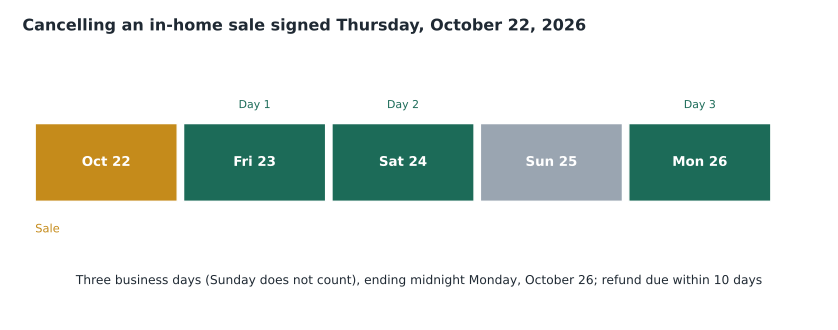
A designer signs a contract for a sectional and two chairs in a customer's living room on Thursday, October 22, 2026. Until when can the customer cancel under the Cooling-Off Rule, and how quickly must Juniper & Pine refund the deposit if she does?
Show solution
- Business days after the sale: Friday, October 23 is the first; Saturday, October 24 is the second, because Saturdays count.
- Sunday, October 25 does not count, so Monday, October 26 is the third business day.
- The customer can cancel until midnight on Monday, October 26, 2026.
- If she cancels, Juniper & Pine must refund all payments within 10 days of receiving the notice.
Answer: The deadline is midnight on October 26, 2026, and the refund is due within 10 days. If the designer had not given the cancellation forms, the cancellation period would not start running properly, and the store would have broken the rule.
The owners decided to go ahead with in-home design, but only after Marcus and the store's lawyer had set up the paperwork: the required contract form, a plain-language cancellation statement, a process for recording when the customer received the contract, and a rule that no furniture would be ordered from suppliers until the cancellation period had passed. That last rule cost a few days of delivery time. It also meant a cancellation would cost the store nothing.
Buying online and by phone: the Mail Order Rule
Juniper & Pine's website and phone orders fall under the FTC's Mail, Internet, or Telephone Order Merchandise Rule. A seller must have a reasonable basis for any shipping time it states, and if it states none, must be able to ship within 30 days of receiving a properly completed order. If the seller cannot ship on time, it must notify the customer before the promised date and offer the choice of agreeing to the delay or canceling for a prompt refund. For a second delay, the customer must give express consent or the order is canceled. Separately, the Restore Online Shoppers' Confidence Act requires clear disclosure, express consent and a simple cancellation method for online subscriptions that renew automatically. The FTC adopted a broader click-to-cancel rule in 2024, but a federal appeals court vacated it in July 2025, so the older law and state automatic-renewal laws remain the main rules.
Unsolicited goods and other traps
Federal law also deals with practices that have nothing to do with the sales conversation but everything to do with trust. Under federal law, a consumer who receives unordered merchandise may keep it as a gift and has no obligation to pay for it, so a retailer cannot ship an extra item and bill for it. Credit sales bring in the Truth in Lending Act, which requires the cost of credit to be disclosed, and store financing through a partner lender must follow its rules. These details are mostly handled by store systems and paperwork, but a seller who knows they exist can spot a problem before it reaches a customer.
Business customers and consumer protection
Most consumer protection laws do not apply when a business buys for business use. A dental office buying printers is not a consumer, and neither is a school division buying furniture. That does not mean anything goes. Contract law, misrepresentation, competition and advertising law, covered in the next lessons, still apply. And small business owners often buy the way consumers do, without lawyers or purchasing departments. Ridgeline's policy is to treat sole proprietors and very small offices with the same care as consumers, especially when explaining automatic renewals and cancellation terms. Darnell puts it simply: "The law draws a line at business use. Our reputation doesn't."
Pressure and vulnerability on the sales floor
Consumer protection law does not ban persuasion. A seller can explain benefits, point out that a sale ends on Sunday when it really does, and ask for the order. What the law targets is pressure that overrides the customer's ability to decide, and selling to customers who cannot protect their own interests. In practice, the line is crossed in recognizable ways: refusing to let a customer leave to think it over, calling them repeatedly at home after they have said no, telling them a price will never be offered again when it will, or continuing a sale when it is clear the customer does not understand what they are agreeing to.
Vulnerability is not always obvious. A customer may be elderly and sharp, or young and confused. A customer may speak English well in conversation but struggle with contract language. A customer may be grieving, exhausted after a long move or under financial stress. Bev teaches associates to watch for signs that a customer is not following the conversation, such as agreeing to everything without questions, asking the same question several times or looking to someone else for answers, and to slow down when they see them. Slowing down can mean summarizing the deal in plain words, suggesting the customer bring someone they trust, or offering to hold the price until they return.
| Sign | What the associate does |
|---|---|
| The customer agrees to everything without questions | Summarize the total price, delivery and terms, and ask them to say it back |
| The customer seems confused by the paperwork | Walk through each line in plain words, or offer to email it for review |
| A family member is pushing the purchase | Speak to the customer directly and confirm it is their decision |
| The customer mentions money worries | Show lower-priced options, and do not push financing |
| The customer wants to think about it | Offer a written quote with the date it is valid until |
When a customer wants to cancel
When a customer exercises a cancellation right, the seller's job is to make it easy. Thank them, confirm the cancellation in writing, explain when the refund will arrive, and arrange the return of any goods. Arguing, delaying or suggesting the customer has no right to cancel when they do is itself an unfair practice, and it turns one lost sale into a complaint to a regulator. Juniper & Pine's in-home design process now includes a short cancellation checklist so that any associate, not just the designer, can handle a cancellation correctly on the first call.
Business customers sometimes ask for the same flexibility consumers get by law. Ridgeline does not have to offer a cooling-off period on business contracts, but Darnell often agrees to a short review window on a first order with a small office, written into the contract, because a customer who feels trapped is unlikely to renew.
Common mistakes
MistakeConsumer protection only matters for big-ticket sales.
InsteadUnfair practice rules apply to every consumer sale, whatever the price.
MistakeA sale in the customer's home works the same way as a sale in the store.
InsteadSales away from the store's permanent premises trigger special paperwork and cancellation rights.
MistakeIf the customer signs, they cannot change their mind.
InsteadSome contracts, such as in-home sales, come with a legal right to cancel.
MistakeLate online deliveries are just a customer service issue.
InsteadMissing delivery dates triggers legal rights to cancel and obligations to refund.
MistakeConsumer protection law does not affect business sellers at all.
InsteadIt does not usually apply to business buyers, but small businesses deserve the same honesty, and other laws still apply.
Summary and key terms
- Consumer protection law protects individuals buying for personal, family or household use, not usually businesses buying for business use.
- The FTC Act and state UDAP laws, such as South Dakota's chapter 37-24, ban unfair and deceptive practices.
- The Cooling-Off Rule gives buyers three business days to cancel in-home and temporary-location sales, with refunds due within 10 days.
- The Mail Order Rule requires a reasonable basis for shipping times and a choice to cancel when an order is delayed.
- Small business buyers deserve the same honesty even when consumer law does not apply.
- UDAP law
- A state law against unfair or deceptive acts or practices.
- Cooling-Off Rule
- The FTC rule giving buyers three business days to cancel certain in-home and temporary-location sales.
- Materiality
- Whether a claim or omission is likely to affect a consumer's decision.
- Unordered merchandise
- Goods sent to a consumer who did not request them, which the consumer may keep.
Practice problems
Work each problem on paper first, then reveal the answer to check.
Why do consumer protection laws generally not apply to Ridgeline's sale of printers to a clinic?
Show answer
The clinic is buying for business use, not personal, family or household use.
A sale is made in a customer's home on Thursday, October 22. What is the cancellation deadline?
Show answer
Midnight on Monday, October 26: Friday and Saturday count, Sunday does not.
Why did Juniper & Pine decide not to order furniture until the cancellation period had passed?
Show answer
So that a cancellation would cost the store nothing and the refund could be made promptly.
Lesson quiz · 5 questions
Score 60% or more to complete this lesson.
Create a free account to save your progress, take quizzes and earn a certificate.