
SLS-150 · Lesson 8 of 12 · 18 min
Customer data and privacy under US law
▶ Video coming soon A video version of this lesson is on the way.
On a Saturday evening in early November, Aiden left Juniper & Pine's sales tablet on the seat of a bus. It held the store's delivery app, which showed names, addresses, phone numbers and delivery notes for the 37 customers whose orders were scheduled for the following week. He realized what had happened on the walk home, called the transit lost-and-found, then called Bev. Bev's first questions were practical: Was the tablet locked? Was it encrypted? Could the store wipe it remotely? The answers were yes, yes and yes. Marcus Dube wiped it within the hour. But the store still had to work out whether it had a privacy breach on its hands, and what the law required it to do next.
Selling runs on information about people: names, job titles, contact details, purchase histories, preferences, notes from conversations and, increasingly, data from websites and apps. Privacy law governs how businesses collect, use, share and protect that information. Sellers handle personal information every day, often more of it than anyone else in the company, so they are on the front line of privacy compliance. This lesson explains the privacy law that applies in your country, what it means for CRM records and sales conversations, and what to do when something goes wrong.
A patchwork of federal and state laws
The United States has no single general privacy law for the private sector. Instead, privacy is governed by a patchwork. Federal laws cover particular sectors and kinds of data, such as health information held by health care providers and their business associates under HIPAA, financial information under the Gramm-Leach-Bliley Act, children's information online under COPPA, and consumer reports under the Fair Credit Reporting Act. The FTC uses section 5 of the FTC Act to act against companies that break their own privacy promises or fail to protect data reasonably. And a growing number of states have comprehensive consumer privacy laws: 24 by October 2026, starting with California's Consumer Privacy Act and including Virginia, Colorado, Texas, Oregon, Minnesota and, in 2026, Alabama, Louisiana, Oklahoma and Vermont. South Dakota does not have a comprehensive privacy law, but its breach notification law applies to any business holding South Dakota residents' data, and a business selling into other states may be covered by theirs.
What the state privacy laws require
The state comprehensive laws share a common structure, though thresholds and details vary. Most apply to businesses that handle the personal data of a set number of state residents a year, often 100,000, or a smaller number if the business earns revenue from selling data; some states set lower thresholds. They give consumers rights to know what data a business holds, to correct and delete it, and to opt out of the sale of their data, targeted advertising and some kinds of profiling. They require privacy notices, data minimization, reasonable security, contracts with vendors that process data, and usually opt-in consent for sensitive data such as health or precise location data. Most are enforced by state attorneys general; California also has a dedicated privacy agency and a limited private right to sue after data breaches. Many of these laws exempt employee and business-to-business data, but California's does not.
| Principle | In practice for a seller |
|---|---|
| Purpose | Know why you are collecting each piece of information, and tell the customer |
| Consent | Get agreement for anything a customer would not reasonably expect, such as adding them to a newsletter |
| Limit collection | Record what you need to serve the customer, not everything you hear |
| Limit use and disclosure | Use data for the purpose given; do not pass it to partners without a basis |
| Accuracy | Update contact records when they change |
| Safeguards | Lock devices, use approved systems and never keep customer lists on personal accounts |
| Access | Know how to route a customer's request to see or correct their information |
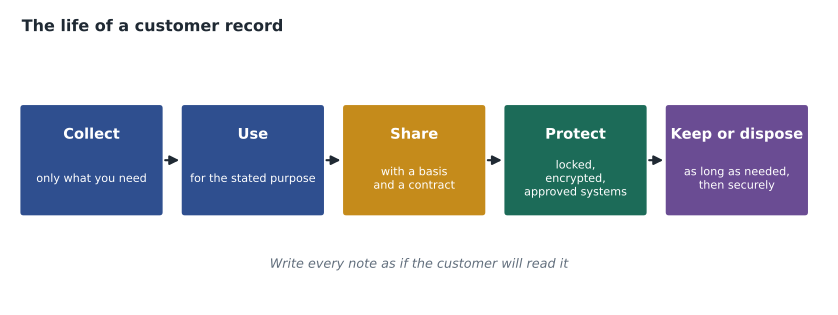
What goes in the CRM notes
The CRM is the biggest store of personal information most sales teams have, and sellers write most of what is in it. Darnell's rule for Ridgeline is that CRM notes should be written as if the customer will read them, because under the law customers can often ask to see them. Write facts and business needs. Do not record health details, family circumstances, personal opinions about the buyer or gossip unless there is a clear business reason and the customer would expect it.
| Better | Worse |
|---|---|
| "Office manager prefers email; back from leave Nov 2." | "Janet was off with a back injury, seemed stressed." |
| "Decision needs Dr. Anand's approval above 5,000." | "Dr. Anand is difficult and cheap." |
| "Clinic expanding into the unit next door in January." | "Heard from the landlord their lease is in trouble." |
| "Asked us not to call before 10 a.m." | "Grumpy in the mornings." |
Sharing data with partners and service providers
Juniper & Pine shares some customer information with its financing partner when a customer applies for credit, with its delivery contractor and with the company that administers protection plans. Under the state comprehensive laws, a business must have contracts with processors limiting how they use the data, and passing data to a third party for its own purposes can count as a sale that consumers can opt out of. The lender's own use of the data is covered by the Gramm-Leach-Bliley Act. For Ridgeline, service work for clinics is more sensitive: when its technicians service a multifunction printer at Northfield, the device's memory may hold scanned patient records. Under HIPAA, a vendor that creates, receives, maintains or transmits protected health information for a provider is a business associate and must sign a business associate agreement with the provider and follow HIPAA's security rules. Ridgeline signs one with every clinic customer, and its contract requires a machine's hard drive to be wiped or kept on site when the machine is removed.
When something goes wrong: breaches
Every state, including South Dakota, has a data breach notification law. South Dakota's, in sections 22-40-19 to 22-40-26 of its codified laws, requires a business to notify affected residents within 60 days of discovering a breach of unencrypted personal information, such as a name combined with a Social Security number, driver's license number or account number with an access code. If more than 250 residents are affected, the business must also notify the attorney general. A business that, after an appropriate investigation and notice to the attorney general, reasonably determines the breach will not likely result in harm does not have to notify residents, but must document that decision. Encrypted data is generally outside the definition of a breach unless the key was also taken. Other states have different definitions and deadlines, so a breach affecting customers in several states may trigger several laws at once.
Worked problem
Assessing the lost tablet
Aiden's tablet held names, addresses, phone numbers and delivery notes for 37 customers. It was locked with a passcode, its storage was encrypted, and it was wiped remotely about an hour after it was lost. Does Juniper & Pine need to report or notify?
Show solution
- Identify the information: contact details and delivery notes. No payment card numbers, government ID numbers or account numbers were on the device.
- Consider the safeguards: the device was encrypted, locked and wiped, so the chance anyone accessed the data is very low.
- Apply the test: the data does not include the elements in South Dakota's definition of personal information, and it was encrypted, so it is unlikely to be a notifiable breach under state law.
- Record it anyway: document the facts, the assessment and the steps taken, in case a regulator or customer asks.
- Consider customers as people: Bev decided to call the customers with deliveries that week to explain, confirm their delivery times and answer questions.
Answer: The store probably did not have a reportable breach, because of the encryption and remote wipe, but it documented the incident and told the customers anyway. If the tablet had been unlocked and unencrypted, the answer could have been different.
Privacy as part of the sale
For Ridgeline, privacy is also a selling point. Clinics, law firms and schools all hold sensitive information, and they ask suppliers hard questions: where RoomFlow stores booking data, who can access it, how printer hard drives are handled and what happens in a breach. Maya keeps a one-page summary, approved by Leah, of Ridgeline's data handling, its business associate agreements and its incident response steps. Answering accurately is essential: a seller who overstates a product's security creates a false claim that the FTC can treat as deceptive, as it has in many data security cases. The safe practice is to answer from the approved summary and route detailed questions to the company's security or privacy lead.
Access requests and AI tools
Customers in states with comprehensive privacy laws have rights to know, correct and delete the personal data a business holds about them. Most state laws require a response within 45 days, with a possible extension. A seller who receives such a request should not try to answer it alone, but should pass it immediately to the person responsible for privacy, usually named in the company's privacy notice. Because CRM notes can be included in what a customer receives, the habit of writing notes as if the customer will read them has a practical purpose.
A newer risk comes from AI tools. It is tempting to paste a customer's email thread or a list of contacts into a public AI chatbot to draft a reply or summarize a meeting. Doing so may disclose personal and confidential information to a third party, outside the company's control and possibly outside the country. Ridgeline allows only the AI assistant built into its CRM, which the company has assessed and contracted for, and prohibits pasting customer information into other tools. The same caution applies to recording meetings with transcription tools: the other participants should know, and the recordings belong in approved systems.
| Habit | Why it matters |
|---|---|
| Lock your laptop and phone whenever you step away | Most breaches start with simple lapses |
| Use only approved systems for customer data | Personal email and cloud accounts are outside the company's safeguards |
| Do not paste customer data into public AI tools | It discloses data to a third party |
| Shred printed customer documents | Paper is still a common source of breaches |
| Report lost devices and misdirected emails at once | Fast reporting limits harm and is often legally required |
Retention: how long to keep customer data
Privacy law in both countries expects organizations to keep personal information only as long as it is needed. Some records must be kept for set periods, such as invoices and tax records, and some contracts specify retention. Beyond those, keeping old prospect lists, closed opportunity notes and former customers' details indefinitely increases the harm if a breach happens and makes access requests harder to answer. Ridgeline's CRM now flags prospect records with no activity for three years for review, and the sales team either refreshes consent or deletes them. Juniper & Pine deletes delivery notes, such as gate codes and parking instructions, ninety days after delivery, because they are useful for the delivery and risky afterwards.
Privacy questions also come up in ordinary selling conversations. A clinic manager may ask whether a technician will see patient files on a printer's screen during a repair, or a customer may ask why the store needs a phone number for a delivery. Short, accurate answers, such as explaining that the number is used only to arrange the delivery and is deleted afterwards, build trust and show that the business takes privacy seriously.
Common mistakes
MistakeCustomer data belongs to the seller who collected it.
InsteadIt belongs in the company's systems, and the company is accountable for it. Never take customer lists to a personal account or a new employer.
MistakeAnything a customer tells me can go in the CRM.
InsteadRecord what you need for the business relationship, written as if the customer will read it.
MistakeIf a device is lost, we only need to act if we know someone accessed the data.
InsteadAssess the risk based on the data and safeguards, document the incident and follow the notification rules.
MistakePassing customer details to a partner is fine if it helps the customer.
InsteadSharing for a new purpose needs a legal basis, often the customer's consent, and service providers need contracts.
MistakePrivacy is the IT department's job.
InsteadSellers handle more personal information than almost anyone and are part of compliance.
Summary and key terms
- US privacy law is a patchwork of sectoral federal laws, FTC enforcement and, by 2026, comprehensive laws in 24 states; South Dakota has none but has a breach notification law.
- State privacy laws give consumers rights to access, correct, delete and opt out, and require notices, security and processor contracts.
- CRM notes should record business facts, written as if the customer will read them.
- Breach laws require notice to affected residents, and in South Dakota to the attorney general when more than 250 residents are affected.
- Privacy promises in sales must be accurate; overstating security can be a deceptive practice.
- Personal data
- Information linked or reasonably linkable to an identifiable individual.
- Business associate
- Under HIPAA, a vendor that handles protected health information for a covered health care provider.
- Data breach notification
- The legal duty to tell affected people, and sometimes regulators, about certain security breaches.
- Processor
- A business that handles personal data on another business's behalf under contract.
Practice problems
Work each problem on paper first, then reveal the answer to check.
Rewrite this CRM note: "Seemed stressed, said her mother is sick."
Show answer
Something like: "Asked us to follow up next week instead of this week."
Why did the encryption of the tablet matter?
Show answer
It made it very unlikely anyone could access the data, which affects whether the incident is a reportable breach.
Why does Ridgeline sign business associate agreements with clinics?
Show answer
Because its equipment and service may involve protected health information, which makes it a business associate under HIPAA.
Lesson quiz · 5 questions
Score 60% or more to complete this lesson.
Create a free account to save your progress, take quizzes and earn a certificate.