
SLS-150 · Lesson 9 of 12 · 18 min
Gifts, bribery and the FCPA
▶ Video coming soon A video version of this lesson is on the way.
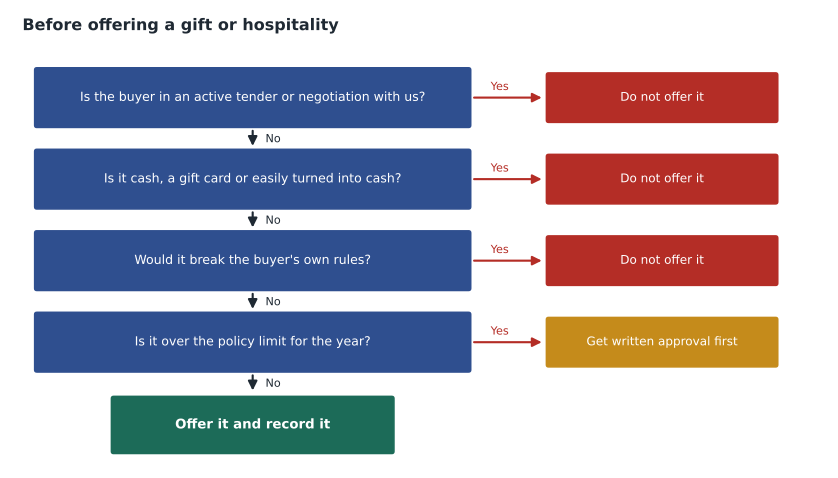
Every December, Ridgeline sends small gifts to its customers. This year, Maya planned to send Janet Morrow at Northfield Family Clinic a gift basket and to invite her and Dr. Ravi Anand to a hockey game in Ridgeline's corporate seats. She also wanted to do something for the facilities team at the City, which was about to issue a request for proposals for meeting-room technology. Before ordering anything, she opened Ridgeline's gifts and hospitality policy. Two sentences stopped her. The first said that gifts to public sector employees involved in a current or upcoming purchasing decision were not allowed at all. The second said that anything over 100 dollars per person per year needed Darnell's written approval.
Gifts, meals, entertainment and hospitality are a normal part of business relationships in both countries. Handled well, they express thanks and build goodwill. Handled badly, they can look like, or actually be, an attempt to buy a decision. At the extreme, they are bribery, which is a serious crime whether the person bribed works for a private company, a city or a foreign government. This lesson explains the difference between courtesy and corruption, the laws against bribery in your country and how to use a company's gifts policy in practice.
Why gifts are a legal and ethical issue
A purchasing decision is supposed to be made for the benefit of the buyer's organization. When a seller gives something of value to the person making that decision, the risk is that the decision will be made for the person's own benefit instead. That conflict is the core of bribery. Even when no one intends a bribe, a lavish gift can create an obligation in the recipient's mind, make the seller look as if they are buying the business and expose both people to discipline under their employers' policies.
Most companies manage this risk with a written policy that sets value limits, bans certain kinds of gifts entirely, such as cash or gift cards, requires approval for anything above the limit, and requires gifts and hospitality to be recorded. Many buying organizations have mirror-image policies limiting what their staff may accept. A seller needs to know both.
| Usually acceptable | Needs approval or care | Not acceptable |
|---|---|---|
| A modest holiday gift basket | Tickets to a sporting event | Cash, gift cards or anything that can be converted to cash |
| A working lunch during a meeting | An expensive dinner or travel | Anything during an active tender or negotiation with that buyer |
| Branded items of low value | Gifts to the same person several times a year | Anything requested by the buyer in exchange for business |
| Hosting a training session for customer staff | Paying for a customer's travel to a site visit | Gifts hidden from the buyer's employer |
Worked problem
Checking a gift plan against the policy
Ridgeline's policy allows gifts and hospitality of up to 100 dollars per person per year without approval. Maya's plan for Janet Morrow is a gift basket worth 60 dollars and a seat at a hockey game worth 95 dollars, plus a share of food in the corporate box estimated at 30 dollars per guest. Does the plan need approval?
Show solution
- Total value for Janet: 60 plus 95 plus 30, which is 185 dollars.
- The limit is 100 dollars per person per year, so the plan exceeds it by 85 dollars.
- Maya needs Darnell's written approval, or she must choose one item, such as the basket alone.
- She should also check Northfield's own rules. Clinics, like many organizations, may limit what staff can accept, and the invitation should go to Janet with the clinic's knowledge.
Answer: The plan totals 185 dollars and needs approval. Maya chose to send the basket and to invite Janet and Dr. Anand to the game only after Darnell approved it and Janet confirmed the clinic was comfortable with it.
Public sector buyers
Selling to governments, school divisions, health authorities and other public bodies raises the stakes. Public employees are spending public money, and they are usually bound by codes of conduct that limit gifts to items of nominal value or prohibit them entirely, especially during a procurement. A gift that would be a normal courtesy to a private customer can be a breach of the public employee's code, a reason to disqualify the seller from a tender, or a crime. That is why Ridgeline's policy bans gifts to public sector staff involved in a current or upcoming purchase, and why Maya sent the City's facilities team nothing but a holiday card.
Bribery under US law
Bribery in domestic US business is covered by several overlapping laws. Most states, either in their criminal codes or through broader fraud and corruption statutes, make it a crime to bribe an employee or agent of a private company to influence their business decisions, a practice known as commercial bribery. Federal law reaches commercial bribery through the Travel Act, which makes it a federal crime to use interstate travel or communications to carry out bribery that violates state law, and through honest services fraud, which covers bribes and kickbacks that deprive an employer of an employee's honest services. Bribing federal officials is a crime under 18 U.S.C. section 201, and bribery of state and local officials is covered by state law and, when federal funds are involved, by federal law. Federal employees may generally accept unsolicited gifts worth no more than 20 dollars per occasion and 50 dollars per year from one source, and many state and local governments have similar limits.
The Foreign Corrupt Practices Act
The Foreign Corrupt Practices Act, or FCPA, makes it a crime for US companies, citizens, residents, companies listed on US stock exchanges and anyone acting in US territory to corruptly offer or give anything of value to a foreign official to obtain or retain business. Its accounting provisions require listed companies to keep accurate books and records and adequate internal controls. Anti-bribery violations can bring fines of up to 2 million dollars per violation for companies and up to 250,000 dollars and five years in prison for individuals, and fines can be much higher under the Alternative Fines Act. There is a narrow exception for facilitating payments for routine government actions, and affirmative defenses for payments lawful under the foreign country's written law and for reasonable, bona fide expenses such as product demonstrations. Since 2023, the Foreign Extortion Prevention Act also makes it a crime for a foreign official to demand or accept such a bribe.
Enforcement changed sharply in 2025. A February 10, 2025 executive order paused new FCPA enforcement for 180 days while the Justice Department reviewed its approach. On June 9, 2025, the Department issued new guidelines that focus enforcement on cases involving cartels and transnational criminal organizations, harm to US companies' ability to compete, threats to national security and substantial bribery schemes, and that direct prosecutors not to pursue routine business courtesies of low value. The number of new cases fell. But the FCPA itself did not change, its statute of limitations is generally five years, a later administration can bring cases for conduct that happens now, and other countries enforce their own anti-bribery laws. Companies that sell abroad still need strong compliance programs, especially for third parties, because most foreign bribery cases involve payments through agents, consultants or distributors.
Red flags with agents and intermediaries
In October, a consultant contacted Rob Kowalski, Ridgeline's vice-president of sales, about selling RoomFlow to a government-owned agricultural college overseas. He said he had excellent relationships with the college's leadership and asked for a success fee of 15 percent of the contract value, paid to a company registered in a third country, with half in advance. Rob forwarded the proposal to Leah before replying. She listed the red flags, and Ridgeline declined.
| Red flag | Why it matters |
|---|---|
| An unusually high commission or success fee | Extra money may be intended for officials |
| Payment to a third country or a different company | It can hide who receives the money |
| Large advance payments | Money may be paid before any legitimate work is done |
| Claims of special relationships with officials | The agent may be selling influence, not services |
| A refusal to sign anti-bribery terms or allow audits | Legitimate agents usually accept them |
| An agent recommended by the government official | The official may benefit from the agent's fee |
Using a gifts policy well
Gifts policies work only if people use them before acting, not after. A few habits help. Check the policy, and the buyer's policy, before offering anything of value. Record gifts and hospitality in the CRM or the company's register, with the value and the business purpose. Never give anything during an active tender or negotiation with that buyer. Never give anything the buyer asks for in exchange for business. Treat the same buyer consistently across the year, since several small gifts can add up. And when a buyer declines a gift because of their own rules, accept it gracefully; it is a sign they take their job seriously.
The same rules apply in reverse. Sellers are sometimes offered gifts by suppliers, partners or customers. Maya was offered a weekend at a supplier's lake cabin after Ridgeline increased its orders. She declined and told Darnell, because Ridgeline's policy treats gifts received the same way as gifts given.
Hospitality with a business purpose
Not all hospitality is a gift. A working lunch during a site visit, a product training session for a customer's staff with refreshments, or paying reasonable travel costs for a customer to see equipment working at another site can all serve a genuine business purpose. The test is whether the main reason for the spending is the business discussion or demonstration, whether the cost is reasonable for the location and the people involved, whether it is open and recorded, and whether the customer's employer would be comfortable with it. A weekend trip with a two-hour product demonstration squeezed in fails that test; a day visit to a reference site, with the demonstration as the point of the trip, passes it.
When someone asks for a bribe
Sometimes the request comes from the other side. A purchasing manager hints that a contract would be easier to award if Ridgeline paid for a family holiday; an agent says a contract can be secured for an extra fee. The response should be clear and immediate: refuse, without ambiguity, and report it to your manager and the company's legal or compliance contact the same day. Do not negotiate, do not agree to think about it and do not try to handle it quietly yourself. Write down what was said, when and by whom. The company may need to decide whether to withdraw from the deal, report to authorities or notify the buyer's senior management.
| Do | Do not |
|---|---|
| Refuse clearly and politely | Hint that you might agree later |
| Report it the same day to your manager and legal contact | Keep it to yourself to protect the deal |
| Write down what was said, when and by whom | Delete messages or notes |
| Let the company decide the next steps | Contact the buyer's senior management on your own |
Refusing a request can feel like losing the deal, and sometimes it does. But a deal won through a bribe is a liability that can surface years later, and a company known to pay is a company that will be asked to pay again.
Retail sellers face the same issues on a smaller scale. A supplier representative who offers Juniper & Pine's associates concert tickets in exchange for featuring a brand on the floor is offering an inducement to steer customers, which Bev treats as a gifts-policy matter and a conflict of interest, not a perk.
Recording gifts consistently also protects the seller. If a buyer is later accused of favoring a supplier, a clear record showing modest, approved and disclosed courtesies is the best evidence that nothing improper happened.
Common mistakes
MistakeGifts are only a problem with government buyers.
InsteadCommercial bribery of private-sector employees is a crime under many state laws and can be prosecuted federally.
MistakeIf the gift is small, it is always fine.
InsteadSmall gifts during an active tender, or several small gifts over a year, can still breach policies.
MistakePaying through an agent protects the company.
InsteadBribery through an intermediary is still bribery.
MistakeA buyer who asks for a favor is just being friendly.
InsteadA request for something of value in exchange for business is a serious red flag; refuse and report it.
Mistakeca
Insteadus
Summary and key terms
- Gifts and hospitality are normal, but anything that could influence a purchasing decision for the recipient's own benefit is a risk.
- Use the company's gifts policy before acting, check the buyer's policy and record what you give.
- Public sector buyers usually have strict limits, and gifts during a procurement are generally off limits.
- Commercial bribery is a crime under many state laws and can be prosecuted federally under the Travel Act and honest services fraud.
- The FCPA bans bribing foreign officials; 2025 brought an enforcement pause and narrower priorities, but the law is unchanged.
- Most foreign bribery runs through agents and intermediaries, so watch for red flags.
- Commercial bribery
- Bribing a private-sector employee or agent to influence their business decisions.
- Foreign official
- Under the FCPA, an officer or employee of a foreign government, public body or public international organization.
- Facilitating payment
- A small payment for a routine government action, a narrow FCPA exception.
- Accounting provisions
- FCPA requirements for listed companies to keep accurate books and internal controls.
Practice problems
Work each problem on paper first, then reveal the answer to check.
A plan includes a 60 dollar basket, a 95 dollar ticket and 30 dollars of food. Under a 100 dollar annual limit, does it need approval?
Show answer
Yes. It totals 185 dollars, 85 over the limit.
Why did Maya send the City's facilities team only a card?
Show answer
They were about to run a procurement, and gifts to public sector staff involved in a purchase are banned by policy and usually by their codes of conduct.
Name three red flags in the consultant's proposal to Rob.
Show answer
A 15 percent success fee, payment to a company in a third country, half paid in advance, and claims of relationships with the college's leadership.
Lesson quiz · 5 questions
Score 60% or more to complete this lesson.
Create a free account to save your progress, take quizzes and earn a certificate.