
SLS-150 · Lesson 6 of 12 · 20 min
Pricing law: price-fixing and price discrimination
▶ Video coming soon A video version of this lesson is on the way.
At a facilities management trade show in late September, Maya stopped at a competitor's booth to pick up their brochure. The account manager there, someone she had met at a school open house, chatted for a while and then lowered his voice. "Prairie Valley's tender for classroom furniture is coming out next month," he said. "Between you and me, there's no point both of us killing our margins on it. If you go easy on that one, we'll stay out of the city facilities job in the spring." Maya said she had to go, walked straight to the coffee line and texted Darnell. Darnell called Leah Marchand, and Leah's first question was, "Did Maya say anything back?" She had not. That turned out to matter a great deal.
Price is the most sensitive part of any sale, and pricing law is where the most serious legal penalties in selling are found. This lesson covers two areas. The first is agreements between competitors, such as price-fixing, bid-rigging and dividing up customers, which are crimes in both countries. The second is how sellers present prices to buyers, including hidden fees, reference prices such as "was" prices, and charging different customers different prices.
Agreements between competitors
Competition law starts from a simple idea: competitors should set their prices independently. When competitors agree on prices, they take away the buyer's main protection, which is the ability to choose a better offer. That is why agreements to fix prices, rig bids, allocate customers or territories, or limit output are treated as some of the most serious business offenses.
In the United States, section 1 of the Sherman Act bans contracts, combinations and conspiracies in restraint of trade. Courts treat agreements between competitors to fix prices, rig bids or allocate customers or territories as illegal per se, meaning no justification is accepted and no proof of harm is needed. The Department of Justice prosecutes these as crimes. Corporations can be fined up to 100 million dollars, or twice the gain or loss caused if that is greater, and individuals can be fined up to 1 million dollars and imprisoned for up to 10 years. The Justice Department and the FTC have also said that agreements between employers to fix wages or not to poach workers can violate section 1. Buyers harmed by price-fixing can sue for three times their damages, and state attorneys general enforce state antitrust laws as well.
An agreement does not need to be written or formal. A nod, a wink, a conversation over drinks at a trade show or a message through a mutual customer can be enough if the parties reach a common understanding. That is why Leah asked what Maya had said. By leaving immediately and saying nothing that could be taken as agreement, and by reporting it at once, Maya made it clear that Ridgeline had not joined any arrangement. Leah made a written note of the conversation and Ridgeline's response, and took advice from outside counsel on whether to report the approach to the authorities.
| Situation | Safe response |
|---|---|
| A competitor suggests coordinating prices or bids | Refuse clearly, leave, and report it to your manager and legal contact the same day |
| Trade association meeting drifts to pricing or margins | Object, ask for the objection to be minuted, and leave if the discussion continues |
| A customer tells you a competitor's price | You can use what customers tell you, but do not ask the competitor to confirm it |
| You want to know market prices | Use public price lists, customer feedback and independent market data, not competitor conversations |
| A competitor asks you not to hire their staff | Do not agree; refer the question to HR and legal |
Bids and tenders
Public bodies such as school divisions, municipalities and health authorities buy through competitive tenders, and bid-rigging is a particular risk in this kind of selling. Bid-rigging takes several forms: competitors agree who will win and the others submit deliberately high cover bids, take turns winning, or agree that one will not bid at all. Purchasing officers are trained to look for warning signs such as identical bids, the same errors appearing in different bids, or a pattern of the same suppliers winning in rotation. A seller preparing a tender response should prepare it entirely independently, with no discussion of the bid with any competitor, and should be careful about subcontracting with a competitor on the same bid without legal advice.
Hidden fees and drip pricing
Drip pricing is the practice of advertising a low price and then adding mandatory fees later in the buying process. The FTC treats it as a deceptive practice under section 5 of the FTC Act, and its Rule on Unfair or Deceptive Fees, which took effect on May 12, 2025, specifically requires businesses selling live-event tickets and short-term lodging to show the total price, including all mandatory fees, more prominently than other pricing information. Government charges, shipping and optional add-ons may be shown separately but must be disclosed before payment. Outside those two industries the rule does not apply, but the general ban on deceptive practices does, and a growing number of states, such as California and Minnesota, have passed their own laws requiring all-in pricing for most consumer sales.
Worked problem
Finding the price that must be advertised
Juniper & Pine wants to advertise a sofa at 1,299 dollars. Every buyer must also pay a 149 dollar delivery and set-up fee, because the store does not allow customer pickup for that model, and a 25 dollar fabric protection treatment that is applied to every unit at the factory. Sales tax is extra. What price should the advertisement show?
Show solution
- Identify mandatory charges: the 149 dollar delivery fee is unavoidable for this model, and the 25 dollar treatment is applied to every unit, so both are mandatory.
- Identify charges that may be shown separately: sales tax is imposed by law on the buyer.
- Add the mandatory charges to the base price: 1,299 plus 149 plus 25 is 1,473 dollars.
- Optional extras, such as a protection plan the customer can decline, are not included.
Answer: The advertised price should be 1,473 dollars plus applicable taxes. Showing 1,299 with the fees in fine print, or only at checkout, would be drip pricing.
Tessa changed Juniper & Pine's website so that mandatory fees are built into the displayed price for each product. On the models where customer pickup is allowed, the delivery fee became an optional add-on, clearly priced, and the advertised price is the pickup price.
Reference prices and "was" claims
A "was" price or "regular" price is a claim about the price the product normally sells for. The FTC's Guides Against Deceptive Pricing say a former price comparison is legitimate only if the former price is the actual, bona fide price at which the article was offered to the public openly and actively, in good faith, for a reasonably substantial period in the recent, regular course of business. A price inflated briefly so that a later "sale" looks bigger is fictitious. Many states have their own rules on reference prices, and class actions over misleading "compare at" and "was" prices are common. Bait advertising, meaning advertising a bargain the seller does not intend to sell, is also deceptive.
Worked problem
Testing a "was" price
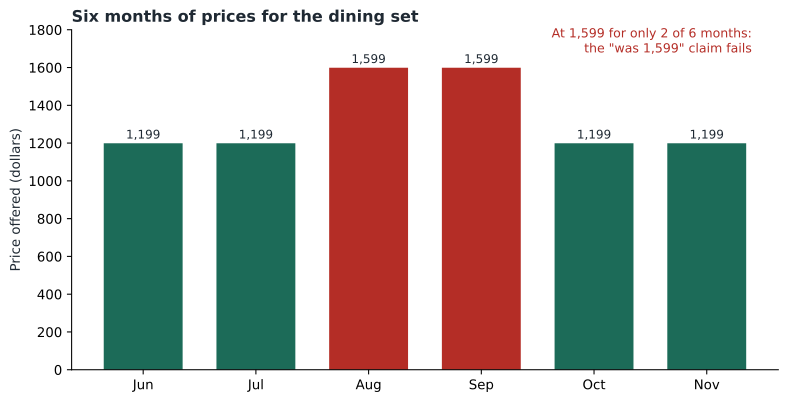
Over the past six months, Juniper & Pine offered a dining set at 1,599 dollars for two months, and at 1,199 dollars on promotion for the other four. It now wants to advertise the set as "Was 1,599, now 1,199". Does the claim pass?
Show solution
- The set was offered at 1,599 for 2 of the last 6 months, which is one-third of the period.
- Under the FTC Guides, 1,599 should have been the genuine price for a reasonably substantial period; two months out of six, with the set mostly at 1,199, makes 1,199 look like the real price.
- The volume test would only help if most units had actually sold at 1,599 or more, which store records show they did not.
- The claim fails. A truthful alternative is "Now 1,199" or "Save 400 off our former price of 1,599 (offered August and September)", if that fully and accurately describes the history and does not create a false impression.
Answer: The "was" claim fails because the set spent most of the period at the lower price. Juniper & Pine dropped it and advertised "1,199" with no comparison.
Price discrimination and the Robinson-Patman Act
The Robinson-Patman Act, passed in 1936, makes it illegal for a seller to charge different prices to competing buyers for goods of like grade and quality, sold at about the same time, where the difference may harm competition. It applies to goods, not services, and mostly to sales to resellers, such as a distributor charging a large chain less than an independent store. The main defenses are that the price difference is justified by real cost differences, such as lower delivery costs for larger orders, or that the lower price was offered in good faith to meet a competitor's price. After decades of little federal enforcement, the FTC sued two beverage companies under the Act in late 2024 and early 2025. It dismissed the PepsiCo case in May 2025, and in October 2026 announced a proposed settlement with the distributor Southern Glazer's Wine and Spirits that limits significant price gaps between chain and nearby independent retailers. Private businesses can still sue under the Act. Separately, a supplier setting minimum resale prices for its dealers is judged under a rule of reason federally, but some states treat it more strictly.
For most front-line sellers, the practical rule is to follow the company's pricing and discount policies, document the reasons for special prices, and never let a competitor's pricing become a topic of conversation with that competitor.
Information exchanges and benchmarking
Not every contact with competitors is illegal. Competitors meet at industry events, sit on the same association committees, buy from each other and sometimes cooperate on standards or joint projects. The risk is exchanging competitively sensitive information, such as current or future prices, margins, bids, costs, capacity or customer lists, because that can be evidence of an agreement even if no agreement was intended. Competition authorities in both countries accept benchmarking surveys that are run by an independent third party, use historical rather than current data, and report results in aggregated form that does not reveal any one company's figures. Ridgeline's policy is to take part in industry surveys only after Leah has checked how they are run.
Discounts that you can explain
Within the company's own pricing, sellers usually have room to negotiate, and different customers will pay different prices. The safeguard is documentation. Every discount above the standard price should have a business reason recorded in the CRM, such as a volume commitment, a multi-year term, a competitive price the customer showed in writing or a strategic reason approved by a manager. Documented reasons protect the company if a customer later complains about unfair treatment, help managers see whether discounting is out of control, and keep sellers honest with themselves about why they are cutting the price.
Price changes and price protection
Sellers also need to handle price changes honestly. When a supplier announces an increase, it is legitimate to tell customers so they can order before it takes effect, as long as the increase and its date are real. Inventing or exaggerating an increase to create urgency is a false representation. Price protection clauses, which promise a customer a refund of the difference if the seller's price drops within a set period, must be honored as written, and the conditions must be explained clearly at the time of sale.
Price claims in proposals need the same care. A line such as "Special pricing: 20 percent off list" implies that customers normally pay list price. If almost every customer receives a similar discount, the claim gives a false impression of a special deal, and the honest wording is simply the price being offered.
Common mistakes
MistakeA friendly chat with a competitor about pricing is harmless if nothing is signed.
InsteadAn informal understanding can be an illegal agreement. Refuse, leave and report.
MistakeMandatory fees can be added at checkout as long as they are disclosed.
InsteadMandatory charges, other than taxes and similar government charges, should be included in the advertised price.
MistakeAny price we have ever charged can be used as a "was" price.
InsteadA reference price must reflect a genuine regular price for a substantial period or volume.
MistakeSplitting tenders with a competitor saves both companies money.
InsteadBid-rigging is a serious crime in both countries.
MistakeIf a customer mentions a competitor's price, I should call the competitor to check it.
InsteadUse what customers tell you, but never confirm prices with a competitor.
Summary and key terms
- Price-fixing, bid-rigging and market allocation are per se illegal under section 1 of the Sherman Act, with fines up to 100 million dollars for companies and prison for individuals.
- Agreements need not be formal; refuse any suggestion of coordination, leave and report it immediately.
- Drip pricing is deceptive under the FTC Act; the 2025 fees rule requires all-in prices for tickets and lodging, and some states require all-in pricing more broadly.
- "Was" prices must reflect a genuine former price offered for a reasonably substantial period.
- The Robinson-Patman Act limits price discrimination between competing resellers, with cost and meeting-competition defenses.
- Per se illegal
- Illegal without any need to prove harm or consider justifications.
- Bid-rigging
- An agreement among bidders about who will bid or what they will bid.
- Drip pricing
- Advertising a price that cannot be attained because mandatory fees are added later.
- Price discrimination
- Charging competing buyers different prices for goods of like grade and quality.
Practice problems
Work each problem on paper first, then reveal the answer to check.
What should Maya have done if the competitor had kept pushing at the trade show?
Show answer
Said clearly that Ridgeline would not discuss bids or pricing, left the conversation and reported it the same day.
A sofa is advertised at 899 with a mandatory 120 dollar delivery fee and tax extra. What should the advertised price be?
Show answer
1,019 dollars plus applicable taxes.
Why are identical bids from different suppliers a warning sign?
Show answer
They can suggest that the bidders coordinated their prices.
Lesson quiz · 5 questions
Score 60% or more to complete this lesson.
Create a free account to save your progress, take quizzes and earn a certificate.