
SLS-150 · Lesson 5 of 12 · 18 min
Deceptive claims and the FTC Act
▶ Video coming soon A video version of this lesson is on the way.
Ridgeline's marketing team wanted a headline for the RoomFlow booking software. Their draft read: "RoomFlow cuts double bookings by 95 percent." The number came from a single customer, Halverson Law, whose meeting room double bookings had dropped from twenty a month to one after it switched. Rob Kowalski, Ridgeline's vice-president of sales, liked the line. Grace Liu, the sales operations analyst who keeps the customer data, did not. She pulled the numbers for all six customers that had used RoomFlow for at least three months and sent them to Rob with one sentence: "If we say 95, we need to be able to show 95 to anyone who asks."
Sellers make claims constantly: in conversations, proposals, emails, social media posts, product demonstrations and the marketing materials they hand to buyers. Every one of those claims is subject to advertising law, which bans false or misleading representations to the public. This lesson explains how your country's law judges claims, what evidence a seller needs before making certain kinds of claims, and how to talk about competitors, the environment and customer reviews without crossing the line.
Section 5 of the FTC Act
In the United States, false advertising is governed mainly by section 5 of the Federal Trade Commission Act, which bans unfair or deceptive acts or practices, and section 12, which deals specifically with false advertisements for food, drugs, devices and cosmetics. The FTC's 1983 Policy Statement on Deception sets out the test. A claim is deceptive if it is likely to mislead a consumer acting reasonably in the circumstances, and if it is material, meaning likely to affect the consumer's choice. The FTC can investigate, issue cease-and-desist orders, seek refunds for consumers in some cases and, when a company violates an FTC rule or an existing order, obtain civil penalties of more than 53,000 dollars per violation, adjusted for inflation each year. Competitors can also sue each other under section 43(a) of the Lanham Act for false or misleading statements about their own or a competitor's products, and state attorneys general enforce state laws against deceptive practices.
How a claim is judged
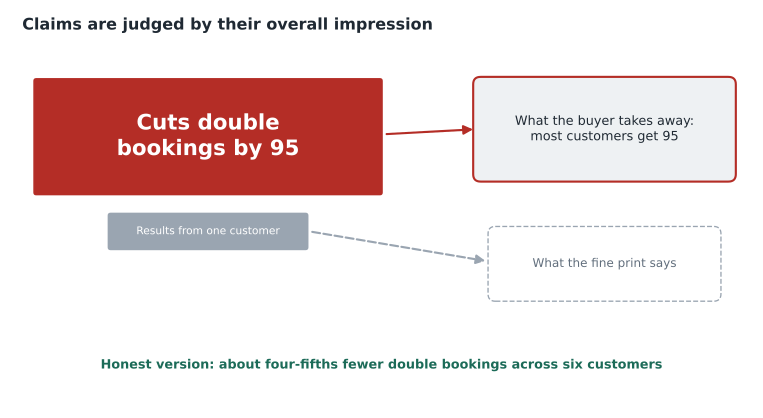
Two ideas decide most cases. First, the net impression test: the FTC looks at the overall message a claim conveys to reasonable consumers, including what it implies, not only its literal words. A headline that says "cuts double bookings by 95 percent" conveys that customers generally get that result, even if fine print says "results from one customer". Second, the standard is a reasonable member of the audience the claim is aimed at. If a claim targets a particular group, such as older consumers or small business owners, the FTC asks how a reasonable member of that group would understand it. Fine print and disclaimers cannot cure a misleading headline; a qualification has to be clear, prominent and close to the claim it qualifies.
Performance claims need evidence first
The FTC's substantiation doctrine says that advertisers must have a reasonable basis for objective claims before they make them. What counts as a reasonable basis depends on the claim, the product and what experts in the field would consider adequate. A claim that specifically says "tests show" or "studies prove" must be backed by exactly that level of evidence. A claim that a printer prints 45 pages a minute needs testing under realistic conditions, and a claim that software saves users two hours a week needs data from real users that supports that figure. A seller cannot make the claim first and look for evidence later.
Worked problem
Turning customer data into an honest claim
Grace's data for the six RoomFlow customers showed the following total double bookings per month, before and after switching: Halverson Law 20 before, 1 after; Northfield Family Clinic 6 before, 2 after; Keystone Grain Equipment 9 before, 2 after; and three smaller offices with 13 before and 4 after combined. What claim can the data support?
Show solution
- Total before: 20 plus 6 plus 9 plus 13, which is 48 double bookings a month.
- Total after: 1 plus 2 plus 2 plus 4, which is 9 a month.
- Reduction: 48 minus 9 is 39. Divided by 48, that is about 0.81, or about four-fifths.
- Halverson's result: 19 out of 20, or 95 in 100, is the best result, not the typical one.
- Six customers over three months is a small sample, so the claim should say so.
Answer: A supportable claim is: "Across our first six RoomFlow customers, double bookings fell by about four-fifths in the first three months." The 95 figure can only be used as a clearly labeled single customer story, not as a general promise.
Rob agreed to the revised wording. He also asked Grace to set up a simple substantiation file: a folder in the shared drive holding the data, the date it was collected and who approved each claim used in marketing and proposals. Leah Marchand, the contracts manager, now checks new claims against that file before they go into proposal templates.
What sellers say counts too
Advertising law is not only about printed ads and websites. Statements a seller makes to buyers, product demonstrations, proposals and posts on social media can all be representations to the public. When Maya tells a school division that RoomFlow "eliminates double bookings", she is making a performance claim. If it is not true, the risk is the same as if it were printed on a billboard, and so is the damage to trust. The safe habit is to repeat the approved, substantiated claim, not a stronger version of it: "Our first six customers saw double bookings fall by about four-fifths. I can show you how we measured it."
Talking about competitors
Comparative claims are allowed in both countries if they are true and not misleading. A seller can say that Ridgeline's managed print plan includes toner and a competitor's does not, if that is accurate and current. Problems arise when comparisons are selective, out of date or simply invented. A claim such as "their machines break down twice as often as ours" needs reliable evidence comparing like with like. Disparaging a competitor with false statements can expose the seller and company to claims from the competitor as well as regulators.
| Safer | Riskier |
|---|---|
| "Our plan includes toner and service visits; theirs charges toner separately, according to their current price list." | "They'll nickel-and-dime you on everything." |
| "We have a technician based in the city; I can show you our response-time data." | "Their service is terrible." |
| "Here's a side-by-side of the published specifications." | "Their machines break down twice as often." (with no data) |
| "I don't know their current pricing, but I can tell you ours." | Guessing at a competitor's price to make yours look better |
Environmental claims
The FTC's Guides for the Use of Environmental Marketing Claims, known as the Green Guides, explain how the FTC applies section 5 to environmental claims. They advise against broad, unqualified claims such as "eco-friendly" or "green", which are very hard to substantiate, and require that claims such as "recyclable" or "compostable" be qualified if recycling or composting facilities are not available to a substantial majority of consumers where the product is sold. The FTC began reviewing the Guides in 2022, so details may change, but the basic principle that green claims must be specific and supported has not.
At Juniper & Pine, a mattress supplier's display card described one model as "eco-friendly and non-toxic". Bev asked the supplier for the evidence behind it. The supplier sent a certificate for low chemical emissions from the foam, which supports a narrower claim about emissions. The card was replaced with one that named the certification and what it tested.
Reviews, testimonials and endorsements
Testimonials and reviews are covered by the FTC's Guides Concerning the Use of Endorsements and Testimonials in Advertising, updated in 2023, and by the Rule on the Use of Consumer Reviews and Testimonials, which took effect on October 21, 2024. The Rule bans fake reviews, including reviews by people who did not use the product or that misrepresent the reviewer's experience, reviews by company insiders without disclosure, buying positive or negative reviews, and suppressing negative reviews through threats or false claims. Because it is a rule, violations can bring civil penalties. If Juniper & Pine offers customers a draw entry for leaving a review, the incentive must not depend on the review being positive, and the connection should be disclosed.
Building a substantiation file
Grace's substantiation file turned an informal habit into a system. Each claim the company uses in marketing, proposals or sales scripts has an entry. The entry records the exact wording approved, the evidence behind it, when the evidence was collected, who approved the claim and when it must be reviewed. Claims based on customer results are reviewed every six months, because results change as more customers join.
| Field | Example for the RoomFlow claim |
|---|---|
| Approved wording | "Across our first six RoomFlow customers, double bookings fell by about four-fifths in the first three months." |
| Evidence | Booking logs for six customers, three months before and after, pulled by sales operations |
| Date collected | October 2026 |
| Approved by | Rob Kowalski and Leah Marchand |
| Limits | Small sample; not a guarantee; customers used different room setups |
| Review date | April 2027, or sooner if the result changes |
The file also protects sellers. When a buyer asks "Where does that number come from?", Maya can answer with confidence, and if a competitor or regulator ever questions a claim, the company can show that it had the evidence before making it.
Demonstrations, social media and employee posts
Claims are not only made in words. A product demonstration that uses a specially tuned machine, a carefully chosen file or ideal network conditions can create a misleading impression of how the product performs in normal use. The honest approach is to demonstrate under realistic conditions, or to say what is different: "This demo unit has the extra memory upgrade; the standard model is a little slower on large scans."
Social media posts by sellers are representations too. When Maya posted on a professional network about Northfield's new managed print setup, she checked two things first: that the clinic had agreed to be mentioned, and that every number in the post came from the substantiation file. Employees who post about their own company's products should also make the connection clear. A post praising RoomFlow from someone whose profile does not show that they work for Ridgeline can mislead readers into thinking it is an independent opinion, which is exactly the kind of undisclosed connection that advertising rules in both countries target.
Finally, sellers should be careful with claims they did not make but repeat. If a supplier's brochure says a mattress is "recommended by chiropractors", a Juniper & Pine associate who repeats it is making the claim too. Bev's rule is to repeat only claims the store has checked, and to ask the supplier for evidence of the rest.
Checking a claim before you use it
Before repeating any claim to a buyer, a seller can run four quick checks. Is it in the approved wording, or a stronger version of it? Is there evidence on file, and is it current? Does the overall impression match the evidence, including any limits? And would the claim still be fair if the buyer's situation is different from the customers it is based on? If the answer to any of these is uncertain, the safer course is to describe what happened for specific customers and offer to show the data, rather than to promise a result.
The same discipline applies to numbers that sound modest. "Saves about an hour a week" is a performance claim just as much as "cuts costs in half", and it needs the same evidence. Small claims are repeated more often, so an unsupported small claim can mislead more buyers than a bold one.
Common mistakes
MistakeIf the fine print explains it, the headline can say anything.
InsteadClaims are judged by their overall impression; qualifications must be clear and close to the claim.
MistakeI can make the claim now and gather proof if anyone asks.
InsteadEvidence must exist before a performance claim is made.
MistakeSpoken claims in a meeting are not advertising.
InsteadWhat sellers say, show and post can all be representations to the public.
MistakeComparing ourselves with a competitor is always risky.
InsteadTruthful, current, like-for-like comparisons are allowed; invented or selective ones are not.
Mistake"Eco-friendly" is just a marketing word.
InsteadEnvironmental claims must be specific and supported.
Summary and key terms
- Section 5 of the FTC Act bans deceptive claims; the Lanham Act and state laws add competitor and state enforcement.
- Claims are judged by their net impression on a reasonable member of the target audience.
- Objective claims need a reasonable basis before they are made; "tests show" claims need those tests.
- Sellers should repeat approved, substantiated claims, not stronger versions of them.
- Comparative, environmental and review-based claims follow the same rules, with particular attention to evidence and disclosure.
- Net impression
- The overall meaning a claim conveys to reasonable consumers, including what it implies.
- Substantiation
- A reasonable basis, established before a claim is made, showing the claim is true.
- Materiality
- Whether a claim is likely to affect a consumer's decision.
- Substantiation file
- A record of the evidence and approvals behind each claim a company uses.
Practice problems
Work each problem on paper first, then reveal the answer to check.
Why was "cuts double bookings by 95 percent" misleading even though one customer achieved it?
Show answer
The overall impression is that customers generally get that result, but the typical result across customers was about four-fifths.
What should a seller say instead of "RoomFlow eliminates double bookings"?
Show answer
The approved claim: double bookings fell by about four-fifths across the first six customers, with an offer to show how it was measured.
Give one example of a safer comparative claim.
Show answer
A side-by-side of published specifications, or a factual, current comparison of what is included in each plan.
Lesson quiz · 5 questions
Score 60% or more to complete this lesson.
Create a free account to save your progress, take quizzes and earn a certificate.