
SLS-211 · Lesson 3 of 12 · 16 min
Questioning models: SPIN and its successors
▶ Video coming soon A video version of this lesson is on the way.
After the first discovery lab, Darnell gave Maya a second chance with Keystone Grain Equipment. Linda Sorensen agreed to a forty-minute call on Tuesday, September 22, 2026, and persuaded Dale Petrie to join for the second half. Maya had one evening to prepare. Darnell handed her a dog-eared copy of Neil Rackham's *SPIN Selling* and said, "Read chapters 4 to 6. Then write me eight questions, two of each kind."
SLS-120 taught the basic types of question: open, closed and probing. This lesson is about questioning models, structured ways of deciding which questions to ask and in what order, so that a discovery conversation moves from facts to problems to consequences to value. The best known is SPIN, and most later models are variations on it, reactions to it or extensions of it.
Where SPIN came from
Neil Rackham was a British researcher whose consultancy, Huthwaite, studied what successful salespeople actually did on calls. With his colleagues, he observed about 35,000 sales calls in more than 20 countries over about 12 years, working with large companies such as Xerox and IBM. The findings were published for a general audience in *SPIN Selling* in 1988.
Rackham's most important finding was that the techniques that worked in small, quick sales did not work in large, complex ones. In small sales, conventional advice, such as pushing for the close and handling objections smoothly, often helped. In large sales, with long cycles, several decision makers and a big price, those same techniques were often associated with fewer successful calls. What distinguished successful sellers in large sales was the kind of questions they asked.
The four types of SPIN question
| Type | Purpose | Keystone example |
|---|---|---|
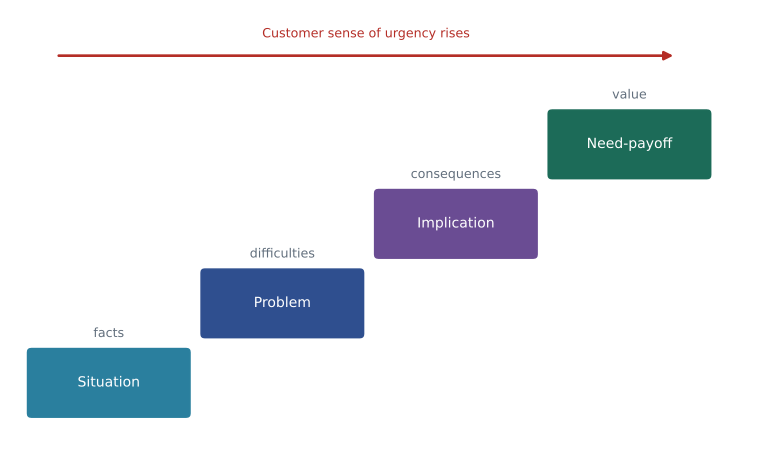
| Situation | Gather facts about the customer's current situation | "How many meeting rooms do you have, and how are they booked today?" |
| Problem | Uncover difficulties, dissatisfactions or problems | "Have you had rooms double booked or unavailable when you needed them?" |
| Implication | Explore the consequences and effects of a problem | "What happened with the dealers when the boardroom wasn't available?" |
| Need-payoff | Get the customer to state the value of solving the problem | "If every dealer visit had a confirmed room, what would that be worth to you?" |
The sequence is not a script. Rackham described it as the natural order in which successful calls tended to unfold: enough situation questions to understand the context, problem questions to find a difficulty, implication questions to make the difficulty larger and clearer in the customer's mind, and need-payoff questions to have the customer describe the value of a solution in their own words.
What the research found about each type
Rackham's team reported several findings that changed how sales trainers thought about questions. Each is worth knowing, along with its practical lesson.
| Finding | Practical lesson |
|---|---|
| Successful sellers asked fewer situation questions than less successful ones | Do your research; ask only the situation questions you need |
| Problem questions mattered more in small sales than in large ones | Finding a problem is necessary but not enough in a big sale |
| Implication questions were the strongest marker of success in large sales | Spend time on consequences before talking about solutions |
| Need-payoff questions were linked to calls that ended in an advance | Let the customer state the value; it is more convincing than the seller saying it |
| Customers stating explicit needs mattered more than implied needs | Help the customer move from "it's a bit annoying" to "we need to fix this" |
Two terms from that table need explaining. An implied need is a statement of a problem or dissatisfaction: "The booking system is a bit of a mess." An explicit need is a clear statement of a want or desire: "We need a way to guarantee a room for dealer visits." Rackham found that in large sales, successful sellers did not jump on implied needs with a solution. They asked implication questions until the customer expressed an explicit need, because a customer who has said "we need this" is far more likely to act than one who has said "it's a bit annoying."
Maya's SPIN questions for Keystone
Maya wrote her eight questions and Darnell marked them up. His main comment was that her first drafts of implication questions were really problem questions with different wording. An implication question asks about the effects of a problem on something else the customer cares about: money, time, customers, staff, reputation, risk.
| Type | Maya's first draft | After Darnell's comments |
|---|---|---|
| Situation | "How many rooms do you have?" | Dropped: the website floor plan showed four. Replaced with "Who books rooms for dealer visits?" |
| Problem | "Is booking a problem?" | "How often does a room clash happen, roughly?" |
| Implication | "Is the double booking a problem?" | "When a dealer visit lands in the lunchroom, what does that do to how dealers see Keystone?" |
| Implication | "Does it waste time?" | "How much time does Linda's team spend sorting out clashes and rebooking?" |
| Need-payoff | "Would RoomFlow help?" | "If clashes stopped, what would that mean for the dealer program?" |
The revised need-payoff question does not mention RoomFlow. Need-payoff questions ask about the value of solving the problem, not about the seller's product. "Would our product help?" invites a guarded yes or no. "What would it mean if this stopped happening?" invites the customer to describe the value in their own words.
How the Keystone call went
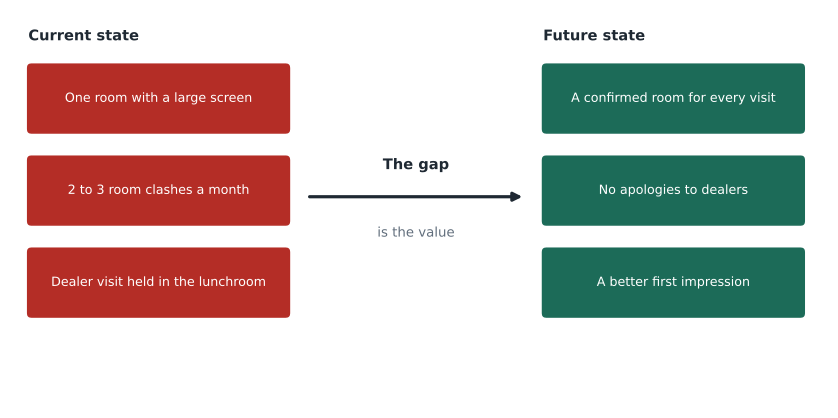
Linda described the September dealer visit in detail. Maya asked how often clashes happened, and Linda estimated two or three a month, mostly involving the boardroom, which was the only room with a large screen. Dale joined halfway through. When Maya asked what the lunchroom episode did to how dealers saw Keystone, Dale was quiet for a moment and then said that Keystone was trying to persuade its largest dealer group to carry a new line of grain dryers, and that being disorganized in front of them was "exactly the wrong look." That single implication question turned a scheduling annoyance into a revenue issue. Maya then asked her need-payoff question, and Dale answered it himself: "It would mean I'd stop apologizing."
Evidence and limits
SPIN is one of the few sales methods based on systematic observation of real calls, which is why it has lasted. But its evidence has limits that a careful seller should know.
| Limit | Why it matters |
|---|---|
| The research was conducted by Rackham's own consultancy, which sold SPIN training | Independent replication is limited, so treat the exact findings as strong indications, not laws |
| Most calls were observed in the 1970s and early 1980s, face to face, at large firms | Buyers now research online first, and many calls are by video |
| Success was often measured by whether a call ended in an advance | An advance is not the same as a closed, profitable sale |
| Categorizing a question as problem or implication involves judgment | Different observers could classify the same question differently |
None of these limits means SPIN is wrong. They mean it is best used as a guide to the balance and direction of questions, not as a rigid sequence or a formula. Rackham himself warned against treating the model mechanically.
Later models
Since SPIN, many trainers and writers have proposed questioning models. Most share SPIN's core idea, that sellers should understand the problem and its consequences before proposing solutions, and differ in emphasis.
| Model | Origin | Core idea | How it relates to SPIN |
|---|---|---|---|
| Pain funnel | Sandler Training, founded by David Sandler in 1967 | A sequence of increasingly personal questions that move from the surface problem to its cost and the customer's feelings about it | Similar to problem and implication questions, with more emphasis on emotion |
| Conceptual Selling question types | Robert Miller and Stephen Heiman, *Conceptual Selling*, 1987 | Confirmation, new information, attitude, commitment and basic issue questions | Adds questions about the customer's attitudes and commitment |
| Gap selling | Jim Keenan, *Gap Selling*, 2018 | Map the customer's current state and desired future state; the gap between them is what the customer buys | Puts implications and need-payoffs into a before-and-after picture |
| Insight-led questions | Brent Adamson and Matthew Dixon, *The Challenger Sale*, 2011, and others | Questions that challenge the customer's assumptions and introduce new perspectives | Adds teaching to questioning; covered in lesson 8 |
Gap selling is a useful companion to SPIN because it gives the conversation a shape the customer can see. Keenan's idea is that every purchase is a move from a current state, the customer's situation today with its problems and their effects, to a future state, where those problems are solved and the customer has gained something. The value of the purchase is the size of the gap. A seller who can describe both states in the customer's own words has done the essential work of discovery.
What conversation data suggests
Several conversation-analytics companies publish findings from recorded sales calls, such as how many questions successful sellers ask and how much of the call they spend talking. These figures can be useful prompts, but they come from vendors' own customer data, their definitions of success vary, and they are rarely published in a form that can be checked independently. Treat them as interesting patterns, not research results. The consistent message across vendors, and across SPIN, is that good discovery calls are conversations in which the customer talks most of the time, the seller's questions follow from what the customer just said, and the seller does not fire a long list of questions in a row.
That last point matters. A questioning model is a way of planning and checking a conversation, not a questionnaire to read aloud. Maya kept her eight questions on her planner, used five of them, and asked several others that came from what Linda and Dale told her. Darnell considered that a success.
Practicing the balance of questions
Darnell used a simple drill to build the habit. Each seller took a recent call and sorted every question they had asked into the four SPIN types. Then they wrote down how many of each they had asked and compared that with what the call needed. Most new sellers found that more than half of their questions were situation questions, and that they had asked one or two implication questions at most, usually by accident. Maya's first Keystone meeting had four questions in total, three of them situation questions. Her second call had nineteen: five situation, six problem, six implication and two need-payoff.
The drill is not about reaching a magic ratio. In a short sale with an obvious need, a few situation and problem questions may be all that is needed. In a large sale, the drill reliably shows the same gap: sellers find problems and then stop, instead of exploring what those problems affect. Writing out three implication questions before every important call, each linked to a different consequence such as money, customers or staff, is the simplest fix Darnell knew.
One caution applies to every model. Customers recognize obviously scripted questions, and a question asked only because a model says so sounds hollow. The best implication questions come from genuine curiosity about the customer's business. A model tells the seller which kind of question is missing; it cannot supply the interest that makes the question sound real.
Common mistakes
MistakeTreating SPIN as a fixed script to be read in order.
InsteadUse it as a guide to the balance of questions, and follow the customer's answers.
MistakeWriting implication questions that are really problem questions.
InsteadAsk about effects on money, time, customers, staff, reputation or risk.
MistakeAsking need-payoff questions about your product.
InsteadAsk about the value of solving the problem; let the customer describe it.
MistakeJumping on an implied need with a solution.
InsteadAsk implication questions until the customer states an explicit need.
MistakeQuoting vendor call statistics as established fact.
InsteadTreat conversation-analytics figures as patterns from vendor data, not independent research.
Summary and key terms
- Questioning models help a seller choose and order questions so that discovery moves from facts to problems, consequences and value.
- SPIN, from Neil Rackham's observation of about 35,000 calls over 12 years, published in 1988, uses situation, problem, implication and need-payoff questions.
- Successful sellers in large sales asked fewer situation questions and more implication and need-payoff questions, and helped customers move from implied needs to explicit needs.
- The research has limits: it came from Rackham's own consultancy, it is decades old and success was often measured by advances.
- Later models include Sandler's pain funnel, Miller and Heiman's question types, Keenan's gap selling, which maps a current state against a future state, and insight-led questioning.
- Vendor call data is suggestive but not independent research.
- SPIN
- A questioning model of situation, problem, implication and need-payoff questions, from Neil Rackham's research.
- Implication question
- A question that explores the consequences of a problem for something else the customer cares about.
- Need-payoff question
- A question that asks the customer to describe the value of solving a problem.
- Implied need
- A customer's statement of a problem or dissatisfaction.
- Explicit need
- A customer's clear statement of a want or a need to act.
- Current state and future state
- In gap selling, the customer's situation today and the situation they want; the gap between them is the value.
Practice problems
Work each problem on paper first, then reveal the answer to check.
Classify: "How much rework does a misprinted insurance form cause?"
Show answer
An implication question: it asks about a consequence of the problem.
Rewrite "Would our booking system help?" as a need-payoff question.
Show answer
For example: "If room clashes stopped, what would that mean for your dealer visits?"
Give one limit of the SPIN research.
Show answer
Any of: conducted by Rackham's own consultancy; decades old and mostly face to face; success often measured by advances; classifying questions involves judgment.
Lesson quiz · 5 questions
Score 60% or more to complete this lesson.
Create a free account to save your progress, take quizzes and earn a certificate.