
SLS-211 · Lesson 5 of 12 · 26 min
Quantifying impact
▶ Video coming soon A video version of this lesson is on the way.
On Thursday, October 15, 2026, Maya spent an hour at Eastgate Physiotherapy with Carla Bennett. She looked at the three printers, photographed their page counters and the jam logs on their display screens, and asked the front-desk team to show her what happened on a Monday morning. By the end of the visit she had something the call had not given her: numbers.
At the discovery lab the following Wednesday, Darnell asked her what the jams cost Eastgate. Maya said, "A lot." Darnell said that "a lot" would not get past the clinic's two owners, who would decide on anything over 5,000 dollars. "They are physiotherapists running a business. Give them a number, show them how you got it, and let Carla check it." This lesson is about that number.
Why quantify
Quantifying impact means estimating, in numbers the customer accepts, what a problem costs them or puts at risk. In SPIN terms, it is the arithmetic behind implication questions. It matters for three reasons.
| Reason | What it does |
|---|---|
| It makes the problem real to people who did not feel it | Carla felt every jam; the owners had heard about them only occasionally |
| It gives the customer a basis for comparing options | A price only means something next to the cost of doing nothing |
| It creates urgency honestly | If a problem costs a known amount every month, delay has a cost too |
| It tests whether there is a deal | If the problem costs less than any solution, the honest advice may be to leave it alone |
The last point deserves emphasis. Quantifying impact is not a persuasion trick. Sometimes the numbers show that the problem is too small to justify spending money on it. A seller who says so keeps the customer's trust and saves themselves weeks of chasing a deal that will never close.
Hard and soft impacts
Impacts come in two broad kinds. Hard impacts can be measured in money with reasonable confidence: staff time, overtime, service fees, wasted materials, lost revenue that can be traced. Soft impacts are real but harder to price: frustration, reputation, risk, staff morale, customer experience. Both matter. A good discovery separates them, prices the hard ones carefully, and describes the soft ones honestly without inventing dollar figures for them.
| Impact at Eastgate | Kind | How to measure |
|---|---|---|
| Staff time clearing jams | Hard | Jams per week × minutes per jam × staff cost per hour |
| Overtime for printing at home on Sunday nights | Hard | Hours claimed × overtime rate |
| Service call-out fees on the current lease | Hard | Invoices from the past 12 months |
| Patients waiting at the desk on Monday mornings | Soft | Describe it; ask Carla how often it happens |
| Front-desk frustration and turnover risk | Soft | Describe it; note that one staff member had mentioned leaving |
| Privacy risk of printing patient programs at home | Soft, but serious | Describe it; ask how the owners view it |
The privacy point came up almost by accident. When the front-desk team explained that they printed Monday's exercise programs at home on Sunday nights, Maya asked, carefully, whether the programs included patients' names. They did. Under HIPAA and South Dakota law, a clinic is responsible for protecting patient information wherever it is handled. Maya did not give legal advice; she simply asked Carla whether the owners knew. Carla said she would raise it with them. A soft impact can be the most important one.
Building the estimate
Maya used data from the visit and a few figures from Carla to build her estimate. Darnell's rules were: use the customer's numbers wherever possible, show every step, round conservatively, and let the customer check the result.
Worked problem
The staff cost of printer jams
The jam logs and the front desk agree that the three printers jam about 4 times a week each. Clearing a jam, reprinting and calming the queue takes about 15 minutes. Carla says front-desk staff cost the clinic about 32 dollars an hour including benefits. The clinic is open about 50 weeks a year. What do the jams cost in staff time each year?
Show solution
- Jams per week: 3 printers × 4 jams = 12 jams.
- Jams per year: 12 × 50 weeks = 600 jams.
- Time per jam: 15 minutes = 0.25 hours.
- Staff cost per jam: 0.25 × 32 = 8 dollars.
- Annual cost: 600 × 8 = 4,800 dollars.
Answer: The jams cost about 4,800 dollars a year in staff time. Carla checked the inputs and agreed they were fair, if anything slightly low.
Worked problem
The cost of Sunday-night printing
Two front-desk staff each claim about half an hour of overtime most Sundays to print Monday's programs at home. Their base rate is 24 dollars an hour and overtime is paid at one and a half times. How much does this cost over 50 weeks?
Show solution
- Overtime hours per week: 2 staff × 0.5 hours = 1 hour.
- Overtime rate: 24 × 1.5 = 36 dollars an hour.
- Cost per week: 1 × 36 = 36 dollars.
- Annual cost: 36 × 50 = 1,800 dollars.
Answer: Sunday-night printing costs about 1,800 dollars a year, on top of the privacy risk.
Maya then put the hard costs together with what Eastgate already paid for its printers. Carla had found the old lease invoices: lease payments, service call-outs and toner came to about 7,500 dollars a year.
| Cost per year | Today | Notes |
|---|---|---|
| Lease, service and toner | 7,500 | From Carla's invoices |
| Staff time clearing jams | 4,800 | Worked example above |
| Sunday overtime | 1,800 | Worked example above |
| Total measurable cost | 14,100 | Soft impacts not included |
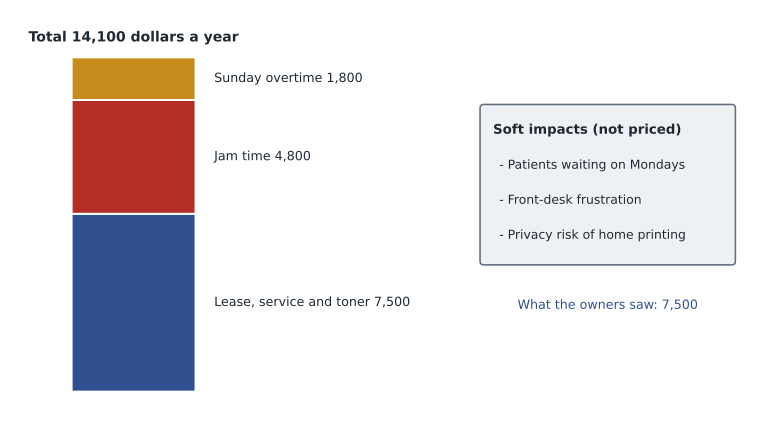
The table made Darnell's point for him. The owners thought printing cost 7,500 dollars a year, because that was what they paid the leasing company. The measurable cost was nearly twice that. Ridgeline's eventual proposal, discussed in later courses, would come to 14,400 dollars over three years, or 4,800 dollars a year. Maya was careful not to claim it would eliminate every jam or every hour of overtime; she planned to show what a realistic improvement would be, once the right machines were sized to the clinic's volume.
The cost of waiting
A quantified problem also shows the cost of delay: what the customer loses for each month the problem continues. It is the honest version of urgency. Instead of inventing a deadline or a special offer, the seller points out what the status quo costs.
Worked problem
Cost of delay at Eastgate
Excluding the lease payments that would be replaced, the staff-time costs total 4,800 + 1,800 = 6,600 dollars a year. How much do they cost per month of delay?
Show solution
- Monthly cost: 6,600 ÷ 12 = 550 dollars.
- If a decision slips from the owners' December meeting to their February meeting, that is about two months: 2 × 550 = 1,100 dollars.
Answer: Each month of delay costs about 550 dollars in staff time, plus the soft costs. Maya used this figure only once, plainly, and did not repeat it as pressure.
Quantifying impact in a larger sale
The same method works for bigger and less tidy problems, but the estimates become less certain and the seller should say so. At Keystone Grain Equipment, part of the impact was simple: Linda's team spent time resolving room clashes. Part was much harder: the risk that a disorganized dealer visit would weaken Keystone's pitch for its new grain dryer line.
Worked problem
Keystone: the measurable part
Room clashes happen about 2 or 3 times a month; use 2.5. Each takes about 1.5 hours of staff time to resolve, at about 40 dollars an hour. What is the yearly cost?
Show solution
- Clashes per year: 2.5 × 12 = 30.
- Hours per year: 30 × 1.5 = 45 hours.
- Cost per year: 45 × 40 = 1,800 dollars.
Answer: About 1,800 dollars a year: real, but on its own not enough to justify a large purchase.
For the revenue risk, Maya did not invent a number. She asked Dale how much business the dealer group might bring from the new line, and he said, "If they carry it, several hundred thousand a year." She then asked him how much a poor first impression might affect their decision, and he said he could not put a number on it but that he would not take the risk. That was enough. The soft impact, described in Dale's own words, mattered more than the measurable one. A seller who had multiplied the dealer revenue by an invented probability would have produced a figure Dale did not trust.
Rules for honest numbers
Impact numbers are powerful, which makes them easy to misuse. A seller who inflates them may win one deal and lose the customer's trust for good, and an exaggerated claim of savings in a proposal can amount to a misleading representation under the FTC Act and state consumer protection law. Darnell's team used the following rules.
| Rule | Why |
|---|---|
| Use the customer's own data and estimates where possible | They trust their own numbers and can check them |
| Show every step of the arithmetic | Hidden assumptions look like tricks |
| Round down, not up, when unsure | A conservative number survives scrutiny |
| Give ranges when inputs are uncertain | "Between 3,600 and 6,000 dollars" is more honest than a precise guess |
| Keep hard and soft impacts separate | Mixing invented values with measured ones undermines both |
| Ask the customer to confirm the result | A number they agree with becomes their number |
Worked problem
Giving a range
Carla was not sure whether jams took 10 or 20 minutes each; 15 was her best guess. What range should Maya show for the annual jam cost?
Show solution
- Low: 600 jams × (10 ÷ 60) hours × 32 = 600 × 5.33 = about 3,200 dollars.
- High: 600 × (20 ÷ 60) × 32 = 600 × 10.67 = about 6,400 dollars.
- Best estimate: 4,800 dollars, as calculated earlier.
Answer: Show "about 3,200 to 6,400 dollars a year, most likely around 4,800." The range is wide, but even the low end is significant.
Who should own the numbers
Darnell insisted that the final numbers belong to the customer, not to Ridgeline. In practice that meant three things. Maya built the estimate in front of Carla, or sent it to her as a draft with the inputs clearly labeled, so Carla could change any input she disagreed with. Maya used Carla's words in the labels: "jam time (Carla's estimate, 15 minutes per jam)" rather than "lost productivity". And when Carla changed a number, Maya used the changed number without arguing, even when it made the case smaller.
Ownership matters because the person who will defend the number inside the customer's organization is the customer, not the seller. When the owners asked Carla where the 4,800 dollars came from, she could explain it herself, because she had worked it out. A number the seller produced and the customer merely accepted is far more fragile: the first time someone questions it, the customer has no answer and the seller's credibility suffers with it.
Sellers sometimes worry that letting the customer control the numbers will make the case weaker. Occasionally it does. But a smaller number the customer believes is worth far more than a larger one they doubt, and the discipline protects the seller from the temptation to round up.
There is one more benefit. Once the customer has agreed the cost of the problem, later conversations about price change character. The question is no longer whether 4,800 dollars a year is expensive, but whether it is a reasonable price for removing a problem the clinic itself values at more than that.
Common mistakes
MistakeSaying a problem costs 'a lot' without a number.
InsteadEstimate the cost with the customer's data and show the steps.
MistakePutting invented dollar values on soft impacts.
InsteadDescribe soft impacts in the customer's words and keep them separate from hard costs.
MistakeInflating estimates to make a solution look better.
InsteadRound conservatively, give ranges and ask the customer to confirm the result.
MistakeUsing the cost of delay as repeated pressure.
InsteadState it once, plainly, as information for the customer's decision.
MistakeIgnoring a result that shows the problem is small.
InsteadSay so honestly; it saves time and builds trust.
Summary and key terms
- Quantifying impact means estimating, in numbers the customer accepts, what a problem costs or risks.
- It makes problems real to decision makers who did not feel them, gives a basis for comparing options, creates honest urgency and tests whether there is a deal at all.
- Hard impacts, such as staff time, overtime and fees, can be priced; soft impacts, such as reputation, morale and privacy risk, should be described in the customer's words.
- Build estimates from the customer's data, show every step, round conservatively, give ranges when unsure and ask the customer to confirm.
- The cost of delay is the monthly cost of leaving the problem alone.
- At Eastgate, the measurable cost of printing was about 14,100 dollars a year, nearly twice what the owners thought.
- Quantifying impact
- Estimating, in numbers the customer accepts, what a problem costs or puts at risk.
- Hard impact
- A consequence that can be measured in money with reasonable confidence.
- Soft impact
- A real consequence that is hard to price, such as reputation, morale or risk.
- Cost of delay
- What the customer loses for each period a problem remains unsolved.
- Conservative estimate
- An estimate that rounds down when inputs are uncertain, so it survives scrutiny.
Practice problems
Work each problem on paper first, then reveal the answer to check.
A printer jams 5 times a week, each jam takes 12 minutes, and staff cost 30 dollars an hour. What is the cost over 48 weeks?
Show answer
5 × 48 = 240 jams; 12 minutes = 0.2 hours; 240 × 0.2 × 30 = 1,440 dollars.
Name one hard and one soft impact of slow customer support.
Show answer
Hard: staff time or refunds; soft: customer frustration or reputation.
A problem costs 9,600 dollars a year. What is the cost of a three-month delay?
Show answer
9,600 ÷ 12 × 3 = 2,400 dollars.
Lesson quiz · 5 questions
Score 60% or more to complete this lesson.
Create a free account to save your progress, take quizzes and earn a certificate.