
SLS-211 · Lesson 9 of 12 · 20 min
Solution selling
▶ Video coming soon A video version of this lesson is on the way.
By the second week of November 2026, Maya understood Northfield Family Clinic's real problem. The ten clinicians had nowhere private to finish their charting between patients, so most of them stayed after closing to catch up, and two physicians had complained to Dr. Ravi Anand, the managing physician. The clinic was taking over the unit next door, and the expansion was the chance to fix it. Janet Morrow, the office manager, had first asked for six desks. Now she was asking Maya a different question: "What should we actually do with the space?"
That question is the point at which discovery turns into designing a solution. This lesson covers solution selling: building, with the customer, a combination of products, services and changes that solves the problem the discovery uncovered, and presenting it so the customer can see how it fits. SLS-212 covers formal presentations and proposals. This lesson is about the thinking that comes first.
Where solution selling came from
The term is most closely associated with Mike Bosworth, who developed a sales training approach in the 1980s drawing on his experience at Xerox, and published *Solution Selling: Creating Buyers in Difficult Selling Markets* in 1995. Keith Eades, who worked with Bosworth, extended it in *The New Solution Selling* (2003). The approach emphasized that buyers do not buy products, they buy answers to problems, and that the seller's job is to help the buyer build a vision of how the problem could be solved, a vision the buyer feels is their own.
Bosworth's method included structured question sequences to help buyers discover the reasons for their pain and picture a solution, and it stressed reaching the person with power over the decision. Many of its ideas are now so standard that they are taught as general good practice, which is a sign of its influence. The word "solution" has since been so overused in marketing, where every product is described as a solution, that it can sound empty. The test is whether the offer is designed around a specific customer's diagnosed problem, not whether the brochure uses the word.
What a real solution includes
A product is something the seller supplies. A solution is the full set of changes that will solve the customer's problem, which may include products, services, process changes the customer makes, and things the seller does not supply at all.
| Part of the solution | What it covers | Northfield example |
|---|---|---|
| Products | Equipment, furniture, software | Semi-enclosed charting stations, privacy screen filters |
| Services | Design, delivery, installation, training, support | Space planning, weekend installation, a short setup session |
| Customer changes | Processes or habits the customer adjusts | Clinicians book a charting slot between patients; front desk adjusts schedules |
| Things others supply | Work outside the seller's offering | Electrical outlets installed by the landlord's contractor |
| Measures of success | How both sides will know it worked | Fewer hours of after-closing charting, measured before and after |
Including customer changes and outside work in the solution, even when Ridgeline earns nothing from them, matters because a solution that depends on them will fail if they are forgotten. A consultative seller is responsible for the whole picture working, not just for delivering their own part.
Building the solution with the customer
Solution selling works best when the customer helps design the answer. Customers are far more committed to a plan they helped shape. On November 10, Maya and Janet held a fifteen-minute call with Dr. Anand, followed by an hour in the empty unit with a tape measure and a floor plan. Maya asked questions that let them design it together.
| Question | What it helped decide |
|---|---|
| "How many clinicians are usually in the clinic at the same time?" | The number of stations: schedules showed at most eight at once, so ten stations were not needed |
| "Where do clinicians go between patients now?" | Location: close to the exam rooms, not in the new unit's far corner |
| "What do they need at a station: screen, phone, privacy?" | Specification: semi-enclosed, with privacy filters, no phone |
| "Are there calls that need a closed door?" | A small bookable room for phone consultations |
| "How would you know in March that this had worked?" | The success measure: hours of after-closing charting |
| "What would worry you about the change?" | Concern: installation disrupting patient days; answered with weekend installation |
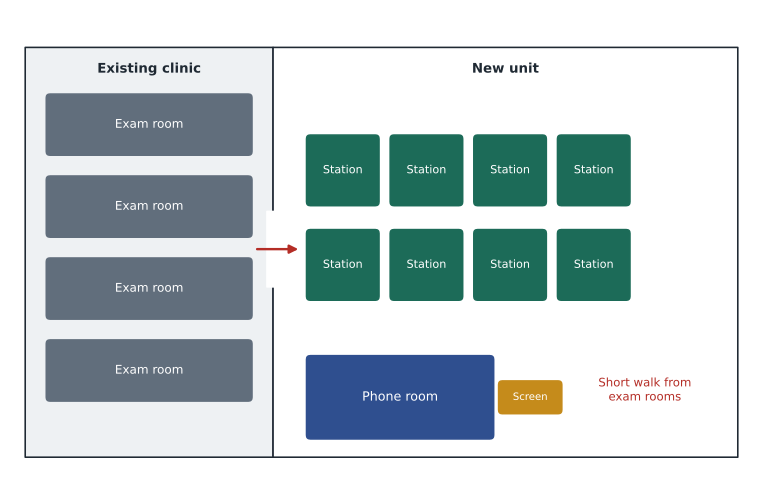
Offering options
Customers usually appreciate a small number of clear options. Options let them choose the level of investment, and the act of choosing between options moves the conversation from "whether" to "which". Too many options, though, slow decisions. SLS-110 discussed research on choice overload and its mixed replication; the safe practice is two or three options and a clear recommendation.
| Option A: Desks as requested | Option B: Charting stations | Option C: Stations and phone room (recommended) | |
|---|---|---|---|
| What it includes | Six open-plan desks and chairs | Eight semi-enclosed stations with privacy filters | Option B plus a small bookable phone-consultation room |
| One-time cost | 8,100 dollars | 15,680 dollars | 18,080 dollars |
| Monthly cost | None | None | 30 dollars for one more room on RoomFlow |
| Solves private charting | No: screens visible in an open area | Yes | Yes |
| Solves private phone calls | No | No | Yes |
| Risks | Clinicians still stay late | Calls still taken in exam rooms | Clinicians must use bookings |
Worked problem
Pricing the options
Desks cost 1,350 dollars each including chair. Charting stations cost 1,900 dollars each, and privacy filters 60 dollars each. Furnishing the phone room costs 2,400 dollars. What is the one-time cost of each option?
Show solution
- Option A: 6 × 1,350 = 8,100 dollars.
- Option B stations: 8 × 1,900 = 15,200 dollars; filters: 8 × 60 = 480 dollars; total 15,200 + 480 = 15,680 dollars.
- Option C: 15,680 + 2,400 = 18,080 dollars.
Answer: Option A costs 8,100, Option B 15,680 and Option C 18,080 dollars before tax. All three are over Janet's 5,000-dollar limit, so Dr. Anand will decide.
Including Option A, Janet's original request, was deliberate. It showed that Maya had listened, and it let the clinic see clearly why the cheaper option would not solve the problem. Maya was careful not to make Option A artificially unattractive; it was a real option, priced fairly, and its weakness was simply that it did not meet the need they had agreed on.
Connecting the solution to value
The solution should be presented in terms of the problem it solves and the value the customer described in discovery, not as a list of features. Lesson 5 showed how to quantify impact. For Northfield, most of the value was in clinicians' time and in keeping them, which is harder to price, so Maya stated it in hours and let the clinic judge the worth.
Worked problem
Estimating the time recovered
Janet estimates that the ten clinicians each stay about 45 minutes after closing on about 4 days a week to finish charts. Dr. Anand thinks private stations near the exam rooms could cut that by about two-thirds. How many hours a week of after-closing charting might the solution recover?
Show solution
- After-closing charting now: 10 clinicians × 0.75 hours × 4 days = 30 hours a week.
- Expected reduction: 30 × 2 ÷ 3 = 20 hours a week.
- Remaining after-closing charting: 30 − 20 = 10 hours a week.
Answer: The solution could give the clinicians back about 20 hours a week. The estimate is the clinic's own, and Maya proposed measuring it before and after installation rather than promising it.
Dr. Anand's reaction was the most useful moment of the meeting. "If I keep one physician who would otherwise leave," he said, "that pays for all of it many times over." That was the value, in his words, and it was far more persuasive than anything Maya could have said about the stations.
Recommending, not just presenting
Having prepared options, a consultative seller should say which one they recommend and why. Customers facing a significant decision often find a clear recommendation reassuring. Dixon and McKenna's *The JOLT Effect* argued that sellers who give a firm recommendation, limit further exploration and reduce the risk of the decision help indecisive buyers more than sellers who present every option neutrally.
Maya recommended Option C. Her reasoning was short: it was the only option that solved both problems the clinic had described, its extra cost over Option B was 2,400 dollars plus 30 dollars a month, and it could be installed over a weekend in January so that no patient day was disrupted. She also offered a way to reduce risk: if the clinic preferred, it could start with Option B and add the phone room later, at the same price, once it saw how the stations were used.
Phasing and fit
Large solutions are often easier to approve in phases. A phased plan lowers the first decision's cost and risk, and lets the customer see results before committing further. It also fits the customer's decision process: Dr. Anand could approve the stations at the clinic's January budget meeting and decide on the phone room in the spring.
| Check | Question | Northfield |
|---|---|---|
| Problem fit | Does every part trace back to a problem confirmed in discovery? | Yes: stations for charting, room for private calls |
| Criteria fit | Does it meet the decision criteria and their weights? | Privacy first, then cost and no disruption |
| Process fit | Can it be approved through the real decision process on time? | January budget meeting; installation weekend in January |
| Stakeholder fit | Does it address each stakeholder's main concern? | Dr. Anand: retention; Janet: no disruption; clinicians: privacy |
| Delivery fit | Can Ridgeline and others deliver it as promised? | Stations in stock by late January; landlord's electrician booked |
The last check catches a common failure. A solution that wins the customer's approval but cannot be delivered on time, because a part is back-ordered or a contractor is unavailable, turns a successful sale into a damaged relationship. Maya confirmed stock and installation dates with Ridgeline's operations team before sending anything to Janet.
When the best solution is not yours
Sometimes the honest design includes something the seller cannot supply, or shows that a competitor's product would fit better. In the Northfield design, the clinic also needed better soundproofing on one wall of the phone room, which Ridgeline did not do. Maya recommended the landlord's contractor and included the work in the plan, with its timing, so the clinic would not discover the gap after installation.
Occasionally the best answer is not to buy at all, or to buy far less. A consultative seller who says so loses a sale in the short term. Over a career, that habit is one of the strongest builders of trust and referrals a seller has. Darnell's view was that customers remember the seller who told them not to spend money long after they have forgotten the ones who sold them something they did not need.
The same principle applies to timing. If the clinic's budget for the year was spent, the right recommendation might be to install the stations in the new year rather than to stretch for a December order that would strain the clinic's cash. Fitting the customer's financial reality is part of fitting the solution.
Common mistakes
MistakeCalling a product bundle a solution without diagnosing the problem.
InsteadDesign the offer around the specific problem confirmed in discovery.
MistakeLeaving out work the seller does not supply.
InsteadInclude customer changes and outside work, because the solution fails without them.
MistakeDesigning the solution alone and presenting it as finished.
InsteadBuild it with the customer through questions about needs, constraints and success.
MistakeOffering many options with no recommendation.
InsteadOffer two or three clear options and say which one you recommend and why.
MistakePromising results the customer has not estimated.
InsteadUse the customer's own estimates and propose measuring before and after.
Summary and key terms
- Solution selling, associated with Mike Bosworth's 1995 book and Keith Eades's later work, holds that buyers buy answers to problems and that sellers should help buyers build their own vision of a solution.
- A real solution includes products, services, changes the customer makes, work others supply and measures of success.
- Build it with the customer through questions about needs, constraints, concerns and how success will be judged.
- Offer two or three clear options, including the customer's original request if it is a fair option, and give a clear recommendation with reasons.
- Connect the solution to the value the customer described, using their own estimates.
- Phasing can lower risk and fit the decision process.
- Before presenting, check problem, criteria, process, stakeholder and delivery fit.
- Solution selling
- An approach in which the seller helps the buyer design and picture a solution to a diagnosed problem.
- Solution
- The full set of products, services and changes that will solve the customer's problem.
- Vision
- In solution selling, the buyer's own picture of how their problem could be solved.
- Option set
- Two or three alternative solutions at different levels of scope and cost.
- Phasing
- Delivering a solution in stages so each decision is smaller and results can be seen first.
- Delivery fit
- Confirmation that the seller and others can deliver the solution as promised and on time.
Practice problems
Work each problem on paper first, then reveal the answer to check.
Stations cost 2,100 dollars each and filters 75 dollars each. What do 6 stations with filters cost?
Show answer
6 × 2,100 = 12,600; 6 × 75 = 450; total 13,050 dollars.
Twelve staff each spend 30 minutes after hours on 5 days a week. If a change cuts that by half, how many hours a week are recovered?
Show answer
12 × 0.5 × 5 = 30 hours; half is 15 hours a week.
Why include the customer's original request as one of the options?
Show answer
It shows you listened and lets the customer see fairly why it does or does not solve the agreed problem.
Lesson quiz · 5 questions
Score 60% or more to complete this lesson.
Create a free account to save your progress, take quizzes and earn a certificate.