
SLS-211 · Lesson 8 of 12 · 18 min
Insight selling: teaching the customer something
▶ Video coming soon A video version of this lesson is on the way.
When Priya Nandakumar first described Westgate & Rowe's meeting-room problem, she had already decided on the answer. The firm's two rooms were booked solid, the partners complained they could never find one, and she wanted to convert a storage room into a third meeting room. She asked Maya whether Ridgeline could furnish it and put a screen on the wall.
Maya had learned in lesson 4 to ask what was behind a request. But Darnell, at the discovery lab on November 4, 2026, pushed her further. "Questions find what the customer knows. Sometimes the most useful thing you can do is tell them something they don't know." Ridgeline had data from dozens of RoomFlow customers about how meeting rooms are actually used, and one pattern appeared almost everywhere: rooms that looked fully booked were, a good part of the time, empty. This lesson is about using knowledge like that to help the customer see their own situation differently.
What insight selling means
Insight selling is an approach in which the seller brings the customer a new, relevant and well-supported idea about their own business: a problem they had not noticed, a cause they had misjudged, an opportunity they had missed or a cost they had underestimated. The insight changes how the customer thinks about the decision, and the seller's solution follows from the new view.
The idea is not new; good consultants have always done it. It became prominent in sales training through two books. Matthew Dixon and Brent Adamson's *The Challenger Sale* (2011) reported research by the Corporate Executive Board (CEB) that grouped sales representatives into five profiles and argued that one of them, the "Challenger", was over-represented among top performers in complex sales. Mike Schultz and John Doerr's *Insight Selling* (2014), from the RAIN Group, described how sellers who brought new ideas and educated buyers won more often in their surveys of buyers.
The Challenger research and its limits
| Profile | Description in The Challenger Sale |
|---|---|
| Hard Worker | Puts in extra effort and persists |
| Relationship Builder | Builds strong personal relationships and advocates for the customer |
| Lone Wolf | Follows their own instincts; hard to manage |
| Reactive Problem Solver | Reliable, detail-focused, makes sure problems are fixed |
| Challenger | Teaches the customer, tailors the message and takes control of the sale |
The book reported that the study covered several thousand sales representatives across many companies, and that Challengers made up a much larger share of star performers in complex sales than any other profile, while Relationship Builders were the profile least often found among stars. Its practical advice was summed up in three verbs: teach the customer something valuable, tailor the message to each stakeholder, and take control of the conversation, including discussing money and pushing back politely.
The findings have been widely adopted and widely questioned. A careful seller should know both sides.
| Criticism | Why it matters |
|---|---|
| The data came from managers' ratings of their own reps, gathered by a firm selling advice | Ratings and definitions of "star" may reflect what managers already believed |
| The study showed association, not cause | Challenger behavior may be common among stars because experienced stars feel confident enough to challenge |
| Detailed data and methods were not published for independent review | Others cannot check or reproduce the analysis |
| "Take control" is easily misread as aggressiveness | Pushing customers around damages trust; the authors meant constructive tension, not pressure |
| Relationship skills still matter | Teaching only works if the customer trusts the teacher |
The fair conclusion is that the core advice is sensible and consistent with SPIN and other models: understand the customer's business deeply enough to offer a useful perspective, and be willing to challenge assumptions respectfully. The specific statistics should be treated as one firm's findings, not established fact.
What makes a good insight
Not every interesting fact is an insight. Darnell gave his team a four-part test, adapted from the books above.
| Test | Question to ask | Westgate & Rowe example |
|---|---|---|
| New | Does the customer not already know this? | Priya believed the rooms were full; she did not know how many bookings went unused |
| Relevant | Does it bear on a decision the customer is making? | It affects whether the firm needs a third room at all |
| Supported | Can I show evidence, preferably their own? | Ridgeline's RoomFlow customer data, then a two-week count of the firm's own rooms |
| Leads somewhere | Does it point to a better action? | Release unused bookings automatically instead of building a new room |
The order matters as well. An insight should lead to the customer's problem and the better action before it leads to the seller's product. If the "insight" is really a disguised product pitch, customers notice quickly.
Structuring an insight conversation
*The Challenger Sale* described a sequence for presenting an insight, which it called the commercial teaching choreography. Darnell simplified it into five steps for his team.
| Step | What the seller does | Maya with Priya |
|---|---|---|
| 1. Show you understand | Describe the customer's situation and challenges as they see them | "Partners can't find a room, and you're thinking of adding one." |
| 2. Reframe | Introduce the new perspective | "In firms like yours, a booked room is often an empty room." |
| 3. Support | Give the evidence calmly | RoomFlow customer data on unused bookings, then an offer to measure Westgate & Rowe's own rooms |
| 4. Connect to impact | Show what the new view means for them | "If a quarter of bookings go unused, you may already have most of a third room." |
| 5. Point to a better way | Describe the better approach before the product | Check-in at the door, with unused bookings released after ten minutes |
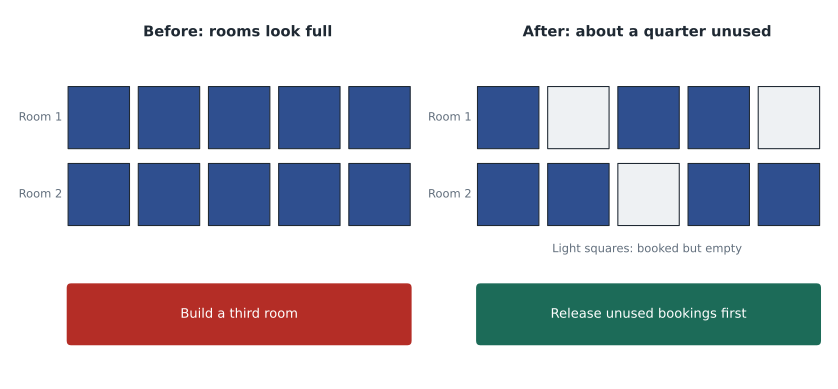
The numbers behind the insight
Maya did not want to rely on other customers' data alone, so she suggested a simple two-week test: Priya would note, three times a day, whether each booked room actually had people in it. The results were close to Ridgeline's pattern.
Worked problem
How much of a "full" room is actually used?
Westgate & Rowe has 2 meeting rooms available 9 hours a day, 5 days a week. In the test, rooms were booked for about 90 in 100 of available hours, and about 1 in 4 booked hours turned out to be empty. What share of available hours was actually used?
Show solution
- Available room-hours per week: 2 rooms × 9 hours × 5 days = 90 room-hours.
- Booked: 90 × 0.90 = 81 room-hours.
- Unused bookings: 81 × 0.25 = 20.25 room-hours.
- Actually used: 81 − 20.25 = 60.75 room-hours.
- Share used: 60.75 ÷ 90 = 0.675, or about 68 in 100.
Answer: The rooms looked 90 in 100 full but were used only about 68 in 100 of the time. About 20 room-hours a week, more than two full days of one room, were booked and empty.
Priya's first reaction was disbelief, then laughter. She knew exactly which recurring Monday meeting had been canceled months earlier but never removed from the calendar. The insight did not make the firm's problem go away; it changed what the firm should do first. Converting the storage room would have cost the firm well over 10,000 dollars in renovation and furniture. Releasing unused bookings would recover most of the missing capacity for a fraction of that, and the firm could decide on a third room later with real data.
Note what this did to Ridgeline's sale. The original request, a furnished third room, would have been a larger furniture order. Maya's recommendation, RoomFlow with check-in on all four bookable spaces, the two meeting rooms and two small phone rooms, plus new furniture for the existing rooms rather than a new one, was smaller up front. But it solved the problem, it made Maya the person Priya trusted on the subject, and it opened the conversation about the firm's printers and its planned office refresh. Darnell's view was that losing a furniture order and winning an account was a good trade.
Tailoring the insight to each stakeholder
The same insight lands differently with different people. Lesson 6 showed that each stakeholder has different interests; *The Challenger Sale* called adjusting the message for each one tailoring. Maya prepared three versions for Westgate & Rowe.
| Stakeholder | What they care about | How Maya framed the insight |
|---|---|---|
| Priya, operations manager | Smooth operations, fewer complaints | "You can fix most of the room complaints before tax season without construction." |
| Managing partner | Cost, partners' time, no disruption | "Recovering about 20 room-hours a week costs far less than building a room, with nothing torn down during tax season." |
| Partners who book rooms | Getting a room when they need one | "If a booking isn't used in ten minutes, the room is freed for you." |
Challenging without being disrespectful
Teaching a customer something about their own business is delicate. Done badly, it sounds arrogant: an outsider telling an expert they are wrong. Several habits keep it respectful.
| Habit | Example |
|---|---|
| Ask permission | "Could I share something we see a lot with other firms?" |
| Attribute the pattern to evidence, not to the seller's cleverness | "Across our RoomFlow customers, about a quarter of bookings go unused." |
| Invite the customer to test it | "Would it be worth checking your own rooms for two weeks?" |
| Acknowledge what the customer knows better | "You know your partners far better than I do, so tell me if this doesn't fit." |
| Accept when the insight does not apply | If the rooms really are full, say so and move on |
"Taking control", in the Challenger sense, means being willing to guide the conversation and to discuss difficult topics such as cost and risk. It does not mean pressure, arguing or refusing to listen. A seller who challenges a customer's assumption with evidence and then listens to the response is consulting. A seller who insists they know best is not.
Honesty and evidence
An insight is a claim about the customer's business, and the same rules apply as for impact numbers in lesson 5. It must be true, it must be supported, and the seller must be honest about its limits. Ridgeline's RoomFlow data came from its own customers, who were not a random sample of all businesses, and Maya said so. Overstating a pattern to win a sale, or presenting marketing material as research, is not only poor practice; misleading claims about what a product will achieve can breach the FTC Act and state consumer protection laws. The safest insight is one the customer has confirmed with their own data.
Where insights come from
Sellers often assume insights must come from expensive research. Most come from the seller's own experience, multiplied across customers. A seller who has watched twenty clinics replace their printers knows things no single clinic knows: which volumes break which machines, what staff actually do when a printer jams, how long a lease really takes to end. The job is to notice those patterns, check them against data where possible, and keep a short list of the ones that keep proving true.
Ridgeline kept such a list in a shared document that Darnell called the pattern file. Each entry recorded the pattern, the evidence behind it, how many customers it had been seen at, and any exceptions. The unused-bookings pattern had been seen at most RoomFlow customers, with two exceptions: a law firm and a hospital unit whose rooms really were full. Knowing the exceptions made Maya more credible, because she could tell Priya when the insight would not apply.
Common mistakes
MistakePresenting a disguised product pitch as an insight.
InsteadLead with the customer's problem and the better action before the product.
MistakeQuoting the Challenger statistics as established fact.
InsteadTreat them as one firm's findings and know the criticisms.
MistakeTelling an expert customer they are wrong.
InsteadAsk permission, show evidence, invite them to test it and acknowledge what they know better.
MistakeReading 'take control' as pushing the customer around.
InsteadGuide the conversation and discuss hard topics, while listening and respecting the customer.
MistakeUsing an insight that is interesting but irrelevant.
InsteadCheck that it bears on a decision the customer is making and points to a better action.
Summary and key terms
- Insight selling brings the customer a new, relevant, supported idea about their own business that changes how they view the decision.
- It was popularized by Dixon and Adamson's The Challenger Sale (2011), which described five seller profiles and advised teaching, tailoring and taking control, and by Schultz and Doerr's Insight Selling (2014).
- The Challenger research has been criticized for relying on managers' ratings, showing association rather than cause and not publishing its methods, so treat its statistics cautiously.
- A good insight is new, relevant, supported and leads to a better action.
- Present it in five steps: show understanding, reframe, support, connect to impact and point to a better way.
- Tailor it to each stakeholder, challenge respectfully and keep claims honest.
- At Westgate & Rowe, rooms that looked 90 in 100 booked were used about 68 in 100 of the time.
- Insight selling
- Bringing the customer a new, relevant, supported idea about their business that changes how they see the decision.
- Challenger
- In Dixon and Adamson's research, a seller profile that teaches, tailors and takes control.
- Reframe
- Presenting a new perspective that changes how the customer sees their problem.
- Tailoring
- Adjusting how an insight is presented to fit each stakeholder's interests.
- Commercial teaching
- A structured way of presenting an insight that leads to the seller's strengths, described in The Challenger Sale.
Practice problems
Work each problem on paper first, then reveal the answer to check.
Three rooms are available 8 hours a day for 5 days. They are booked 85 in 100 of the time, and 1 in 5 booked hours is empty. What share of available hours is used?
Show answer
120 room-hours; booked 102; unused 20.4; used 81.6; 81.6 ÷ 120 = 0.68, or 68 in 100.
Give the four tests of a good insight.
Show answer
New, relevant, supported and leads somewhere better.
Why should a seller say that their own customer data is not a random sample?
Show answer
Because honesty about the evidence's limits keeps trust and avoids misleading claims.
Lesson quiz · 5 questions
Score 60% or more to complete this lesson.
Create a free account to save your progress, take quizzes and earn a certificate.