
SLS-211 · Lesson 7 of 12 · 20 min
Decision criteria and the decision process
▶ Video coming soon A video version of this lesson is on the way.
On Wednesday, October 28, 2026, Maya spent an hour with Priya Nandakumar, the operations manager at Westgate & Rowe, a professional firm of about thirty people in an older building downtown. The firm's printer lease ended on March 31, 2027, and its two meeting rooms were constantly double booked. Priya was friendly, well organized and clearly interested. At the end of the call Maya realized she had learned a great deal about the firm's problems and almost nothing about how it would decide what to do about them.
Darnell's reaction at the next lab was blunt. "You know why they want to buy. You don't know how they buy. That's how deals die in December." This lesson is about the second half of discovery: learning the decision criteria, the standards the customer will use to judge options, and the decision process, the steps, people and dates through which the decision will actually be made.
Decision criteria
Decision criteria are the factors the buying group will use to compare options and choose one. Some are written down, as in a formal request for proposals. Many are not. A seller who knows the criteria can shape a proposal around them, and can sometimes help the customer think about criteria they had not considered.
| Kind of criterion | Example | How to learn it |
|---|---|---|
| Stated and formal | Prairie Valley's published scoring: price, service, technical fit, references | Read the RFP and its evaluation section |
| Stated but informal | Priya: "It has to be simple for the partners to book rooms." | Ask: "What will matter most when you compare options?" |
| Unstated | Westgate & Rowe's managing partner dislikes long contracts | Ask: "Is there anything that would rule an option out?" |
| Personal | Priya wants the move-in to go smoothly because she organized it | Listen, and ask what a good outcome looks like for her |
| Hidden constraint | The building's landlord must approve any wall-mounted screens | Ask about approvals outside the firm, such as landlords, head office or regulators |
Criteria also have weights: some matter much more than others. A customer may list ten requirements and care deeply about two of them. Asking the customer to rank or weight their criteria is one of the most useful things a seller can do, because it tells both sides where to focus. Maya's follow-up question to Priya, by email, was: "Of the things you mentioned, which two would the partners care about most?" Priya replied within the hour: ease of booking and no disruption during tax season, which for the firm ran from February to April.
Helping to shape criteria, fairly
Sellers sometimes try to influence a customer's criteria so that they favor the seller's product. Done honestly, this is part of consulting: if Ridgeline has learned that response time for repairs matters more to schools than print speed, saying so helps the customer. Done dishonestly, by steering criteria toward features only one supplier has without a real reason, it damages trust and, in public procurement, can be improper. The test is simple: would the customer still agree the criterion is important if a competitor met it better?
The decision process
The decision process is how a decision actually gets made: the steps, the order, who is involved at each step, what each step needs and when it happens. Many deals that look certain stall here, because the seller did not know about a step: a budget meeting, a legal review, a landlord's approval, a security assessment, an owners' meeting held only quarterly.
| Question | Why it matters |
|---|---|
| "Once you have chosen an option, what happens next?" | Reveals steps after the choice, such as legal review and signature |
| "Who needs to sign off, and in what order?" | Reveals the approval chain |
| "When do those people meet?" | Reveals fixed dates, such as Eastgate's first-Wednesday owners' meetings |
| "Is there anyone outside the firm who needs to approve?" | Reveals landlords, head offices, boards or regulators |
| "How have similar decisions been made in the past?" | Reveals the real process, which may differ from the official one |
| "What would need to happen by when for the new system to be in place on time?" | Connects the process to the customer's deadline |
Several sales qualification frameworks include decision criteria and decision process explicitly. The best known is MEDDIC, developed at the software company PTC in the 1990s and usually credited to Dick Dunkel and Jack Napoli: metrics, economic buyer, decision criteria, decision process, identify pain and champion. Later versions add paper process (MEDDPICC) and competition. SLS-210 covers qualification frameworks; the point here is that these two letters are about learning how the customer will decide, not just why.
Building a mutual action plan
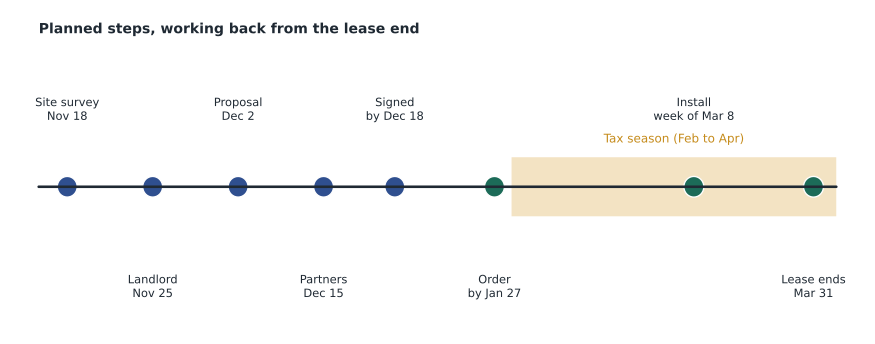
For Westgate & Rowe, Maya worked backward from the end of the printer lease with Priya on a call on November 4. The result was a mutual action plan: a shared, dated list of the steps both sides would take to reach a decision and have the solution working by the customer's deadline. Some teams call it a close plan or a joint plan.
| Date | Step | Owner |
|---|---|---|
| Nov 18, 2026 | Site survey of both meeting rooms and the printer locations | Maya, with Priya |
| Nov 25 | Landlord asked to approve wall-mounted room screens | Priya |
| Dec 2 | Proposal and pricing delivered | Maya |
| Dec 9 | Questions answered; any changes made | Maya and Priya |
| Dec 15 | Partners' meeting decides | Priya and the managing partner |
| By Dec 18 | Agreement signed | Managing partner; Darnell for Ridgeline |
| Week of Mar 8, 2027 | Delivery and installation, before the lease ends | Ridgeline service team |
| Mar 31, 2027 | Old lease ends; old printers collected | Leasing company |
A mutual action plan is mutual because the customer helps write it and owns some of the steps. That ownership is what makes it useful. A plan written only by the seller is a forecast; a plan the customer has agreed to is a commitment, and if a step slips, both sides can see it and talk about it. Priya told Maya the plan was the first time anyone had shown her the whole sequence on one page, and she forwarded it to the managing partner without being asked.
Worked problem
Working back from a deadline
Installation must finish before the lease ends on March 31. Equipment takes about 6 weeks from order to delivery, installation takes 1 week, and Ridgeline wants 2 weeks of buffer. By what date must the order be placed?
Show solution
- Total time needed: 6 + 1 + 2 = 9 weeks.
- Nine weeks before Wednesday, March 31, 2027 is 63 days earlier.
- March 31 minus 31 days is February 28; minus another 28 days is January 31; minus the remaining 4 days is January 27.
- So the order must be placed by Wednesday, January 27, 2027.
Answer: The order must be placed by about January 27, 2027. Signing by December 18 leaves a comfortable margin, which matters because the holidays and the start of tax season will slow every step.
Decisions inside formal procurement
Public bodies such as school divisions, municipalities and health authorities usually buy through formal competitive processes. In South Dakota, public bodies such as school districts follow state bidding and purchasing laws (SDCL chapter 5-18A and related statutes) and their own policies, which require competitive bids or proposals above set value thresholds. The details vary, but formal processes share features that change how discovery works.
| Feature of formal procurement | What it means for discovery |
|---|---|
| Criteria and weights are published | Read them carefully; they are the decision criteria |
| Contact is restricted once the RFP is issued | Ask questions only through the named contact; answers go to every bidder |
| A clarification process allows written questions | Use it to understand purpose, not to lobby |
| An evaluation committee scores responses | Write the response so each evaluator can find what they are scoring |
| Decisions may need board or council approval | Add those meetings to the timeline |
| Unsuccessful bidders can usually ask for a debrief | Learn from losses; ask for a debrief every time |
Most real discovery in public sales happens before the RFP is issued, through conversations, site visits and published plans. That is why Darnell had spent a year on Prairie Valley. Once the RFP was out on September 14, 2026, Ridgeline followed the rules exactly: every question went in writing to Colleen Sawatzky, the procurement officer, and nobody from Ridgeline discussed the bid with anyone else at the division until the decision on November 10.
Worked problem
How a weighted evaluation works
Suppose an evaluation gives price 40 points, service 30, technical solution 20 and references 10, and awards price points as (lowest price ÷ bidder's price) × 40. Bidder A offers 62,900 dollars a year and scores 21 for service, 15 for technical and 9 for references. Bidder B offers 66,000 dollars and scores 27, 18 and 8. These scores are illustrative. Which bidder wins?
Show solution
- Bidder A's price score: (62,900 ÷ 62,900) × 40 = 40.0.
- Bidder B's price score: (62,900 ÷ 66,000) × 40 = 0.953 × 40 = 38.1.
- Bidder A total: 40.0 + 21 + 15 + 9 = 85.0.
- Bidder B total: 38.1 + 27 + 18 + 8 = 91.1.
Answer: Bidder B wins with 91.1 points to 85.0, despite a higher price, because it scores better where most of the points are. Knowing the weights tells a seller where effort pays.
The example mirrors the shape of Prairie Valley's evaluation, where price carried 40 of 100 points, though the real scores were not published. It shows why understanding the criteria and their weights is worth more than guessing: a seller who assumed price was everything would have cut margin to the bone and still lost.
When the process is unclear
Sometimes the customer does not know how they will decide. This is common in small organizations making a first purchase of a kind, and it is a warning sign, because an undefined process often ends in no decision. The consultative response is to help: describe how similar organizations have made the decision, suggest the steps that usually matter, and offer to draft a plan. Matthew Dixon and Ted McKenna's *The JOLT Effect* argued that buyers stalled by indecision respond well to sellers who limit the options, give a clear recommendation and reduce the risk of the decision, rather than to sellers who add more choices and information.
At Eastgate, Carla had never bought equipment over 5,000 dollars. When Maya asked how the owners would decide, Carla said she was not sure. Maya described what Northfield had done, with permission: a one-page summary of the problem and cost, two options, a recommendation and a start date. Carla said that sounded right, and they agreed to aim for the owners' meeting on Wednesday, December 2, with papers due a week earlier.
A final caution: decision criteria and processes change during a sale. A new manager arrives, a budget is cut, a competitor makes an offer. Revisit both at every significant meeting by asking, simply, "Has anything changed in how this decision will be made?"
Common mistakes
MistakeLearning why the customer wants to buy but not how they will decide.
InsteadAsk about criteria, steps, approvers and dates in every discovery.
MistakeTreating every stated requirement as equally important.
InsteadAsk the customer to rank or weight their criteria.
MistakeWriting a close plan alone and calling it agreed.
InsteadBuild a mutual action plan with the customer, who owns some of the steps.
MistakeContacting other staff during a formal tender.
InsteadFollow the procurement rules exactly and use the clarification process.
MistakeLeaving an undefined decision process alone.
InsteadHelp the customer design a simple process, with a recommendation and dates.
Summary and key terms
- Discovery must cover how the customer will decide as well as why they want to buy.
- Decision criteria are the factors used to compare options; they may be formal, informal, unstated, personal or hidden constraints, and they carry different weights, so ask the customer to rank them.
- Shaping criteria is fair only if the customer would still value the criterion when a competitor meets it better.
- The decision process covers steps, approvers, dates and outside approvals; MEDDIC names both criteria and process.
- A mutual action plan is a shared, dated list of steps owned by both sides, often built backward from the customer's deadline.
- Formal public procurement publishes criteria, restricts contact, uses written clarifications and committee scoring, and may need board approval.
- When the customer has no process, help design one.
- Decision criteria
- The factors a buying group uses to compare options and choose one.
- Decision process
- The steps, people, order and dates through which a buying decision is made.
- MEDDIC
- A qualification framework: metrics, economic buyer, decision criteria, decision process, identify pain, champion.
- Mutual action plan
- A shared, dated list of steps both sides will take to reach a decision and meet the customer's deadline.
- Weighted evaluation
- A scoring method in which each criterion carries a set number of points.
- Clarification process
- The formal channel for written questions during a tender, with answers shared with all bidders.
Practice problems
Work each problem on paper first, then reveal the answer to check.
Give one question that reveals an outside approval step.
Show answer
For example: "Is there anyone outside the firm, such as a landlord or head office, who needs to approve this?"
Equipment takes 4 weeks to arrive, installation 1 week and you want 1 week of buffer. Go-live must be by June 30. When must the order be placed?
Show answer
6 weeks, or 42 days, before June 30: May 19.
Price is worth 30 points, scored as lowest price ÷ your price × 30. The lowest bid is 45,000 and yours is 50,000. What is your price score?
Show answer
45,000 ÷ 50,000 × 30 = 0.9 × 30 = 27 points.
Lesson quiz · 5 questions
Score 60% or more to complete this lesson.
Create a free account to save your progress, take quizzes and earn a certificate.