
SLS-298 · Lesson 1 of 12 · 21 min
The capstone store
▶ Video coming soon A video version of this lesson is on the way.
This course is different from every other course in the diploma. Instead of a new topic, it gives you a job. For one simulated season you run a department of a real-sized store and make the decisions a department manager makes: what to sell, how many people to schedule, how to lay out the floor, how to coach the sellers, when to run a promotion, how to protect the stock and how to look after customers once they have bought. At the end you present your results and a portfolio of your work.
How the capstone works
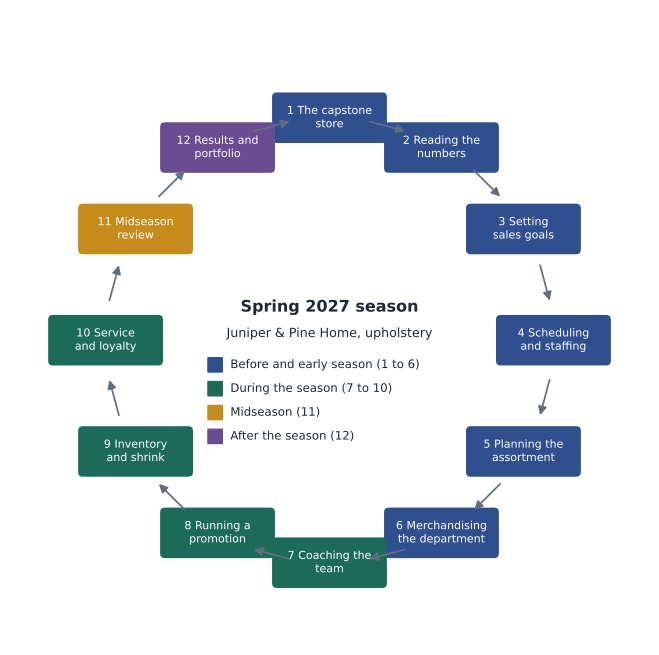
The capstone is a structured simulation. The store is Juniper & Pine Home, the furniture, mattress and appliance retailer you have followed since the first year, in Sioux Falls, South Dakota. The department is upholstery: sofas, sectionals, recliners, accent chairs and the services that go with them. The season is the spring of 2027, from Monday, February 1 to Saturday, July 31, a period of 26 weeks.
Because this course is written in November 2026, the spring 2027 season has not happened. Everything you read about it, including the traffic counts, the sales, the problems and the customer comments, is scenario data prepared for the simulation. The figures are built from the store's real history in the earlier courses, such as the 2025 department results in SLS-253 and the pay plan in SLS-230, so they behave the way a real season would. You will work through the season in order. At each stage you receive a short decision brief with the data for that stage, you produce a deliverable, and your work is scored against a published rubric.
In the story, Bev Halvorsen, the store manager, gives Aiden Laroque acting responsibility for upholstery for the season while the department's regular manager is on a planned leave. Aiden has been on the main floor since October 2026, has sold furniture, mattresses and appliances, and was coached by Carl Jensen. He now has to lead people who have sold for longer than he has. Each lesson shows Aiden's deliverable as a model answer: not the only right answer, but one that would score well, with Bev's comments. You produce your own version first, then compare.
The people
A department manager works through other people. The simulation gives Aiden a team and a set of colleagues in other parts of the store. The team members are fictional, like everyone in the course, and are described only as much as the decisions need.
| Person | Role in the simulation | What you need to know |
|---|---|---|
| Bev Halvorsen | Store manager and Aiden's coach | Approves the plans, scores each deliverable, holds a review every two weeks |
| Aiden Laroque | Acting upholstery lead | Leads the team and still sells about 20 hours a week |
| Jasmine Kaur | Full-time upholstery seller, four years at the store | Strongest at custom orders; protection-plan attachment below the floor average |
| Leon Fournier | Full-time seller, two years | High conversion, low average sale; prefers in-stock pieces |
| Mei Wong | Part-time seller, 24 hours a week | Strong with returning customers; works most Saturdays |
| Dylan Redcloud | New part-time seller from February, 20 hours a week | Needs training on custom orders and the counter checklist |
| Carl Jensen | Top commission seller in appliances and mattresses | Helps on peak Saturdays and coaches Aiden informally |
| Noura Saleh | Visual merchandising lead | Owns the reset calendar and approves floor moves |
| Marcus Dube | Operations and loss prevention lead | Receiving, counts, damage and shrink; observe-and-report rules |
| Tessa Yellowbird | E-commerce and marketing coordinator | Product pages, the website, chat, and promotion messages |
Jasmine, Leon, Mei and Dylan are paid the store's floor plan from SLS-230: a base of 13.00 dollars an hour plus 8 in 100 of the gross margin on furniture they sell. Aiden is paid the same way for his selling hours and a fixed hourly rate for his lead hours. Labor costs therefore depend on hours, margin and the minimum-wage and overtime rules in South Dakota and under federal law, which lesson 4 covers.
The department
Upholstery is the largest department at Juniper & Pine by floor space and the second largest by sales. The 2025 figures from SLS-253 are the starting point for every calculation in the season.
| Measure (2025) | Upholstery | Whole store |
|---|---|---|
| Net sales | 3,600,000 dollars | 12,400,000 dollars |
| Gross margin rate | 46 in 100 | 39.4 in 100 |
| Selling floor | 9,000 sq ft | 30,000 sq ft |
| Average inventory at cost | 780,000 dollars | about 2,660,000 dollars |
| Stock turn at cost | about 2.49 | about 2.8 |
| GMROI | about 2.12 | about 1.83 |
| Sales per selling square foot | 400 dollars | about 413 dollars |
| Shrink | 28,800 dollars (0.8 in 100) | 99,000 dollars (0.8 in 100) |
Sales in 2026 were flat at about 3.6 million dollars. The spring half of 2026, February to July, brought in 1,790,000 dollars, and the plan Bev presented to the owners in November 2026 asks for 1,850,000 dollars in spring 2027, with a gross margin of 851,000 dollars, a markdown budget of 148,000 dollars and a planned end-of-July inventory of 1,450,000 dollars at retail. Lesson 2 shows where those numbers come from.
Worked problem
How big is the spring plan?
The spring 2026 department sales were 1,790,000 dollars, and the spring 2027 plan is 1,850,000 dollars. What increase does the plan ask for, in dollars and in 100?
Show solution
- Increase in dollars:
- \[1{,}850{,}000 - 1{,}790{,}000 = 60{,}000 \text{ dollars}\]
- Increase as a rate:
- \[\frac{60{,}000}{1{,}790{,}000} \approx 0.0335\]
Answer: The plan asks for 60,000 dollars more, about 3.4 in 100 above spring 2026. That is a modest increase, but the department was flat in 2026, so it needs a reason: the new sofa price lines, the sectional color mix and the April promotion are the planned sources of growth.
The deliverables and how they are scored
Each lesson ends with one deliverable. Together they make your capstone portfolio. A deliverable is a short business document, not an essay: a one-page profile, a goal sheet, a schedule, an assortment plan, a floor plan, a coaching record, a promotion plan, a count reconciliation, a service plan, a midseason memo and a final results report. The last lesson asks you to assemble them with a reflection.
| Stage | Deliverable | Main skill from earlier courses |
|---|---|---|
| 1 | Department profile | Reading a business (SLS-101, SLS-253) |
| 2 | Numbers brief | Retail math (SLS-253) |
| 3 | Season goal sheet | Goal setting and quotas (SLS-230) |
| 4 | Four-week schedule and labor check | Staffing and employment rules (SLS-230) |
| 5 | Assortment and open-to-buy plan | Merchandise planning (SLS-253) |
| 6 | Department floor plan and display test | Visual merchandising (SLS-251) |
| 7 | Coaching record for one seller | Coaching and floor skills (SLS-230, SLS-250) |
| 8 | Promotion plan and post-event analysis | Pricing law and promotion math (SLS-150, SLS-253) |
| 9 | Count reconciliation and shrink action plan | Operations and loss prevention (SLS-252) |
| 10 | Service and loyalty plan | Customer service (SLS-130, SLS-256) |
| 11 | Midseason review memo | Analysis and forecasting (SLS-253) |
| 12 | Season results report and portfolio | Everything |
Every deliverable is scored out of 20 on a rubric with five criteria worth 4 points each. The criteria change from stage to stage, but four ideas run through all of them: the numbers are right, the decision follows from the evidence, the plan respects the law and store policy, and the document is clear enough that someone else could act on it. A portfolio total of 168 out of 240, which is 70 in 100, passes the capstone. Bev also scores a short presentation of the final results.
| Level | Points per criterion | What it looks like |
|---|---|---|
| Excellent | 4 | Correct, complete and clearly reasoned; a manager could act on it without questions |
| Good | 3 | Correct with small gaps; one or two points need explaining |
| Developing | 2 | Partly correct; a calculation error or a missing step changes the decision |
| Beginning | 1 | Mostly incorrect or incomplete; the decision does not follow from the evidence |
| Not done | 0 | Missing |
Worked problem
What does a pass require?
The portfolio has 12 deliverables, each out of 20. The pass mark is 70 in 100. Aiden scores 14 on his first deliverable. If he scores the same on every one, does he pass, and what average does he need?
Show solution
- Maximum score:
- \[12 \times 20 = 240\]
- Pass mark:
- \[240 \times 0.70 = 168\]
- Average needed per deliverable:
- \[\frac{168}{12} = 14\]
- Score at 14 every time:
- \[12 \times 14 = 168\]
Answer: An average of exactly 14 out of 20 reaches the pass mark of 168. Scoring 14 every time is a bare pass with no margin for one weak deliverable, so Bev encourages him to aim for 16.
Rules for the simulation
Three rules keep the simulation realistic. First, decisions are made with the information available at the time. When you plan the assortment in stage 5 you do not know what will sell in June; you use the sell-through from the previous season, and you live with the result. Second, the law and store policy always apply. A schedule that breaks overtime rules, a promotion that advertises a regular price that was never charged, or a loss-prevention plan that asks staff to chase people scores zero on the compliance criterion however good the numbers look. Third, show your arithmetic. Most rubrics give a point for correct numbers and a separate point for showing how you got them, because a manager has to be able to check your work.
The store's policies from the earlier courses carry over unchanged: the up system and split rules on the floor, 48-hour holds, price matching on identical models, rain checks on advertised items, the 30-day return policy, the counter checklist and read-back, the fit and access checklist on every delivery, the two-hour delivery window, and the rule that associates observe and report suspected theft and never chase, block, touch or detain anyone.
Template: the department profile
Your first deliverable is a one-page department profile: the facts a new manager needs on the first day. Use this template.
| Section | What to include |
|---|---|
| Department and season | Name, selling area, season dates and number of weeks |
| Last year in numbers | Sales, gross margin rate and dollars, inventory, turn, GMROI, sales per square foot, shrink |
| This season's plan | Sales, gross margin, markdown budget and planned ending inventory |
| The team | Names, hours and one strength and one development need for each person |
| Products and services | Main categories, price lines, special orders, delivery and protection plans |
| Three risks | What could stop the plan being met |
| Three opportunities | Where growth is most likely to come from |
Model answer: Aiden's profile
Aiden's profile fitted on one page. His risks were: the department was flat in 2026, so the 3.4 in 100 increase had to be earned; Dylan was new and would need weeks before selling custom orders confidently; and the April promotion could give away margin if the discount was too deep. His opportunities were: the new 999-dollar sofa price line could bring in first-home buyers who previously left for online retailers; the fall sell-through data showed exactly which sectional colors to buy deeper; and Jasmine's custom-order skill could be taught to Leon and Mei.
Bev scored it 17 out of 20. She gave full marks for the numbers and the team section, 3 for the risks because "the risk of a delivery or supply delay is missing, and in upholstery that is your biggest one", and 3 for clarity because the opportunities did not say how much each might be worth. "A manager's list of opportunities should have a rough number on each," she wrote. "Otherwise you cannot tell which one to spend your time on."
| Criterion | Excellent (4) | Developing (2) | Aiden |
|---|---|---|---|
| Accuracy of the figures | Every figure matches the source data | Two or more figures wrong or missing | 4 |
| Understanding of the plan | Plan and change from last year stated and explained | Plan stated without comparison | 4 |
| Team assessment | Each person has a specific strength and need | Generic comments | 3 |
| Risks and opportunities | Three of each, specific, with a rough size | Vague or incomplete lists | 3 |
| Clarity | One page, easy to act on | Long, unclear or missing sections | 3 |
Reflection
Before you start stage 2, write a short paragraph for yourself. Which earlier course do you feel least confident about, and how will you prepare before the stage that uses it? What would you do if a seller who has been at the store longer than you disagreed with one of your decisions? Keep your answers; the final lesson asks you to look back at them.
Common mistakes
MistakeTreating the simulation figures as real results from 2027.
InsteadRemember the season is a scenario built from real history; use it to practice decisions.
MistakeStarting with last year's total and ignoring the department's other measures.
InsteadRead sales together with margin, inventory, turn, GMROI and shrink.
MistakeWriting deliverables as long essays.
InsteadWrite short business documents that a manager could act on.
MistakeLeaving out the arithmetic.
InsteadShow how each number was calculated so it can be checked.
MistakeListing risks and opportunities without a size.
InsteadPut a rough dollar value or likelihood on each item.
Summary and key terms
- The capstone is a structured simulation of the spring 2027 upholstery season at Juniper & Pine, 26 weeks from February 1 to July 31.
- Each of the 12 stages has a decision brief, a deliverable, a model answer and a rubric out of 20; 168 of 240 passes.
- The department sold 3.6 million dollars in 2025 at a 46 in 100 margin on 9,000 square feet; the spring 2027 plan is 1,850,000 dollars, about 3.4 in 100 above spring 2026.
- Decisions use only the information available at the time, the law and store policy always apply, and arithmetic must be shown.
- The first deliverable is a one-page department profile.
- Structured simulation
- A realistic exercise in which scenario data is released in stages and decisions are scored.
- Decision brief
- The short package of data and instructions for one stage of the capstone.
- Model answer
- A worked example of a strong deliverable, shown after you produce your own.
- Rubric
- A scoring guide that sets out the criteria and what each level of performance looks like.
- Department profile
- A one-page summary of a department's results, plan, team, risks and opportunities.
- Capstone portfolio
- The collected deliverables and reflection that show what you can do at the end of the program.
Practice problems
Work each problem on paper first, then reveal the answer to check.
The spring 2026 sales were 1,790,000 dollars. If the plan had asked for a 5 in 100 increase instead, what would the target be?
Show answer
1,790,000 × 1.05 = 1,879,500 dollars.
A learner scores 15, 16, 13 and 18 on the first four deliverables. What is the total so far, and what average does the learner need on the remaining eight to pass?
Show answer
Total 62. The pass is 168, so 106 more are needed over 8 deliverables: 13.25 on average.
Why does a loss-prevention plan that asks staff to follow a suspected shoplifter score zero on compliance?
Show answer
Store policy, consistent with the law and safety guidance in SLS-252, is observe and report only; staff never chase, block, touch or detain.
Lesson quiz · 5 questions
Score 60% or more to complete this lesson.
Create a free account to save your progress, take quizzes and earn a certificate.