
SLS-298 · Lesson 8 of 12 · 24 min
Running a promotion
▶ Video coming soon A video version of this lesson is on the way.
The season plan includes one promotion: a spring weekend in April. The stage 8 brief, dated Monday, March 8, 2027, gives Aiden the weekend dates, Friday, April 23 to Sunday, April 25, the markdown budget used so far, a normal late-April weekend's results from 2026, the store's delivery costs, Tessa's marketing calendar and the rules on price claims and commercial messages. The deliverable has two parts: a promotion plan written before the event, and a post-event analysis written after it. The second part uses the results that arrive in the stage 11 brief, but you write the plan now, before you know them.
A promotion is one of the few levers a department can pull quickly. It is also one of the easiest ways to lose money. SLS-253 showed how a discount changes margin, and SLS-150 showed the legal limits on what a store can say about prices. This stage asks you to design a promotion that brings in extra customers, earns more margin than it gives away, and makes only claims the store can support.
What a normal weekend looks like
To judge a promotion you need a baseline: what would have happened without it. Aiden used the same weekend in 2026, adjusted to the 2027 plan.
Worked problem
The baseline weekend
The April plan is 330,000 dollars over 30 days. Friday, Saturday and Sunday together normally carry about 62 in 100 of a week's upholstery sales. What does a normal late-April weekend look like?
Show solution
- A normal April week:
- \[\frac{330{,}000}{30} \times 7 = 77{,}000 \text{ dollars}\]
- The weekend share:
- \[77{,}000 \times 0.62 \approx 47{,}740 \text{ dollars}\]
- Rounded baseline and margin at 46 in 100:
- \[48{,}000 \times 0.46 = 22{,}080 \text{ dollars of margin}\]
Answer: A normal weekend brings in about 48,000 dollars of sales and 22,080 dollars of margin from about 27 transactions. A promotion is worth running only if it does better than that, after its costs and after any sales it simply moves from the weeks around it.
Three options
Aiden and Tessa sketched three options and worked out how much extra business each would need just to break even on margin.
| Option | Offer | Applies to |
|---|---|---|
| A | 20 in 100 off all upholstery | Everything in the department |
| B | 15 in 100 off in-stock sofas and sectionals in the 1,799 and 2,799 lines | About 70 in 100 of a normal weekend's sales |
| C | Free delivery and haul-away on upholstery orders over 1,500 dollars | About 20 of 27 weekend orders; delivery and haul-away normally cost the customer 79 and 39 dollars and are charged at about cost |
Worked problem
Break-even for a percentage discount
For option A, a 20 in 100 discount on goods with a 46 in 100 margin. For option B, a 15 in 100 discount. How much must unit sales rise just to earn the same margin dollars?
Show solution
- Margin left per 100 dollars of regular price, option A:
- \[46 - 20 = 26\]
- Units needed, option A:
- \[\frac{46}{26} \approx 1.77 \Rightarrow 77 \text{ in 100 more units}\]
- Margin left per 100 dollars, option B:
- \[46 - 15 = 31\]
- Units needed, option B:
- \[\frac{46}{31} \approx 1.48 \Rightarrow 48 \text{ in 100 more units}\]
Answer: Option A needs about 77 in 100 more units sold just to stand still, and option B about 48 in 100 more on the products it covers. Both would also use the markdown budget: option B on a normal weekend's 33,600 dollars of covered sales would cost about 5,040 dollars of markdowns before any lift.
Worked problem
Break-even for free delivery
For option C, about 20 of the 27 normal weekend orders would qualify, and each free delivery and haul-away costs the store about 118 dollars. How much must weekend sales rise for margin to break even, if new orders qualify at the same rate?
Show solution
- Cost on a normal weekend:
- \[20 \times 118 = 2{,}360 \text{ dollars}\]
- Margin after the cost:
- \[22{,}080 - 2{,}360 = 19{,}720 \text{ dollars}\]
- Sales lift needed so that margin after costs is back to 22,080:
- \[\frac{22{,}080}{19{,}720} \approx 1.12 \Rightarrow 12 \text{ in 100}\]
Answer: Option C breaks even with about 12 in 100 more business, far less than either discount, because the giveaway is a fixed amount per order rather than a share of the price. It also speaks to a real worry: delivery cost is one of the reasons furniture shoppers compare online sellers, as SLS-254 showed.
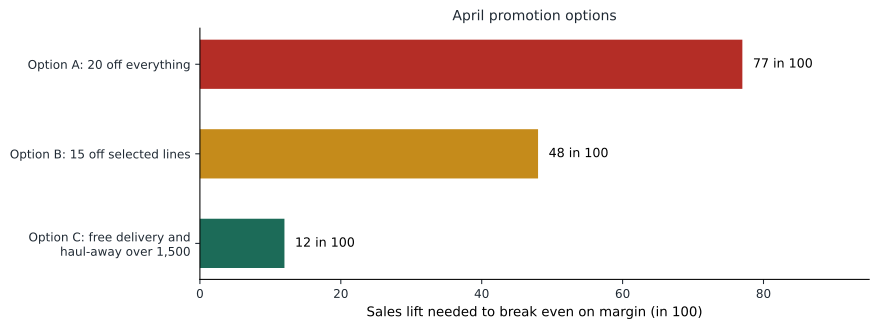
Aiden chose option C. It needed the smallest lift, did not touch the markdown budget, did not train customers to wait for a percentage sale, and fitted the store's message about reliable two-hour delivery windows. He kept one element of option B: the terracotta test sectionals, which had not reached the reorder rule, could be offered at 15 in 100 off during the weekend if fewer than four had sold by April 16, using the markdown budget that was set aside for clearing a failed test anyway.
What the store may say
Every promotion message is a set of claims, and each one has to be true and complete. Aiden checked the plan against the rules from SLS-150 and SLS-253.
| Claim or practice | Rule that applies | How the plan meets it |
|---|---|---|
| "Free delivery and haul-away" | The FTC's Guide Concerning Use of the Word "Free" requires that the regular price of the main product not be raised to cover the free item, and that conditions be stated clearly | Prices are not changed for the weekend; the conditions appear next to the offer |
| "On orders over 1,500 dollars, within our delivery zone" | Conditions must be clear and not hidden or contradicted in fine print | Minimum, delivery zone, dates and the upholstery-only limit appear in the same size as the offer on signs and pages |
| "15 in 100 off terracotta sectionals" (if used) | The FTC's Guides Against Deceptive Pricing allow a former-price comparison only if the item was openly offered at that price in good faith for a reasonably substantial period | The sectional has been sold only at its regular price since February, so the claim is supportable; the sign states the regular price and the dates |
| Email and text to past customers | CAN-SPAM requires accurate headers and subject, the store's postal address and a working opt-out honored within 10 business days; texts need the consent the TCPA requires | Tessa sends only to customers with recorded consent, using the store's system that adds identification and the unsubscribe |
| Total price | State and federal law treat hidden mandatory fees as deceptive; the store's policy shows all charges | Taxes are shown separately as usual; no new fees are introduced |
The promotion plan
| Element | Aiden's plan |
|---|---|
| Objective | At least 12 in 100 more weekend sales than the 48,000-dollar baseline, with margin after costs above 22,080 dollars |
| Offer | Free delivery and haul-away on upholstery orders over 1,500 dollars, April 23 to 25, within the delivery zone |
| Audience | Customers with open quotes, past customers with consent, and new shoppers through the website and local social media |
| Messages | Email and text on April 19 and 22 (Tessa), website banner from April 19, two floor signs |
| Staffing | All five sellers on Saturday; Carl on Saturday and Sunday afternoons; delivery capacity checked with Hamid's crew for the following two weeks |
| Stock | Gray and oatmeal sectionals and the 1,799 sofas checked for depth; reorders from the reserve placed by March 22 |
| Measures | Sales, transactions, average sale, qualifying orders, delivery cost, margin after costs, and the following week's sales |
| Rules | Every condition shown beside the offer; no price changes for the weekend; consent checked before every message |
Preparing the team
A promotion fails on the floor as often as in the plan. Aiden held a 15-minute briefing at the Thursday huddle before the weekend. Every seller was given the exact wording of the offer and its conditions, a printed card with the delivery zone map, and three answers to the questions customers were likely to ask: whether the offer applied to special orders (yes, if the order total was over 1,500 dollars before taxes), whether it could be combined with the price match (yes, because the price match covers the product price and the offer covers delivery), and whether a customer who had bought the week before could have it (no, but the seller could offer a 48-hour hold on any additional piece at the normal terms). He also reminded the team that the up system and split rules applied as usual, so nobody had a reason to compete for customers at the door on a busy Saturday.
After the weekend
The results arrive in the stage 11 brief. In the scenario, the weekend brought in 71,500 dollars of upholstery sales from 39 transactions, and 33 orders qualified for free delivery and haul-away. The following week, sales were about 8 in 100 below the normal April week, a sign that some customers had simply waited for the weekend.
Worked problem
Did the promotion pay?
Weekend sales were 71,500 dollars at a 46 in 100 margin, with 33 qualifying orders at 118 dollars each. The following week lost about 8 in 100 of a normal 77,000-dollar week. What did the promotion add to margin?
Show solution
- Weekend margin before costs:
- \[71{,}500 \times 0.46 = 32{,}890\]
- Promotion cost:
- \[33 \times 118 = 3{,}894\]
- Margin after costs compared with the baseline weekend:
- \[32{,}890 - 3{,}894 - 22{,}080 = 6{,}916\]
- Margin lost the following week:
- \[77{,}000 \times 0.08 \times 0.46 \approx 2{,}834\]
- Net effect:
- \[6{,}916 - 2{,}834 = 4{,}082 \text{ dollars}\]
Answer: The weekend added about 6,900 dollars of margin compared with a normal weekend, but about 2,800 of that came back out of the next week, so the true gain was about 4,100 dollars. Sales rose about 49 in 100 over the baseline, four times the 12 needed to break even. The analysis also shows why measuring only the weekend would have overstated the result by about 70 in 100.
Aiden's post-event analysis also looked at quality. Average sale on the weekend was about 1,833 dollars, slightly above the plan's 1,780, because the 1,500-dollar threshold encouraged a few customers to add a chair. Delivery capacity held: Hamid's crew added a Saturday route in the following two weeks, and on-time delivery stayed above 95 in 100. Three of the six terracotta sectionals had sold by April 16, so the 15 in 100 discount was used, and two more sold on the weekend, taking the test color to five of six.
Template: the promotion plan and analysis
| Section | What to include |
|---|---|
| Baseline | What would have happened without the promotion, with working |
| Options and break-even | At least two options with the lift each needs |
| Chosen plan | Offer, audience, messages, staffing, stock and measures |
| Compliance check | Every claim and message against the rules |
| Post-event analysis | Results against baseline, costs, pull-forward, quality effects and lessons |
Model answer and Bev's scoring
Bev scored Aiden's plan and analysis 19 out of 20. She gave full marks for the break-even work, the compliance table and the pull-forward adjustment. She took a point from the plan because the objective did not include a limit on delivery complaints, and asked him to add one for the next promotion: "Free delivery that arrives late is not free to us."
| Criterion | Excellent (4) | Developing (2) | Aiden |
|---|---|---|---|
| Baseline and break-even | Baseline justified; break-even for each option | No baseline, or break-even wrong | 4 |
| Choice of offer | Chosen for margin, customer and brand reasons | Biggest discount chosen | 4 |
| Compliance | Every claim and message checked against the site's rules | A misleading or unconsented message | 4 |
| Operations | Staffing, stock and delivery capacity planned | Promotion planned in isolation | 3 |
| Analysis | Results net of costs and pull-forward | Gross sales only | 4 |
Reflection
Would option C have worked as well if the store already offered free delivery on large orders all year? What would you measure to see whether the promotion brought in customers who would come back?
Common mistakes
MistakeChoosing the biggest discount because it sounds attractive.
InsteadWork out the lift each option needs to break even on margin.
MistakeJudging a promotion by weekend sales alone.
InsteadSubtract costs and allow for sales moved from other weeks.
MistakeAdvertising "save" against a price that was never really charged.
InsteadUse comparison prices only with a genuine basis.
MistakeHiding conditions in small print.
InsteadPut conditions beside the offer, as clear as the offer itself.
MistakeMessaging everyone in the customer file.
InsteadSend commercial messages only with the consent the law requires.
Summary and key terms
- A promotion is judged against a baseline; a normal late-April weekend is about 48,000 dollars of sales and 22,080 of margin.
- A 20 in 100 discount on a 46 in 100 margin needs about 77 in 100 more units to break even; 15 in 100 needs about 48.
- Free delivery and haul-away over 1,500 dollars needed only about 12 in 100 more business and did not use the markdown budget.
- Every claim must be true and complete, comparison prices need a genuine basis, and messages need consent.
- In the scenario the weekend added about 6,900 dollars of margin, but about 2,800 came out of the next week, a net gain of about 4,100.
- Baseline
- What sales and margin would have been without the promotion.
- Break-even lift
- The increase in sales needed for margin after promotion costs to equal the baseline.
- Pull-forward
- Sales moved into a promotion from the periods before or after it.
- Ordinary or former price
- The genuine regular price a savings claim is compared with.
- Promotion cost
- Markdowns or giveaways that reduce margin because of the offer.
- Post-event analysis
- A review of a promotion's results against its objective and baseline.
Practice problems
Work each problem on paper first, then reveal the answer to check.
A 10 in 100 discount on goods with a 46 in 100 margin. What unit lift breaks even?
Show answer
46 ÷ 36 ≈ 1.28, so about 28 in 100 more units.
A weekend sells 60,000 dollars at 46 in 100 with 25 orders getting 118 dollars of free delivery. What margin after costs does it earn?
Show answer
60,000 × 0.46 = 27,600; minus 2,950 = 24,650 dollars.
Why is a fixed giveaway per order often cheaper than a percentage discount on high-price items?
Show answer
Its cost does not grow with the price, so it takes a smaller share of the margin on each sale.
Lesson quiz · 5 questions
Score 60% or more to complete this lesson.
Create a free account to save your progress, take quizzes and earn a certificate.