
SLS-298 · Lesson 4 of 12 · 24 min
Scheduling and staffing
▶ Video coming soon A video version of this lesson is on the way.
Stage 4's decision brief arrives on Monday, January 25, 2027, a week before the season opens. It contains the traffic pattern for upholstery by day and hour from spring 2026, the store's opening hours, each team member's availability and booked time off, and the store's scheduling policy. Bev asks for a four-week schedule for February and a labor check that shows the schedule is affordable and legal. "The best goal sheet in the world doesn't sell anything if nobody is on the floor at two o'clock on Saturday," she says.
Scheduling is where a department's plan meets the law. Every shift has to respect the federal Fair Labor Standards Act and South Dakota's wage laws and the store's own rules, and every hour has to be paid for out of the department's margin. SLS-230 covered the rules on minimum wage, commission and overtime for sales staff; this stage applies them to a real schedule.
When the customers come
The store is open from 10 a.m. to 9 p.m. Monday to Friday, 10 a.m. to 6 p.m. on Saturday and 11 a.m. to 5 p.m. on Sunday, which is 69 hours a week. Upholstery traffic is far from even across those hours.
| Day | Share of weekly engaged groups (in 100) | Groups in an average February week | Busiest hours |
|---|---|---|---|
| Monday | 8 | 23 | 6 to 8 p.m. |
| Tuesday | 8 | 23 | 6 to 8 p.m. |
| Wednesday | 10 | 29 | 6 to 8 p.m. |
| Thursday | 12 | 35 | 5 to 8 p.m. |
| Friday | 15 | 44 | 4 to 8 p.m. |
| Saturday | 32 | 93 | 12 to 4 p.m. |
| Sunday | 15 | 43 | 1 to 4 p.m. |
| Week | 100 | 290 |
The February plan expects about 1,150 engaged groups over four weeks, roughly 290 a week. Almost a third of them arrive on Saturday. Weekday mornings are quiet; weekday evenings are busier because many furniture shoppers come after work, often as couples who have to agree on a decision.
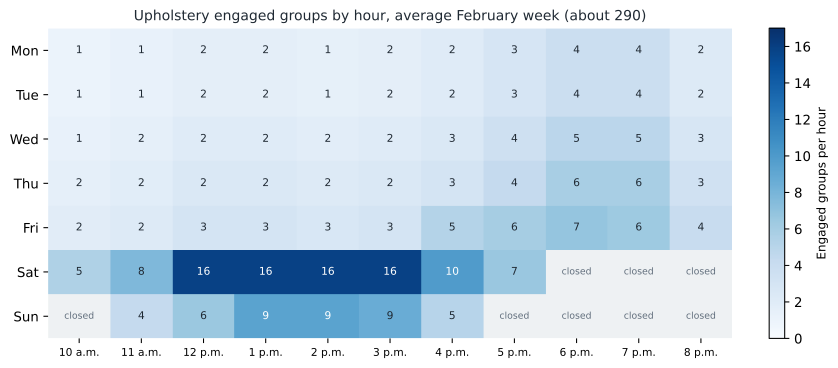
How many sellers each hour
An upholstery conversation is long. A customer looking at sectionals may sit on four or five, discuss fabric and size, look at a swatch book and ask about delivery; 30 to 45 minutes is normal, and a custom order can take an hour. Some groups need only a greeting and a quick answer. From the floor checklist data in SLS-250, Bev's rule of thumb is that one seller can look after about four engaged groups an hour across a mix of short and long conversations, with at least one seller in the department whenever the store is open.
Worked problem
Saturday peak coverage
In an average February week, 93 groups arrive on Saturday across 8 opening hours, and the busiest hours carry about 1.4 times the average. How many sellers are needed at the peak?
Show solution
- Average groups per hour on Saturday:
- \[\frac{93}{8} \approx 11.6\]
- Groups per hour at the peak:
- \[11.6 \times 1.4 \approx 16.2\]
- Sellers needed at four groups each:
- \[\frac{16.2}{4} \approx 4.1\]
Answer: About four sellers are needed from noon to 4 p.m. on Saturday. The team has five people, so the schedule puts four of them on the Saturday peak and asks Carl to cover the department when someone takes a break. A weekday morning, at about two groups an hour, needs only one seller.
The same calculation for each hour produces a coverage plan: the number of sellers needed in each block of the week. Aiden built it in four blocks: weekday daytime (one seller), weekday evenings (two, three on Friday), Saturday (two in the morning, four from noon to 4 p.m., two from 4 to 6) and Sunday (two, three from 1 to 4 p.m.).
The legal limits
A schedule that meets the coverage plan still has to follow the employment rules. The rules that matter most for this schedule are set out below; SLS-230 gives more detail.
| Rule | What applies at the store |
|---|---|
| Minimum wage | 11.85 dollars an hour in 2026; South Dakota adjusts it each January for inflation, and Bloomberg Tax projected 12.30 for 2027. The floor base of 13.00 is above both |
| Overtime | Time and a half for hours over 40 in a workweek under the FLSA; South Dakota has no daily overtime. Retail sellers paid mainly by commission may be exempt under section 7(i) if their regular rate is more than 1.5 times the federal minimum and more than half their pay is commission |
| Meal breaks | No state requirement for adults; the store gives a 30-minute unpaid meal break on shifts over 5 hours as policy |
| Rest between shifts | No state requirement; the store keeps 10 hours between a closing and an opening shift as policy |
| Public holidays in the season | No legal holiday premium in South Dakota. The store closes on Easter Sunday and July 4 (a Sunday in 2027) and pays time and a half on Memorial Day (May 31) as policy, not because the law requires it |
The store's own scheduling policy adds three rules: schedules are posted two weeks ahead, no one is scheduled for more than 40 hours without the store manager's approval, and part-time staff are offered extra hours in order of seniority before anyone is asked to work overtime.
Worked problem
A long Saturday
Leon is scheduled for 37.5 hours in a week, including a Saturday shift from 9:30 a.m. to 6:30 p.m. with a 30-minute unpaid meal break. Does any overtime arise?
Show solution
- Hours worked on Saturday:
- \[9 \text{ hours on site} - 0.5 \text{ hour break} = 8.5 \text{ hours}\]
- The FLSA counts overtime only after 40 hours in the week:
- \[37.5 < 40 \Rightarrow \text{no overtime}\]
Answer: No overtime arises, because the week is under 40 hours and South Dakota has no daily overtime. Aiden still shortened the shift to 8 hours so that Leon was not tired for the evening rush on Monday.
The February schedule
Dylan starts on February 1 with two weeks of training: product knowledge, the swatch and custom-order process, the counter checklist and a shadow shift with Jasmine each Saturday. His training hours count as paid work but not as selling hours. Jasmine's week of vacation is booked in June, and Mei cannot work Tuesdays.
| Person | Mon | Tue | Wed | Thu | Fri | Sat | Sun | Hours |
|---|---|---|---|---|---|---|---|---|
| Jasmine | off | 10–6 | 10–6 | 1–9 | 1–9 | 10–6 | off | 37.5 |
| Leon | 1–9 | 1–9 | off | 10–6 | 1–9 | 10–6 | off | 37.5 |
| Mei | off | off | off | 5–9 | 5–9 | 10–6 | 11–5 | 24 |
| Dylan (training) | 10–2 | off | 1–5 | 10–2 | off | 10–6 | 11–5 | 20 + break time unpaid |
| Aiden | 10–6 | 1–9 | 1–9 | off | 10–6 | 10–6 | off | 37.5 (20 selling, 17.5 lead) |
Checking the schedule against the coverage plan, Aiden found one gap: on Sunday from 1 to 4 p.m. the plan needed three sellers but only Mei and Dylan were on, and Dylan was still in training. He swapped Leon's Monday evening to a Sunday afternoon in weeks 3 and 4 and asked Carl to look in on the department on Sunday in weeks 1 and 2.
The labor check
The schedule also has to be affordable. Upholstery labor is paid from the department's margin, so Bev tracks labor cost as a share of sales.
Worked problem
Labor cost for an average week
In an average week of the season the department plans 71,154 dollars of sales (1,850,000 ÷ 26) at a 46 in 100 margin. Sellers work 139 selling hours at a base of 13.00 dollars and earn 8 in 100 of margin; Aiden's 17.5 lead hours are paid at 21.00 dollars. What is labor cost as a share of sales?
Show solution
- Commission:
- \[71{,}154 \times 0.46 \times 0.08 \approx 2{,}618 \text{ dollars}\]
- Base pay for selling hours:
- \[139 \times 13.00 = 1{,}807 \text{ dollars}\]
- Lead hours:
- \[17.5 \times 21.00 = 367.50 \text{ dollars}\]
- Labor cost as a share of sales:
- \[\frac{1{,}807 + 2{,}618 + 367.50}{71{,}154} = \frac{4{,}792.50}{71{,}154} \approx 0.067\]
Answer: Labor is about 6.7 in 100 of sales before benefits and payroll taxes, within the store's guideline of 8 for furniture departments. The figure rises in February, when sales are lowest, and falls in May.
Because about half of the labor cost is commission, it moves with sales automatically: in a slow week the department pays less. The base hours do not move. That is why the schedule follows the traffic curve. Adding a seller on a quiet Tuesday morning costs the base rate for every hour and adds almost no sales.
Worked problem
Checking a seller's pay against the rules
In an average week Leon works 37.5 hours and sells about 20,230 dollars (his 526,000-dollar goal ÷ 26) at a 46 in 100 margin. What does he earn, and would section 7(i) apply if he ever worked over 40 hours?
Show solution
- Commission:
- \[20{,}230 \times 0.46 \times 0.08 \approx 744 \text{ dollars}\]
- Base pay:
- \[37.5 \times 13.00 = 487.50 \text{ dollars}\]
- Total and regular rate:
- \[487.50 + 744 = 1{,}231.50; \quad \frac{1{,}231.50}{37.5} \approx 32.84 \text{ dollars an hour}\]
- Share of pay from commission:
- \[\frac{744}{1{,}231.50} \approx 0.60\]
Answer: Leon earns about 1,231.50 dollars, a regular rate of about 32.84 dollars an hour. More than half his pay is commission and his rate is well above 1.5 times the federal minimum of 7.25 (10.88), so section 7(i) could exempt overtime hours in a representative period. The store still schedules no one over 40 hours without approval, and would get advice before relying on the exemption.
When the schedule changes
No schedule survives four weeks unchanged. People get sick, cars break down, a delivery truck arrives on the wrong day and needs extra hands, and a promotion week needs more coverage than planned. Aiden wrote three simple rules into the deliverable so that changes would be handled the same way every time. First, a seller who cannot come in calls Aiden or the manager on duty at least two hours before the shift, not a colleague, so that the change is recorded. Second, shift swaps between sellers are allowed if Aiden approves them in the scheduling app and the swap does not create overtime, a rest-period problem or a coverage gap. Third, extra hours go first to part-time staff in order of seniority, as the store's policy requires, and only then to full-time staff, who would be pushed toward overtime.
He also kept a short call-in list: Carl for Saturdays, a décor associate trained on the up system for weekday daytime, and Mei for evenings outside Tuesdays. A list like this means that when the phone rings at 8 a.m., the person on duty knows who to call and in what order, instead of texting everyone at once.
Template: the schedule and labor check
| Section | What to include |
|---|---|
| Coverage plan | Sellers needed in each block of the week, with the calculation |
| Four-week schedule | Shifts by person and day, with breaks |
| Coverage check | Gaps found and how they were closed |
| Legal check | Minimum wage, overtime, breaks, rest and holidays for the site |
| Labor cost | Cost and share of sales for an average week and the lowest week |
Model answer and Bev's scoring
Aiden's deliverable included the coverage plan, the four weekly schedules, the Sunday gap and its fix, the long-Saturday correction and the labor check. Bev scored it 17 out of 20. She took a point from the legal check because he had not stated the store's policy on hours worked on Presidents' Day, February 15, even though no law requires a premium, and two from the labor cost section because he gave only the average week. "February is your most expensive month for labor per dollar of sales," she wrote. "Show it."
| Criterion | Excellent (4) | Developing (2) | Aiden |
|---|---|---|---|
| Coverage | Staffing follows traffic, with the calculation | Flat staffing or no calculation | 4 |
| Schedule quality | Fair, posted ahead, respects availability and time off | Conflicts with availability or policy | 4 |
| Legal compliance | All site rules applied and shown | A rule broken or ignored | 3 |
| Labor cost | Average and lowest weeks shown, within guideline | Missing or wrong | 2 |
| Clarity | Readable schedule and clear checks | Hard to read | 4 |
Reflection
Which would you protect first if two sellers called in sick on a Saturday: coverage at the peak, or the training shift for the new seller? How would you explain the choice to the team?
Common mistakes
MistakeScheduling the same number of sellers every hour.
InsteadFollow the traffic curve with a coverage plan.
MistakeAssuming a commission seller is automatically exempt from overtime.
InsteadCheck both conditions of section 7(i) for a representative period, or avoid overtime.
MistakePaying overtime at 1.5 times the base rate only.
InsteadUse the regular rate, which includes commission.
MistakeForgetting public holidays when building a schedule.
InsteadMark them first and apply the holiday rules for the site.
MistakeCalculating labor cost for an average week only.
InsteadShow the lowest-sales week too.
Summary and key terms
- Upholstery traffic peaks on Saturday afternoons and weekday evenings; about 32 in 100 of groups come on Saturday.
- At about four groups per seller per hour, the Saturday peak needs about four sellers and a weekday morning one.
- Rules: South Dakota minimum wage 11.85 in 2026 (projected 12.30 for 2027), FLSA overtime over 40 a week, the 7(i) commission exemption, and holiday pay only as store policy.
- An average week's labor is about 6.7 in 100 of sales; commission moves with sales but base hours do not.
- The deliverable shows coverage, the schedule, its gaps, the legal check and the labor cost.
- Coverage plan
- The number of sellers needed in each block of the opening hours.
- Labor cost share
- Wages and commission divided by sales for the same period.
- Regular rate
- Total pay for the week divided by hours worked, including commission, used for overtime.
- Section 7(i) exemption
- A federal overtime exemption for some retail employees paid mainly by commission.
- Holiday premium
- Extra pay for working a holiday; in South Dakota it is a matter of store policy, not law.
- Rest period
- Scheduled time off between shifts, set by store policy.
Practice problems
Work each problem on paper first, then reveal the answer to check.
A Friday evening has 44 groups over 5 hours from 4 to 9 p.m. How many sellers are needed at four groups each per hour?
Show answer
44 ÷ 5 = 8.8 groups an hour; 8.8 ÷ 4 ≈ 2.2, so two sellers with a third for the busiest hour.
Mei works 42 hours in a week at a base of 13.00 dollars with 300 dollars of commission. What is her overtime premium if she is not exempt?
Show answer
Regular rate (42 × 13 + 300) ÷ 42 ≈ 20.14; premium for 2 overtime hours is 0.5 × 20.14 × 2 ≈ 20.14 dollars.
Why does labor cost as a share of sales rise in February?
Show answer
Base hours stay similar while sales are at their lowest, so the fixed part is spread over fewer dollars.
Lesson quiz · 5 questions
Score 60% or more to complete this lesson.
Create a free account to save your progress, take quizzes and earn a certificate.