
CON-100 · Lesson 1 of 12 · 25 min
Construction and the economy
Almost everything people use in daily life passes through the construction industry at some point. Homes, schools, hospitals, offices, factories, roads, bridges, transit lines, water treatment plants, pipelines, power stations and data centres are all designed by some people and built by others, and the people who organize that building are construction managers. This course introduces the industry that you are preparing to work in: how large it is, how it is organized, who the players are, how projects move from an idea to an operating facility, how work is procured and delivered, how a site runs, who does the work, how technology is changing it, and what careers and professional responsibilities it offers. This first lesson looks at construction as part of the economy: its size, its role, why it is so sensitive to economic cycles, how it is measured, and what makes it different from other industries.
What the construction industry includes
Statistical agencies in Canada and the United States classify construction using the North American Industry Classification System (NAICS), which both countries developed together with Mexico in the 1990s. Sector 23, Construction, covers establishments primarily engaged in building new structures, adding to or altering existing ones, and maintaining and repairing them. It is divided into three broad subsectors:
- Construction of buildings (NAICS 236): residential builders and non-residential general contractors who build homes, apartments, offices, schools, warehouses, factories and other buildings.
- Heavy and civil engineering construction (NAICS 237): contractors who build roads, bridges, tunnels, pipelines, power lines, water and sewer systems, dams and other infrastructure.
- Specialty trade contractors (NAICS 238): firms that perform particular parts of the work, such as excavation, concrete, framing, electrical, plumbing, mechanical, roofing, drywall and painting.
The broader construction economy also includes many activities classified elsewhere: architects and engineers (professional services), manufacturers of cement, steel, lumber, windows and equipment, building material dealers, equipment rental companies, surveyors, inspectors, lenders and insurers. When people speak of "the construction industry" in a wider sense, they often mean this whole chain of design, supply, construction and maintenance.
| NAICS subsector | Typical firms | Examples of work |
|---|---|---|
| 236 Construction of buildings | Home builders, general contractors, construction managers | Houses, condominiums, offices, schools, hospitals, warehouses |
| 237 Heavy and civil engineering | Road builders, utility contractors, marine and pipeline contractors | Highways, bridges, transit, water mains, pipelines, power lines |
| 238 Specialty trade contractors | Electrical, mechanical, concrete, framing, roofing, finishing firms | Wiring, ductwork, foundations, framing, roofing, drywall, flooring |
How big is construction?
Construction is one of the largest industries in both countries, whether measured by output, investment or employment.
In Canada, construction employs more than 1.6 million people and contributes roughly 7 % of gross domestic product, according to figures summarized by BuildForce Canada, the industry-led organization that forecasts construction labour markets. Statistics Canada's Labour Force Survey reported construction employment of about 1.69 million in September 2026, with a construction unemployment rate of about 3.8 %. Investment in building construction, which Statistics Canada reports monthly, runs to well over $200 billion a year, and engineering construction for roads, utilities, pipelines and other infrastructure adds a similar order of magnitude. Construction is also one of the largest employers of skilled trades and small businesses in every province and territory.
Numbers like these change every month and every year, and different sources measure different things: value added (GDP), gross output, investment or spending, and employment. When you use statistics, note the source, the date and exactly what is being measured.
Why construction matters to the economy
Construction matters for reasons beyond its size. It creates the physical capital that every other industry depends on: a factory cannot produce without a building, a city cannot grow without transit and water, and the digital economy cannot run without data centres and power lines. Construction investment therefore shapes long-term productivity and quality of life. It is also labour-intensive and largely local: most construction work must be done where the building or infrastructure will stand, so spending on construction tends to create jobs in the region where it occurs, which is one reason governments use infrastructure spending to support the economy during downturns. Construction purchases goods and services from many other industries, from quarries and steel mills to trucking and engineering, so its activity has strong ripple effects, often described with economic multipliers.
Worked problem
Reading an economic multiplier
An economic impact study states that a $500 million hospital project has an output multiplier of 1.9 and creates about 7 jobs per $1 million of construction spending during the build. What do these figures mean, and how should they be interpreted?
Show solution
- An output multiplier of 1.9 means that each dollar of construction spending is associated with about $1.90 of total economic output, including the direct spending, purchases from suppliers (indirect effects) and spending by workers (induced effects).
- Total associated output: \(500 \times 1.9 = 950\) million dollars.
- Jobs: \(500 \times 7 = 3{,}500\) person-years of employment during construction, not 3,500 permanent jobs.
- Multipliers come from input-output models and assume the economy has spare capacity; when labour and materials are already scarce, a new project may partly displace other work rather than add to it.
Answer: About $950 million of total output and about 3,500 person-years of work during construction, with the caveat that multipliers overstate the net gain when the economy is near capacity.
The construction cycle
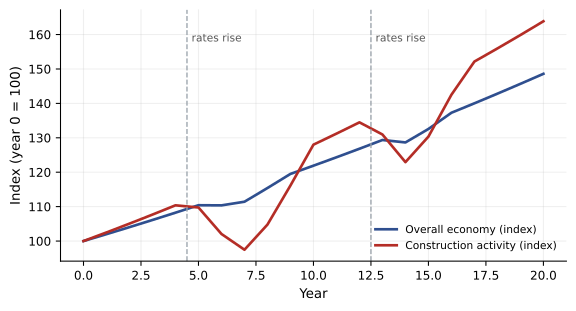
Construction is among the most cyclical industries. When the economy grows, interest rates are low and businesses and households are confident, demand for new homes, offices, factories and stores rises quickly. When the economy weakens or interest rates rise, private projects are delayed or cancelled, and construction activity can fall sharply. Several features make construction especially sensitive:
- Interest rates: most construction is financed with borrowed money, and buyers of homes and buildings also borrow, so higher rates reduce both the feasibility of projects and the demand for the finished product.
- Long lead times: projects take years to plan and build, so the industry can be caught with too much work in progress when demand falls, or too little capacity when demand rises.
- Investment decisions: construction is investment, and investment is more volatile than consumption because it can be postponed.
- Public spending: governments are major clients, and their budgets and stimulus programs can either soften or amplify private cycles.
Different sectors move at different times. Residential construction often responds first to interest rates, while large industrial and infrastructure projects follow longer investment cycles tied to commodity prices, government programs and technology trends, such as the recent boom in data centre and energy projects. Construction managers need to understand where in the cycle their market is, because it affects bidding competition, labour availability, material prices and risk.
Measuring construction activity
Construction managers, lenders and governments watch a range of indicators to judge where the market is heading:
| Indicator | What it measures | Typical source |
|---|---|---|
| Building permits | Value and number of permits issued, a leading indicator | Statistics Canada |
| Housing starts | New homes begun each month | Canada Mortgage and Housing Corporation (CMHC) |
| Investment in building construction | Monthly spending on residential and non-residential buildings | Statistics Canada |
| Construction employment and wages | Jobs, hours and earnings | Statistics Canada Labour Force Survey and SEPH |
| Building construction price indexes | Changes in the cost of building | Statistics Canada |
| Labour market forecasts | Ten-year demand and supply by trade | BuildForce Canada |
Leading indicators, such as permits, design billings and contractor backlog, signal future activity, while employment and spending show current conditions. Price indexes are essential for estimating and for escalating costs on long projects (CON-200, CON-310).
What makes construction different
Construction differs from manufacturing and most service industries in ways that shape how it is managed:
- Every project is a prototype. Even similar buildings differ in site, soil, design, codes, weather and team, so each project must be planned and organized anew.
- The factory moves to the product. Work happens on a temporary site, outdoors or in partially enclosed buildings, with changing conditions each day.
- Temporary organizations. Each project brings together an owner, designers, a contractor and dozens of subcontractors and suppliers who may never have worked together before and will disband when the project ends.
- Fragmentation. The industry consists of many small firms; most specialty contractors employ only a handful of people, and even large projects depend on long chains of subcontracts.
- High risk and thin margins. Contractors often work for profit margins of a few per cent on revenue while carrying risks of weather, ground conditions, price changes, productivity and payment.
- Safety. Construction has one of the highest rates of serious and fatal injuries of any industry, which makes safety management central to the job (HSE-370).
- Long life of the product. Buildings and infrastructure last for decades, so decisions made during construction affect operating costs, energy use and safety for generations.
The construction manager's place in the economy
Construction managers sit at the point where money, design, labour, materials, equipment and time are turned into physical assets. They work for general contractors, construction management firms, specialty contractors, owners, developers, governments and consultants. Their decisions about estimates, schedules, methods, procurement and safety determine whether a project is delivered on time, within budget, at the required quality and without harm. Understanding the economic context helps them price risk sensibly, plan the workforce, advise clients on timing, and anticipate how changes in interest rates, commodity prices or public policy will affect their projects and their firms.
Productivity, costs and prices
Construction costs are shaped by the prices of labour, materials and equipment and by how efficiently they are used. Labour typically accounts for roughly 30 to 50 % of the cost of building work, depending on the type of project and how much is prefabricated; materials for a similar share; and equipment, subcontractor overhead and profit for the rest. Construction material prices are volatile: lumber, steel, copper and diesel prices can rise or fall by tens of per cent within a year, as the industry saw during the supply disruptions of 2021 and 2022. Tariffs and trade disputes affecting steel, aluminium, lumber and other inputs add further uncertainty for projects on both sides of the border. Because many contracts are fixed-price, contractors carry the risk of cost increases between bid and purchase, which is why escalation clauses, early procurement and careful price forecasting matter.
Regional differences
Construction markets are strongly regional. Costs, wages, codes, climate, soil conditions, labour supply and the mix of sectors vary between provinces and states, between cities and rural areas, and even between neighbourhoods. A high-rise residential boom in one city, an energy megaproject in another region, or a hurricane rebuilding effort elsewhere can draw workers and equipment away from other markets and push up local prices. Cost guides and estimating databases therefore apply location factors to adjust costs between cities. Winter conditions in much of Canada and the northern United States add costs for heating, hoarding, snow removal and cold-weather concreting, and they compress outdoor work such as paving and earthwork into the warmer months.
Construction and public policy
Governments influence construction through infrastructure spending, housing policy, building codes, environmental regulation, immigration and training policy, procurement rules and tax incentives. Infrastructure programs can support construction employment during downturns, while policies to increase housing supply, such as zoning reform, faster approvals and financing incentives, affect residential activity. Energy and climate policies drive investment in transmission lines, renewable generation, electric vehicle and battery plants, and building retrofits. Construction managers do not set these policies, but they need to follow them, because they determine where the next wave of work will come from and which skills will be in demand.
Reading the market as a construction manager
Practical market awareness comes from simple habits: following monthly construction spending and permit releases, reading industry association forecasts, tracking material price indexes, watching interest rate announcements and noting which owners are announcing projects. Estimators notice when bid competition tightens or loosens, superintendents notice when skilled trades become hard to find, and project managers notice when subcontractors start declining to bid. Combining these signals gives a firm early warning of changes in the market.
Common mistakes
MistakeQuoting statistics without a source or date.
InsteadNote who measured what, and when.
MistakeTreating multiplier jobs as permanent jobs.
InsteadRead them as person-years during construction.
MistakeAssuming all sectors move together.
InsteadTrack residential, non-residential and civil cycles separately.
MistakeIgnoring interest rates when forecasting work.
InsteadWatch rates, permits and backlog as leading indicators.
MistakeThinking construction is like factory production.
InsteadPlan each project as a unique, temporary undertaking.
Summary and key terms
- NAICS 23 covers building, heavy and civil, and specialty trade construction.
- Construction is one of the largest industries by output and employment in both countries.
- It builds the physical capital other industries depend on and is largely local.
- Construction is highly cyclical and sensitive to interest rates.
- Permits, starts, spending, employment and price indexes track the market.
- Projects are unique, temporary, fragmented, risky and long-lived.
- Construction managers turn resources into assets and must read the economic context.
- NAICS
- North American Industry Classification System.
- General contractor
- Firm with overall responsibility for building a project.
- Specialty trade contractor
- Firm that performs a particular part of the work.
- Heavy civil construction
- Infrastructure work such as roads, bridges and utilities.
- Gross domestic product
- Value added by an industry or economy.
- Economic multiplier
- Ratio of total economic effect to direct spending.
- Leading indicator
- Measure that signals future activity.
- Housing starts
- New dwellings on which construction has begun.
- Backlog
- Work under contract but not yet completed.
- Cyclical industry
- Industry whose activity rises and falls with the economy.
Practice problems
Work each problem on paper first, then reveal the answer to check.
Name the three NAICS construction subsectors.
Show answer
Buildings, heavy and civil engineering, specialty trades.
Name two activities outside NAICS 23 that belong to the wider construction economy.
Show answer
Design services, materials manufacturing, equipment rental, finance.
Why is construction spending largely local?
Show answer
The work must be done where the asset will stand.
Total output from $200 million at a multiplier of 1.8?
Show answer
$360 million.
What do multiplier job figures usually represent?
Show answer
Person-years during construction.
Why are higher interest rates bad for construction?
Show answer
They raise financing costs and reduce demand for buildings.
Name two leading indicators.
Show answer
Building permits, housing starts, design billings, backlog.
What does a construction price index help with?
Show answer
Estimating and escalating costs.
Name three features that make construction different.
Show answer
Unique projects, temporary sites and teams, fragmentation, risk, safety.
Why must construction managers understand the cycle?
Show answer
It affects competition, labour, prices and risk.
Lesson quiz · 5 questions
Score 60% or more to complete this lesson.
Create a free account to save your progress, take quizzes and earn a certificate.