
CON-100 · Lesson 6 of 12 · 25 min
Procurement and bidding at a glance
Procurement is how owners select and contract with the firms that will design and build their projects, and how contractors in turn select subcontractors and suppliers. For many contractors, winning work through bids and proposals is the lifeblood of the business: a contractor that does not win work has nothing to build, and one that wins work at the wrong price may lose money on every project. This lesson gives an overview of how construction work is procured: the main selection methods, the tendering process, bids and bonds, how contractors decide what to bid and price their work, and the ethics and fairness rules that govern bidding. Estimating and bidding are covered in detail in CON-200 and CON-300, and procurement of subcontractors in CON-330.
Ways of selecting a contractor
Owners select contractors in several ways:
- Open competitive tendering: the owner advertises the project publicly, any qualified contractor may bid, and the contract is usually awarded to the lowest compliant bid. This is standard for many public projects.
- Invited or selective tendering: the owner invites a short list of contractors, often after prequalification, to submit bids.
- Prequalification followed by bidding: contractors first submit information on experience, capacity, safety record, financial strength and bonding, and only those who qualify may bid.
- Best-value or qualifications-based selection: proposals are evaluated on a combination of price and non-price factors, such as experience, team, approach, schedule and safety, often with published weightings.
- Negotiated contracts: the owner selects a contractor, often one it trusts from previous work, and negotiates price and terms directly. Common in private work and for construction management and design-build delivery.
The choice depends on the owner's rules, the project's complexity, the delivery method and how much the owner values factors other than price.
| Method | Basis of award | Typical use |
|---|---|---|
| Open tender | Lowest compliant price | Public design-bid-build projects |
| Invited tender | Lowest price among invited bidders | Private and some public projects |
| Prequalified tender | Lowest price among qualified bidders | Large or complex public projects |
| Best value | Weighted price and qualifications | Construction management, design-build, complex work |
| Negotiated | Agreed price and terms | Private repeat clients, early contractor involvement |
The tendering process
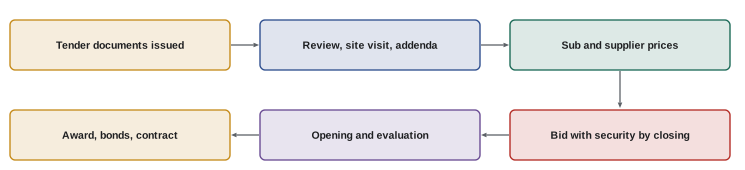
On a traditional competitive tender, the process usually follows these steps:
- The owner or its consultant issues a call for tenders or invitation to bid, with the tender documents: instructions to bidders, bid form, contract conditions, drawings and specifications.
- Contractors obtain the documents, often through online plan rooms and bid platforms, and decide whether to bid.
- Bidders attend site visits or pre-bid meetings, ask questions, and receive addenda that clarify or change the documents.
- General contractors prepare estimates, solicit and receive prices from subcontractors and suppliers, and compile their bid, often in a hectic final few hours on bid day.
- Bids are submitted by a fixed closing time, usually with bid security, and are opened, sometimes publicly.
- The owner evaluates bids for compliance and price, may clarify details, and awards the contract, after which the successful bidder provides performance and payment security and insurance and signs the contract.
Bids, bonds and bid security
Owners usually require bid security to ensure that a bidder who is awarded the contract will sign it at its bid price. Bid security may be a bid bond issued by a surety, a certified cheque or a letter of credit, typically 5 to 10 % of the bid price. If the winning bidder refuses to sign, the owner can claim the security, usually up to the difference between that bid and the next lowest. After award, contractors often must provide performance bonds, guaranteeing completion of the work, and labour and material payment bonds, guaranteeing payment of subcontractors and suppliers, typically each for 50 to 100 % of the contract price. Bonding capacity, the total volume of bonded work a surety will support for a contractor based on its finances and experience, limits how much public work a contractor can take on (CON-350).
In Canada, the law of tendering is shaped by the Supreme Court of Canada's decision in R. v. Ron Engineering (1981), which established that submitting a compliant bid in response to a formal call for tenders can create a preliminary contract, often called "Contract A", with obligations of fairness on the owner and irrevocability on the bidder, distinct from the construction contract itself ("Contract B"). Later decisions, such as M.J.B. Enterprises v. Defence Construction (1999), held that owners generally may not accept non-compliant bids. Provincial construction associations publish bidding practices, and some provinces have bid depositories for trade prices.
Deciding whether to bid
Preparing a bid is expensive: a general contractor may spend tens of thousands of dollars in estimator time on a large bid, with no guarantee of winning. Contractors therefore decide carefully which projects to pursue, considering:
- Fit with the firm's experience, capabilities and preferred sectors.
- Project size relative to the firm's capacity, bonding and cash flow.
- The owner and design team, their reputation, payment record and the quality of the documents.
- Competition: how many bidders, and who.
- Risk: contract terms, site conditions, schedule, location and unusual requirements.
- Current workload and backlog, and the strategic value of the project, such as entering a new market or maintaining a relationship.
Many firms use a formal go/no-go checklist and track their hit rate, the share of bids that become contracts, to judge whether their pursuit strategy is working.
Pricing a bid
A bid price builds up from direct costs, indirect costs and markup. Direct costs are the labour, materials, equipment and subcontracts for the permanent work. Indirect costs, called general conditions or general requirements, are the costs of running the project, such as site supervision, temporary facilities, safety, cleanup, permits and insurance. Markup covers the firm's head office overhead and profit, and sometimes a contingency for risk. The final bid is often adjusted on bid day as subcontractor prices arrive at the last moment.
Worked problem
Building up a bid
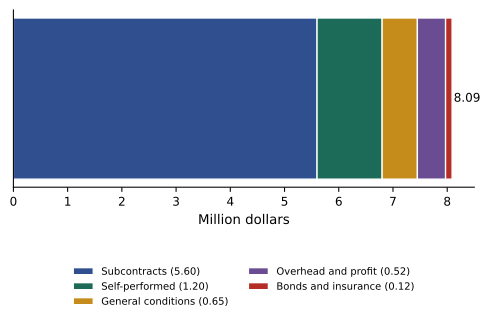
A general contractor's estimate for a small commercial building totals: self-performed direct work $1.2 million, subcontracts $5.6 million, general conditions $650,000. The firm applies 4 % for head office overhead and 3 % for profit on total cost, and bonding and insurance cost 1.5 % of the bid. What is the bid price?
Show solution
- Total project cost before markup: \(1.2 + 5.6 + 0.65 = 7.45\) million dollars.
- Overhead and profit at 7 % of cost: \(7.45 \times 0.07 = 0.5215\) million dollars.
- Subtotal: \(7.45 + 0.5215 = 7.9715\) million dollars.
- Bonds and insurance at 1.5 % of the bid price B: \(B = 7.9715 + 0.015B\), so \(B = 7.9715 / 0.985 \approx 8.093\) million dollars.
Answer: A bid of about $8.09 million, of which profit is roughly $224,000, under 3 % of the price.
Fairness, ethics and the bidding process
Competitive bidding depends on trust that all bidders compete fairly on the same information. Practices that undermine this are prohibited by law, codes of practice or ethics. Bid rigging, in which competitors agree among themselves who will win or what prices to submit, is a serious criminal offence under competition law in both countries, and has led to large fines and prison sentences. Bid shopping, in which a general contractor uses one subcontractor's price to pressure others to lower theirs after the bid, or "peddles" prices after award, is widely considered unethical and is restricted by many codes of practice and bid depositories. Owners must evaluate bids according to the published rules and must not favour particular bidders. Conflicts of interest must be declared. Construction managers must understand these rules, both to protect their firms from legal risk and to maintain the reputation on which future work depends.
In Canada, bid rigging is a criminal offence under section 47 of the Competition Act, enforced by the Competition Bureau, with penalties including fines at the court's discretion and imprisonment for up to 14 years.
Proposals for qualifications-based work
Not all construction work is won on price alone. For construction management, design-build and many private projects, contractors respond to requests for qualifications (RFQ) and requests for proposals (RFP) with written proposals and interviews. Proposals present the firm's experience, key personnel, approach, schedule, safety record, value-added ideas and fees. Winning proposals respond directly to the owner's evaluation criteria, demonstrate understanding of the project's challenges, and present a credible team. Interviews are often decisive, so the people who would actually run the project usually attend. Proposal and business development skills are therefore part of many construction managers' careers.
Electronic bidding and plan rooms
Most tendering now happens electronically. Owners publish opportunities on public procurement portals and private bid platforms, contractors download documents and addenda, and bids are submitted electronically with digital signatures and bonds. Builders' exchanges and construction associations operate plan rooms and bid notification services, helping subcontractors find projects to price. Electronic bidding speeds the process and reduces errors, but bidders must still read every document and addendum carefully, confirm that submissions are complete and received before the deadline, and keep records of what they submitted.
Subcontractor and supplier pricing
General contractors depend on subcontractor and supplier prices to compile their bids. On bid day, prices arrive by email, phone and bid platforms, often in the final hours, and the estimating team must compare them carefully: checking each price against the scope of its trade, identifying exclusions and qualifications, filling gaps where a scope item is missing, and choosing the best combination. A low price that excludes part of the scope may not really be low. Some regions use bid depositories, where subcontractors submit sealed prices to a central office, to reduce bid shopping and last-minute pressure. These practices are covered further in CON-300 and CON-330.
Evaluating bids
Owners evaluate bids for compliance and price. A bid that is late, unsigned, missing required security or forms, or materially qualified may be rejected. Owners also check that the lowest bidder can perform the work, reviewing references, financial capacity and safety records where the tender allows, and may ask for clarification of obvious arithmetic errors according to the tender rules. Unusually low bids may signal a mistake or a misunderstanding of the scope; some owners require bidders to confirm such bids. A careful, transparent evaluation protects the owner and the fairness of the process.
Bid errors and withdrawal
Mistakes happen in the pressure of bid day: a missing scope item, an arithmetic error, a misread unit. If a contractor discovers a serious error after submitting its bid, the consequences depend on the tender rules and the law. In some situations, a bid may be withdrawn before closing without penalty; after closing, withdrawing a bid may mean forfeiting bid security, and courts have treated obvious clerical errors differently from errors of judgement. Good estimating practice, such as checklists, independent reviews and comparing totals with historical costs per square metre, reduces the risk of errors. A bid that is too low because of an error can turn a project into a loss from the first day.
Post-bid activities
Winning a bid starts a new set of tasks. The contractor confirms subcontractor and supplier prices, reviews scope gaps identified on bid day, negotiates and signs subcontracts and purchase orders, obtains bonds and insurance certificates, prepares the initial schedule and submittal register, and holds a turnover meeting where the estimating team hands the project to the operations team with all assumptions, quotes and risks documented. A thorough handover from estimating to operations prevents the common problem of a project team inheriting a budget they do not understand and commitments they did not know had been made.
Unsuccessful bids
Most bids are not won. Unsuccessful bidders can often learn from public bid results, which show competitors' prices, and from debriefings that many public owners offer for proposals. Comparing one's price with the winning bid, by trade where possible, reveals whether the firm was uncompetitive in particular trades, overestimated general conditions, or simply faced a competitor with lower overhead. Tracking these results over time improves future bidding.
Common mistakes
MistakeBidding every project available.
InsteadUse go/no-go criteria based on fit, risk and capacity.
MistakeSubmitting a bid that does not comply with instructions.
InsteadFollow the tender instructions exactly.
MistakeIgnoring bonding capacity.
InsteadMatch bids to available bonding and cash flow.
MistakeDiscussing bid prices with competitors.
InsteadNever; bid rigging is a crime.
MistakeShopping subcontractor prices after award.
InsteadTreat subcontractor prices fairly and confidentially.
Summary and key terms
- Owners select contractors by open or invited tender, prequalification, best value or negotiation.
- Tendering follows a set sequence from documents to award.
- Bid security, performance bonds and payment bonds protect owners and subcontractors.
- Tendering law differs between Canada and the United States.
- Contractors decide carefully which projects to bid.
- Bids build up from direct costs, general conditions and markup.
- Fairness rules prohibit bid rigging and discourage bid shopping.
- Tender
- Formal offer to perform work at a price.
- Prequalification
- Screening bidders before they may bid.
- Best-value selection
- Award based on price and qualifications.
- Bid bond
- Surety guarantee that a bidder will sign the contract.
- Performance bond
- Guarantee that the contractor will complete the work.
- Payment bond
- Guarantee that subcontractors and suppliers will be paid.
- General conditions
- Indirect project costs of running the job.
- Markup
- Overhead and profit added to cost.
- Bid rigging
- Illegal agreement among competitors on bids.
- Bid shopping
- Using one subcontractor's price to pressure others after bidding.
Practice problems
Work each problem on paper first, then reveal the answer to check.
Name four ways to select a contractor.
Show answer
Open tender, invited tender, prequalification, best value, negotiation.
What is an addendum used for during tendering?
Show answer
To clarify or change tender documents.
Typical bid security amount?
Show answer
About 5–10 % of the bid.
What does a payment bond guarantee?
Show answer
Payment of subcontractors and suppliers.
What limits how much bonded work a contractor can take?
Show answer
Bonding capacity.
Name three go/no-go factors.
Show answer
Fit, size, owner, competition, risk, workload.
What are general conditions?
Show answer
Indirect costs of running the project.
Bid for $5M cost with 8 % markup, before bonds?
Show answer
$5.4 million.
Is bid rigging legal?
Show answer
No, it is a criminal offence.
What wins qualifications-based selections?
Show answer
Responsive proposals, credible teams and strong interviews.
Lesson quiz · 5 questions
Score 60% or more to complete this lesson.
Create a free account to save your progress, take quizzes and earn a certificate.