
CON-100 · Lesson 7 of 12 · 25 min
Project delivery methods: an overview
A project delivery method is the overall arrangement an owner uses to organize design and construction: who is hired, when, under what kind of contract, and who carries which risks. The same building can be delivered in very different ways, and the choice affects how early the contractor is involved, how quickly the project can be completed, how much price certainty the owner has before construction, how changes are handled and how much the parties collaborate. This lesson introduces the main delivery methods, design-bid-build, construction management, design-build, integrated project delivery and public-private partnerships, along with the main contract pricing arrangements. CON-340 covers them in depth.
Delivery methods and pricing arrangements
It helps to separate two questions. The delivery method describes the organizational relationships: whether design and construction are contracted separately or together, and when the builder joins the team. The pricing arrangement, or compensation method, describes how the contractor is paid: a stipulated lump sum, unit prices, cost plus a fee, or cost plus a fee with a guaranteed maximum price. Most delivery methods can be combined with more than one pricing arrangement, although some combinations are much more common than others.
Design-bid-build
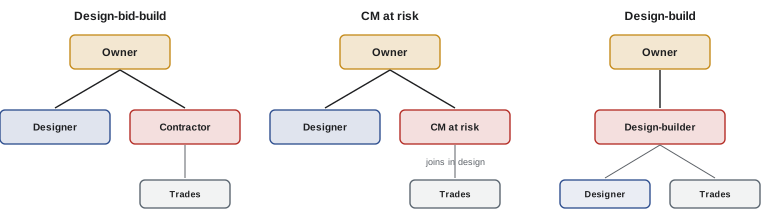
Design-bid-build (DBB), also called the traditional method or general contracting, is the most familiar arrangement. The owner hires a designer to complete the design, then invites contractors to bid on the completed documents, and awards a construction contract, usually a stipulated lump sum, to the lowest compliant bidder. The owner has separate contracts with the designer and the contractor, and the designer typically administers the construction contract. DBB offers clear roles, a well-understood process, competitive pricing and a firm price before construction begins. Its disadvantages are that the contractor's knowledge of cost, constructability and schedule is not available during design, the process is sequential and therefore slow, and the separation between designer and contractor can encourage adversarial relationships, especially when the documents contain errors or omissions that lead to changes and claims.
Construction management
In construction management delivery, the owner hires a construction manager early, often during schematic design, to work alongside the designer. There are two main forms:
- Construction manager as agent or for fee (CMa): the construction manager advises the owner on cost, schedule and constructability, and manages the construction process, but the owner holds the trade contracts directly. The construction manager does not guarantee the price and acts as the owner's agent.
- Construction manager at risk (CMAR), often called construction management at risk or, in some regions, construction management with a guaranteed maximum price: the construction manager provides preconstruction services during design, then commits to build the project, usually for the cost of the work plus a fee, with a guaranteed maximum price (GMP), and holds the trade contracts itself.
Construction management allows the builder's expertise to shape the design and allows early work packages, such as excavation and structure, to start before the whole design is finished. It suits complex projects, renovations of occupied buildings and projects that need early starts, but the owner must manage a more involved relationship and, under CMa, retains more risk.
In Canada, CCDC 5A (construction management for services) and CCDC 5B (construction management for services and construction) are the standard forms for construction management, alongside CCDC 3 for cost plus fee contracts.
Design-build
In design-build (DB), the owner contracts with a single entity, the design-builder, which is responsible for both design and construction. The design-builder may be a contractor with in-house or subcontracted designers, a design firm leading a team, or a joint venture. The owner usually prepares performance requirements or a bridging design, sometimes 20 to 30 % complete, and selects a design-builder by qualifications, price or best value. Design-build offers single-point responsibility, so there is no gap between designer and contractor for the owner to fall into; faster delivery, because design and construction overlap; and early price certainty. The owner, however, gives up some control over design details, and must define its requirements clearly at the start, since changes later can be costly. Design-build is common for infrastructure, industrial and repetitive building types, and has grown steadily in both countries.
Integrated project delivery
Integrated project delivery (IPD), or alliancing, brings the owner, designer, general contractor and key trade contractors together under a single multi-party agreement early in design. The parties share risk and reward: costs are reimbursed, profit is placed at risk and paid according to how well the project meets shared targets for cost, schedule and quality, and the parties typically waive claims against each other except for wilful misconduct. Decisions are made jointly, often in co-located "big rooms", with lean practices and target value design. IPD aims to align everyone's interests with the project's success, and has achieved strong results on complex healthcare and institutional projects, but it requires owners and teams committed to collaboration, transparency and new contracts.
Public-private partnerships
Public-private partnerships (P3s) are used for large public infrastructure and buildings, such as hospitals, highways, transit lines and courthouses. A private consortium, typically including a developer, a design-build contractor, a facility manager and financial investors, designs, builds, finances and often operates and maintains the asset for a long period, such as 25 to 35 years, receiving payments from the public owner linked to availability and performance, or in some cases user fees such as tolls. P3s transfer significant design, construction, financing and life-cycle risk to the private partner, but involve complex procurement, higher financing costs and long contracts.
Canada has been one of the world's most active users of P3s for hospitals, transit and highways, through provincial agencies such as Infrastructure Ontario and Partnerships BC (now part of Infrastructure BC) and others. Recent experience on some large transit projects has led to a shift toward more collaborative alliance and progressive models that share more risk with the public owner.
Comparing the methods
| Method | Contracts with owner | Builder joins | Typical pricing | Main strengths | Main drawbacks |
|---|---|---|---|---|---|
| Design-bid-build | Designer and contractor separately | After design | Lump sum | Clear roles, competitive price | Slow, no builder input in design, adversarial risk |
| CM as agent | Designer, CM adviser, trade contractors | During design | Fee; trades lump sum | Expert advice, early packages | Owner keeps cost risk |
| CM at risk | Designer and CM | During design | Cost plus fee with GMP | Builder input, early start, price cap | GMP set before design complete |
| Design-build | Design-builder only | At the start | Lump sum or GMP | Single responsibility, speed | Less owner control of design |
| IPD | Multi-party agreement | At the start | Cost plus shared risk and reward | Aligned incentives, collaboration | Requires mature teams |
| P3 | Private consortium | At the start | Long-term availability payments | Risk transfer, life-cycle focus | Complex, costly financing |
Pricing arrangements
Contract pricing arrangements allocate cost risk differently:
- Stipulated or lump-sum price: the contractor agrees to perform the defined work for a fixed price and bears the risk of cost overruns, except for changes and specified conditions. It requires complete documents.
- Unit price: the owner pays agreed rates for measured quantities, suited to heavy civil work where quantities are uncertain.
- Cost plus fee: the owner reimburses actual costs and pays a fee, fixed or a percentage, bearing the cost risk; suited to uncertain work and emergencies.
- Cost plus fee with guaranteed maximum price: costs are reimbursed up to a cap, above which the contractor pays; savings below the cap may be shared.
- Target cost: a target is set, and overruns and underruns are shared according to an agreed formula.
Worked problem
Sharing savings under a GMP
A construction manager at risk agrees a guaranteed maximum price of $40 million, including a fee of $1.6 million, with a 50/50 split of savings below the GMP. The final cost of the work plus fee is $38.4 million. What does the owner pay, and what does the CM earn?
Show solution
- Savings below GMP: \(40 - 38.4 = 1.6\) million dollars.
- Shared savings to the CM: \(0.5 \times 1.6 = 0.8\) million dollars.
- Owner pays the cost and fee plus the CM's share: \(38.4 + 0.8 = 39.2\) million dollars.
- The CM earns its fee of $1.6 million plus $0.8 million in shared savings, $2.4 million in total. If the cost had exceeded the GMP, the CM would have absorbed the overrun.
Answer: The owner pays $39.2 million, saving $0.8 million against the GMP; the CM earns $2.4 million.
Choosing a delivery method
Owners choose delivery methods based on their priorities and capabilities: how important are price certainty, speed, quality control, design control and collaboration; how complete and stable are their requirements; how experienced is their organization; what do procurement laws allow; and what does the market prefer. There is no single best method: design-bid-build remains appropriate for straightforward projects with complete designs, construction management and design-build suit complex or fast projects, and IPD and alliancing suit owners seeking deep collaboration. Construction managers work under all of these arrangements during their careers, and understanding each helps them recognize their responsibilities and risks under any contract.
Delivery methods and the construction manager's role
The construction manager's job looks different under each delivery method. In design-bid-build, the contractor's team begins after award, studies the completed documents, buys out subcontracts and manages construction, dealing with design questions through the consultant. In construction management, the team works with the designers for months before construction, preparing estimates, schedules and constructability reviews, packaging the work into trade contracts and managing early works. In design-build, the contractor leads or works closely with the design team and is responsible for coordinating design and construction internally. In IPD, the team shares decisions and targets with all key parties. Each requires slightly different skills, and the best construction managers adapt their approach to the method.
Progressive and collaborative approaches
In recent years, owners have increasingly used progressive design-build and other collaborative variants, in which the design-builder is selected early, mainly on qualifications, and develops the design and price together with the owner in stages, with an option for the owner to proceed or not before committing to the final price. These approaches aim to combine early contractor involvement with transparency and shared decision making, and they have become common on water, transit and other complex public projects in both countries. Early contractor involvement contracts and alliances are similar responses to the difficulties of transferring large, uncertain risks to contractors through fixed-price contracts.
Public owner considerations
Public owners must choose delivery methods that their laws and policies allow. Some public bodies are restricted to design-bid-build with low-bid award for certain types of work, while others have authority to use construction management, design-build or P3s, sometimes only above certain sizes or with special approvals. Public owners must also balance transparency and fairness with the flexibility that collaborative methods require, and they must have the in-house expertise to manage more complex arrangements. Many public owners publish delivery method selection guidance that weighs project characteristics, risks and market conditions.
Partnering and relationship-based approaches
Even under traditional contracts, owners and contractors can choose to work collaboratively. Partnering is a structured process, often started with a workshop at the beginning of a project, in which the parties agree on shared goals, communication protocols and a process for resolving issues quickly at the lowest possible level. Partnering does not change the legal contract, but it can reduce disputes and improve outcomes by building trust and encouraging early problem solving. Many public owners in both countries use partnering on major projects, and its principles influence collaborative delivery methods such as IPD and alliancing.
Contracts and delivery in the rest of the degree
This overview will be developed throughout the degree. CON-220 examines the standard contracts for each delivery method and how they allocate risk. CON-340 compares delivery methods in depth, including selection criteria and case studies. CON-350 looks at how risk, insurance and bonding work under each arrangement, and CON-420 examines how changes and disputes are handled. As you study these courses, keep returning to the basic questions of this lesson: who has a contract with whom, when the builder joins the team, how the contractor is paid, and who carries which risks.
Common mistakes
MistakeConfusing delivery methods with pricing arrangements.
InsteadSeparate how teams are organized from how they are paid.
MistakeUsing lump-sum contracts on incomplete designs.
InsteadMatch pricing to how well the scope is defined.
MistakeTreating a GMP as the final price.
InsteadUnderstand it as a cap on reimbursable cost and fee.
MistakeChoosing design-build with vague requirements.
InsteadDefine performance requirements clearly at the start.
MistakeAssuming one method is always best.
InsteadChoose based on project priorities and owner capability.
Summary and key terms
- Delivery methods organize design and construction; pricing arrangements define payment.
- Design-bid-build separates design and construction and awards on price.
- Construction managers join during design, as agent or at risk with a GMP.
- Design-build gives single-point responsibility and speed.
- IPD shares risk and reward among key parties under one agreement.
- P3s add private finance and long-term operation.
- Lump sum, unit price, cost plus, GMP and target cost allocate risk differently.
- Project delivery method
- Organizational arrangement for design and construction.
- Design-bid-build
- Design completed, then bid to contractors.
- Construction manager as agent
- Adviser managing construction without price risk.
- Construction manager at risk
- CM who builds under a guaranteed maximum price.
- Guaranteed maximum price
- Cap on reimbursable cost and fee.
- Design-build
- Single contract for design and construction.
- Bridging design
- Partial design used to define design-build requirements.
- Integrated project delivery
- Multi-party collaborative contract sharing risk and reward.
- Public-private partnership
- Private consortium designs, builds, finances and operates.
- Target cost
- Contract sharing overruns and underruns against a target.
Practice problems
Work each problem on paper first, then reveal the answer to check.
What two questions define a delivery approach?
Show answer
Organizational method and pricing arrangement.
Name two strengths of design-bid-build.
Show answer
Clear roles, competitive price, firm price before construction.
Name two drawbacks of design-bid-build.
Show answer
No builder input during design, sequential, adversarial risk.
Who holds trade contracts under CM as agent?
Show answer
The owner.
What is a GMP?
Show answer
A cap on reimbursable cost and fee.
Main advantage of design-build?
Show answer
Single-point responsibility and speed.
What do IPD parties typically waive?
Show answer
Claims against one another, except wilful misconduct.
What does a P3 consortium add beyond design-build?
Show answer
Financing and long-term operation and maintenance.
Owner payment with $20M GMP, $19M cost, 50/50 savings?
Show answer
$19.5 million.
When suit cost plus fee?
Show answer
Uncertain scope or emergencies.
Lesson quiz · 5 questions
Score 60% or more to complete this lesson.
Create a free account to save your progress, take quizzes and earn a certificate.