
CON-100 · Lesson 4 of 12 · 27 min
The project life cycle: from idea to operation
Every construction project follows a life cycle that begins long before the first shovel enters the ground and continues long after the contractor leaves. An owner identifies a need, studies options, decides to invest, arranges financing and approvals, hires designers, procures a contractor, builds, commissions and hands over the facility, then operates and maintains it for decades before eventually renovating, repurposing or demolishing it. Construction managers usually work most intensively during the procurement and construction phases, but decisions made in the early phases shape almost everything they later manage, and the operating phase is where the quality of their work is tested. This lesson walks through the life cycle and explains why early decisions have the greatest influence on cost, schedule and value.
Phases of the life cycle
Different organizations divide the life cycle differently, but most recognize similar phases:
- Initiation and feasibility: identifying the need or opportunity, defining objectives, studying alternatives, testing feasibility and deciding whether to proceed.
- Planning and approvals: securing land, financing and planning approvals, selecting a delivery method and assembling the team.
- Design: developing the design from concept through detailed construction documents (Lesson 5).
- Procurement: selecting and contracting with the builder and, in some delivery methods, the trade contractors and suppliers (Lesson 6).
- Construction: mobilizing, building, controlling cost, time, quality and safety, and managing changes.
- Commissioning, handover and closeout: testing systems, correcting deficiencies, training operators, obtaining occupancy and delivering documentation.
- Operation and maintenance: running, maintaining and adapting the facility over its life.
- End of life: renovation, adaptive reuse, deconstruction or demolition.
In practice the phases overlap, especially in fast-track and design-build projects, where construction begins before design is complete (CON-340).
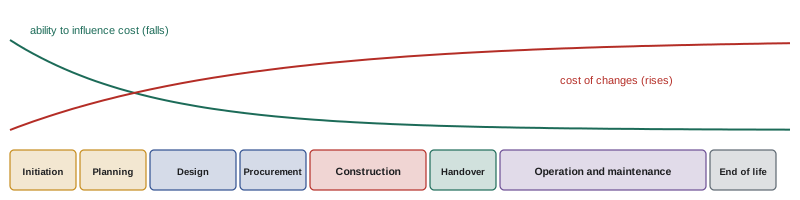
Initiation and feasibility
Projects begin with a need: a school board forecasts enrolment growth, a hospital needs more beds, a developer sees demand for rental apartments, a manufacturer needs a new plant, or a city must replace an ageing bridge. The owner defines objectives, explores options, such as renovating an existing building, building new, leasing or doing nothing, and studies feasibility. A feasibility study typically examines market demand, site options, a preliminary concept, an order-of-magnitude cost estimate, a preliminary schedule, regulatory constraints, environmental issues, financing and financial return or public benefit. For private projects, the key question is whether the project will earn an adequate return on investment; for public projects, it is whether the benefits justify the costs and whether the project fits budgets and policy priorities (ENGG-401 introduces these analyses). The decision to proceed, often called final investment decision or project approval, commits the owner to spending significant money.
Worked problem
A simple development feasibility check
A developer considers a 60-unit rental building. The total development cost, including land, design, construction, financing and fees, is estimated at $27 million. Expected net operating income after operating expenses is $1.35 million per year. If investors require a development yield (stabilized net operating income divided by total cost) of at least 5.5 %, is the project feasible?
Show solution
- Development yield = net operating income ÷ total development cost.
- Yield = \(1.35 / 27 = 0.05\), or 5.0 %.
- This is below the required 5.5 %.
- To reach 5.5 %, total cost would need to fall to \(1.35 / 0.055 \approx 24.5\) million dollars, or income would need to rise to \(0.055 \times 27 \approx 1.49\) million dollars.
Answer: At 5.0 % the project does not meet the 5.5 % target; it would need about $2.5 million of cost savings or about $140,000 more annual income.
Planning and approvals
Once the owner decides to proceed, it secures the site, arranges financing, and seeks planning approvals. Land use planning approvals, such as rezoning, site plan approval, development permits, subdivision, variances and environmental assessments, are governed by provincial or state planning laws and municipal bylaws or ordinances, and they can take months or years, especially for large or controversial projects. Public consultation, heritage reviews, traffic studies and, for major projects, environmental assessments may be required. Indigenous consultation obligations apply to many projects on or affecting traditional territories. The owner also chooses a project delivery method and procures designers. Delays at this stage are common, and construction managers are increasingly brought in early to advise on cost, schedule and constructability while the design and approvals evolve.
Design and procurement
During design, the project is defined in increasing detail, from concept to schematic design, design development and construction documents (Lesson 5). Cost estimates and schedules are refined at each stage, and the owner makes key decisions about scope, quality and budget. Building permit applications are usually made once the design is sufficiently complete. Procurement of the contractor may happen at the end of design, as in design-bid-build, or early, as in construction management and design-build (Lessons 6 and 7). Some long-lead items, such as electrical equipment or structural steel, may be ordered before construction starts to protect the schedule.
Construction
Construction is the phase most people picture: mobilizing to site, excavating, building foundations and structure, enclosing the building, installing mechanical, electrical and plumbing systems, and completing interiors and site work. For the construction manager, it is a period of intense coordination: managing the schedule, subcontractors, deliveries, inspections, quality, safety, cost, changes, documentation and communication with the owner and design team. Construction accounts for the largest share of project spending, typically well over half of total project cost on building projects, and it is where the risks identified earlier materialize: weather, ground conditions, labour availability, supply delays and design problems.
Commissioning, handover and closeout
As construction nears completion, building systems are tested and commissioned, demonstrating that heating, ventilation, plumbing, electrical, fire protection, elevators, controls and other systems work as designed and together. Deficiencies, often recorded on punch lists, are corrected. Authorities carry out final inspections and grant occupancy. The contractor delivers closeout documents: as-built drawings, operation and maintenance manuals, warranties, test reports and spare parts, and trains the owner's staff. Contract milestones such as substantial completion, which triggers payments, warranty periods and lien or claim deadlines, and final completion, are certified (CON-385). A well-managed handover is the foundation of the building's operation.
Operation, maintenance and end of life
The operating phase is by far the longest part of a building's life, often 50 years or more for buildings and longer for infrastructure. Over that period, the costs of energy, maintenance, repairs, renovations and staffing usually exceed the original construction cost several times over. Facility managers maintain systems, plan capital renewal, and adapt the building to changing needs. Eventually, buildings are renovated, repurposed or demolished, and increasingly, designers and builders consider deconstruction and material reuse from the start. Life-cycle thinking encourages owners to choose designs and materials that minimize total cost and environmental impact over the whole life, not just the initial construction cost.
| Cost category (illustrative) | Share of 40-year life-cycle cost |
|---|---|
| Design and construction | About 20–30 % |
| Energy and utilities | About 20–35 % |
| Maintenance, repair and renewal | About 25–40 % |
| Operations, cleaning, security and other | About 10–20 % |
The ability to influence
A well-known principle in construction holds that the ability to influence a project's cost and outcomes is greatest at the beginning and declines steadily, while the cost of making changes rises. Choosing a different site, reducing the floor area, or changing the structural system is relatively cheap during feasibility or concept design, when it involves redrawing and re-estimating; the same change during construction may require demolition, rework, new materials and schedule delays. This principle explains why owners increasingly involve contractors early, why value engineering is most effective during design, and why careful planning before mobilization pays off. It also explains the frustration of construction managers who inherit projects whose budgets and schedules were set unrealistically early.
Worked problem
The rising cost of a change
An owner decides to add a floor to a planned office building. If the decision is made during schematic design, the designers estimate $150,000 in redesign fees. If made after foundations are built, the contractor estimates the change will require strengthening the foundations and columns. Why is the second cost likely to be far higher?
Show solution
- During schematic design, only drawings, calculations and estimates must change; no work has been built.
- After foundations are poured, completed work may need to be demolished or strengthened, materials reordered and permits amended.
- The schedule will be extended, increasing general conditions, financing costs and possibly penalties.
- Subcontracts and procurement may need renegotiation, often at less favourable prices.
Answer: Because built work, procurement, permits and the schedule must all change, a late change can cost many times more than the same change made early.
The construction manager across the life cycle
Construction managers contribute at every stage: preparing conceptual estimates and schedules during feasibility, advising on constructability and cost during design, managing procurement, running construction, leading commissioning and handover, and in some firms providing facility management or warranty services. Understanding the whole life cycle helps construction managers see beyond the immediate project, anticipating the operator's needs, reducing future maintenance problems, and building relationships with owners who will return for their next project.
Stage gates and approvals
Many owners manage the life cycle through stage gates: formal decision points at which the project is reviewed before moving to the next phase. At each gate, the owner reviews the design, estimate, schedule, risks and business case and decides to proceed, revise or stop. Public owners often require approval from a board or government at key gates, such as after feasibility, after schematic design and before contract award. Stage gates help owners avoid committing large sums before the project is well understood, but they also add time, and contractors involved early must plan for pauses while approvals are obtained.
Risks across the life cycle
Different risks dominate at different phases. In feasibility and planning, the main risks are market demand, approvals, site conditions and financing. In design, they are scope growth, coordination errors and cost escalation. In procurement, they are market conditions, bid prices and contract terms. In construction, they are productivity, weather, ground conditions, supply delays, changes and safety. In commissioning and handover, they are system performance and incomplete documentation. In operation, they are maintenance, energy costs and changing needs. Recognizing when each risk arises helps owners and construction managers address it at the right time.
The project charter and success criteria
At the start of a project, many owners prepare a project charter that records the project's purpose, objectives, scope, budget, schedule, key stakeholders, constraints, risks and success criteria. Success is usually judged against cost, time and quality, sometimes called the iron triangle, but increasingly also against safety, sustainability, user satisfaction and community benefits. Clear success criteria help everyone make consistent decisions throughout the life cycle, especially when trade-offs arise, such as whether to spend more to finish earlier.
Lessons learned
At the end of each phase, and especially at project completion, good organizations hold lessons-learned reviews: what went well, what went wrong, and what should be done differently next time. Lessons might concern design details that caused problems, subcontractors who performed well or poorly, estimating assumptions that proved wrong, or schedule logic that worked. Recording these lessons in a usable form, and actually consulting them at the start of the next project, is one of the most valuable but most neglected habits in construction. Owners who build repeatedly, such as school boards and transportation agencies, benefit greatly from feeding operational experience back into the design standards for future projects.
Common mistakes
MistakeTreating construction as the whole project.
InsteadConsider every phase from feasibility to end of life.
MistakeSetting budgets before feasibility is understood.
InsteadRefine estimates as the design develops.
MistakeMaking scope changes during construction.
InsteadMake major decisions early when changes are cheap.
MistakeNeglecting closeout documents.
InsteadDeliver complete as-builts, manuals and training.
MistakeChoosing the cheapest initial option automatically.
InsteadConsider life-cycle cost.
Summary and key terms
- Projects move from initiation and feasibility through planning, design, procurement, construction, handover, operation and end of life.
- Feasibility studies test demand, cost, schedule, approvals and return.
- Planning approvals and consultation can take months or years.
- Construction is the largest spending phase and where risks materialize.
- Commissioning and closeout prepare the building for operation.
- Operation lasts decades and usually costs more than construction.
- The ability to influence cost is greatest early, when changes are cheapest.
- Project life cycle
- The phases of a project from idea to end of life.
- Feasibility study
- Assessment of whether a project should proceed.
- Development yield
- Net operating income divided by total development cost.
- Planning approval
- Permission to use land for a proposed development.
- Fast-track
- Overlapping design and construction.
- Commissioning
- Verifying that systems work as intended.
- Substantial completion
- Milestone when the work is ready for its intended use.
- Closeout
- Completing documentation and contractual obligations.
- Life-cycle cost
- Total cost over a facility's life.
- Value engineering
- Improving value by examining function and cost.
Practice problems
Work each problem on paper first, then reveal the answer to check.
List the life cycle phases.
Show answer
Initiation, planning, design, procurement, construction, handover, operation, end of life.
Name four topics in a feasibility study.
Show answer
Demand, site, cost, schedule, approvals, financing, return.
Development yield for $1.2M income on $20M cost?
Show answer
6 %.
Name two planning approvals.
Show answer
Rezoning, site plan, development permit, variance, environmental assessment.
Why order long-lead items early?
Show answer
To protect the schedule.
What happens at commissioning?
Show answer
Systems are tested to confirm they work as designed.
Name three closeout documents.
Show answer
As-builts, O and M manuals, warranties, test reports.
Which phase usually lasts longest?
Show answer
Operation and maintenance.
When is the ability to influence cost greatest?
Show answer
At the beginning of the project.
Why do late changes cost more?
Show answer
Built work, procurement, permits and schedules must change.
Lesson quiz · 5 questions
Score 60% or more to complete this lesson.
Create a free account to save your progress, take quizzes and earn a certificate.