
CON-100 · Lesson 10 of 12 · 25 min
Technology, productivity and the future of construction
Construction has a reputation as a slow adopter of new technology, yet the industry is changing quickly. Construction managers now carry tablets loaded with drawings and models, sites are scanned by drones and laser scanners, schedules are linked to 3D models, components are built in factories and shipped to site, and data from equipment and sensors feed dashboards in head office. At the same time, the industry faces pressure to reduce carbon emissions, build more housing faster and safely, and cope with labour shortages. This lesson surveys the technologies and trends reshaping construction: digital design and BIM, field technology, reality capture, prefabrication and modular construction, automation and robotics, data and artificial intelligence, and sustainability, along with the challenges of adopting new technology.
Why productivity matters
Lesson 9 noted that construction labour productivity has grown slowly for decades. Even modest improvements have large effects: because labour often makes up a third or more of construction cost, and because many projects are delayed by labour shortages, a 10 % productivity gain can reduce costs, shorten schedules and allow more projects to be built with the same workforce. Productivity is also linked to safety and quality: well-planned work with fewer interruptions tends to produce fewer injuries and less rework. Technology is one lever for improvement, but most gains come from combining technology with better planning, standardization and collaboration.
Building information modelling
Building information modelling (BIM), introduced in Lesson 5, is the foundation of much construction technology. For contractors, BIM supports:
- Coordination: combining architectural, structural and mechanical, electrical and plumbing models to detect clashes before construction, reducing rework.
- Quantity takeoff and estimating directly from model elements (CON-200).
- 4D scheduling: linking model elements to schedule activities to visualize and test the construction sequence.
- 5D cost: linking costs to model elements to track budgets as the design changes.
- Prefabrication: generating fabrication drawings for ductwork, piping, steel and assemblies.
- Facility management: handing over models with equipment data for operation.
Public owners in both countries increasingly require BIM on major projects, and international standards such as the ISO 19650 series set out how information should be managed.
Field technology and connected sites
The site office is moving onto mobile devices. Cloud-based construction management platforms allow superintendents and subcontractors to view the latest drawings and models, mark up issues, create RFIs, complete inspections, record daily reports, track deficiencies and share photos in real time from the field. Digital safety tools manage orientations, hazard assessments and permits. Time and equipment tracking apps reduce paperwork. Connected equipment reports location, hours, fuel and maintenance needs. Sensors monitor concrete curing temperatures and strength gain, environmental conditions, and structural movement. These tools improve information flow, but they also require training, connectivity and discipline in keeping data current.
Reality capture: drones, scanning and photography
Reality capture records the actual condition of a site in digital form. Drones capture aerial photographs and video for progress reporting, stockpile volumes and site logistics, and produce photogrammetric models and orthophotos. Terrestrial laser scanners create point clouds accurate to millimetres, used to document existing buildings before renovation, check that work is built in the right place, and compare as-built conditions with the model. 360-degree cameras carried around the site create walk-through records linked to floor plans, useful for remote review and disputes. Drone operation is regulated, and pilots must hold the appropriate certificates and follow airspace rules.
In Canada, drones weighing 250 g to 25 kg are regulated under Part IX of the Canadian Aviation Regulations; pilots need a Transport Canada pilot certificate (basic or advanced operations) and registered drones, and advanced operations are required near people and in controlled airspace.
Worked problem
Calculating a stockpile volume from a drone survey
A drone survey of a soil stockpile produces a surface model. The software reports an average stockpile height of 3.2 m above the base over a footprint of 1,250 square metres. Estimate the volume, and the number of truckloads to remove it if each truck carries 12 cubic metres of loose material and the soil bulks by 25 % when loaded.
Show solution
- In-place (bank) volume: \(3.2 \times 1{,}250 = 4{,}000\) m³. (Stockpiles are already loose, but treat this as the measured volume.)
- If the measured volume is the pile as it stands, loaded volume is similar; if it is compacted fill, apply bulking: \(4{,}000 \times 1.25 = 5{,}000\) m³ loose.
- Truckloads at 12 m³: \(5{,}000 / 12 \approx 417\) loads (or about 334 if no bulking applies).
- Drone surveys repeated over time show how quickly material is being placed or removed.
Answer: About 4,000 m³ measured, roughly 334–417 truckloads depending on whether bulking applies.
Prefabrication and modular construction
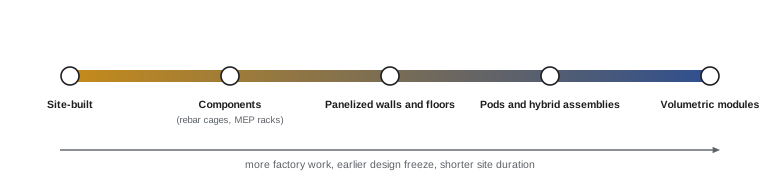
Moving work from the site to a factory, often called industrialized construction or offsite construction, is one of the most promising ways to improve productivity, quality and safety. It ranges from prefabricated components, such as rebar cages, wall panels, mechanical and electrical racks, bathroom pods and precast concrete, to fully volumetric modules that arrive as finished rooms. Factory work is protected from weather, uses repeatable processes and jigs, and can proceed while site foundations are built, shortening schedules significantly. Mass timber, using cross-laminated timber panels and glulam beams, combines prefabrication with lower embodied carbon. Challenges include transportation limits, the need to freeze designs earlier, financing of factory work before delivery, codes and inspections for factory-built components, and the boom-and-bust history of modular manufacturers.
Automation and robotics
Robots and automated equipment are beginning to appear on construction sites. Machine control systems guide excavators, dozers and graders to design surfaces using GNSS and models, improving accuracy and productivity in earthwork (CON-250). Robotic total stations and layout robots mark lines on slabs from the model. Exoskeletons reduce strain for overhead work. Specialized robots tie rebar, drill holes in ceilings, lay bricks, spray insulation and fireproofing, and print concrete structures, and autonomous equipment is used in mining and some heavy civil work. Most of these technologies automate specific repetitive tasks rather than replacing tradespeople, and they require careful integration with site workflows and safety systems.
Data and artificial intelligence
Projects generate enormous amounts of data: schedules, cost reports, RFIs, daily reports, photos, sensor readings and safety observations. Analysing this data helps contractors identify patterns, such as which activities usually run late, where safety incidents cluster or which subcontractors perform best. Artificial intelligence tools are increasingly used to search and summarize documents and specifications, compare drawing revisions, assist with estimating and scheduling, analyse site photos for progress and safety hazards, and generate reports. These tools can save time, but their output must be checked by people who understand construction, because errors in estimates, schedules or safety assessments have real consequences, and because contracts and professional responsibilities remain with people, not software.
Sustainability and decarbonization
Buildings and construction account for a large share of global energy use and greenhouse gas emissions, from operating energy and from the embodied carbon in materials such as cement and steel. Construction is therefore central to climate goals. Trends include higher energy code requirements, net-zero and passive house buildings, electrification of heating with heat pumps, low-carbon concrete and recycled steel, mass timber, embodied carbon limits in public procurement, construction waste diversion, electrified construction equipment and climate-resilient design for heat, flooding and wildfire. Construction managers increasingly track waste, emissions and materials data, and work with rating systems such as LEED and zero-carbon building standards (CON-430).
Adopting new technology
New technology succeeds only when it solves a real problem and is adopted by the people who must use it. Common barriers include the cost of software and training, thin margins that discourage investment, the temporary nature of project teams, incompatible systems between firms, poor connectivity on sites, resistance to change and unclear contractual responsibilities for digital information. Successful adopters start with clear objectives, pilot tools on real projects, train and support users, standardize processes and data, measure results, and share lessons across the company. Construction managers are often the people who make technology work in practice, translating promises into everyday routines.
Digital twins and handover data
A digital twin is a digital model of a building or asset that is connected to data from the real facility, such as sensor readings, equipment performance and maintenance records, and updated over its life. Contractors contribute to digital twins by delivering accurate as-built models and structured equipment data at handover, using standards such as COBie for asset information. Owners can then use the twin to plan maintenance, optimize energy use and manage renovations. Producing good handover data requires planning from the start of the project, with clear requirements for what information is needed, in what format and when it must be delivered.
Cybersecurity and data protection
As construction becomes more digital, it becomes more exposed to cyber threats. Contractors have been targeted by ransomware attacks, payment fraud using compromised email accounts, and theft of sensitive drawings for secure facilities. Building systems themselves, such as controls, access systems and cameras, are increasingly networked and must be installed and configured securely. Construction managers should follow company security policies, verify payment instructions by phone before changing bank details, protect sensitive project information and coordinate with owners on security requirements for building systems.
The human side of technology
Technology changes how people work, and adoption succeeds or fails on people. Superintendents with decades of experience may be sceptical of new tools, while younger staff may be comfortable with software but lack field experience. Successful firms pair the two, involve field staff in selecting tools, keep processes simple, and show how technology saves time rather than adding paperwork. Construction managers who combine practical construction knowledge with digital skills are in high demand, and many new roles, such as VDC coordinator and construction technology manager, have emerged from this combination.
Mass timber and new materials
Mass timber, using cross-laminated timber panels, glued-laminated beams and columns and other engineered wood products, has grown rapidly as building codes in both countries have expanded the height of permitted timber buildings. Canada's national building code and several provincial codes, and the US International Building Code since its 2021 edition, allow encapsulated mass timber buildings of up to about 12 storeys or more, with conditions for fire protection. Mass timber offers faster, quieter erection, lighter structures and lower embodied carbon, but requires careful moisture protection during construction and coordination of prefabricated elements. Other new materials, such as low-carbon cements, high-performance insulation and advanced glazing, are also changing how buildings are designed and built.
Technology and safety
Many technologies improve safety directly: wearable sensors that detect falls or exposure to heat, proximity warning systems that alert workers near moving equipment, drones that inspect roofs and structures without sending people to height, exoskeletons that reduce strain, and digital permits and inspections that make hazards visible to everyone. Technology does not replace safety leadership, but it can provide better information and remove people from some hazardous tasks.
Evaluating a technology
When considering a new tool, construction managers can ask a few practical questions: what problem does it solve, and how is that problem handled now; what will it cost in software, hardware, training and time; who will use it, and will they; how does it fit with existing systems and contracts; what data does it create, and who owns it; and how will success be measured. A small pilot on one project, with clear measures, usually answers these questions better than a sales presentation.
Common mistakes
MistakeBuying technology without a clear problem to solve.
InsteadStart from the problem and pilot solutions.
MistakeAssuming BIM alone prevents rework.
InsteadCombine models with disciplined coordination processes.
MistakeFlying drones without the right certification.
InsteadFollow aviation rules and site procedures.
MistakeFreezing modular designs too late.
InsteadPlan design decisions early for offsite work.
MistakeTrusting AI output unchecked.
InsteadVerify estimates, schedules and safety analyses.
Summary and key terms
- Productivity gains reduce cost, shorten schedules and stretch scarce labour.
- BIM supports coordination, quantities, 4D scheduling and facility management.
- Field platforms and connected equipment improve information flow.
- Drones, laser scanning and 360 cameras capture reality accurately.
- Prefabrication and modular construction move work into factories.
- Robotics, data analysis and AI automate specific tasks and need human judgement.
- Sustainability and successful adoption shape construction's future.
- BIM
- Building information modelling.
- 4D scheduling
- Linking model elements to schedule activities.
- Clash detection
- Finding conflicts between combined models.
- Reality capture
- Digitally recording existing conditions.
- Point cloud
- Set of measured 3D points from scanning.
- Photogrammetry
- Creating models from overlapping photographs.
- Offsite construction
- Building components or modules in a factory.
- Volumetric module
- Factory-built three-dimensional unit of a building.
- Machine control
- GNSS and model guidance of construction equipment.
- Embodied carbon
- Emissions from producing and installing materials.
Practice problems
Work each problem on paper first, then reveal the answer to check.
Why do small productivity gains matter?
Show answer
Labour is a large share of cost and is scarce.
Name three uses of BIM for contractors.
Show answer
Coordination, takeoff, 4D scheduling, prefabrication, handover.
What is ISO 19650?
Show answer
International standards for information management with BIM.
Name two field technologies.
Show answer
Cloud platforms, digital forms, connected equipment, sensors.
What does a laser scanner produce?
Show answer
A point cloud.
Volume of a pile 2.5 m high on 800 m²?
Show answer
2,000 m³.
Name two benefits of offsite construction.
Show answer
Weather protection, quality, speed, safety.
Name two challenges of modular construction.
Show answer
Transport limits, early design freeze, financing, inspections.
What does machine control do?
Show answer
Guides equipment to design surfaces using GNSS and models.
Name two decarbonization trends.
Show answer
Low-carbon concrete, mass timber, heat pumps, embodied carbon limits.
Lesson quiz · 5 questions
Score 60% or more to complete this lesson.
Create a free account to save your progress, take quizzes and earn a certificate.