
CON-130 · Lesson 10 of 12 · 33 min
Unit costs, productivity and labour
Quantities say how much work there is; productivity says how long it takes; unit costs say what it costs. The three are linked by simple arithmetic, and that arithmetic sits at the centre of estimating, scheduling and cost control. A construction manager who can build up a unit cost from a crew, a productivity rate and material prices can check a subcontractor's quote, estimate the cost of a change, decide whether overtime will really save time, and judge whether a crew is on track. This lesson covers unit costs, crew rates and labour burden, productivity rates and durations, equipment production and truck matching, and the effects of overtime and crowding on output.
Unit costs
A unit cost is the cost of one unit of work: dollars per cubic metre of concrete placed, per square foot of drywall hung, per linear metre of pipe laid. It is calculated by dividing a total cost by the quantity it produced, or built up from its parts: labour, equipment and materials per unit. Unit costs make comparison possible: a crew that placed 85 m³ of concrete for $3,400 of labour achieved $40 per m³, which can be compared with the estimate, with other jobs and with other crews.
Unit costs are only comparable when their scope is the same. A drywall price per square metre may include hanging only, or hanging and taping, or hanging, taping and sanding to a specified level of finish. A concrete price may include the concrete only, or placing and finishing, or pumping. Write down what each unit cost includes, and check scope before comparing two numbers.
Crew rates and labour burden
Work is done by crews, groups of workers with a typical mix of trades, such as a foreman, three carpenters and a labourer for formwork. The crew rate is the cost per hour of the whole crew. Each worker's hourly cost to the employer is more than the wage on the pay slip: the employer also pays payroll taxes, workers' compensation premiums, benefits and other costs. These additions, expressed as a percentage of wages, are the labour burden.
In Canada, typical burden items include the employer's share of Canada Pension Plan (or Quebec Pension Plan) contributions and Employment Insurance premiums, provincial workers' compensation premiums (which vary widely by trade and province), vacation pay and statutory holiday pay required by provincial employment standards, union benefits and pension contributions where applicable, and any provincial payroll or health taxes. On unionized work, the collective agreement sets wages and contributions in detail.
Burden commonly adds 25 to 50 % or more to base wages, depending on the trade, the jurisdiction, and whether the work is unionized. Estimators should use their company's actual figures; an estimate that prices labour at base wage will be badly short.
Worked problem
Burdened labour rates
A carpenter's base wage is $40.00 per hour and the burden is 32 %. (a) What is the burdened hourly cost? (b) Overtime is paid at 1.5 times base wage, and some burden items (such as vacation pay) apply to overtime wages while others (such as fixed benefits per hour worked) do not. If 20 points of the burden apply to all wages and the remaining 12 points are fixed at their straight-time value per hour, what is the burdened cost of an overtime hour?
Show solution
- (a) Burdened rate = 40.00 × 1.32 = $52.80 per hour.
- (b) Overtime wage = 1.5 × 40.00 = $60.00. Percentage burden = 0.20 × 60.00 = $12.00. Fixed burden = 0.12 × 40.00 = $4.80. Total = 60.00 + 12.00 + 4.80 = $76.80 per hour.
- An overtime hour costs 76.80 ÷ 52.80 = 1.45 times a straight-time hour in this example, before any loss of productivity.
Answer: $52.80 per straight-time hour; about $76.80 per overtime hour.
Productivity rates
Productivity can be expressed in two equivalent ways: output per unit of time, such as 6.5 m² of formwork per crew-hour, or time per unit of output, such as 0.15 crew-hours per m² or 0.77 labour-hours per m². Estimating references and company databases use both. Labour-hours (or worker-hours) count every person in the crew; crew-hours count the crew as one unit. A five-person crew working one hour provides one crew-hour and five labour-hours.
Productivity rates from references are averages for typical conditions. Real productivity depends on the complexity of the work, repetition, access, weather, the skill and motivation of the crew, supervision, and the availability of materials, equipment and information. A good estimator adjusts published rates for the conditions of the job and, better still, uses records from the company's own past projects, which is why accurate time reporting by cost code is so valuable.
Worked problem
Labour cost and duration for wall forms
The wall in Lesson 4 needs 181.5 m² of formwork contact area. A crew of one foreman ($62/h burdened), three carpenters ($55/h each) and one labourer ($44/h) forms and strips walls at 6.5 m² per crew-hour. Find (a) the crew rate, (b) the labour unit cost per m², (c) the crew-hours and working days at 8 hours per day, and (d) the labour cost.
Show solution
- (a) Crew rate = 62 + 3 × 55 + 44 = $271 per hour.
- (b) Labour unit cost = 271 ÷ 6.5 = $41.69 per m².
- (c) Crew-hours = 181.5 ÷ 6.5 = 27.9 hours, about 3.5 days of 8 hours (5 people × 27.9 = 140 labour-hours).
- (d) Labour cost = 181.5 × 41.69 = $7,567, or 27.9 × 271 = $7,567.
Answer: Crew rate $271/h; $41.69 per m²; about 28 crew-hours (3.5 days); about $7,570.
Building up a unit price
A complete unit price combines labour, equipment and material costs per unit, then adds overhead and profit. Building one up line by line shows where the money goes and makes the price easy to adjust when one input changes, such as a material price increase or a slower productivity rate.
| Component | Basis | Cost per m² |
|---|---|---|
| Concrete, 125 mm thick | 0.125 m³/m² × $260/m³ × 1.05 waste | $34.13 |
| Reinforcing (welded wire or bars) | Supplier quote per m², installed material | $9.50 |
| Vapour barrier and granular base | Material per m² | $11.20 |
| Placing and finishing labour | Crew $310/h at 28 m²/h | $11.07 |
| Equipment (pump, power trowel, screed) | $1,850 per pour ÷ 300 m² | $6.17 |
| Direct cost | Sum | $72.07 |
| Overhead and profit at 12 % markup | 0.12 × 72.07 | $8.65 |
| Unit price | Direct cost × 1.12 | $80.72 |
The same structure works in square feet: 125 mm is about 5 in, and $80.72 per m² is $80.72 ÷ 10.7639 = $7.50 per ft². Prices vary enormously by region and year, so the numbers in this table are for practising the method, not for estimating real work.
Equipment production
Equipment production is estimated from the machine's capacity per cycle, the number of cycles per hour, and factors for how full each load is and how much of each hour is productive. For an excavator or loader, the cycle includes digging, swinging, dumping and returning. The fill factor, or bucket factor, adjusts for how full the bucket is in a given material: near 1.0 in loose sand, lower in hard clay or blasted rock. The job efficiency factor allows for delays; a common assumption is a 50-minute productive hour, an efficiency of 50 ÷ 60 = 0.83.
Here Q is production per hour, q is the heaped bucket capacity, F is the fill factor, t_c is the cycle time in seconds and E is the efficiency. Production calculated from bucket volumes is in loose volume; divide by (1 + swell) to convert to bank volume, which is how excavation is usually measured and paid.
Worked problem
Excavator production and truck matching
An excavator with a 1.5 m³ (about 2.0 yd³) bucket digs common earth with a fill factor of 0.90 and a cycle time of 24 seconds, working a 50-minute hour. The soil swells 25 %. Trucks hold 12 loose m³ and take 40 minutes for the round trip to the disposal site and back. (a) What is the hourly production in loose and bank m³? (b) How long will it take to dig the 650 bank m³ basement from Lesson 5? (c) How many trucks keep the excavator busy?
Show solution
- (a) Cycles per hour = 3,600 ÷ 24 = 150; productive cycles = 150 × 0.83 = 125. Loose production = 1.5 × 0.90 × 125 = 168.75 loose m³/h; bank production = 168.75 ÷ 1.25 = 135 bank m³/h.
- (b) Time = 650 ÷ 135 = 4.8 hours of digging, plus moving the machine, sloping and trimming.
- (c) Loading one truck takes 12 ÷ 168.75 h = 0.0711 h = 4.3 minutes, about 9 bucket loads. A truck's full cycle is 40 + 4.3 = 44.3 minutes. Trucks needed = 44.3 ÷ 4.3 = 10.4.
- With 10 trucks the excavator waits briefly for trucks; with 11, trucks wait for the excavator. Since the excavator and operator usually cost more per hour than one truck, contractors often choose 11, or adjust the haul route.
Answer: About 169 loose m³/h (135 bank m³/h); about 5 hours of digging; 10 to 11 trucks.
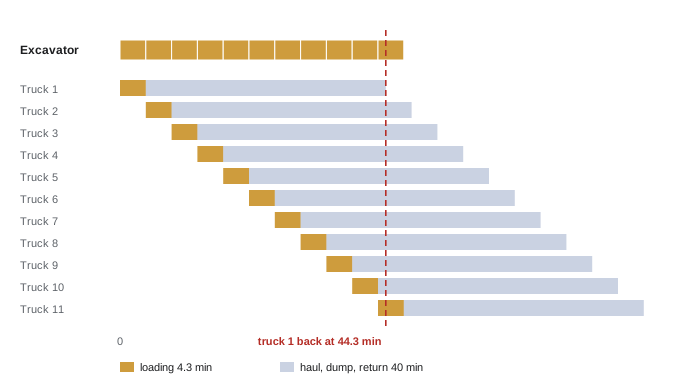
The truck-matching logic applies to any paired operation: pump and concrete trucks (Lesson 5), crane and steel delivery, paver and asphalt trucks. The slower element sets the pace, and the cost of idle time on the more expensive element usually decides which one to oversupply.
Overtime, crowding and other productivity losses
Schedules often tempt managers to add hours or people. The arithmetic of Lesson 2 says that doubling the crew halves the time, but real productivity per worker falls when crews are crowded, when work runs long hours for weeks, when crews are stacked on top of other trades or when materials and information are late. Industry studies of extended overtime have generally found that productivity per hour declines as weekly hours rise and as overtime continues for longer periods, so that the extra hours produce less than their share of output while costing a premium rate.
Worked problem
Does overtime pay?
A crew of six works 40 hours a week at $52.80 per burdened hour and produces 100 units of work per week. The project wants to finish 30 % sooner by working 50-hour weeks for several weeks. Overtime hours cost $76.80 each (from the earlier example), and records suggest productivity per hour falls by 10 % across all hours when the crew works 50-hour weeks for an extended period. (a) What is the weekly output and cost with overtime? (b) What is the cost per unit, compared with straight time? (c) Will the crew finish 30 % sooner?
Show solution
- (a) Straight-time productivity = 100 ÷ (6 × 40) = 0.4167 units per labour-hour. With overtime: 6 × 50 = 300 hours × 0.4167 × 0.90 = 112.5 units per week. Cost = 6 × (40 × 52.80 + 10 × 76.80) = 6 × (2,112 + 768) = $17,280.
- (b) Straight time: 6 × 40 × 52.80 = $12,672 for 100 units = $126.72 per unit. Overtime: 17,280 ÷ 112.5 = $153.60 per unit, 21 % more.
- (c) Output rises by only 12.5 %, so the work finishes about 11 % sooner (1 ÷ 1.125 = 0.89), far short of 30 %. Adding a second crew or a second shift, where space allows, may be more effective.
Answer: About 112.5 units a week at $153.60 per unit, 21 % more per unit, finishing only about 11 % sooner.
These numbers are illustrative, but the pattern is real: overtime is useful for short bursts and specific bottlenecks, and becomes expensive and ineffective when it is used for long periods. Claims for lost productivity caused by changes and delays rely on the same arithmetic, comparing actual unit rates with planned or unimpacted ones.
Tracking productivity on site
Productivity is tracked by recording hours by cost code and quantities installed, then comparing actual unit rates with the estimate. If a crew has used 60 % of the budgeted hours but installed only 45 % of the quantity, the projected final hours are the budget times 60 ÷ 45, a 33 % overrun unless performance improves. The earlier such variances are found, the more options the team has: more supervision, a different method, better material staging or a change claim if the cause is outside the contractor's control.
Worked problem
A productivity check at mid-job
Drywall hanging was budgeted at 1,200 labour-hours for 9,000 m² (96,875 ft²). After four weeks, 4,050 m² (43,594 ft²) are hung and 600 hours have been charged. (a) What is the percent complete? (b) What are the earned hours and the productivity factor? (c) If performance continues, what will the final hours be?
Show solution
- (a) Percent complete = 4,050 ÷ 9,000 = 45 %.
- (b) Earned hours = 1,200 × 0.45 = 540; productivity factor = 540 ÷ 600 = 0.90.
- (c) Forecast final hours = 1,200 ÷ 0.90 = 1,333 hours, an overrun of about 133 hours, or 11 %.
Answer: 45 % complete; factor 0.90; forecast about 1,333 hours (11 % over budget).
Common mistakes
MistakePricing labour at base wage.
InsteadAdd the full labour burden for the trade and jurisdiction.
MistakeComparing unit costs with different scopes.
InsteadWrite down what each unit cost includes before comparing.
MistakeMixing crew-hours and labour-hours.
InsteadA crew-hour is the whole crew for an hour; labour-hours count each person.
MistakeUsing bucket volume as bank production.
InsteadBucket production is loose volume; divide by (1 + swell) for bank volume.
MistakeAssuming overtime hours produce at straight-time rates.
InsteadAllow for productivity loss and premium pay when evaluating overtime.
Summary and key terms
- Unit cost = total cost ÷ quantity; compare only like scopes.
- Crew rates use burdened labour costs, typically 25 to 50 % above base wage.
- Duration = quantity ÷ crew output; labour unit cost = crew rate ÷ crew output.
- Unit prices combine labour, equipment and materials, then overhead and profit.
- Equipment production = capacity × fill factor × cycles per hour × efficiency.
- Truck numbers match the cycle time of the loading equipment.
- Extended overtime and crowding reduce productivity; track earned versus actual hours.
- Unit cost
- Cost of one unit of work.
- Crew rate
- Hourly cost of a whole crew.
- Labour burden
- Employer costs added to wages.
- Crew-hour
- One crew working for one hour.
- Labour-hour
- One person working for one hour.
- Productivity rate
- Output per unit of time or time per unit of output.
- Fill factor
- Fraction of rated bucket capacity actually carried.
- Job efficiency
- Productive fraction of each hour.
- Earned hours
- Budget hours for the work actually completed.
- Productivity factor
- Earned hours divided by actual hours.
Practice problems
Work each problem on paper first, then reveal the answer to check.
A crew costing $240/h installs 30 m² per hour. Labour unit cost?
Show answer
$8.00 per m².
A base wage of $36.50 with 38 % burden. Burdened rate?
Show answer
$50.37.
Quantity 1,500 ft² at 120 ft² per crew-hour. Crew-hours?
Show answer
12.5.
A 4-person crew works 12.5 crew-hours. Labour-hours?
Show answer
50.
Bucket 2.0 yd³, fill 0.85, 30 s cycles, 50-min hour. Loose production?
Show answer
2.0 × 0.85 × 120 × 0.83 = 170 LCY/h (rounded).
Convert 170 LCY/h to bank at 20 % swell.
Show answer
141.7 BCY/h.
Loading takes 5 min and the truck round trip 35 min. Trucks needed?
Show answer
(35 + 5) ÷ 5 = 8.
Budget 800 h; 30 % complete; 300 h used. Productivity factor?
Show answer
240 ÷ 300 = 0.80.
Forecast final hours for that activity?
Show answer
800 ÷ 0.80 = 1,000 h.
Direct cost $64.00 per unit with a 15 % markup. Unit price?
Show answer
$73.60.
Lesson quiz · 5 questions
Score 60% or more to complete this lesson.
Create a free account to save your progress, take quizzes and earn a certificate.