
CON-130 · Lesson 5 of 12 · 32 min
Concrete, aggregates, density and earthwork factors
Lesson 4 calculated the volumes of elements as they appear on the drawings. Those geometric volumes are only the start. Concrete arrives in trucks of limited size and must keep flowing at a steady rate; aggregates are bought by mass but placed and compacted by volume; and soil changes volume as soon as it is dug, swelling when it is loosened and shrinking when it is compacted. This lesson connects volume to mass through density, plans concrete deliveries and pour rates, converts between bank, loose and compacted earth, and explains why a contractor who ignores these factors can be badly wrong on trucking, disposal and fill costs even when every geometric volume is correct.
Density and unit weight
Density is mass per unit volume. It turns a volume into a mass, which is what trucks, cranes, scales and suppliers care about. In SI it is expressed in kilograms per cubic metre (kg/m³), or tonnes per cubic metre. In US customary units, unit weight is expressed in pounds per cubic foot (lb/ft³ or pcf), and aggregate suppliers often quote tons per cubic yard.
| Material | Typical density (kg/m³) | Typical unit weight (lb/ft³) |
|---|---|---|
| Normal-weight concrete | 2,300 to 2,400 | 145 to 150 |
| Reinforced concrete (with steel) | about 2,400 to 2,500 | about 150 to 155 |
| Lightweight structural concrete | 1,450 to 1,850 | 90 to 115 |
| Steel | 7,850 | 490 |
| Water | 1,000 | 62.4 |
| Crushed stone, loose | 1,450 to 1,700 | 90 to 105 |
| Granular base, compacted | 2,050 to 2,300 | 128 to 144 |
| Common earth, in place (bank) | 1,600 to 2,000 | 100 to 125 |
| Dry sand, loose | 1,450 to 1,650 | 90 to 103 |
Because 1 m³ of water has a mass of 1,000 kg, densities in kg/m³ divided by 1,000 give the specific gravity, the ratio of a material's density to that of water. Normal concrete with a density of 2,400 kg/m³ has a specific gravity of 2.4. In US units, 150 lb/ft³ × 27 = 4,050 lb per cubic yard, a little over two short tons.
Worked problem
Mass of a precast element and a load of stone
(a) A precast concrete panel is 6.0 m × 3.0 m × 200 mm. With a density of 2,450 kg/m³, what is its mass, and its weight in kN? (b) A dump truck carries 14 yd³ of loose crushed stone with a unit weight of 100 lb/ft³. What is the load in short tons?
Show solution
- (a) Volume = 6.0 × 3.0 × 0.2 = 3.6 m³; mass = 3.6 × 2,450 = 8,820 kg = 8.82 t.
- Weight = 8,820 × 9.81 = 86,500 N, about 86.5 kN.
- (b) Volume = 14 × 27 = 378 ft³; weight = 378 × 100 = 37,800 lb = 37,800 ÷ 2,000 = 18.9 short tons.
- The truck's legal payload, not just its body size, limits how much it can carry; heavy materials may fill the legal limit before they fill the body.
Answer: The panel has a mass of about 8.8 t (86.5 kN); the stone load is about 18.9 tons.
Ready-mixed concrete: trucks and pour rates
Ready-mixed concrete is delivered in truck mixers that typically carry a maximum of about 7 to 10 m³ (about 9 to 12 yd³), depending on the truck and on legal axle limits. Suppliers charge extra for short loads below a minimum, for waiting time beyond an allowance per load and for after-hours delivery. Planning a pour therefore involves the total volume, the size of each load, the rate at which the crew and pump can place concrete, and the travel time from the plant.
The interval between trucks should match the placing rate, so that a truck is ready as the previous one empties but none wait long enough for the concrete to stiffen or for waiting charges to start. Specifications limit the time from batching to discharge, commonly to about 90 to 120 minutes, and allow less in hot weather.
Worked problem
Planning a slab pour
A slab needs 60 m³ of concrete including waste. Trucks carry 9 m³, the pump and crew can place 30 m³ per hour, and the round trip from the plant, including loading and washing, takes 75 minutes. (a) How many loads are needed, and what size is the last one? (b) How often should trucks arrive? (c) How many trucks must the supplier assign? (d) How long will the pour take?
Show solution
- (a) 60 ÷ 9 = 6.67, so 7 loads: six full loads of 9 m³ (54 m³) and a last load of 6 m³. Order the last load after measuring what remains, to avoid waste.
- (b) Interval = 9 m³ ÷ 30 m³/h = 0.3 h = 18 minutes.
- (c) Trucks in circulation = 75 ÷ 18 = 4.2, so 5 trucks are needed to keep up.
- (d) Placing time = 60 ÷ 30 = 2.0 hours, plus set-up, pump priming and clean-up.
Answer: 7 loads (last one 6 m³), a truck every 18 minutes, 5 trucks, about 2 hours of placing.
For small jobs, bagged concrete mix is common. Bag yields are printed on the bag and are typically about 0.014 m³ for a 30 kg bag and about 0.60 ft³ for an 80 lb bag. Dividing the required volume by the yield gives the number of bags; a fence post hole needing 0.05 m³ takes 0.05 ÷ 0.014 = 3.6, so 4 bags of 30 kg.
Mix proportions by mass
Modern concrete is batched by mass, not volume, because mass is easier to measure accurately. A mix design states the mass of each ingredient per cubic metre or cubic yard of concrete. The water–cement ratio, or water to cementing materials ratio when fly ash or slag replaces part of the cement, is the mass of water divided by the mass of cementing materials. Lower ratios give stronger, more durable concrete, and exposure classes in the standards set maximum ratios for concrete exposed to freezing, de-icing salts or sulphates.
Worked problem
Water from a water–cement ratio
A mix contains 350 kg of cementing materials per m³ with a maximum water–cementing materials ratio of 0.45. (a) What is the maximum water content? (b) A finisher adds 20 L of water to a 9 m³ truck to make it easier to place. What is the new ratio?
Show solution
- (a) Water = 0.45 × 350 = 157.5 kg per m³, which is 157.5 L.
- (b) Water in the truck = 9 × 157.5 = 1,417.5 kg; cement = 9 × 350 = 3,150 kg.
- New water = 1,417.5 + 20 = 1,437.5 kg; ratio = 1,437.5 ÷ 3,150 = 0.456, above the 0.45 limit.
- Adding water on site raises the ratio and lowers strength and durability, which is why specifications control or forbid it and why water added must be recorded on the delivery ticket.
Answer: Maximum water 157.5 kg/m³; adding 20 L to the truck raises the ratio to about 0.456, exceeding the limit.
Aggregates: bought by mass, placed by volume
Granular base, crushed stone and sand are usually bought and delivered by mass, but drawings specify them by compacted thickness. To order, calculate the compacted volume, multiply by the compacted density to get the mass, add a waste or overrun allowance and round up to whole truckloads. The compacted density comes from the supplier or from field density tests on similar work.
Worked problem
Ordering granular base under a slab
The L-shaped building in Lesson 3 has a floor area of 106.0 m². It needs 150 mm of compacted granular base. The compacted density is 2,200 kg/m³, the allowance for overrun and losses is 5 %, and each truck carries 20 t. How many tonnes and how many truckloads should be ordered?
Show solution
- Compacted volume = 106.0 × 0.15 = 15.9 m³.
- Mass = 15.9 × 2,200 = 34,980 kg = 34.98 t.
- With 5 % allowance: 34.98 × 1.05 = 36.7 t.
- Loads = 36.7 ÷ 20 = 1.84, so 2 truckloads (40 t capacity).
Answer: About 37 t, delivered in 2 truckloads.
Bank, loose and compacted earth
Soil in the ground is in its natural or bank state. When it is excavated, the particles are loosened and air fills the spaces between them, so the same mass occupies more volume: the loose state. When it is placed and compacted, the particles are forced closer together, often closer than they were in the ground: the compacted state. Earthwork quantities must always state which state they refer to, usually as bank cubic metres (bank m³) or bank cubic yards (BCY), loose (LCY) and compacted (CCY).
- Swell is the percentage increase in volume from bank to loose: Loose volume = Bank volume × (1 + swell).
- Shrinkage is the percentage decrease in volume from bank to compacted: Compacted volume = Bank volume × (1 − shrinkage).
- The load factor converts loose volume back to bank volume: load factor = 1 ÷ (1 + swell).
| Material | Typical swell | Typical shrinkage (bank to compacted) |
|---|---|---|
| Clean sand and gravel | 10 to 15 % | 5 to 10 % |
| Common earth (loam) | 20 to 30 % | 10 to 15 % |
| Clay | 30 to 40 % | 10 to 20 % |
| Rock, blasted | 50 to 65 % | Negative: compacted rock fill occupies more than its bank volume |
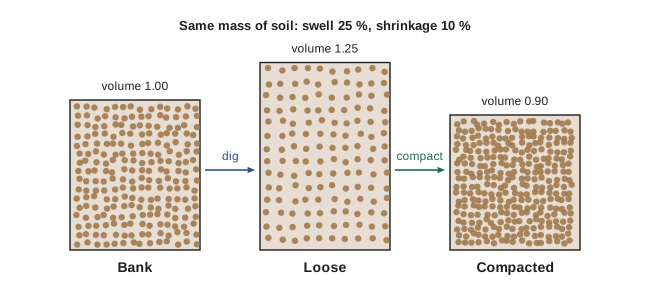
Trucks haul loose material, so truck capacities are loose volumes. Disposal sites may charge by load, by mass or by volume. Fill requirements are compacted volumes, but borrow is bought or excavated in the bank state. Mixing the three states is one of the commonest and most expensive errors in earthwork estimates.
Worked problem
Hauling excavation and buying backfill
A basement excavation contains 650 bank m³ of common earth with a swell of 25 % and a shrinkage of 10 %. (a) How many loose m³ must be hauled, and how many loads at 12 loose m³ per truck? (b) Later, 200 compacted m³ of backfill is needed. If it comes from the stockpiled excavated material, how many loose m³ must be set aside? (c) How much excavated material is left for disposal?
Show solution
- (a) Loose volume = 650 × 1.25 = 812.5 loose m³; loads = 812.5 ÷ 12 = 67.7, so 68 loads if all of it leaves the site.
- (b) Bank volume needed = 200 ÷ (1 − 0.10) = 222.2 bank m³; loose volume = 222.2 × 1.25 = 277.8 loose m³ to stockpile.
- (c) Surplus = 650 − 222.2 = 427.8 bank m³ = 534.7 loose m³, or 45 loads to disposal.
- Stockpiling the backfill saves hauling about 23 loads off site and the same number back in, if there is room on site.
Answer: 812.5 loose m³ (68 loads) if all is hauled; stockpile 277.8 loose m³ for backfill; dispose of about 535 loose m³ (45 loads).
Whether excavated soil can be reused as backfill depends on its type and moisture and on the specification, which may require imported granular fill around foundations and under slabs. Contaminated soil requires testing and disposal at licensed facilities, at costs many times higher than clean fill. The arithmetic is the same; the unit prices are very different.
Moisture and bulking of sand
Moisture changes both mass and volume. Wet aggregate weighs more than dry, so a tonne of wet sand contains less sand than a tonne of dry sand, and concrete plants correct batch weights for measured moisture. Damp sand also bulks: a thin film of water holds particles apart, so damp sand can occupy 20 to 30 % more volume than the same sand dry or fully saturated. This is another reason why batching by volume is unreliable and why sand should be measured by mass where accuracy matters.
Common mistakes
MistakeOrdering aggregate by volume when the supplier sells by mass.
InsteadMultiply compacted volume by compacted density, then add an allowance.
MistakeUsing bank volumes to count truckloads.
InsteadTrucks carry loose volumes; multiply bank volume by (1 + swell).
MistakeIgnoring shrinkage when buying fill.
InsteadDivide the compacted volume needed by (1 − shrinkage) to find the bank volume.
MistakeAdding water to concrete on site without control.
InsteadCheck the water–cement ratio and record any water added on the ticket.
MistakeScheduling trucks without a placing rate.
InsteadSet the truck interval from load size divided by placing rate.
Summary and key terms
- Density links volume and mass: m = ρ V; normal concrete is about 2,400 kg/m³ or 150 lb/ft³.
- Truck interval equals load size divided by placing rate; trucks needed equal round trip divided by interval.
- Bag yields convert small volumes to numbers of bags.
- Water–cement ratio is a mass ratio; adding water raises it and reduces strength.
- Aggregates are bought by mass and specified by compacted volume.
- Soil swells when excavated and usually shrinks when compacted; always state bank, loose or compacted.
- Damp sand bulks, so measure by mass for accuracy.
- Density
- Mass per unit volume.
- Unit weight
- Weight per unit volume in US units.
- Specific gravity
- Ratio of a material's density to water's.
- Truck mixer
- Truck that carries and mixes ready-mixed concrete.
- Water–cement ratio
- Mass of water divided by mass of cementing materials.
- Bank volume
- Volume of soil in its natural state.
- Loose volume
- Volume of soil after excavation.
- Compacted volume
- Volume of soil after placement and compaction.
- Swell
- Volume increase from bank to loose.
- Shrinkage
- Volume decrease from bank to compacted.
Practice problems
Work each problem on paper first, then reveal the answer to check.
What is the mass of 12 m³ of concrete at 2,400 kg/m³?
Show answer
28,800 kg (28.8 t).
How many pounds does 1 yd³ of 150 lb/ft³ concrete weigh?
Show answer
4,050 lb.
A pour of 45 m³ uses 8 m³ trucks. How many loads?
Show answer
45 ÷ 8 = 5.6, so 6 loads (last one 5 m³).
Placing rate 25 m³/h, loads of 7.5 m³. Truck interval?
Show answer
0.3 h = 18 minutes.
Round trip 60 minutes, interval 12 minutes. Trucks needed?
Show answer
5 trucks.
How many 30 kg bags (0.014 m³ each) for 0.2 m³?
Show answer
14.3, so 15 bags.
300 bank m³ with 30 % swell. Loose volume?
Show answer
390 loose m³.
Need 180 compacted m³; shrinkage 12 %. Bank volume?
Show answer
180 ÷ 0.88 = 204.5 bank m³.
Load factor for 20 % swell?
Show answer
1 ÷ 1.2 = 0.833.
Granular base 200 m² × 0.2 m at 2,150 kg/m³. Mass?
Show answer
40 m³ × 2,150 = 86 t.
Lesson quiz · 5 questions
Score 60% or more to complete this lesson.
Create a free account to save your progress, take quizzes and earn a certificate.