
CON-230 · Lesson 6 of 12 · 32 min
Building automation and controls
Mechanical equipment does nothing useful on its own. A chiller, an air handler or a pump needs to be told when to run, how hard to work and what to do when something goes wrong. Building automation systems (BAS), also called building management systems or direct digital control (DDC) systems, do this. They read thousands of sensors, run control sequences, start and stop equipment, raise alarms, log data and give operators a window into the building. They are also where many energy savings are won or lost.
Controls are a frequent weak point at handover. They sit between trades, rely on software as much as hardware, and are often the last system finished, squeezed by a late schedule. A building can have excellent equipment and still perform badly because sequences were never implemented as designed, sensors were never calibrated or alarms were never set up. This lesson explains how controls work and how the constructor can manage them well.
The control loop
Every automatic control has the same basic parts. A sensor measures a variable, such as room temperature, duct pressure or water flow. A controller compares the measurement with a setpoint and calculates an output. An actuator, such as a valve, damper motor or variable frequency drive, changes the process. The process responds, the sensor measures again, and the loop repeats. This is closed-loop or feedback control.
The simplest controllers switch equipment on and off (two-position control), as a house thermostat does. Most commercial controls are modulating: they adjust output gradually. Proportional control sets the output in proportion to the error between measurement and setpoint; adding integral action removes the steady offset that proportional control leaves; adding derivative action responds to the rate of change. Together these are called PID control, and loop tuning, setting the gains so loops are stable but responsive, is a skilled part of controls start-up.
Worked problem
Output of a proportional controller
A cooling valve is controlled with a setpoint of 24 °C and a proportional band of 2 K (the valve goes from closed at 24 °C to fully open at 26 °C). The room reads 25 °C. What is the valve position?
Show solution
- Error: 25 − 24 = 1 K.
- Output: 1 ÷ 2 = 0.5, so the valve is 50 per cent open.
- With proportional control alone the room settles above setpoint; integral action slowly opens the valve further to remove that offset.
Answer: 50 per cent open.
Sequences of operation
A sequence of operation is a written description of how a system should behave in every mode: occupied, unoccupied, warm-up, cool-down, economizer, fire alarm, power failure and equipment failure. It is the most important controls document, because it tells the controls contractor what to program and tells the commissioning team what to test. Vague sequences, such as 'control to maintain comfort', lead to inconsistent programming and disputes.
ASHRAE Guideline 36, High-Performance Sequences of Operation for HVAC Systems, provides standard, tested sequences for common systems such as VAV air handlers and terminal units. Specifying Guideline 36 reduces design effort and makes programming and commissioning more predictable, and it is increasingly referenced in both countries.
Typical sequence elements that the constructor will see tested include:
- Occupancy schedules and optimal start, which brings the building to temperature just before people arrive.
- Economizer control, which uses cool outdoor air for free cooling when conditions allow.
- Supply air temperature and duct static pressure reset, which reduce fan and cooling energy at part load.
- Demand-controlled ventilation, which varies outdoor air with occupancy measured by CO₂ sensors or people counts.
- Safety interlocks: freeze protection, high-pressure limits, smoke detector shutdown and fire alarm responses.
Worked problem
Savings from scheduling a fan
A 15 kW supply fan was found running 24 hours a day, 7 days a week. The building is occupied 12 hours a day, 5 days a week. If the BAS schedules the fan to run only during occupied hours, how much electricity is saved per year at an illustrative rate of $0.12 per kWh?
Show solution
- Hours per week now: 24 × 7 = 168.
- Scheduled hours: 12 × 5 = 60.
- Hours saved: 168 − 60 = 108 per week.
- Energy saved: 108 × 15 = 1,620 kWh per week; × 52 = 84,240 kWh per year.
- Cost saved: 84,240 × 0.12 = $10,109 per year, from one programming change (ignoring any added warm-up time).
Answer: About 84,000 kWh and roughly $10,000 a year.
BAS architecture and protocols
A modern BAS is a layered network.
- Field level: sensors, actuators, valves, dampers and variable frequency drives wired to controllers.
- Controller level: programmable controllers for each air handler, plant and terminal unit, running sequences locally so they keep working if the network fails.
- Supervisory level: network controllers or servers that coordinate schedules, trends and alarms across many controllers.
- Management level: the operator workstation or web interface, often with analytics, dashboards and remote access.
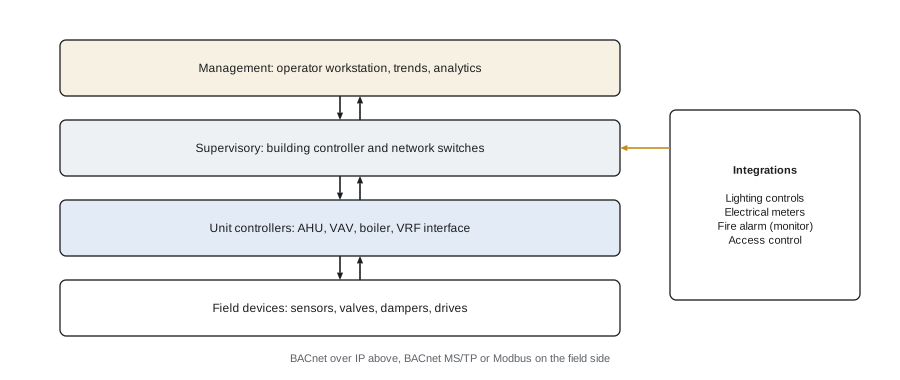
Devices talk through communication protocols. BACnet, developed by ASHRAE (Standard 135) and also published as ISO 16484-5, is the main open protocol for building automation in North America. Modbus is common for meters, drives and packaged equipment, and older buildings may have LonWorks or proprietary systems. Open protocols matter to owners because they reduce dependence on one vendor for future service and expansion; specifications often require BACnet with a protocol implementation conformance statement (PICS) for each device.
Control wiring is low voltage and is usually installed as Class 2 circuits under Section 16 of the Canadian Electrical Code, with line-voltage power to controllers and actuators installed by electricians. Who supplies and installs control power is a classic scope gap between mechanical, controls and electrical subcontracts.
Points and points lists
A point is a single input or output: a temperature sensor, a valve command, a fan status. Points are classified as analog inputs (measured values), analog outputs (modulating commands), binary inputs (status) and binary outputs (on/off commands), plus software or network points read from other systems. The points list, usually a schedule in the specification, is the basis for controls pricing, hardware quantities and checkout.
Worked problem
Estimating points and controls cost
A building has 8 air handlers at about 40 points each, 120 VAV boxes at 8 points each and a central plant with about 150 points. Using an illustrative installed cost of $250 per point, what is the controls budget?
Show solution
- Air handlers: 8 × 40 = 320 points.
- VAV boxes: 120 × 8 = 960 points.
- Plant: 150 points.
- Total: 320 + 960 + 150 = 1,430 points.
- Budget: 1,430 × $250 = $357,500, before integration, graphics and commissioning allowances.
Answer: About 1,430 points and roughly $360,000.
| Point type | Example | Typical device |
|---|---|---|
| Analog input (AI) | Room or duct temperature, duct static pressure | Sensor or transmitter |
| Analog output (AO) | Cooling valve position, fan speed | Valve actuator, variable frequency drive |
| Binary input (BI) | Fan status, filter alarm, smoke detector status | Current switch, differential pressure switch |
| Binary output (BO) | Start and stop a pump or fan | Relay or starter command |
| Network or software point | Chiller internal data, meter readings | BACnet or Modbus integration |
Integration with other systems
The BAS often connects to other building systems: lighting controls, electrical meters and power monitoring, generators, elevators, access control and the fire alarm system. Integration with the fire alarm is a special case. Fire alarm systems are life safety systems with their own codes and listing requirements, so the fire alarm panel usually sends signals to the BAS or directly to equipment (for example to shut down air handlers or run smoke control fans), and the BAS cannot override the fire alarm. Smoke control systems must be tested with the fire department or authority having jurisdiction, as lesson 7 explains.
Meters and submeters for electricity, gas, water and thermal energy feed energy dashboards and, in many jurisdictions, mandatory energy benchmarking and reporting programs. Getting meters integrated and trending correctly at handover avoids months of missing data.
Controls cybersecurity
A connected BAS is also a network that can be attacked. Building systems have been used as entry points to corporate networks, and an attacker who controls HVAC or access control can disrupt operations. Good practice includes separating the operational technology (OT) network from the business network, changing default passwords, limiting and logging remote access, keeping firmware patched, and documenting the network for the owner's IT team.
In Canada, guidance from the Canadian Centre for Cyber Security applies to building systems, and owners of critical infrastructure may face new obligations under the Critical Cyber Systems Protection Act enacted through Bill C-8 in 2026. BACnet Secure Connect (BACnet/SC) adds encrypted communication to the protocol.
Installing and commissioning controls
Controls work runs through the whole project but concentrates at the end. A practical sequence is:
- Review controls submittals: hardware, network riser, points list, graphics and written sequences.
- Install devices and wiring during rough-in, coordinated with mechanical and electrical trades.
- Perform point-to-point checkout: verify that each sensor reads correctly and each output moves the right device.
- Program and tune loops, set up schedules, trends and alarms.
- Support functional performance testing by the commissioning provider, then train operators.
Functional testing of many identical units, such as VAV boxes, is often done by sampling. If too many samples fail, the specification usually requires testing all units at the contractor's cost.
Worked problem
Sampling VAV boxes for functional testing
A specification requires functional testing of a random 20 per cent sample of 120 VAV boxes. If more than 10 per cent of the sample fails, every box must be tested. How many boxes are sampled, and how many failures trigger full testing?
Show solution
- Sample size: 0.20 × 120 = 24 boxes.
- Failure threshold: more than 10 per cent of 24 = more than 2.4, so 3 or more failures.
- If 3 or more of the 24 fail, all 120 boxes must be tested, which can add days to the end of the schedule.
Answer: 24 boxes; 3 or more failures trigger testing of all 120.
Worked problem
Trend data storage
The commissioning plan requires trending all 1,430 points every 15 minutes for a year. If each stored sample uses about 16 bytes, how much storage is needed?
Show solution
- Samples per day per point: 24 × 4 = 96.
- Samples per day: 1,430 × 96 = 137,280.
- Samples per year: 137,280 × 365 = 50,107,200.
- Storage: 50,107,200 × 16 bytes = about 802 million bytes, or roughly 0.8 GB, easily handled if the server is specified for it.
Answer: About 0.8 GB per year.
Monitoring-based commissioning and analytics
Buildings drift from their design performance as sensors fail, overrides accumulate and sequences are changed. Fault detection and diagnostics software examines BAS trend data to find problems such as simultaneous heating and cooling, valves leaking, stuck dampers or schedules overridden. Monitoring-based commissioning uses this continuously after handover, and many owners now specify that the BAS be ready to feed such tools at turnover.
Common mistakes
MistakeAccepting vague sequences of operation.
InsteadRequire detailed written sequences, ideally based on ASHRAE Guideline 36, before programming starts.
MistakeLeaving control power and interlock wiring undefined between trades.
InsteadUse a responsibility matrix for control power, starters, drives, interlocks and fire alarm interfaces.
MistakeSkipping point-to-point checkout.
InsteadVerify every point before functional testing; a mislabelled sensor can defeat a whole sequence.
MistakeLetting the BAS override fire alarm functions.
InsteadKeep life safety functions under the fire alarm system and test interfaces with the authority.
MistakeHanding over with default passwords and open remote access.
InsteadSecure the network, document it and agree remote access rules with the owner.
Summary and key terms
- Controls use sensors, controllers and actuators in feedback loops; PID control is standard.
- The sequence of operation is the key controls document; ASHRAE Guideline 36 provides standard sequences.
- A BAS has field, controller, supervisory and management layers.
- BACnet is the main open protocol; Modbus is common for meters and packaged equipment.
- The points list drives controls hardware, pricing and checkout.
- Fire alarm and smoke control functions take priority over the BAS.
- Point-to-point checkout, functional testing, trending and cybersecurity are part of handover.
- Building automation system (BAS)
- A networked control system for HVAC and other building equipment.
- Direct digital control (DDC)
- Control by digital controllers running programmed logic.
- Setpoint
- The target value a controller tries to maintain.
- PID control
- Control using proportional, integral and derivative actions.
- Sequence of operation
- A written description of how a system operates in every mode.
- Point
- A single input or output in a control system.
- BACnet
- An open data communication protocol for building automation (ASHRAE 135, ISO 16484-5).
- Economizer
- A control mode that uses outdoor air for free cooling.
- Point-to-point checkout
- Verification that each controls point reads or operates correctly.
- Fault detection and diagnostics
- Software that examines system data to find faults.
Practice problems
Work each problem on paper first, then reveal the answer to check.
Name the three parts of a feedback control loop.
Show answer
Sensor, controller and actuator.
Setpoint 22 °C, proportional band 4 K, room at 23 °C. What is the output?
Show answer
25 per cent.
What does integral action add to proportional control?
Show answer
It removes the steady offset between measurement and setpoint.
What is ASHRAE Guideline 36?
Show answer
A guideline of standard high-performance sequences of operation for HVAC systems.
Why do owners prefer open protocols such as BACnet?
Show answer
They reduce dependence on one vendor for service and expansion.
A building has 60 VAV boxes at 8 points and 4 AHUs at 45 points. How many points?
Show answer
480 + 180 = 660 points.
Which system has priority, the BAS or the fire alarm?
Show answer
The fire alarm system.
What is point-to-point checkout?
Show answer
Verifying that each sensor reads correctly and each output operates the right device.
A 10 kW fan runs 168 hours a week but is needed 50. How much energy is saved weekly by scheduling?
Show answer
118 × 10 = 1,180 kWh.
Give two basic controls cybersecurity measures.
Show answer
Separate the OT network, change default passwords, limit remote access or patch firmware.
Lesson quiz · 5 questions
Score 60% or more to complete this lesson.
Create a free account to save your progress, take quizzes and earn a certificate.