
CON-230 · Lesson 8 of 12 · 34 min
Electrical power distribution and standby power
Almost everything in a modern building depends on electricity: lighting, HVAC fans and pumps, elevators, computers, security, fire alarm and, increasingly, heating and vehicle charging as buildings electrify. The electrical distribution system takes power from the utility, transforms it to usable voltages, divides it safely into thousands of circuits and protects people and equipment from faults. Standby systems keep critical loads running when the utility fails.
This lesson explains how the system is arranged, how voltage, current and power relate, what drives the size and cost of electrical equipment, and what the constructor must coordinate. Electrical hazards on site, approach boundaries and arc flash protection are covered in HSE-214; this lesson focuses on the permanent building system.
From the utility to the outlet
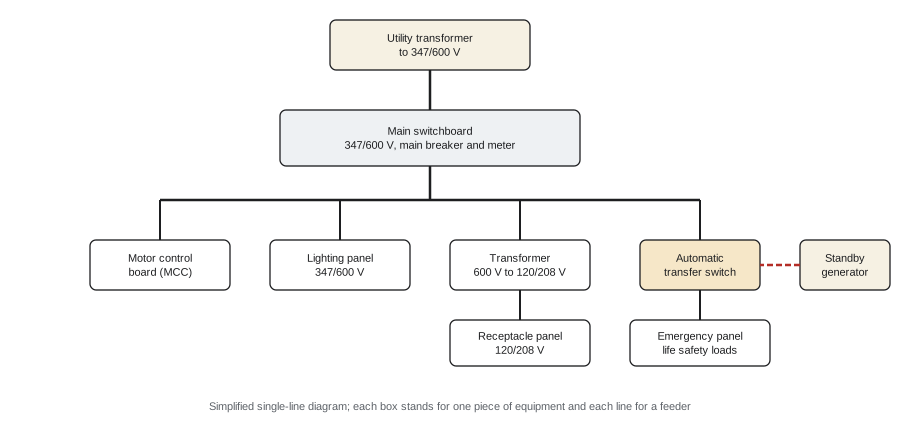
Power flows through a series of components, shown on the single-line diagram, the electrical engineer's map of the system.
- Utility service: the utility's supply, either at a usable low voltage from a pad-mounted or vault transformer, or at medium voltage (for example around 13.8 kV or 27.6 kV) that the building transforms itself.
- Service entrance and metering: the point where the utility's responsibility ends, with revenue metering.
- Main switchgear or switchboard: the main disconnect and overcurrent protection, and feeder breakers to the rest of the building.
- Distribution transformers: step down voltage for lighting and receptacle loads.
- Panelboards: smaller enclosures with breakers that feed branch circuits.
- Feeders and branch circuits: conductors that carry power to panels and from panels to devices and equipment.
Common Canadian commercial voltages are 347/600 V three-phase, with 347 V used for lighting and 600 V for motors and large equipment, and 120/208 V three-phase for receptacles and small loads, obtained through step-down transformers. Houses and small buildings use 120/240 V single-phase.
Voltage, current and power
Voltage (volts) is electrical pressure, current (amperes) is flow, and power (watts) is the rate of energy use. For resistive loads, power is voltage times current. For motors and electronic loads, current and voltage are not perfectly in step, so real power is reduced by the power factor (pf), and equipment such as transformers and generators is rated in kilovolt-amperes (kVA). Three-phase systems deliver power more efficiently and are used for all but small buildings.
Worked problem
Capacity of a three-phase feeder
A 600 V three-phase feeder carries 400 A at a power factor of 0.9. How much real power does it deliver?
Show solution
- P = √3 × 600 × 400 × 0.9.
- √3 × 600 = 1,039.2; × 400 = 415,692 VA; × 0.9 = 374,123 W.
- The feeder delivers about 374 kW (416 kVA).
Answer: About 374 kW.
The higher distribution voltage means less current for the same power, so conductors and equipment are smaller. A 600 V system carries 25 per cent more power than a 480 V system at the same current, which is one reason Canadian equipment and conductor sizes differ from US practice.
Transformers
Dry-type step-down transformers inside the building convert the main distribution voltage to 120/208 V for receptacles and small equipment. They are rated in kVA and come in standard sizes such as 30, 45, 75, 112.5, 150, 225 and 300 kVA. Energy efficiency standards apply to them in both countries. Transformers are heavy, produce heat that the HVAC system must remove and hum, so they need ventilated rooms, structural support and attention to noise near quiet spaces.
Worked problem
Sizing a step-down transformer
Receptacle and small-equipment loads on a floor total 90 kVA after demand factors. The owner wants 25 per cent spare capacity. What standard transformer size should be selected, and what is its full-load current on the 120/208 V side?
Show solution
- Required capacity: 90 × 1.25 = 112.5 kVA.
- Select the standard 112.5 kVA size.
- Secondary current: 112,500 ÷ (√3 × 208) = 112,500 ÷ 360.3 = 312 A.
- The secondary panel and feeder must be rated for this current, so a 400 A panel is likely.
Answer: 112.5 kVA, about 312 A on the secondary.
Overcurrent protection and conductors
Circuit breakers and fuses protect conductors from overheating due to overloads and short circuits. Each conductor's ampacity, the current it can carry continuously without overheating, depends on its size, material (copper or aluminium), insulation temperature rating and installation conditions such as how many conductors share a raceway and the ambient temperature.
In Canada, conductor ampacities come from the tables in Section 4 of the Canadian Electrical Code (such as Table 2 for copper), with correction factors. Loads that run for three hours or more are treated as continuous, and in most cases a breaker may be loaded to only 80 per cent of its rating (Rule 8-104).
Worked problem
Breaker for a continuous load
A lighting circuit has a continuous load of 16 A. What is the minimum standard breaker rating?
Show solution
- Continuous load must not exceed 80 per cent of the breaker rating (equivalently, size at 125 per cent of the load).
- 16 × 1.25 = 20 A.
- A 20 A breaker is the minimum, with conductors rated for at least 20 A under installation conditions.
Answer: 20 A.
Wiring methods include conductors in metallic or PVC conduit, armoured cable and busway. Canadian projects often use Teck90 armoured cable for industrial feeders and AC90 (BX) cable for branch circuits; US projects commonly use THHN conductors in EMT conduit and MC cable. Each method has code limits on where it may be used, especially in fire-rated assemblies, plenums and hazardous locations.
Selective coordination means arranging protective devices so that only the device nearest a fault trips, leaving the rest of the building powered. Codes require it for emergency systems, elevators and fire pumps in many cases, and the coordination study affects which breakers are bought.
Voltage drop
Long conductors lose voltage through resistance, and equipment at the end may run poorly. Designers keep voltage drop within recommended limits.
The Canadian Electrical Code (Rule 8-102) limits voltage drop to 5 per cent from the supply side of the consumer's service to the point of use, and to 3 per cent in a feeder or branch circuit.
Worked problem
Voltage drop on a long branch circuit
A 120 V single-phase circuit carries 20 A to a load 30 m away using 12 AWG copper (about 5.21 Ω per km). Is the voltage drop acceptable? What if 10 AWG (3.28 Ω per km) is used?
Show solution
- 12 AWG: V = 2 × 20 × 0.00521 × 30 = 6.25 V, which is 6.25 ÷ 120 = 5.2 per cent.
- That exceeds the 3 per cent branch circuit limit.
- 10 AWG: V = 2 × 20 × 0.00328 × 30 = 3.94 V, or 3.3 per cent, still slightly high.
- 8 AWG or a shorter run would be needed; long runs often justify larger wire.
Answer: Not acceptable with 12 AWG; upsizing is needed.
Grounding and bonding
Grounding connects the electrical system to the earth to stabilize voltage and dissipate surges such as lightning. Bonding connects all metal parts that could become energized, such as conduit, enclosures, piping and structural steel, so that a fault produces enough current to trip the breaker quickly instead of leaving exposed metal at a dangerous voltage. Ground fault protection devices protect people in wet locations, and large services need ground fault protection of equipment. Grounding electrodes, such as ground rods, building steel and concrete-encased electrodes (Ufer grounds), must often be installed during foundation work, which is easy to miss.
Emergency and standby power
When utility power fails, some loads must keep running. Codes distinguish levels of priority.
In Canada, the National Building Code requires emergency power for life safety loads such as exit and emergency lighting, fire alarm and, in high buildings, fire pumps, elevators and smoke control. Emergency generators are designed to CSA C282 Emergency electrical power supply for buildings, and Section 46 of the Canadian Electrical Code covers emergency systems and unit equipment (battery packs). Optional standby power for business continuity follows the owner's requirements.
Automatic transfer switches (ATS) sense the loss of utility power, signal the generator to start, and transfer the load once the generator is stable. Emergency loads are kept on separate panels and wiring, often with fire-rated protection for feeders. Uninterruptible power supplies (UPS) use batteries to carry critical electronic loads without any break, bridging the seconds before a generator picks up.
Worked problem
Sizing a standby generator
Emergency loads total 40 kW, legally required or code-required standby loads 60 kW and optional standby loads 80 kW. The owner wants 25 per cent margin. Diesel use at the expected average load is about 0.27 litres (0.071 gallons) per kWh delivered. What generator size is needed, and how much fuel for 24 hours at an average load of 75 per cent of the rating?
Show solution
- Connected standby load: 40 + 60 + 80 = 180 kW.
- With margin: 180 × 1.25 = 225 kW; select the next standard size, 250 kW.
- Average output: 0.75 × 250 = 187.5 kW; energy in 24 h: 187.5 × 24 = 4,500 kWh.
- Fuel: 4,500 × 0.27 = 1,215 litres (4,500 × 0.071 = 320 gallons), before the code's minimum fuel duration rules and refuelling plans are checked.
- Motor starting currents and harmonic loads may push the size up further; the engineer confirms with a sizing study.
Answer: About 250 kW, with roughly 1,200 litres (320 gallons) of fuel for 24 hours.
Worked problem
UPS battery runtime
A UPS supports a 30 kW load from a battery with 40 kWh of usable energy, and the inverter is 90 per cent efficient. How long will it run?
Show solution
- Energy delivered to the load: 40 × 0.90 = 36 kWh.
- Runtime: 36 ÷ 30 = 1.2 hours, or 72 minutes.
- Battery capacity falls with age and temperature, so designers apply aging and temperature factors.
Answer: About 72 minutes.
Electrification and new loads
Electrical services are growing as buildings switch from gas to heat pumps, add electric vehicle charging and install battery storage and rooftop solar. Many codes and municipalities now require EV-ready parking spaces, and utilities may need months or years to upgrade a service. The constructor should confirm utility capacity, application timelines and any service upgrade costs early, because they can control the schedule.
| Item | Canada | Construction note |
|---|---|---|
| Main code | CSA C22.1:24 with provincial amendments | Edition adopted varies; confirm early |
| Typical commercial voltages | 347/600 V and 120/208 V | Equipment rated for 600 V class |
| Emergency power | NBC requirements, CSA C282, CEC Section 46 | Separate panels, generator testing |
| Inspection | Provincial authority, e.g. ESA (Ontario), Technical Safety BC | Permit and inspections before energizing |
Common mistakes
MistakeAssuming the utility can connect the building on short notice.
InsteadApply early; service upgrades and medium-voltage connections can take many months.
MistakeLoading breakers to 100 per cent with continuous loads.
InsteadSize circuits and breakers so continuous loads are no more than 80 per cent of the rating.
MistakeIgnoring voltage drop on long runs.
InsteadCheck long feeders and branch circuits and upsize conductors where needed.
MistakeForgetting grounding electrodes during foundation work.
InsteadInstall concrete-encased electrodes and bonding before concrete is placed.
MistakeMixing emergency and normal wiring.
InsteadKeep emergency circuits on separate panels and wiring as the code requires.
Summary and key terms
- Power flows from the utility service through switchgear, transformers and panelboards to branch circuits.
- Canadian commercial buildings commonly use 347/600 V and 120/208 V.
- Three-phase power is √3 × V × I × pf; transformers and generators are rated in kVA.
- Breakers protect conductors; continuous loads are limited to 80 per cent of breaker rating.
- Voltage drop is kept to about 3 per cent in a branch and 5 per cent overall.
- Grounding and bonding protect people and equipment; electrodes are installed early.
- Emergency, required standby and optional standby power have different rules; ATS and UPS keep loads running.
- Single-line diagram
- A simplified drawing showing the electrical distribution system from service to panels.
- Switchgear
- Assemblies of switching and protective devices that control and distribute power.
- Panelboard
- An enclosure of breakers feeding branch circuits.
- Transformer
- A device that changes voltage levels.
- kVA
- Kilovolt-amperes, the apparent power rating of electrical equipment.
- Power factor
- The ratio of real power to apparent power.
- Ampacity
- The current a conductor can carry continuously without exceeding its temperature rating.
- Selective coordination
- Arrangement of protective devices so only the device nearest a fault opens.
- Automatic transfer switch
- A switch that transfers load from utility to generator power automatically.
- Uninterruptible power supply (UPS)
- A battery-based system that supplies power without interruption.
Practice problems
Work each problem on paper first, then reveal the answer to check.
What is the power of a 600 V three-phase circuit at 100 A and pf 0.85?
Show answer
√3 × 600 × 100 × 0.85 ≈ 88 kW.
What is the full-load secondary current of a 75 kVA transformer at 208 V three-phase?
Show answer
75,000 ÷ 360.3 ≈ 208 A.
A continuous load is 24 A. What minimum breaker rating applies?
Show answer
30 A.
What voltage drop limit applies to a branch circuit under the CEC?
Show answer
3 per cent.
Why does higher distribution voltage reduce conductor size?
Show answer
The same power needs less current.
What is the purpose of bonding?
Show answer
To connect metal parts so faults trip breakers quickly and exposed metal does not stay energized.
What does an automatic transfer switch do?
Show answer
It transfers load from utility to generator power when the utility fails.
Standby loads total 120 kW. With 25 per cent margin, what generator size is needed?
Show answer
150 kW.
A UPS has 20 kWh usable and 92 per cent efficiency with a 15 kW load. Runtime?
Show answer
18.4 ÷ 15 ≈ 1.23 h, about 74 minutes.
Why should EV charging and heat pumps be raised with the utility early?
Show answer
They increase the service size, and utility upgrades can take months or years.
Lesson quiz · 5 questions
Score 60% or more to complete this lesson.
Create a free account to save your progress, take quizzes and earn a certificate.