
CON-315 · Lesson 1 of 12 · 24 min
The role of the field engineer
Every building starts as lines on drawings and ends as concrete, steel, wood and glass in exactly the right place. The people who turn one into the other, point by point and pour by pour, are the field engineers. On a mid-rise project the field engineer sets out gridlines, checks formwork before concrete arrives, chases conflicts between drawings, writes the questions that go back to the design team, keeps the layout records and, at the end, helps prove that what was built matches what was designed. This course follows that work through a whole building. It builds on the surveying methods taught in CON-250, which covered instruments, levelling, traverses, coordinates and the basics of building layout, and applies them to the daily decisions of a field engineer on a live project.
The running example is Larkspur Commons, the invented six-storey rental building from CON-305: 112 homes over shops, a two-storey concrete podium with four storeys of wood frame above, built by the invented general contractor Thornbury Builders in Kelowna, British Columbia. Dana Whitfield is the superintendent, Priya Nair the project manager, and Mei Lin is the field engineer whose work we follow. In this course Mei is joined by a second field engineer, Arjun Mehta, a recent graduate in his first year on site.
What a field engineer does
Titles vary between companies. Some general contractors use field engineer for the site-based technical role and project engineer for the office-based role that handles submittals and requests for information; others use the titles the other way round, or combine them. Smaller firms may give the layout work to an assistant superintendent or a carpenter foreman, or hire a layout subcontractor. Whatever the title, the field engineering function on a building project usually includes the same group of tasks.
| Area | Typical tasks on Larkspur Commons | Main lesson |
|---|---|---|
| Drawings and questions | Read and compare drawings and specifications, find conflicts, draft requests for information and field sketches | Lesson 2 |
| Control and layout | Maintain control points, set gridlines and offset lines, lay out footings, anchor bolts, walls, columns, embeds and openings | Lessons 3, 4, 5 |
| Tolerances and checking | Check formwork, steel and framing against tolerances before covering or pouring; record deviations | Lesson 6 |
| Coordination of embedded items | Coordinate sleeves, blockouts, embeds and post-tensioning with trades before each pour | Lesson 7 |
| Constructability | Review upcoming work for buildability, propose alternatives, support prefabrication | Lesson 8 |
| Sequencing | Plan pour sequences, construction joints, reshoring and the order of trades in an area | Lesson 9 |
| Measurement and verification | Measure quantities for progress, run scans, compare work with the model | Lesson 10 |
| Records | Keep layout logs, survey records, redlines and as-built information for handover | Lesson 11 |
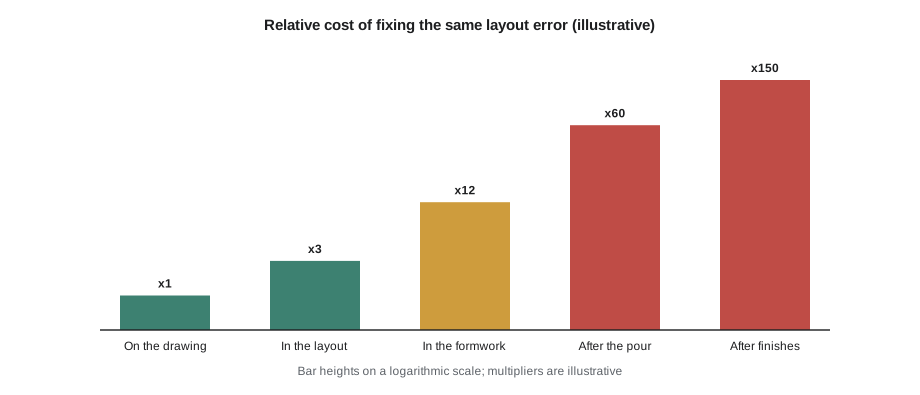
The common thread is accuracy in time. A layout error found on the drawing costs an email. Found in the formwork, it costs an hour of a carpenter's time. Found after the pour, it can cost tens of thousands of dollars in demolition, delay and redesign. A field engineer's value lies in finding problems at the cheapest possible moment, which means working one or two steps ahead of the crews.
Where the role sits in the site team
On Larkspur Commons, Mei reports to Dana on day-to-day field matters and to Priya on documentation, cost and the design team. That dual line is normal. The superintendent directs the work and the trades (CON-305); the project manager runs the contract, budget and design-team relationship; the field engineer supplies the technical information both of them need. A field engineer has little formal authority over subcontractors but considerable influence, because layout, checks and answers to questions control when a trade can start.
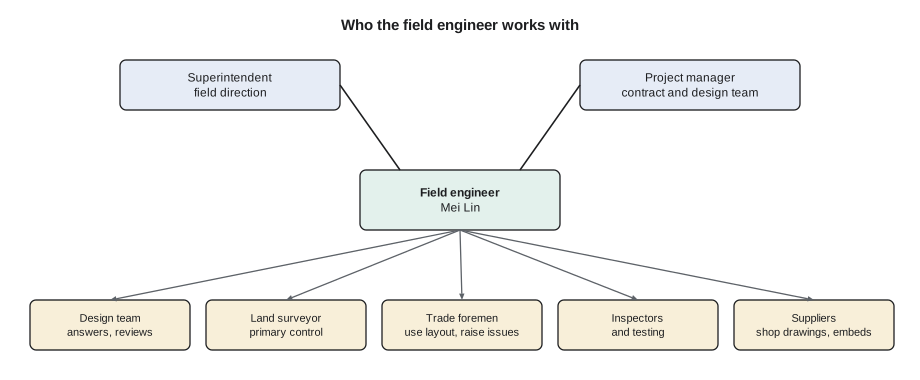
The relationships that matter most are with the people who supply or use field information.
- The design team: the architect and engineers answer questions, review submittals and inspect work. A field engineer who writes clear questions with proposed solutions gets faster, better answers (lesson 2).
- The land surveyor: in British Columbia, legal surveys of property boundaries are reserved for British Columbia Land Surveyors. The project's surveyor establishes the primary control and confirms the building's position relative to the property lines. The field engineer then works from that control (lesson 3).
- Subcontractor foremen: they need gridlines, offset lines, elevations and answers. They also find problems, and a good field engineer listens to their questions.
- Inspectors and testing agencies: building officials, the engineer of record's field reviewers and testing technicians inspect reinforcing, embeds and concrete. CON-345 covers quality control and testing in depth.
- The superintendent's planning: layout must be ready before the crew needs it. Mei attends the weekly coordination meeting and plans layout from the look-ahead schedule, which CON-335 covers.
A week in the field
Field engineering is a mix of planned work and interruptions. During the podium phase on Larkspur Commons, a typical week for Mei looks like this.
| Day | Main tasks |
|---|---|
| Monday | Control check at the start of the week; lay out level 2 columns and walls on the new deck; update the layout log |
| Tuesday | Embed and sleeve walk with the mechanical and electrical foremen; draft two questions on conflicting sleeve locations |
| Wednesday | Pre-pour check of the level 2 deck forms: elevations, edge of slab, openings, embeds; sign the pour card |
| Thursday | Pour day: watch the pour sequence and cold joint timing; elevations on screeds; afternoon on submittal review for curtain wall anchors |
| Friday | Survey of the poured columns for plumbness; scan of the ground floor slab for flatness; update as-built notes; plan next week with Dana |
Two patterns stand out. First, most tasks are tied to an upcoming event, usually a pour, a delivery or an inspection, and the deadline is fixed by the crew's schedule, not by the field engineer's convenience. Second, a large share of the work is checking: other people's formwork, the trades' sleeves, the design team's drawings and the field engineer's own layout. Experienced field engineers protect time for checking because it is the first thing squeezed out when the site gets busy.
Layout as a production process
Layout is often treated as a small technical task, but on a large floor it is a production operation with its own crew, inputs and outputs. The inputs are current drawings, control and access to the area. The outputs are marks on the ground, the deck or the walls that crews will trust without question. When layout is late, the formwork crew waits; when it is wrong, they build the error.
A field engineer therefore plans layout like any other work. How many points must be set? How long does each take? Who checks them? The example estimates the layout effort for one podium level of Larkspur Commons and asks whether an independent check is worth its cost.
# Layout workload for one podium level and the value of an independent check (illustrative)
tasks = {  # task: (points to set, minutes per point)
    "Gridlines and offset lines": (36, 6),
    "Column and wall corners": (140, 3),
    "Embeds and anchor plates": (85, 4),
    "Sleeves and blockouts": (120, 3),
    "Slab edge and openings": (60, 4),
}
setup_min = 45 * 4        # four instrument setups per level
total_min = setup_min + sum(n * m for n, m in tasks.values())
check_min = 0.30 * total_min   # independent check of critical points
print(f"Layout time for the level: {total_min/60:.1f} h, independent check: {check_min/60:.1f} h")
crew_rate = 2 * 85.0           # two-person layout crew, $/h loaded
p_error = 0.06                 # chance a level has one significant undetected layout error without a check
cost_error = 85000             # demolish, re-form, re-pour, delay (illustrative)
p_after = 0.004                # chance an error survives the check
cost_check = check_min / 60 * crew_rate
saving = (p_error - p_after) * cost_error
print(f"Cost of the check: ${cost_check:,.0f}")
print(f"Expected rework avoided: ${saving:,.0f}")
print(f"Benefit-cost ratio: {saving/cost_check:.1f}")Layout time for the level: 29.3 h, independent check: 8.8 h Cost of the check: $1,493 Expected rework avoided: $4,760 Benefit-cost ratio: 3.2
With these assumptions, laying out the level takes a two-person crew about 29 hours, and an independent check of the critical points takes another 9. The check costs about $1,500 but avoids an expected $4,760 of rework, a ratio of about 3 to 1. The probabilities are illustrative; the point is that independent checking pays for itself even when errors are rare, because the cost of a single error is so large compared with the cost of looking. Lesson 6 returns to how much checking is enough.
The field engineer's mindset
Good field engineers share some habits that are worth stating explicitly, because they rarely appear in job descriptions.
- Trust, but verify: drawings contain errors, instruments drift, control points get knocked and people misread numbers. Every important dimension should be checked by a second, independent method or person.
- Work from the whole to the part: establish and check the control and gridlines first, then lay out details from them. Measuring from one detail to the next accumulates errors.
- Think one step ahead: before setting a point, ask what will be attached to it, what will cover it and what will be built on it.
- Write it down: a layout that is not recorded did not happen. Logs, photos and field books protect the company and the next person.
- Ask early: a question asked two weeks before the pour is a coordination issue; the same question on pour day is a crisis.
- Respect the trades: foremen often spot problems first. A field engineer who listens gets warned; one who lectures gets surprised.
The two-person rule deserves special mention. On many sites, critical layout, such as anchor bolts, column grids, elevator rails and curtain wall anchors, must be set by one person and checked by another using a different setup or method. Mei sets the level 2 column layout; Arjun checks it from a different control point. If the two disagree by more than the agreed tolerance, they find out why before anyone builds.
Tools of the trade
Field engineers use a mix of traditional and digital tools. CON-250 covered how the instruments work; here the question is which tool suits which task.
| Tool | Typical use by the field engineer |
|---|---|
| Steel tape, chalk line, plumb bob, string | Short measurements, offset lines, quick checks; still the fastest tools for many tasks |
| Automatic or digital level, rotating laser | Elevations of forms, screeds, anchor bolts and finished floors |
| Total station, including robotic models | Setting and checking points from coordinates, column plumbness, as-built surveys |
| GNSS receiver | Site work, excavation and open areas; less useful inside a building or near tall structures |
| Layout tablet with the model or drawings | Selecting points directly from the model or drawing and staking them with a robotic total station |
| Laser scanner and photogrammetry | Capturing as-built conditions for comparison with the model (lesson 10) |
| Ground-penetrating radar or other scanning | Locating reinforcing, tendons and conduits before coring or drilling (lesson 7) |
| Field management software | Questions, drawings, photos, punch lists and daily logs (CON-260) |
Manufacturers such as Trimble, Leica Geosystems and Topcon sell layout instruments and software, and platforms such as Autodesk Construction Cloud and Procore manage drawings, questions and field records. The course mentions products only as examples; the principles apply whichever tools a contractor uses. What matters is that the tools are calibrated, the data comes from the current drawing revision and the results are checked.
Career path and learning
Field engineering is a common entry point for graduates of construction management, engineering and technology programs. It gives a broad view of the whole building and the whole team. Typical paths lead to project engineer, project coordinator or assistant project manager on the office side, or to assistant superintendent and superintendent on the field side. Some field engineers specialize in layout and surveying and may pursue professional credentials. In Canada that path leads through provincial associations of land surveyors and engineering technologists; in the US it can lead to a professional land surveyor licence or to certifications in surveying technology. Lesson 3 and lesson 11 return to the boundaries between construction layout and work reserved for licensed surveyors.
Arjun's first-year development plan on Larkspur Commons is typical: shadow Mei through one full floor cycle; run the layout log and the question log under her review; lay out interior walls on level 3 with Mei checking; lead the pre-pour check for one deck with Mei present; and by the end of the podium, lay out a level and run the embed walk on his own, with Mei doing the independent check.
Ethics and professionalism in field engineering
Field engineers handle information that others rely on, which brings particular ethical duties. Layout records and survey data must be honest. A field engineer must never adjust a recorded measurement to make an out-of-tolerance condition look acceptable, sign a pre-pour card without doing the check, or describe a field change as approved when it was not. When something has gone wrong, the right response is to report it promptly to the superintendent and project manager so that the design team can decide how to deal with it. Hiding a layout error is far more damaging than the error itself, both to the building and to the field engineer's career. CON-305 covers professional conduct for supervisors more generally.
Common mistakes
MistakeTreating layout as a quick task that can be done the morning the crew needs it.
InsteadPlan layout from the look-ahead schedule so that points are set and checked before crews arrive.
MistakeLaying out details by measuring from one detail to the next.
InsteadWork from the control and gridlines to each detail so that errors do not accumulate.
MistakeHaving the person who set the layout also check it with the same setup.
InsteadUse an independent check by another person or from different control, especially for critical items.
MistakeRaising drawing conflicts on the day of the pour.
InsteadReview drawings ahead of the work and ask questions while there is time to answer them.
MistakeAdjusting records so that out-of-tolerance work appears acceptable.
InsteadRecord the real measurement and report deviations so the design team can decide what to do.
Summary and key terms
- The field engineer turns drawings into work in place through layout, checking, questions, coordination and records.
- Titles vary, but the field engineering function sits between the superintendent, the project manager, the design team and the trades.
- Most field engineering tasks are tied to fixed events such as pours, deliveries and inspections.
- The cost of an error rises steeply the later it is found, so checking early is the main lever.
- Layout is a production process that should be planned, resourced and checked like other work.
- Independent checking pays for itself even when errors are rare, because a single error costs so much.
- Good habits include working from the whole to the part, recording everything, asking early and listening to the trades.
- Honest records and prompt reporting of problems are core professional duties.
- Field engineer
- A site-based technical role responsible for layout, checking, coordination of embedded items, field questions and records.
- Project engineer
- A technical role, often office-based, that handles submittals, requests for information and documentation; titles vary between companies.
- Layout
- Marking the positions and elevations of building elements on site from the drawings and control.
- Control
- Surveyed reference points of known position and elevation from which layout is measured.
- Independent check
- A verification made by a different person or from different control or by a different method.
- Two-person rule
- A practice requiring critical layout to be set by one person and checked by another.
- Pour card
- A sign-off sheet confirming that each discipline has checked the work before concrete is placed.
- Layout log
- A record of what was laid out, when, from which control and drawing revision, by whom and how it was checked.
Practice problems
Work each problem on paper first, then reveal the answer to check.
Name four areas of work that make up the field engineering function.
Show answer
For example: drawings and questions, control and layout, tolerances and checking, coordination of embedded items, constructability, sequencing, measurement and records.
Why does the cost of a layout error rise so steeply over time?
Show answer
Each later stage adds work built on the error, so correcting it means removing and redoing more work and delaying more trades.
To whom does Mei report on Larkspur Commons, and for what?
Show answer
To Dana, the superintendent, on field matters, and to Priya, the project manager, on documentation, cost and the design team.
In the workload example, what was the benefit-cost ratio of the independent check?
Show answer
About 3.2: an expected $4,760 of rework avoided for a check costing about $1,500.
What is meant by working from the whole to the part?
Show answer
Establish and check control and gridlines first, then lay out details from them rather than from each other.
Give two examples of critical layout that should follow the two-person rule.
Show answer
Anchor bolts, column grids, elevator rails, curtain wall anchors.
What should a field engineer do on discovering a layout error after the pour?
Show answer
Record the facts and report them promptly to the superintendent and project manager so the design team can decide on a fix.
Which tool would you use to find reinforcing before coring a slab?
Show answer
Ground-penetrating radar or another suitable scanning method.
Lesson quiz · 5 questions
Score 60% or more to complete this lesson.
Create a free account to save your progress, take quizzes and earn a certificate.