
CON-345 · Lesson 11 of 12 · 22 min
Deficiencies, punch lists and warranties in Canada
The last weeks of a building project are dominated by lists. Every suite, corridor, stair and room is walked, and every incomplete or defective item is recorded: a missing cover plate, a scratch on a counter, a door that rubs, a sprinkler escutcheon not seated, a paint touch-up. On a 112-home building these lists can run to thousands of items, and closing them can take longer than anyone planned, holding up turnover, payment and the owner's leasing schedule. Then the warranty period starts, and defects that appear after handover come back to the contractor. This lesson covers how to manage deficiencies so that the lists stay short, how they connect to the contract milestones, and what warranties and latent defect obligations follow.
Deficiency lists and punch lists
The terms vary. Many Canadian contracts and site teams speak of deficiencies and deficiency lists; many US teams speak of punch lists. Both mean a list of items that are incomplete or do not conform, found by inspection as areas near completion. On Larkspur Commons, Thornbury distinguishes between its own deficiency walks, done by the field team and the trades before an area is offered to the consultant, and the consultant's deficiency or punch list, prepared when the consultant inspects the area for completion.
The contractor's own walk is the most important. A consultant who finds 40 items in a suite will lose confidence in the area and may decline to inspect further until the contractor has done its own walk properly. A consultant who finds four items, all minor, will move quickly. The aim is that the consultant's list contains only items the contractor could not reasonably have found, not items it should have caught.
| Stage | Who | Purpose |
|---|---|---|
| Trade self-check | Each trade foreman, at handoff | Close own items before handing over the area (CON-335) |
| Contractor deficiency walk | Omar or Mei with the main finishing trades | Find and close everything visible before the consultant inspects |
| Consultant inspection | Architect, engineers, envelope consultant | Inspect for completion; issue a deficiency or punch list |
| Owner walk | Owner's representative and property manager | Confirm readiness for occupancy and leasing; may add items |
| Back-check | Contractor, then consultant | Confirm each item is closed and sign off the area |
Why punch lists grow
Long punch lists are a symptom, not a cause. They grow when handoffs between trades are not checked (CON-335), when finished work is not protected, when trades leave small items to come back to later and then do not come back, when the schedule compresses the finishing trades into the last weeks, and when nobody owns an area. Each of these is a process problem with a process fix, and most of the fixes come earlier in this course: first-work standards, handoff walks, protection, and inspection during the work rather than only at the end.
Damage is a large share of most punch lists. On the first three floors of a typical Thornbury project, Lena found that about a third of deficiency items were damage to finished work by later trades or by moving materials and equipment, rather than items the original trade had left incomplete. That is why protection of finished work, and recording the condition of areas at each handoff, matter so much.
Zero-punch and progressive deficiency management
Some contractors aim for a zero-punch handover, meaning that when the consultant inspects an area, it has no deficiencies at all. True zero is rare on a building of this size, but the approach changes behaviour. Instead of a big list at the end, deficiencies are found and closed continuously, area by area, as each trade finishes. On Larkspur Commons, Thornbury set a target of no more than five consultant deficiency items per home on average, with no item affecting function, safety or code compliance.
Progressive management works like this. After each finishing trade completes a suite, the next trade's foreman and the trade itself check the suite against the first-work standard in suite 301 (lessons 4 and 5). Items are tagged with a coloured sticker by trade, logged in the inspection application against the suite, and closed before the next trade starts or within an agreed time. When the last trade finishes, the contractor's deficiency walk should find little that has not already been logged.
# Contractor deficiency walk results by floor and trade (illustrative)
from collections import Counter
items = {  # floor: list of trades responsible for each open item found on the walk
    "L3": ["paint"] * 61 + ["drywall"] * 38 + ["finish carpentry"] * 27 + ["electrical"] * 14 + ["plumbing"] * 9 + ["flooring"] * 18 + ["damage, unassigned"] * 52,
    "L4": ["paint"] * 44 + ["drywall"] * 21 + ["finish carpentry"] * 19 + ["electrical"] * 9 + ["plumbing"] * 6 + ["flooring"] * 11 + ["damage, unassigned"] * 30,
    "L5": ["paint"] * 29 + ["drywall"] * 14 + ["finish carpentry"] * 12 + ["electrical"] * 7 + ["plumbing"] * 5 + ["flooring"] * 8 + ["damage, unassigned"] * 17,
}
homes_per_floor = 28
for f, lst in items.items():
    print(f"{f}: {len(lst):3d} items, {len(lst) / homes_per_floor:4.1f} per home")
allitems = [t for lst in items.values() for t in lst]
tot = len(allitems); cum = 0
print("Pareto, all floors:")
for trade, n in Counter(allitems).most_common():
    cum += n
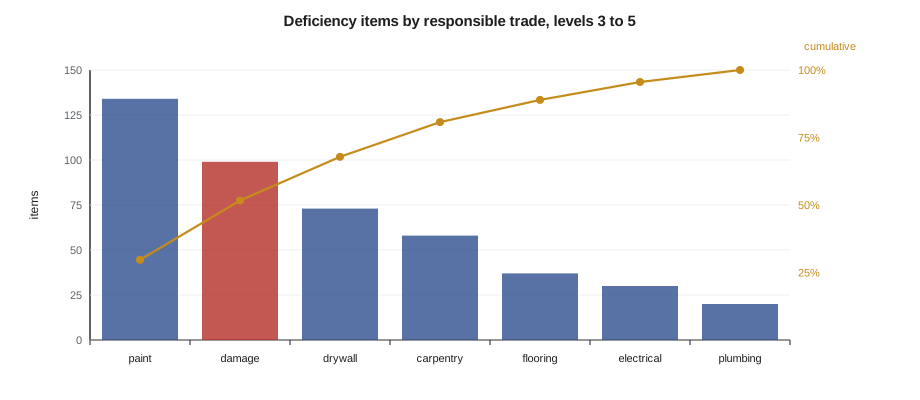
print(f" {trade:20s} {n:3d} cumulative {cum / tot:5.1%}")L3: 219 items, 7.8 per home L4: 140 items, 5.0 per home L5: 92 items, 3.3 per home Pareto, all floors: paint 134 cumulative 29.7% damage, unassigned 99 cumulative 51.7% drywall 73 cumulative 67.8% finish carpentry 58 cumulative 80.7% flooring 37 cumulative 88.9% electrical 30 cumulative 95.6% plumbing 20 cumulative 100.0%
Two things stand out. The number of items per home fell sharply from level 3 to level 5, from about 7.8 to 3.3, which shows the progressive process and the trades' learning taking effect. And paint and unassigned damage together make up more than half of all items. Damage with no responsible trade identified is the most expensive kind of item, because the contractor usually pays to fix it. Dana responded by tightening the handoff records, so that the condition of each suite was photographed at each handoff, and by assigning a protection crew to install and maintain floor and door protection on every floor.
Managing the list to closure
Each item on a deficiency list should have a clear description, a location precise enough to find it, a responsible trade, a photograph and a target date. Vague items such as 'touch up paint, bedroom' waste time, because the painter cannot find what the inspector meant. Good items look like 'suite 412, bedroom 2, north wall beside window, 50 mm scrape at outlet height, repaint full wall section'.
Closure is tracked daily as handover approaches. Omar watches the open count, the closure rate, and items open more than a week. A useful forecast compares the current closure rate with the number of items remaining and the time left before turnover.
# Will the open deficiencies on levels 5 and 6 close before turnover? (illustrative)
open_items = 412
days_left = 15               # working days before turnover of levels 5 and 6
recent_closures = [31, 28, 35, 22, 30, 33, 26, 29, 32, 27]   # items closed per working day, last 10 days
new_items_per_day = 6        # new items still being found by the owner's walks
rate = sum(recent_closures) / len(recent_closures) - new_items_per_day
days_needed = open_items / rate
print(f"net closure rate {rate:.1f} items per day; days needed {days_needed:.1f} of {days_left}")
if days_needed > days_left:
    extra = open_items / days_left - rate
    print(f"short by {days_needed - days_left:.1f} days: need about {extra:.0f} more closures per day")
else:
print(f"on track with {days_left - days_needed:.1f} days of margin")net closure rate 23.3 items per day; days needed 17.7 of 15 short by 2.7 days: need about 4 more closures per day
At the current net rate the list would close nearly three days late. Rather than wait, Dana asked the painting and finish carpentry subcontractors, which accounted for most of the open items, to add a crew each for two weeks, and arranged for the property manager's walks to be combined into a single walk per floor so new items were found earlier. The list closed with a day to spare.
Substantial performance and completion
Deficiencies connect directly to the contract milestones. In British Columbia, the Builders Lien Act defines when a contract is substantially performed using a formula based on the cost of finishing the remaining work: broadly, the work is substantially performed when it is capable of being used for its intended purpose and the cost to complete it is no more than a small percentage of the contract price, set on a sliding scale in the Act. Under CCDC 2, the consultant certifies substantial performance, and that date matters for releasing the holdback that owners retain under the Act, for starting the warranty period and for the lien periods. Minor deficiencies outstanding at substantial performance are listed and must be completed afterwards; the owner may retain an amount to cover them.
# Is the work substantially performed? Illustrative sliding-scale test in the style of
# BC's Builders Lien Act; confirm the current thresholds in the Act before relying on them.
def threshold(price):
    tiers = [(500_000, 0.03), (500_000, 0.02)]
    t, rest = 0.0, price
    for size, rate in tiers:
        part = min(rest, size)
        t += part * rate
        rest -= part
    return t + rest * 0.01
price = 48_000_000
cost_to_complete = 412_000      # estimated cost of remaining work and deficiencies
limit = threshold(price)
print(f"contract price {price:,}; allowable cost to complete {limit:,.0f}")
print(f"estimated cost to complete {cost_to_complete:,}: {'test met' if cost_to_complete <= limit else 'test not met'}")contract price 48,000,000; allowable cost to complete 495,000 estimated cost to complete 412,000: test met
In this example the estimated cost to complete is below the allowable amount, so the test is met. The sliding-scale figures in the code are illustrative of the structure of the Act, and readers should confirm the current thresholds before relying on them. The test is about cost, not about the number of items: 400 cheap touch-ups may still allow substantial performance, while one unfinished elevator may not.
Final completion follows when all items are closed, closeout documents such as as-built drawings, operation and maintenance manuals and warranties are delivered, and the consultant confirms the work is complete. CON-385 covers closeout in full. For the quality program, the important point is that every deficiency left at substantial performance or completion is still the contractor's obligation, and that the cost of returning crews to an occupied building is much higher than closing items before the tenants move in.
Warranties
A warranty is a promise that the work will be free of defects for a period, and that the contractor will correct defects that appear. Construction projects involve several layers of warranty.
| Type | Typical source | Notes |
|---|---|---|
| Contractor's general warranty or correction period | The prime contract | CCDC 2 provides a one-year warranty period from substantial performance for the work |
| Extended warranties for specific work | The specifications | For example, longer warranties on roofing, windows or sealants, often by the installer and manufacturer jointly |
| Manufacturer's warranties | Product manufacturers | Often require installation by approved installers and inspection; may cover materials only |
| Statutory or implied warranties | Legislation and case law | In BC, new homes for sale are covered by mandatory home warranty insurance under the Homeowner Protection Act; purpose-built rental buildings may be exempt under conditions set by the regulator |
Warranties are only useful if they are valid and can be found. Manufacturers' warranties often depend on conditions: approved installers, inspections by the manufacturer's representative, registration within a set time and correct maintenance. Lena's closeout checklist confirms each condition was met and collects every warranty in the closeout documents, with a summary table listing each item, the warrantor, the start date, the length and the contact.
Warranty callbacks are the external failure costs in the cost-of-quality model. Thornbury tracks them by project and by trade, and the most frequent causes become topics for preinstallation meetings on the next project. On recent wood-frame projects the most common callbacks were drywall cracks and nail pops from framing shrinkage, door adjustments, plumbing fixture leaks and sealant failures at windows, most of which trace back to framing moisture, workmanship at first work, or envelope details.
Latent defects
A latent defect is one that exists at handover but could not reasonably have been discovered by inspection at the time, such as a hidden flashing error that causes a leak only in a severe storm years later. Warranty periods do not end the contractor's exposure to latent defects. The owner can usually still claim for breach of contract or in negligence, within the limitation periods set by law, and those periods typically run from when the defect was or should have been discovered, subject to an ultimate time limit.
In British Columbia, the Limitation Act sets a basic limitation period of two years from discovery of a claim and an ultimate limitation period of fifteen years for most claims; other provinces have their own legislation. These periods are general summaries and the details depend on the type of claim, so legal advice is needed for any specific case. For contractors, the practical consequence is that records of inspections, tests, nonconformances and approvals should be kept well beyond the warranty period, because they may be the only evidence of how the work was built.
This is where the whole quality program pays a final dividend. The ITPs, inspection records, photographs, test reports, field review reports and NCRs described in this course are the contractor's defence if a latent defect claim arises. A contractor that can show, with dated photographs and signed records, that a window was installed to the approved detail, tested and accepted, is in a far stronger position than one that can only say it believes the work was done correctly.
Common mistakes
MistakeLetting the consultant's inspection find items the contractor should have found.
InsteadDo a thorough contractor deficiency walk first, so the consultant's list holds only items that could not reasonably have been caught.
MistakeLeaving deficiencies to a big list at the end.
InsteadFind and close deficiencies progressively as each trade finishes, against the first-work standard.
MistakeWriting vague deficiency items.
InsteadGive each item a precise location, description, responsible trade, photograph and target date.
MistakeTreating the warranty period as the end of the contractor's exposure.
InsteadLatent defect claims can arise years later within limitation periods; keep quality records long-term.
MistakeAssuming manufacturers' warranties are valid by default.
InsteadConfirm installer approvals, inspections, registration and maintenance conditions, and collect the documents at closeout.
Summary and key terms
- Deficiency or punch lists record incomplete or nonconforming items as areas near completion; the contractor's own walk comes first.
- Long lists are a symptom of weak handoffs, poor protection, deferred items and compressed finishing; damage is often a third of items.
- Progressive deficiency management closes items as each trade finishes, against the first-work standard.
- Each item needs a precise location, description, responsible trade, photograph and date; closure rates can be forecast against time left.
- Substantial performance in BC is defined by the Builders Lien Act's cost-to-complete test and triggers holdback release, warranty start and lien periods.
- Final completion requires all items closed and closeout documents delivered.
- CCDC 2 gives a one-year warranty from substantial performance; extended, manufacturer and statutory warranties add further layers.
- Latent defect claims can arise within limitation periods long after handover; quality records are the contractor's evidence.
- Deficiency
- An item of work that is incomplete or does not conform, found near completion.
- Punch list
- A list of items to be completed or corrected before final acceptance of the work.
- Zero-punch handover
- An approach aiming to hand over areas with no deficiencies found by the consultant.
- Substantial performance
- The stage, defined in BC by the Builders Lien Act, at which the work is usable and the cost to complete is within the statutory limit.
- Holdback
- An amount the owner retains from payments under lien legislation to protect against liens.
- Warranty period
- The period after completion during which the contractor must correct defects that appear.
- Latent defect
- A defect present at handover that could not reasonably have been found by inspection then.
- Limitation period
- The time limit set by law for starting a legal claim.
Practice problems
Work each problem on paper first, then reveal the answer to check.
Why should the contractor's deficiency walk come before the consultant's inspection?
Show answer
So the consultant's list holds only items that could not reasonably have been found, which keeps the consultant's confidence and speeds acceptance.
From the deficiency walk results, how did items per home change from level 3 to level 5?
Show answer
From about 7.8 to about 3.3 per home.
Which two categories made up more than half of all items, and why is one especially costly?
Show answer
Paint and unassigned damage; unassigned damage is usually paid for by the contractor.
Rewrite 'touch up paint, bedroom' as a usable deficiency item.
Show answer
For example: suite 412, bedroom 2, north wall beside window, scrape at outlet height, repaint full wall section.
In the closure forecast, how many days late would the list have closed, and what did Dana do?
Show answer
Nearly three days; he added a painting crew and a finish carpentry crew and combined the property manager's walks.
Why do quality records matter after the warranty period ends?
Show answer
They are the evidence of how the work was built if a latent defect claim arises within the limitation period.
Lesson quiz · 5 questions
Score 60% or more to complete this lesson.
Create a free account to save your progress, take quizzes and earn a certificate.