
CON-345 · Lesson 9 of 12 · 22 min
Field reviews, inspections and letters of assurance
Besides the contractor's own quality control and the owner's testing, buildings are checked by people whose role is set by the building code: the authority having jurisdiction, which issues the permit and inspects for code compliance, and the design professionals or special inspectors whose reviews the code requires. These checks are not optional extras the contractor can schedule around. Without them the building cannot be occupied. This lesson explains how that system works on Larkspur Commons and how the field team works with it.
Canada and the United States approach this differently. In British Columbia, the building code relies heavily on registered professionals, the architects and engineers responsible for the design, to carry out field reviews and to give written assurance that the building substantially conforms to their design and the code. The municipal building inspector inspects selected stages but relies on those professional assurances for most structural and building-system matters on larger buildings.
The authority having jurisdiction
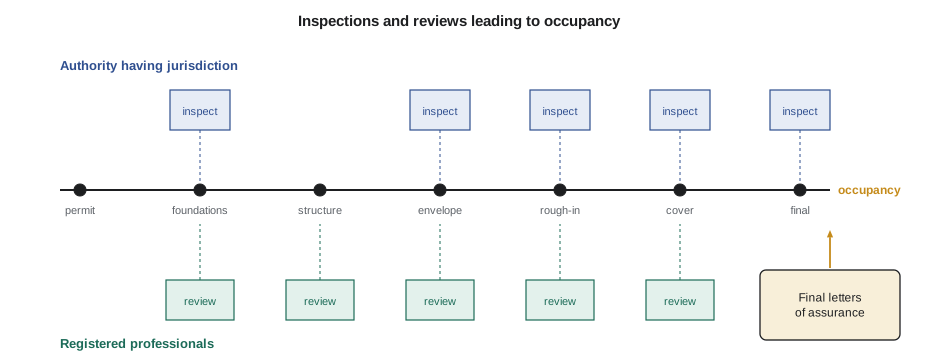
The authority having jurisdiction is the body that enforces the building code, usually the municipal building department. It reviews the permit application and drawings, issues the building permit, inspects the work at specified stages and, at the end, issues the permission to occupy. Its inspections check code compliance, not contract compliance, and they are periodic: an inspector may spend an hour on a floor that took the trades weeks to build.
In Kelowna, the City's building permit for Larkspur Commons lists the inspections the City requires, such as footing and foundation inspections, plumbing and drainage inspections, and inspections of framing and fire separations, and the contractor books them through the City's system. Because the building is a Part 3 building under the BC Building Code, the City relies on the registered professionals' letters of assurance for structural design and field review, and for the other building systems the professionals are responsible for. Exact stages and procedures are set by the City's bylaws and permit conditions.
Two practical points matter on site. First, the permit drawings and the construction drawings must stay aligned. Revisions that affect code compliance, such as a moved fire separation or a changed structural element, must be submitted to the authority as permit revisions, not just issued to the trades. Second, the authority's inspectors respond well to a site that is ready when they arrive: documents laid out, the area clean and safe, and a person to walk with them, as CON-335 lesson 3 described.
Registered professionals and field review
Under the BC Building Code, a building like Larkspur Commons requires registered professionals of record for each design discipline: the architect, and the structural, mechanical, electrical and geotechnical engineers, with one of them acting as the coordinating registered professional. Before the permit is issued, the owner and the professionals sign letters of assurance in which each professional confirms responsibility for the design of their discipline and commits to carrying out field reviews during construction. At the end of construction, each professional signs a further letter confirming that, based on their field reviews, the work substantially complies with their design and the code, and the coordinating professional confirms that the field reviews have been carried out. The authority requires these letters before it permits occupancy.
Field review is defined in professional guidelines, such as those of Engineers and Geoscientists BC and the Architectural Institute of BC, as periodic site visits that the professional judges appropriate to determine whether the work substantially complies with the design. It is not continuous inspection and does not cover every element. The structural engineer on Larkspur Commons reviews the reinforcing and post-tensioning before major pours, the shear walls and hold-downs on each wood-frame floor, and the steel connections, but cannot see every bar, nail and bolt. The contractor's own quality control fills that gap.
| Element | Main field review by | Typical timing |
|---|---|---|
| Foundations and bearing | Geotechnical engineer | Each footing excavation before concrete |
| Concrete reinforcing and PT | Structural engineer | Before each major pour; stressing records |
| Wood shear walls and hold-downs | Structural engineer | Each floor before cover |
| Structural steel connections | Structural engineer; weld inspection by certified inspector | After erection and bolting; welds as specified |
| Building envelope | Architect, with the envelope consultant | Mock-ups, first work in each zone, periodic |
| Fire separations and firestopping | Architect, with the fire consultant | Each zone before cover |
| Mechanical, plumbing and sprinklers | Mechanical engineer | Rough-in and testing; system verification |
| Electrical and fire alarm | Electrical engineer | Rough-in; fire alarm verification |
What these reviews do and do not do
Field reviews and special inspections are valuable second checks, but they are often misunderstood on site. Foremen sometimes treat them as the inspection, assuming that if the engineer or special inspector did not reject something, it must be right. That is not their purpose, and it is not how the law treats them.
- They are sample-based or periodic. Even continuous special inspection covers only the listed operations; nobody reviews everything.
- They check against the approved design and code, not every requirement of the contract and specifications.
- They do not transfer responsibility. The contractor remains responsible for building to the documents, and the professional's or inspector's review does not relieve it.
- They depend on access and timing. A reviewer who is not called, or who arrives to find the work covered, cannot review it.
The last point causes the most trouble. If work that required review is covered before the review, the reviewer may require it to be uncovered at the contractor's cost, or may decline to give assurance or to sign off. That is why the ITPs in lesson 3 put these reviews in as hold points, with notice periods, and why the look-ahead tracks them as constraints.
Tracking the reviews
A building of this size generates hundreds of review and inspection events, and the documents that prove they happened must be complete at the end. Mei keeps a tracker that lists each required review or inspection, the date it was requested, the date it was done, whether the report has been received, and any open items the reviewer raised. Open items stay open until the reviewer confirms they are resolved.
# Field review tracker summary, end of month 9 (illustrative)
reviews = [  # (discipline, element, done, report received, open items)
    ("geotechnical", "footing bearing, all footings", True, True, 0),
    ("structural", "podium pours 1-6 reinforcing", True, True, 0),
    ("structural", "transfer slab pour 1 tendons", True, True, 1),
    ("structural", "transfer slab pour 2 tendons", True, False, 0),
    ("structural", "L3W shear walls", True, True, 2),
    ("structural", "L3E shear walls", False, False, 0),
    ("architect/envelope", "envelope mock-up", True, True, 0),
    ("architect/envelope", "L3W first windows", True, True, 1),
    ("architect/fire", "L3W firestopping", True, False, 0),
    ("mechanical", "podium underground plumbing", True, True, 0),
]
done = [r for r in reviews if r[2]]
missing_reports = [r for r in done if not r[3]]
open_items = sum(r[4] for r in reviews)
print(f"reviews done {len(done)} of {len(reviews)}; reports outstanding {len(missing_reports)}; open items {open_items}")
for d, e, *_ in missing_reports:
    print(f"  chase report: {d} - {e}")
for d, e, dn, rep, oi in reviews:
    if oi:
print(f" open items: {d} - {e}: {oi}")reviews done 9 of 10; reports outstanding 2; open items 4 chase report: structural - transfer slab pour 2 tendons chase report: architect/fire - L3W firestopping open items: structural - transfer slab pour 1 tendons: 1 open items: structural - L3W shear walls: 2 open items: architect/envelope - L3W first windows: 1
Outstanding reports are a quiet risk. A review that happened but was never written up is, for the purposes of the final assurance, the same as a review that did not happen. Mei chases reports within a week of each review, and Lena checks the tracker at the monthly quality review. The open items, such as the two raised on the level 3 west shear walls, are linked to nonconformance or correction records so that their closure can be shown.
Letters of assurance at completion
The final letters of assurance are a hard gate. Each registered professional must be satisfied, based on their field reviews, that the work substantially complies before signing, and the coordinating professional must assemble them before the City will permit occupancy. If field reviews were missed or open items remain, a professional may refuse to sign or may require testing or opening up of work before signing. On Larkspur Commons, Lena's plan includes a review three months before substantial performance, with each professional, of any gaps in their field review records, so that problems surface while there is still time to resolve them. CON-385 covers the rest of the closeout process.
Life-safety systems have their own verification. Fire alarm systems are verified as complete and working, sprinklers are tested and flushed, standpipes are tested, emergency lighting and exit signs are checked, and elevators are inspected by the elevator authority. The fire department or fire marshal is often involved in the final acceptance of these systems. These verifications are often on the critical path at the end of a job, as CON-335's capstone showed, and their requirements belong in the quality plan from the start.
In British Columbia, fire alarm system verification is typically carried out to CAN/ULC-S537 by a qualified verification technician, sprinkler systems are installed and tested to NFPA 13 as referenced by the code, and elevators are inspected by Technical Safety BC. Larkspur Commons's quality plan lists each of these as a hold point before occupancy.
Qualifications of testing agencies and inspectors
The value of every test and inspection depends on the competence of the people doing it. Specifications therefore set qualification requirements for testing agencies and inspectors, and the contractor should check them at the start of the job, not after a disputed result.
In Canada, concrete testing laboratories are commonly certified to CSA A283, which covers the qualification of laboratories testing concrete and its materials, and field technicians hold certifications such as those offered by the Canadian Council of Independent Laboratories or ACI field testing technician programs. Weld inspection organizations and inspectors are certified to the CSA W178 standards, and fire alarm verification technicians hold the qualifications the verification standard and the province require. Larkspur Commons's specification lists these requirements, and Lena checks the certificates of each agency and technician when they are first engaged.
Qualifications are not a formality. A disputed low strength result, a rejected weld or a failed fireproofing test usually leads first to questions about whether the test was done correctly. If the technician's certification had lapsed, or the laboratory was not qualified for the test, the result may be challenged by whichever party it hurts, and the dispute takes longer to settle. Checking qualifications at the start removes that argument.
Calibration is the other half of competence. Testing equipment, from slump cones and air meters to bolt tension calibrators and spray racks, must be calibrated at the intervals the standards require, and the records should be available. Thornbury's own measuring equipment, such as the field engineer's total station and levels, moisture meters and torque wrenches, is covered by the calibration procedure in the company quality system described in lesson 2. A result from an uncalibrated instrument is an opinion, not a measurement.
Inspections, testing and commissioning
Near the end of the project, inspection and testing overlap with commissioning, the process of verifying that building systems, such as heating, ventilation, plumbing, electrical and controls, are installed and perform as the owner requires. Commissioning goes beyond code inspections: it checks that the ventilation system delivers the design air flows to each suite, that controls respond correctly, that the domestic hot water system holds temperature, and that operating staff are trained. On Larkspur Commons, the owner has hired an independent commissioning agent whose plan is integrated with the quality plan. CON-385 covers commissioning and closeout in detail; the point here is that the inspection and test records described in this course, such as pressure tests of piping and duct leakage tests, are the foundation the commissioning agent builds on.
Working well with reviewers
Reviewers and inspectors are not opponents. A good relationship with them makes the project run better, and a poor one adds days of delay and stacks of paperwork. Dana's team follows a few simple practices.
- Plan with them. Share the look-ahead so they can plan their visits, and agree notice periods at the start.
- Be ready. Pre-inspect the work with their checklist and fix obvious items before they arrive.
- Walk with them. Send someone who knows the work, can answer questions and can record their comments.
- Close items promptly. Respond to every comment in writing, with photographs, and ask them to confirm closure.
- Never hide problems. If something is wrong, tell them before they find it, with a proposal to fix it. Professionals who discover concealed problems stop trusting everything else on the site.
That last practice was tested on Larkspur Commons when the field team found that a hold-down on level 4 had been installed with the wrong anchor rod size after the engineer had already reviewed that floor. Mei reported it to the engineer the same day with photographs and a proposed fix. The engineer approved the fix and, because the team had reported it, accepted the corrected installation on photographs and a short return visit rather than requiring the whole floor to be reinspected.
Common mistakes
MistakeTreating a reviewer's silence as approval of everything.
InsteadField reviews and special inspections are periodic or sample-based; the contractor remains responsible for all the work.
MistakeCovering work before a required review.
InsteadPut reviews in the ITPs as hold points and in the look-ahead with notice periods.
MistakeLetting review reports go missing.
InsteadTrack every review, chase reports within a week and link open items to correction records.
MistakeChanging permit-relevant work without a permit revision.
InsteadSubmit revisions that affect code compliance to the authority, not just to the trades.
MistakeHiding a defect found after a review.
InsteadReport it promptly with a proposed fix; transparency keeps the reviewer's trust.
Summary and key terms
- The authority having jurisdiction issues the permit, inspects for code compliance at set stages and permits occupancy.
- BC relies on registered professionals' field reviews and letters of assurance for the design disciplines on larger buildings.
- Field review is periodic and judged by the professional; it is not continuous inspection.
- Reviews and inspections are second checks; they do not transfer the contractor's responsibility for conforming work.
- Work covered before a required review may have to be uncovered at the contractor's cost.
- A tracker of reviews, reports and open items keeps the record complete for the final sign-off.
- Letters of assurance at completion are a gate to occupancy; gaps should be reviewed months in advance.
- Life-safety system verifications are often critical at the end; reviewers respond best to planning, readiness and transparency.
- Authority having jurisdiction
- The body, usually the municipal building department, that enforces the building code.
- Registered professional of record
- An architect or engineer responsible for the design of a discipline and its field review.
- Field review
- Periodic site visits by a design professional to determine whether work substantially complies with the design.
- Letter of assurance
- A signed statement by an owner or professional of responsibility for design or field review.
- Coordinating registered professional
- The professional who coordinates the design and field reviews of the other professionals.
- Permit revision
- A change to the permitted drawings submitted to the authority for review.
- Life-safety verification
- Testing and acceptance of fire alarm, sprinkler, emergency lighting and similar systems before occupancy.
- Open item
- A comment or discrepancy raised by a reviewer that remains to be resolved.
Practice problems
Work each problem on paper first, then reveal the answer to check.
What does the building inspector check, and what does the inspector rely on for structural matters on Larkspur Commons?
Show answer
Code compliance at set stages; the registered professionals' letters of assurance.
Why is field review not the same as inspection of every element?
Show answer
It is periodic, at intervals the professional judges appropriate, and samples the work.
From the tracker, which reports are outstanding?
Show answer
Transfer slab pour 2 tendons (structural) and L3W firestopping (architect and fire consultant).
What happens if a professional's field reviews were missed?
Show answer
The professional may refuse to sign the final letter of assurance or require testing or opening up before signing.
Why did the engineer accept the level 4 hold-down correction on photographs?
Show answer
The team reported the problem promptly with a proposed fix, which kept the engineer's trust.
Name two life-safety systems that must be verified before occupancy.
Show answer
Any two of: fire alarm, sprinklers, standpipes, emergency lighting and exit signs, elevators.
Lesson quiz · 5 questions
Score 60% or more to complete this lesson.
Create a free account to save your progress, take quizzes and earn a certificate.