
CON-375 · Lesson 1 of 12 · 21 min
Why documentation matters
Nine months into the Westgate Branch Library and Community Hub, the mass-timber package arrived three weeks late. Brightwater Constructors' superintendent, Marcus Bell, knew exactly what that had cost the job: crews standing down, a crane kept on rent, a winter enclosure that had to be bought because the roof would not be closed before the cold. Knowing it and proving it are different things. When project manager Elena Vasquez sat down to prepare the claim, the first question from the owner's project manager, Robert Kaminski, was simple: show me. What Brightwater could recover depended almost entirely on what had been written down, photographed and sent at the time.
This course is about that discipline: creating, sending, organizing and keeping the records that run a construction project and protect everyone on it. We follow Brightwater through the Westgate project, a four-storey public library and community hub with a concrete podium and a mass-timber superstructure, from the first submittal to the day the keys are handed over. Along the way you will meet project coordinator Jun Park, who runs document control; field engineer Hannah Lowe, who handles requests for information and submittals; Simone Achebe of Arden Moss Architects, the contract administrator; and Owen Grady, project manager for the mechanical subcontractor, Tallis Mechanical.
Brightwater is building Westgate in Ottawa under a CCDC 2 2020 stipulated price contract worth about $64 million with the Westgate Public Library Board. Ontario's Construction Act applies to payment, holdback and liens, and its prompt payment and adjudication rules shape how invoices and disputes must be documented.
What counts as project documentation
Project documentation is every record created or received in the course of delivering the project. It is far broader than the drawings and specifications. A useful way to think about it is in five families, each with its own owner on the project team and its own rules for how it is created and kept.
| Family | Examples | Main purpose |
|---|---|---|
| Contract documents | Agreement, general and supplementary conditions, drawings, specifications, addenda | Define what was promised and who carries which risk |
| Administrative records | Correspondence, transmittals, meeting minutes, RFIs, submittals, change records | Coordinate decisions and record who said what, when |
| Field records | Daily reports, diaries, inspection and test reports, photos, video, delivery tickets | Record what actually happened on site |
| Financial records | Schedule of values, payment applications, cost reports, time and material sheets, invoices | Support payment and prove cost |
| Closeout records | As-built drawings, operation and maintenance manuals, warranties, commissioning reports, training records | Hand over a building the owner can run |
The contract documents set the baseline. Everything else records how the project moved away from or along that baseline. When people argue on a construction project, they almost always argue about the difference between what the contract documents said would happen and what the field records show did happen. The administrative records sit in between: they show who knew what, and when.
The four jobs that records do
Good records are not paperwork for its own sake. On a busy site every record should be doing at least one of four jobs, and the best ones do several at once.
- They coordinate the work. A clear RFI answer, an approved shop drawing or a well-written set of minutes tells forty trades what to build and in what order. Most rework traces back to someone working from an outdated or misunderstood document.
- They prove what happened. Months later, nobody will remember which day the crane was idle or which grid line was flooded. The daily report, the photo and the delivery ticket will.
- They protect entitlement. Contracts give extra time and money only when the contractor gives written notice within set periods and supports the request with records. A valid claim can be lost entirely on a missed notice.
- They hand over the asset. The owner will operate the building for fifty years or more. As-built drawings, manuals and warranties are part of what the owner paid for.
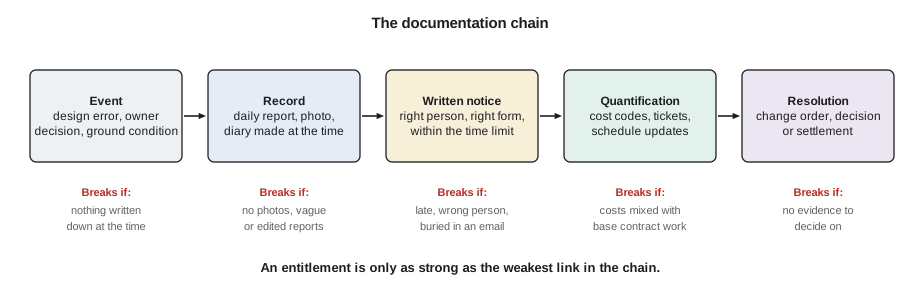
The figure shows the chain that turns a site event into a resolved change or claim. Something happens: a design error, an owner decision, unexpected ground conditions, late information. Someone records it at the time. Someone gives written notice to the right person within the contract's time limits. The effect on time and cost is measured using records. Finally the parties agree, or a decision maker decides. A break at any link, such as no record, late notice or costs that cannot be traced, weakens or destroys what follows.
Why records made at the time carry weight
Judges, arbitrators and adjudicators prefer evidence created when events happened, by people with a duty to record them, over recollections assembled after a dispute has begun. Such records are called contemporaneous records. A daily report signed by the superintendent on the evening of a rain day is far more persuasive than a summary written a year later by a claims consultant.
Canadian evidence law recognizes this. Records made in the usual and ordinary course of business are generally admissible as evidence of the facts they record, under section 30 of the Canada Evidence Act and section 35 of Ontario's Evidence Act, provided they were made at or near the time and as part of a regular practice. The weight a court gives a record depends on how regular, complete and unaltered it is.
That has practical consequences for the way Brightwater writes its records. A record is strongest when it is made routinely, on the day, by the person who saw the event, in a consistent format, and stored where it cannot be quietly edited. A record created only when something goes wrong, or edited months later, invites the question of why.
Where the contract asks for documentation
The construction contract itself requires much of the documentation in this course. The general conditions require written notices, set out how changes are ordered and priced, and say how payment is applied for. The specifications, usually in Division 01 of the MasterFormat structure, add detailed procedures.
| Typical Division 01 section | What it usually requires |
|---|---|
| 01 31 19 Project meetings | Preconstruction and progress meetings, who attends, who takes minutes |
| 01 32 00 Construction progress documentation | Schedules, progress reports, photographs |
| 01 33 00 Submittal procedures | Shop drawings, product data, samples, review times |
| 01 45 00 Quality control | Inspection and testing records |
| 01 77 00 Closeout procedures | Substantial performance and final completion steps |
| 01 78 00 Closeout submittals | As-builts, manuals, warranties, spare parts |
Under CCDC 2 2020, the contractor's documentation duties appear throughout: keeping a current set of documents on site, submitting shop drawings for review, following the change order and change directive procedures in Part 6, applying for payment under Part 5, and giving written notice of claims under GC 6.6. Notices must be delivered in writing to the addresses set out in the agreement.
Brightwater's first step on every project is a documentation matrix: a table of every record the contract and specifications require, who produces it, who receives it, how often and in what format. Jun builds it from the contract during preconstruction, and it becomes the checklist for the whole job.
Who reads the records
It helps to remember that construction records have many readers, and that most of them were not on site when the record was made.
| Reader | What they look for |
|---|---|
| Project team and trades | Current instructions: what to build, where, by when |
| Owner and contract administrator | Progress, quality, compliance, the basis for payment and changes |
| Lenders and sureties | Progress against cost, risks, liens or stop notices |
| Insurers | Facts of an incident or loss, the date and cause of damage |
| Adjudicators, arbitrators, judges | Contemporaneous proof of events, notices, costs |
| Regulators and inspectors | Permits, inspections, safety records |
| Facility managers | What was installed, where, how to maintain it, warranties |
Because of this, Brightwater writes records for a stranger. Daily reports avoid shorthand that only the crew would understand. Photos have dates, locations and descriptions. Emails say which drawing revision they refer to. A good test is whether an intelligent person who has never visited the site could understand the record a year from now.
The qualities of a good record
| Quality | What it means in practice |
|---|---|
| Timely | Made on the day, sent within contract periods |
| Accurate | Correct dates, locations, quantities, names, document revisions |
| Complete | Covers every day and every event the format calls for, including quiet days |
| Objective | Facts first; opinions labelled as such; no insults or speculation |
| Consistent | Same format, numbering and terminology across the project |
| Retrievable | Filed in the agreed system with metadata so it can be found in seconds |
| Secure | Protected from loss or alteration; changes tracked |
Objectivity deserves a special word. Records are often read by the very people they describe. A daily report that says the electrician was 'useless again' helps nobody and may embarrass Brightwater in front of an adjudicator. A report that says 'electrical crew of four arrived 09:40, two hours after the agreed start; level 2 rough-in in rooms 214 to 220 not started' is factual and far more useful.
Roles on the Brightwater team
Brightwater assigns every record family to an owner. Ownership does not mean the person writes every document; it means they make sure the record exists, is complete and is filed.
| Role | Records owned |
|---|---|
| Project manager (Elena) | Contract correspondence, notices, change records, payment applications, cost reports |
| Superintendent (Marcus) | Daily reports, site diary, safety records, look-ahead schedules, photos |
| Field engineer (Hannah) | RFIs, submittals, inspection and test records, as-built markups |
| Project coordinator (Jun) | Document control system, transmittals, logs, minutes, closeout tracking |
| Subcontractor PMs (e.g. Owen) | Their own daily reports, RFIs, submittals and notices to Brightwater |
Worked problem
What weak records cost
Brightwater believes the late timber delivery delayed the project by 18 working days. Its time-related site costs (supervision, crane, temporary facilities) run at $4,850 per working day. Its daily reports clearly record standby and the critical path impact for only 11 of the 18 days; the other 7 days have no daily report or a report that says only 'no timber'. How much of the time-related claim is at risk?
Show solution
- Value of the full claim: 18 × $4,850 = $87,300.
- Value supported by clear records: 11 × $4,850 = $53,350.
- At risk: $87,300 − $53,350 = $33,950, or about 39 percent of the claim.
- The missing days may still be argued from schedules and other evidence, but the claim is weaker and slower to resolve.
Answer: About $33,950 of the $87,300 claim rests on weak records.
The same check can be automated. Jun keeps the daily report data in a spreadsheet, and a short script flags days in a delay window that lack the details needed to support a claim.
# Flag delay-window days whose daily reports would not support a time claim
reports = {
    '2026-03-02': {'filed': True,  'standby_logged': True,  'cause_noted': True},
    '2026-03-03': {'filed': True,  'standby_logged': True,  'cause_noted': True},
    '2026-03-04': {'filed': False, 'standby_logged': False, 'cause_noted': False},
    '2026-03-05': {'filed': True,  'standby_logged': False, 'cause_noted': True},
    '2026-03-06': {'filed': True,  'standby_logged': True,  'cause_noted': False},
    '2026-03-09': {'filed': True,  'standby_logged': True,  'cause_noted': True},
}
daily_cost = 4850
weak = [d for d, r in reports.items() if not all(r.values())]
strong = len(reports) - len(weak)
print('Days in window:', len(reports))
print('Well-supported days:', strong, ' value $', strong * daily_cost)
print('Weak days:', ', '.join(weak))
print('Value at risk: $', len(weak) * daily_cost)Days in window: 6 Well-supported days: 3 value $ 14550 Weak days: 2026-03-04, 2026-03-05, 2026-03-06 Value at risk: $ 14550
Running a check like this weekly, not at the end of the job, gives the superintendent a chance to fix gaps while memories are fresh, for example by adding a dated addendum to a report that explains the standby. An addendum must be marked as added later; quietly editing the original would destroy its value.
Common mistakes
MistakeTreating documentation as office work that can wait until the end of the month.
InsteadRecords lose most of their value if they are not made at the time; build them into the daily routine.
MistakeWriting records only when a problem appears.
InsteadRecord every day, including quiet days; a gap in routine records looks suspicious.
MistakeEditing old reports to strengthen a claim.
InsteadLeave originals intact and add dated, signed addenda that say they were added later.
MistakeAssuming an oral instruction from the owner is enough.
InsteadConfirm every instruction in writing, quoting who gave it and when.
MistakeUsing shorthand or insults in records.
InsteadWrite factually for a stranger who will read the record a year from now.
Summary and key terms
- Project documentation covers contract, administrative, field, financial and closeout records.
- Records coordinate work, prove what happened, protect entitlement and hand over the asset.
- Contemporaneous records made routinely by people with knowledge carry the most weight.
- CCDC 2 2020 and Division 01 specify many required records and notices.
- A documentation matrix lists every required record, its owner, recipient, frequency and format.
- Good records are timely, accurate, complete, objective, consistent, retrievable and secure.
- A weak link anywhere in the chain from event to resolution can sink an otherwise valid entitlement.
- Contemporaneous record
- A record made at or near the time of the events it describes.
- Business records rule
- The rule of evidence that admits records made in the usual and ordinary course of business.
- Documentation matrix
- A table of every record required on a project with its owner, recipient, frequency and format.
- Division 01
- The general requirements section of a MasterFormat specification, which sets procedures such as meetings and submittals.
- Written notice
- Formal written communication required by the contract, often within a set time, to preserve rights.
- CCDC 2
- The standard Canadian stipulated price contract between owner and contractor.
Practice problems
Work each problem on paper first, then reveal the answer to check.
Name the five families of project documentation.
Show answer
Contract documents, administrative records, field records, financial records and closeout records.
List the four jobs that records do.
Show answer
Coordinate the work, prove what happened, protect entitlement and hand over the asset.
Why is a daily report written on the day more persuasive than a summary written later?
Show answer
It is a contemporaneous record made in the ordinary course of business by someone with knowledge, with less risk of hindsight or bias.
A claim covers 12 days at $3,200 per day, but only 9 days are well documented. What value is at risk?
Show answer
3 × $3,200 = $9,600.
Rewrite this diary entry objectively: 'Drywallers lazy again, nothing done.'
Show answer
For example: 'Drywall crew of 3 on site 07:00 to 15:30; no board hung on level 3; foreman reported waiting for inspection of in-wall services.'
Lesson quiz · 5 questions
Score 60% or more to complete this lesson.
Create a free account to save your progress, take quizzes and earn a certificate.