
CON-375 · Lesson 9 of 12 · 20 min
Changes, delays and claims-ready records
By the end of the Westgate project, Brightwater had processed 94 changes. Most were small and uncontroversial: an added door, a revised finish, a relocated outlet. A few were large: the buried foundation, the sprinkler sleeves through the glulam beams, the late timber delivery, and a six-week owner delay while the library board redesigned the children's area after a donor's gift. The small changes were settled in days. The large ones took months, and the outcome of each depended less on who was right than on who could prove it. This lesson brings together everything earlier in the course and applies it to the records that support changes, delays and claims.
A change is any alteration to the work, the contract price or the contract time that the contract allows. A claim, in the everyday sense, is a request for more time or money that the other party has not yet agreed. Most claims start as changes that could not be agreed. The records needed are the same in both cases; the difference is how hard they will be tested. Brightwater's approach is to keep every change record as though it will end up in front of an adjudicator, because a few of them will.
How changes happen under the contract
CCDC 2 2020 provides two main instruments for changes. A Change Order is a written amendment agreed by the Owner and Contractor, setting the change in the Work and any adjustment to the price and time. A Change Directive is a written instruction from the Owner, signed by the Consultant, directing the Contractor to proceed with a change before the price and time adjustment is agreed; the adjustment is worked out later, often on the basis of actual costs plus a fee. The Consultant may also issue Supplemental Instructions for minor changes that do not affect price or time.
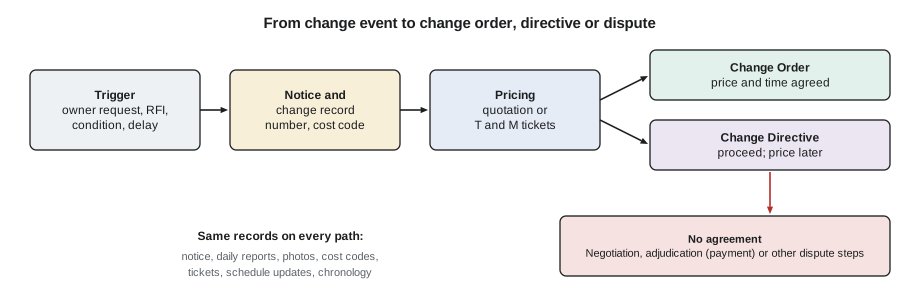
Changes reach Brightwater in many ways: a proposed change from the owner asking for a price, an RFI answer or submittal comment that adds scope, a site instruction, a differing site condition, or an event such as a delay caused by others. Whatever the trigger, the record-keeping steps are the same: record the event, give notice where the contract requires it, open a change record with its own number and cost code, track costs and time separately, price the change, and keep the record until it is closed.
The change log
Every potential change on Westgate gets a number in the change log the day it is identified, even if it may come to nothing. The log follows each item from potential change through quotation and negotiation to a signed change order, a directive, or a rejected or withdrawn item.
| Field | Example |
|---|---|
| Change number and title | PCO-061: Sprinkler sleeves through glulam beams |
| Trigger and date | RFI-147 answer, 2026-05-28 |
| Notice reference | Letter BWC-WGT-L-0212, 2026-05-29 |
| Cost code | 61-21-13 (separate from base contract code) |
| Status | Quotation submitted 2026-06-02; under review |
| Value submitted and agreed | $48,600 submitted; not yet agreed |
| Time impact | 2 working days claimed on the sprinkler rough-in, not critical |
| Linked records | RFI-147; revised sheets FP-2101 to FP-2104; photos; daily reports 2026-06-08 to 06-19 |
The change log is reviewed with the owner at every progress meeting, and it feeds Brightwater's cost forecast. A project manager who knows the total value of pending changes, and the probability of recovering each, has a much clearer picture of the job's real financial position than one who looks only at signed change orders.
Pricing and cost records
Where a change is priced in advance, the quotation should be detailed enough for the reviewer to check: quantities, labour hours and rates, materials, equipment, subcontract quotations, overhead and fee as the contract allows, and the time effect. Lump sums with no breakdown invite rejection and delay.
Where the work is done before the price is agreed, under a directive or on a disputed basis, the cost record must be built as the work happens. The most important tool is the time and material ticket, sometimes called a force account or extra work ticket.
| Ticket element | Practice |
|---|---|
| Reference | Change number and description; one ticket per change per day |
| Labour | Names, trades, hours worked on the change only |
| Materials | Items and quantities used, with delivery ticket or invoice references |
| Equipment | Units, hours operating and idle |
| Signature | Signed daily by the owner's representative or contract administrator to confirm the resources were used, without necessarily agreeing entitlement |
| Photos | Linked to show the work in progress |
Daily signatures matter. A ticket presented for signature weeks later is hard for the owner's representative to verify and easy to dispute. Signing does not always mean the owner agrees the work is extra: tickets often carry a note that the signature confirms only that the resources were used. That still narrows any later dispute to whether the work was a change, not what it cost.
Separate cost codes are the other essential. When change work is mixed with base contract work under the same code, it becomes almost impossible to prove what the change cost. On Westgate, Elena opens a new cost code for every potential change worth more than a few thousand dollars, and the crews' timesheets carry the code from the first day.
Delay records
Delay claims are among the hardest to prove, because they require showing not only that something happened, but that it delayed the completion of the project, and by how much. The essential records are the schedule and its updates, together with the field records that explain them.
- A baseline schedule accepted at the start of the project, with logic that reflects how the work will really be built.
- Regular schedule updates, typically monthly, recording actual progress and any changes in logic, with a narrative explaining what changed and why.
- Daily reports and photos that show what work was and was not done, and why.
- Notices of delay given within the contract periods, with time impact analyses where the contract requires them.
- Records of the resources affected: crews and equipment on standby, extended site overheads.
Schedule updates are themselves contemporaneous records, and they carry more weight when they are prepared honestly each month rather than reconstructed later. Delay analysts often use the updates to examine the project in windows of time, finding which activities were critical in each window and what delayed them. If updates are missing or were manipulated to hide problems, that analysis becomes guesswork.
Concurrent delay is where weak records hurt most. When the owner's redesign of the children's area held up the level 1 fit-out, Brightwater's own drywall subcontractor was also running behind on level 2. The owner argued that the project would have finished late anyway. Brightwater's answer came from its records: the monthly updates showed level 1 fit-out on the critical path and level 2 drywall with float, the daily reports showed which crews were idle and why, and the look-ahead records showed the level 2 crew had been reassigned, not held up. Without those records, the argument about concurrency would have been one opinion against another. How concurrent delay is treated varies with the contract wording and the law of the place, but every approach needs the same thing: a clear, contemporaneous picture of what was critical and what was holding it up on each day.
Disruption and lost productivity
Not every problem delays completion. Many reduce productivity instead: crews work out of sequence, stack up in the same area, wait for information or redo work. Proving lost productivity requires showing what productivity should have been and what it was. One widely used approach is the measured mile, which compares productivity on an unaffected part of the work with productivity on the affected part, using the contractor's own records.
Worked problem
Measured mile on the level 3 ceiling grid
Kestrel Interiors installed ceiling grid on levels 2 and 3. On level 2, work went normally: 1,840 square metres in 368 labour hours. On level 3, work was disrupted for weeks by the owner's redesign of the children's area, which forced crews to skip zones and return later: 1,720 square metres took 516 labour hours. Using level 2 as the measured mile, how many hours were lost on level 3, and what is that worth at $88 per hour?
Show solution
- Unimpacted productivity (level 2): 368 ÷ 1,840 = 0.200 hours per square metre.
- Expected hours on level 3 at that rate: 1,720 × 0.200 = 344 hours.
- Actual hours on level 3: 516.
- Lost hours: 516 − 344 = 172 hours, a loss of about 33 percent compared with expected.
- Value: 172 × $88 = $15,136, before any argument about other causes of the difference.
Answer: About 172 lost hours, worth about $15,136.
The measured mile works only if the records allow it: quantities installed, hours by area and activity, and daily reports that show which periods were affected and why. A contractor that records only total hours per week cannot do this analysis.
# Measured mile: compare impacted and unimpacted productivity
unimpacted = {'qty': 1840, 'hours': 368}   # level 2
impacted = {'qty': 1720, 'hours': 516}     # level 3
rate = 88
base = unimpacted['hours'] / unimpacted['qty']
expected = impacted['qty'] * base
lost = impacted['hours'] - expected
print(f'Unimpacted: {base:.3f} h per m2')
print(f'Expected hours on impacted area: {expected:.0f}')
print(f'Lost hours: {lost:.0f} ({lost / expected:.0%} over expected)')
print(f'Value at ${rate}/h: ${lost * rate:,.0f}')Unimpacted: 0.200 h per m2 Expected hours on impacted area: 344 Lost hours: 172 (50% over expected) Value at $88/h: $15,136
Building a claims-ready file
When a change cannot be agreed, the records must be assembled into a claim that someone outside the project can follow. Brightwater keeps a claim file for every disputed item from the day it is identified, rather than assembling one at the end.
| Section of the file | Contents |
|---|---|
| Summary | What happened, what is claimed, the contract basis, the amount and time |
| Chronology | A dated list of events with references to the record for each |
| Contract provisions | The clauses relied on and the notices given under them |
| Notices and correspondence | Copies in date order with proof of delivery |
| Field records | Daily reports, diaries, photos, inspection records for the period |
| Schedule analysis | Baseline, updates and the analysis of time impact |
| Cost records | Cost code reports, time and material tickets, invoices, rates |
| Quantum calculation | How the amount is built up, with assumptions stated |
The chronology is the spine. Each entry is a date, a short factual statement and a reference to the record that proves it. A chronology built from records, rather than from memory, quickly shows where the record is strong and where it has gaps.
If a payment dispute cannot be settled by negotiation, Ontario's Construction Act allows a party to refer it to adjudication, a fast process run through the Ontario Dispute Adjudication for Construction Contracts authority. Since January 1, 2026, adjudicators may decide matters needed to resolve a payment dispute, including questions of contract interpretation and performance, and adjudication may be started up to 90 days after the contract or subcontract is completed. Adjudication runs on short deadlines, so a claims-ready file is not a luxury.
Common mistakes
MistakeMixing change work with base contract work under one cost code.
InsteadOpen a separate cost code for each significant change from the first day.
MistakePresenting time and material tickets weeks later.
InsteadHave tickets signed daily, even if the signature confirms only the resources used.
MistakeProceeding on a change without an instrument the contract recognizes.
InsteadObtain a Change Order or Change Directive, or give notice and keep records if instructed without one.
MistakeSkipping or manipulating schedule updates.
InsteadUpdate the schedule honestly every month with a narrative of what changed.
MistakeBuilding the claim file only at the end.
InsteadOpen a file for each disputed item when it arises and keep the chronology current.
Summary and key terms
- CCDC 2 2020 uses Change Orders, Change Directives and Supplemental Instructions.
- Every potential change gets a number, a notice where needed, a separate cost code and a place in the change log.
- Quotations should be detailed; work done before agreement needs daily signed time and material tickets.
- Delay claims rest on an accepted baseline, honest monthly updates, daily reports and timely notices.
- Lost productivity can be measured by comparing impacted and unimpacted work, if quantities and hours are recorded by area.
- A claims-ready file has a summary, chronology, contract basis, notices, field records, schedule analysis, cost records and quantum.
- Ontario adjudication and its 2026 changes make fast, well-documented payment claims essential.
- Change Order
- A written amendment agreed by the owner and contractor setting a change in the work, price and time.
- Change Directive
- A written instruction to proceed with a change before the price and time adjustment is agreed.
- Time and material ticket
- A daily record of labour, materials and equipment used on a change, signed by the owner's representative.
- Measured mile
- A method of measuring lost productivity by comparing affected work with similar unaffected work.
- Chronology
- A dated list of events, each referenced to the record that proves it.
- Adjudication
- A fast, interim dispute process for payment disputes under Ontario's Construction Act.
Practice problems
Work each problem on paper first, then reveal the answer to check.
What is the difference between a change order and a change directive?
Show answer
A change order is agreed, including price and time; a directive instructs the contractor to proceed before price and time are agreed.
Why have time and material tickets signed daily?
Show answer
They are easy to verify while the work is fresh, which narrows later disputes to entitlement rather than cost.
Unimpacted work took 0.25 h per unit; impacted work took 600 h for 2,000 units. How many hours were lost?
Show answer
Expected 2,000 × 0.25 = 500 h; lost 600 − 500 = 100 h.
Name four records needed to support a delay claim.
Show answer
Any four of: accepted baseline, monthly updates with narratives, daily reports, photos, timely notices, time impact analyses, records of affected resources.
What is the spine of a claim file, and why?
Show answer
The chronology, because it links every event to the record that proves it and shows where the record is weak.
Lesson quiz · 5 questions
Score 60% or more to complete this lesson.
Create a free account to save your progress, take quizzes and earn a certificate.