
CON-375 · Lesson 4 of 12 · 20 min
Daily reports and site diaries
Every evening at about five o'clock, Marcus Bell sits in the Westgate site office and completes the day's report. It takes him twenty minutes. Some days it records nothing remarkable: forty-two workers, clear weather, level 3 timber panels set on schedule. Other days it records a crane shutdown for wind, a failed inspection or a delivery that arrived with the wrong connectors. Marcus does not know, on any given evening, which of his reports will matter. He knows from experience that some of them will, and that nobody can tell in advance which ones.
The daily report is the backbone of the field record. It is the one document created every working day, by a person with first-hand knowledge, in a consistent format. Combined with the superintendent's diary, subcontractor reports, photos and delivery records, it gives a day-by-day account of the project that nobody can reconstruct later. This lesson covers what a daily report should contain, how it differs from a diary, how subcontractor reports fit in, and how to write and review reports that will stand up when they are needed.
What goes in a daily report
Division 01 of the specifications usually sets a minimum content for daily reports and says whether the owner or contract administrator receives copies. Brightwater's own template goes further than most specifications require, because the report serves Brightwater's interests as well as the owner's.
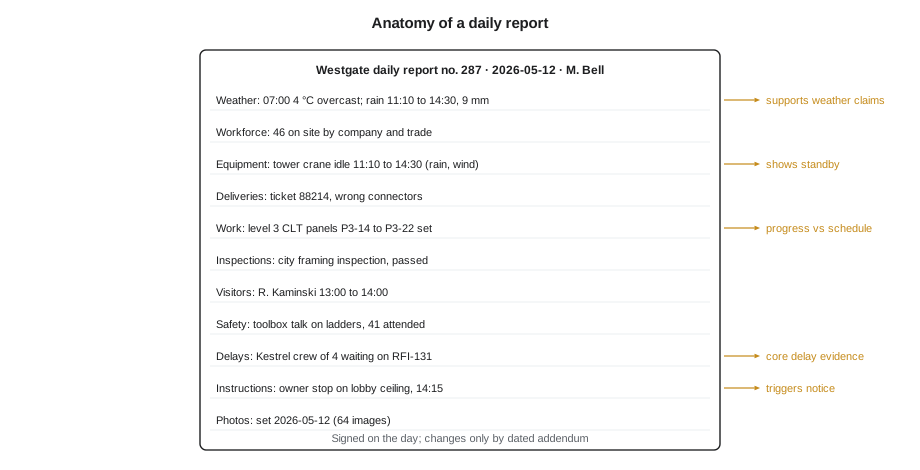
| Section | What to record | Why it matters later |
|---|---|---|
| Weather | Conditions at start, midday and end; temperature; wind; precipitation; ground conditions | Supports weather delay claims and explains concrete, roofing or crane decisions |
| Workforce | Headcount and hours by company and trade, including Brightwater's own staff | Shows resources available, standby and productivity |
| Equipment | Major equipment on site, working, idle or broken down | Supports standby and equipment cost claims |
| Deliveries | What arrived, from whom, condition, late or early, delivery ticket number | Ties material arrivals to schedule and supplier delays |
| Work performed | Activities by area or grid, quantities where practical, started and completed | Measures progress against the schedule |
| Inspections and tests | Who inspected what, result, follow-up | Links to quality records and hold points |
| Visitors | Owner, consultants, inspectors, regulators, with time and purpose | Records who saw conditions and gave instructions |
| Safety | Incidents, near misses, toolbox talks, orders from inspectors | Supports the safety program and investigations |
| Delays and problems | What stopped or slowed work, why, which crews were affected and for how long | Core evidence for delay and disruption |
| Instructions received | Any direction from the owner or consultants, by whom and how | Triggers written confirmation and possible change |
| Photo references | Numbers or links for the day's photo set | Connects words to images |
The delays section is where most reports are weakest. 'Waiting on drawings' tells a reader almost nothing. 'Drywall crew of 4 (Kestrel Interiors) unable to start level 3 east corridor, rooms 301 to 318, pending RFI-131 response on bulkhead height; crew reassigned to level 2 punch work from 08:00; level 3 start now forecast for Monday' tells a reader who, where, why, how long and what was done about it.
Daily report or diary?
The terms are sometimes used interchangeably, but on Westgate they are different documents with different purposes.
| Feature | Daily report | Superintendent's diary |
|---|---|---|
| Format | Structured template in the project platform | Free-form notes, bound book or app |
| Audience | Shared with the owner and consultants as the contract requires | Brightwater internal; may still be disclosed in a dispute |
| Content | Facts in set categories | Conversations, observations, concerns, reminders |
| Timing | Completed and signed every working day | Written throughout the day as things happen |
| Strength as evidence | Routine, consistent, contemporaneous | Detailed and personal; credible if kept honestly every day |
Marcus writes his diary in a bound notebook with numbered pages, in ink, and dates every entry. If he makes a mistake he strikes it through with a single line and initials it, so the original is still readable. Bound books with numbered pages are harder to challenge than loose sheets, because missing or inserted pages are obvious. Many superintendents now keep diaries in an app instead; the same principles apply, and the app should time-stamp entries and keep a history of edits.
A diary is not private just because it is internal. In litigation or arbitration in both countries, relevant documents in a party's possession are generally disclosable, and a diary full of frustrated comments about the owner, or admissions about Brightwater's own mistakes, will be read aloud. The rule Marcus follows is to write what he saw and heard, not what he thinks of people.
Subcontractor daily reports
Brightwater's subcontracts require every subcontractor to submit its own daily report by 09:00 the next working day. These reports feed Brightwater's records and protect both parties. They also reveal disagreements early: if Tallis Mechanical reports eight workers on level 2 and Brightwater's own count shows five, the discrepancy is raised the next morning, not discovered in a claim a year later.
- Use a common format, ideally submitted through the same platform, so reports can be compared and searched.
- Require names or crew lists, not just numbers, on days with extra work, standby or disputed conditions.
- Have Brightwater's superintendent or field engineer review and acknowledge each report, noting any disagreement in writing.
- Make clear in the subcontract that acknowledging a report means receiving it, not agreeing that extra payment is owed.
Weather records
Weather is one of the most common causes of delay and one of the most commonly disputed. A report that says 'rain' is weak. A report that records the time rain began and ended, the amount if a gauge is on site, the activities stopped and the conditions underfoot is much stronger. Brightwater supplements its own observations with official data.
For Westgate, Jun downloads daily weather records for the nearest Environment and Climate Change Canada station each month and files them with the daily reports. Where the contract allows extra time for weather only when conditions exceed what is normal for the season, historical climate normals for the same station are used to show what 'normal' means.
On-site observations matter because official stations can be kilometres away. A thunderstorm that soaks the site may miss the station entirely. A simple site weather station, or at least a rain gauge read at the same time each day, gives Brightwater its own data.
Writing reports that hold up
The value of a daily report depends on how it is written. Brightwater trains its field staff in six habits.
| Habit | Weak entry | Strong entry |
|---|---|---|
| Be specific | Framing on level 3 | Kestrel framing crew of 6, level 3 grid A-D/1-4, 42 m of wall framed |
| Be quantitative | Slow progress on curtain wall | Curtain wall: 4 of 9 planned units set; crane stood down 10:20 to 13:40 for wind above 50 km/h |
| Separate fact from opinion | Electrician incompetent | Electrical rough-in in rooms 214 to 220 failed inspection; inspector noted missing box supports |
| Name sources | Told to stop work | R. Kaminski (owner PM) instructed stop on level 1 lobby ceiling at 14:15 pending finish decision |
| Record quiet days | (blank) | No delays. All trades worked as planned. |
| Note follow-up | Wrong connectors delivered | Delivery ticket 88214: 120 connectors type HC-6 received, type HC-8 specified; supplier notified 11:05; replacement promised 2026-05-14 |
The 'quiet day' entry is easy to overlook. If a report is blank on days when nothing went wrong, a reader cannot tell whether nothing went wrong or nobody filled in the report. 'No delays' is a fact worth recording, and it makes the days with delays more credible.
Reports must be finished the same day. A report completed three days later from memory is not much better than a reconstruction and loses much of its weight. If something is learned after the report is signed, Marcus adds a dated addendum that says when and why it was added, leaving the original untouched.
Worked problem
Do the reports support the standby claim?
Tallis Mechanical claims that its crew of 6 pipefitters stood by for 3 full days (8 hours each) on level 2 waiting for the structural engineer to approve a revised sleeve layout, at a loaded labour rate of $96 per hour. Brightwater's daily reports for the three days show the Tallis crew on site as 6, 6 and 4 workers, and record the sleeve approval as the reason the level 2 work could not proceed. On the third day, the reports note that 2 Tallis workers were moved to level 1 for 6 hours of productive work. What standby cost do the records support?
Show solution
- Day 1: 6 workers × 8 h = 48 h. Day 2: 6 × 8 = 48 h. Day 3: 4 workers on site × 8 h = 32 h.
- Day 3 adjustment: of the 4 workers on site, 2 were moved to level 1 and were productive for 6 h each, so 12 h are not standby: 32 − 12 = 20 h. The other 2 workers claimed on day 3 were not on site at all.
- Total supported standby: 48 + 48 + 20 = 116 h.
- Cost: 116 × $96 = $11,136, compared with the $13,824 claimed for 144 h.
Answer: The records support about 116 hours, or $11,136, of the $13,824 claimed.
Comparing subcontractor claims with daily reports is routine work, and it becomes much faster when report data are structured. Jun exports the workforce section of the reports and runs a check that compares claimed hours with recorded hours.
# Compare claimed standby hours with hours recorded in daily reports
reports = {  # date: (workers on site, productive hours elsewhere)
    '2026-05-11': (6, 0),
    '2026-05-12': (6, 0),
    '2026-05-13': (4, 12),
}
claimed = {'2026-05-11': 48, '2026-05-12': 48, '2026-05-13': 48}
rate = 96
total_claim = total_ok = 0
for day, (workers, productive) in reports.items():
    supported = workers * 8 - productive
    total_claim += claimed[day]
    total_ok += supported
    print(day, 'claimed', claimed[day], 'h  supported', supported, 'h')
print('Claimed $', total_claim * rate, ' Supported $', total_ok * rate)2026-05-11 claimed 48 h supported 48 h 2026-05-12 claimed 48 h supported 48 h 2026-05-13 claimed 48 h supported 20 h Claimed $ 13824 Supported $ 11136
The comparison is not an accusation. Subcontractors often claim honestly from their own payroll records, which may include workers who were sent home or moved elsewhere. Matching the two sets of records quickly, while people still remember the days, lets differences be settled in a conversation rather than an argument.
Review, signature and storage
Every Westgate daily report is reviewed by Elena, the project manager, within two working days. She looks for missing sections, vague delay entries and any instruction that needs written confirmation or notice. Reports are signed electronically in the platform, which time-stamps the signature and locks the report. After locking, changes can be made only as addenda, which the platform records with their own time stamps.
Where the contract requires it, signed reports are shared with Arden Moss as the contract administrator and with the owner's project manager weekly. Brightwater exports a PDF of each month's reports and stores it outside the platform, as part of the project record it will keep for years after the job ends.
Common mistakes
MistakeLeaving the report until the end of the week.
InsteadComplete and sign the report on the day; add dated addenda for anything learned later.
MistakeWriting vague delay entries such as 'waiting on information'.
InsteadRecord which crew, where, why, how long, what document is awaited and what was done instead.
MistakeLeaving quiet days blank.
InsteadWrite 'no delays' so readers know the report was completed.
MistakeUsing the diary to vent about people.
InsteadRecord what was seen and heard; diaries can be disclosed in disputes.
MistakeAccepting subcontractor reports without comparing them with Brightwater's own.
InsteadReview and reconcile reports the next day and record disagreements in writing.
Summary and key terms
- The daily report is the core field record, made every working day by someone with first-hand knowledge.
- It records weather, workforce, equipment, deliveries, work by area, inspections, visitors, safety, delays, instructions and photo references.
- A superintendent's diary adds conversations and observations; it should be kept daily, honestly and in a form that shows any changes.
- Subcontractor daily reports should use a common format and be reconciled with the contractor's own records promptly.
- Official weather data and on-site observations together support weather delay claims.
- Strong entries are specific, quantitative, factual, sourced and completed the same day; quiet days are recorded too.
- Reports are reviewed, signed, locked and archived, with changes made only by dated addenda.
- Daily report
- A structured record of each working day's conditions, resources, progress, events and instructions.
- Site diary
- A superintendent's running record of observations, conversations and concerns, kept throughout each day.
- Standby
- Time when workers or equipment are on site and available but unable to work because of an event outside their control.
- Addendum
- A dated addition to a record, made after it was completed and marked as added later.
- Climate normals
- Long-term averages of weather at a station, used to judge whether conditions were unusual.
- Delivery ticket
- The supplier's document listing what was delivered, when and to where.
Practice problems
Work each problem on paper first, then reveal the answer to check.
Rewrite 'Waiting on drawings' as a strong delay entry.
Show answer
For example: 'Framing crew of 5 (Kestrel) unable to start level 4 east rooms 401 to 410 pending revised sheet A-2405 for wall types; crew moved to level 3 blocking; start forecast 2026-06-03.'
Why record 'no delays' on quiet days?
Show answer
It shows the report was completed and makes entries on delay days more credible.
A crew of 5 is on site for 8 hours; 2 workers do 4 hours of productive work elsewhere. How many standby hours?
Show answer
5 × 8 − 2 × 4 = 32 hours.
Give two ways a diary can show it has not been altered.
Show answer
A bound book with numbered pages and single-line strike-throughs; or an app that time-stamps entries and keeps edit history.
Why use official weather data as well as site observations?
Show answer
Official data are independent and give climate normals; site observations capture local conditions the station may miss.
Lesson quiz · 5 questions
Score 60% or more to complete this lesson.
Create a free account to save your progress, take quizzes and earn a certificate.