
CON-375 · Lesson 5 of 12 · 19 min
Requests for information
By the time the Westgate timber superstructure was going up, Hannah Lowe had written more than 180 requests for information. Some were simple: a dimension missing from a stair section, a door hardware set not listed in the schedule. Others were complicated: how a mechanical duct could pass through a glulam beam that the structural drawings showed as solid, or what fire rating applied to an exposed timber column next to an exit stair. Each one stood for a moment when the people building the work could not tell, from the documents, what they were supposed to build. How quickly and clearly those moments were resolved had a direct effect on the schedule and the cost.
A request for information, or RFI, is a formal written question from the contractor to the design team, through the contract administrator, asking for clarification of the contract documents. It is one of the most common documents on any project and one of the most misused. This lesson explains what an RFI is for and what it is not for, how to write one that gets a fast, useful answer, how to track RFIs in a log, and how to recognize when an RFI answer is really a change.
What an RFI is for
An RFI asks the designer to clarify the design intent where the documents are unclear, incomplete, conflicting or impossible to build as drawn. It creates a record of the question, the answer and the time taken. It is not a tool for every communication.
| Use an RFI for | Do not use an RFI for |
|---|---|
| A conflict between drawings, or between drawings and specifications | Questions the documents already answer clearly |
| Missing dimensions, details or information needed to build | Requests for approval of a substitution (use the substitution procedure) |
| Field conditions that differ from what the documents show | Submitting shop drawings or product data (use the submittal process) |
| Construction that is impossible or unsafe as drawn | Giving notice of a claim (use a notice under the contract) |
| Confirming the designer's intent where two readings are possible | Scheduling, coordination or means and methods that are the contractor's responsibility |
Unnecessary RFIs waste everyone's time and damage credibility. A contractor that sends dozens of questions already answered in the documents trains the designer to respond slowly to all of them. Hannah's rule is to search the drawings, specifications, addenda and previous RFI answers before writing, and to cite where she looked.
The RFI workflow
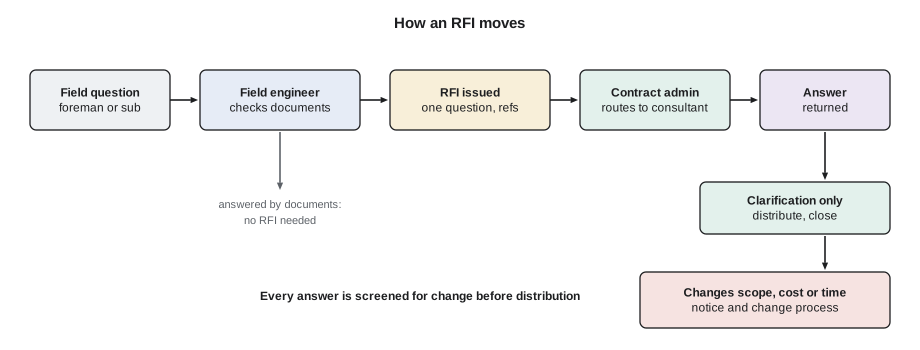
On Westgate, a question usually starts with a foreman or subcontractor. It reaches Hannah through the subcontractor's own RFI, which she reviews before forwarding: some are answered from documents the subcontractor missed, some are combined with similar questions, and the rest are rewritten into Brightwater's format and sent through the platform to Arden Moss. Arden Moss answers architectural questions directly and routes others to the structural, mechanical or electrical consultants, then returns the answer. Hannah distributes it to everyone affected and checks whether the answer changes the scope, cost or time.
CCDC 2 2020 does not give a fixed number of days for the Consultant to answer questions, but requires the Consultant to provide clarifications and supplemental instructions in a timely way, consistent with the schedule. Westgate's Division 01 sets a target of 5 working days for routine RFIs and asks Brightwater to flag urgent ones.
Writing an RFI that gets answered
A good RFI makes the designer's job easy. The designer should be able to read it once, understand the problem, see where to look, and answer in a sentence or a sketch.
| Element | Purpose | Example from RFI-112 |
|---|---|---|
| Number and title | Unique identity and a subject that names the location and issue | RFI-112: Level 2 transfer beam embed plates at grid C/3 |
| References | Exact drawing sheets, revisions, details and specification sections | S-2102 C02 detail 4; A-2104 C02; Section 06 17 19 |
| Question | One clear question, or a small set on the same issue | Confirm embed plate locations to suit the glulam connection on S-3010 C01 |
| Background | What was found and why it matters | S-2102 shows plates 150 mm west of the connection centre line on S-3010 |
| Proposed solution | The contractor's suggestion, which often speeds the answer | Relocate plates 150 mm east to align with S-3010 |
| Impact | Effect on cost and schedule if any; required-by date | Formwork for beam starts 2026-04-20; answer needed by 2026-04-16 |
| Attachments | Marked-up drawings, photos, sketches | Overlay of S-2102 and S-3010 with conflict circled |
The proposed solution is powerful. A designer who sees a sensible suggestion can often answer 'proceed as proposed' in minutes. But the solution must be offered as a suggestion, not presented as a decision, and Brightwater must not build it until the answer comes back. If the proposed solution would cost more or take longer, the RFI should say so, because the designer may prefer a cheaper alternative.
One question per RFI keeps the log clean. An RFI with six unrelated questions tends to get five answered and one forgotten, and it is impossible to close cleanly. Related questions about the same detail can be grouped; unrelated questions get separate numbers.
The RFI log
Every RFI is tracked in a log that shows its status at a glance. On Westgate the log lives in the platform, but its fields are the same as a well-kept spreadsheet.
| Field | Purpose |
|---|---|
| Number, title, discipline | Identity and routing |
| Date sent, required-by date | Starts the clock and sets urgency |
| Ball in court | Who must act next: Brightwater, Arden Moss or a consultant |
| Date answered, days open | Measures response time |
| Answer summary | Quick reference without opening the full RFI |
| Cost or time impact (yes, no, possible) | Flags potential changes |
| Linked documents | Revised drawings, change records, submittals that follow from the answer |
The 'ball in court' field is the most useful on any given day. At the weekly coordination meeting, Hannah filters the log for RFIs past their required-by date with the ball in the design team's court, and those are the first agenda item. Equally, RFIs waiting on Brightwater, for example for more information the designer asked for, are chased internally.
Measuring RFI performance
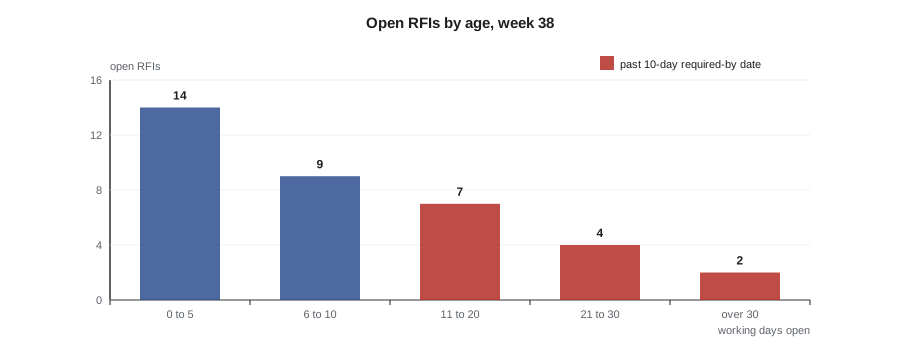
The log turns into management information. Brightwater watches three numbers on every project: how many RFIs are open, how long they have been open, and how many are past their required-by date. The trend matters as much as the snapshot. A growing number of overdue RFIs is an early sign of a design team under pressure or of incomplete documents, and either can lead to delay.
Worked problem
How is the design team performing?
In the four weeks to week 38, Arden Moss and its consultants answered 36 Westgate RFIs. The days taken to answer, in working days, were: 2, 3, 3, 4, 4, 4, 5, 5, 5, 5, 5, 6, 6, 6, 7, 7, 7, 8, 8, 9, 9, 10, 10, 11, 12, 12, 14, 15, 15, 18, 19, 21, 22, 25, 28, 34. The target is 5 working days. What are the median and mean response times, and what share met the target?
Show solution
- Median: with 36 values, the median is the average of the 18th and 19th values: (8 + 8) ÷ 2 = 8 working days.
- Mean: the values add to 384, so the mean is 384 ÷ 36 = 10.7 working days.
- Met target: 11 of the 36 answers took 5 days or less: 11 ÷ 36 = 30.6 percent.
- The mean is much higher than the median because a few RFIs took 20 days or more; those long tails are where schedule risk sits.
Answer: Median 8 working days, mean about 10.7, and about 31 percent within the 5-day target.
Numbers like these are shared with the owner and design team factually, at the monthly meeting, alongside a list of the specific overdue RFIs and the work they are holding up. The point is not to blame but to get the overdue questions answered. A chart that shows the oldest RFIs and the activities they affect usually moves faster than a letter of complaint.
# RFI response statistics from the log
from statistics import mean, median
days = [2, 3, 3, 4, 4, 4, 5, 5, 5, 5, 5, 6, 6, 6, 7, 7, 7, 8, 8, 9, 9,
        10, 10, 11, 12, 12, 14, 15, 15, 18, 19, 21, 22, 25, 28, 34]
target = 5
on_time = sum(1 for d in days if d <= target)
print('RFIs answered:', len(days))
print('Median days:', median(days))
print('Mean days:', round(mean(days), 1))
print('Within target:', on_time, f'({on_time / len(days):.1%})')
print('Over 20 days:', sum(1 for d in days if d > 20))RFIs answered: 36 Median days: 8.0 Mean days: 10.7 Within target: 11 (30.6%) Over 20 days: 5
When an RFI answer is a change
Many RFI answers simply clarify what the documents already required. Some go further: they add work, change materials, alter dimensions or impose a sequence that costs money or time. An RFI answer is not a change order. If an answer changes the scope, Brightwater must treat it as a potential change and follow the contract's change process.
- Review every answer for cost and time effect before distributing it, and mark the log accordingly.
- Where the answer is a change, write to the contract administrator within the notice period, saying that Brightwater considers the answer a change and will submit a quotation or claim.
- Do not proceed with changed work on an RFI answer alone unless the contract allows it and the owner has confirmed in writing how it will be paid, for example by a change directive.
- Watch for designers answering 'no change in contract price or time' on the RFI form. That statement is the designer's view, not an agreement, and Brightwater should respond in writing if it disagrees.
On Westgate, RFI-147 asked how a sprinkler main could pass a glulam beam. The answer added a steel sleeve and reinforcement plate at 22 locations, with a note 'no change in contract price'. Hannah flagged it the same day, Elena gave notice that Brightwater considered it a change, and the work was later priced and agreed in a change order. Had they simply built the sleeves, the note on the RFI might have been treated as their acceptance.
Answers need the same care as questions. Arden Moss sometimes answered with a marked-up sketch rather than a revised drawing. Sketches are useful, but they must be numbered, referenced in the RFI log and, where they change the design, followed by a formal drawing revision so that the record set and the as-built drawings stay complete. Hannah tracks open 'sketch to be incorporated' items in the log until the revised sheet is issued.
RFIs and subcontractors
Most questions start with subcontractors, who know their own work best. Brightwater's subcontracts require subcontractors to submit RFIs through Brightwater, never directly to the designers, so that every question and answer is tracked in one log and Brightwater can judge whether an answer affects other trades. Brightwater also requires subcontractors to raise questions early enough for the answer to arrive before their work starts, and to read the RFI log for answers that affect them.
Common mistakes
MistakeSending RFIs for questions the documents already answer.
InsteadSearch drawings, specifications, addenda and earlier answers first, and cite where you looked.
MistakePacking several unrelated questions into one RFI.
InsteadUse one RFI per issue so each can be answered and closed.
MistakeLeaving out the required-by date.
InsteadState when the answer is needed and what work it affects.
MistakeTreating an RFI answer as a change order.
InsteadReview every answer for scope, cost and time; give notice and use the change process where needed.
MistakeBuilding a proposed solution before it is accepted.
InsteadWait for the written answer before proceeding.
Summary and key terms
- An RFI is a formal written question asking the designer to clarify the contract documents.
- RFIs are not for substitutions, submittals, notices of claims or the contractor's own means and methods.
- A good RFI has a clear title, exact references, one question, background, a proposed solution, impact, a required-by date and attachments.
- The RFI log tracks status, ball in court, dates, answers and potential impacts.
- Median and mean response times and the share meeting the target show how quickly questions are answered; long tails carry schedule risk.
- An RFI answer that changes scope is a potential change and must go through notice and the change process.
- Subcontractor questions should flow through the contractor so one log captures every RFI.
- Request for information (RFI)
- A formal written question asking the design team to clarify the contract documents.
- Ball in court
- The party who must act next on an open item.
- Required-by date
- The date by which an answer is needed to avoid affecting the work.
- RFI log
- A register of all RFIs with their status, dates, answers and impacts.
- Proposed solution
- The contractor's suggested answer, offered to help the designer respond quickly.
- Median
- The middle value in an ordered list; half the values are lower and half higher.
Practice problems
Work each problem on paper first, then reveal the answer to check.
Give two things that should not be sent as RFIs.
Show answer
Any two of: substitution requests, submittals, notices of claims, questions the documents already answer, the contractor's own means and methods.
Why include a proposed solution in an RFI?
Show answer
It shows the designer a sensible answer that can often be accepted quickly.
Five RFIs took 3, 4, 6, 9 and 18 days. What are the median and mean?
Show answer
Median 6 days; mean 40 ÷ 5 = 8 days.
An RFI answer adds steel sleeves at 22 locations and says 'no change in contract price'. What should Brightwater do?
Show answer
Flag it as a potential change, give written notice within the contract period and price it through the change process before or while doing the work as the contract allows.
What does 'ball in court' show?
Show answer
Who must act next on an open RFI.
Lesson quiz · 5 questions
Score 60% or more to complete this lesson.
Create a free account to save your progress, take quizzes and earn a certificate.