
CRE-302 · Lesson 11 of 12 · 31 min
Services, licensing and speaking
A creator's skills and reputation are valuable beyond their own channels. Brands, agencies, businesses and other creators pay for the same abilities that make a channel succeed: producing video, writing scripts, editing, designing thumbnails, running social accounts, consulting on strategy and growth. Organizations pay creators to speak at conferences, run workshops and host events. Media companies, advertisers and other creators pay to license footage, photos, music and formats. These streams turn expertise and intellectual property into income that does not depend on platform algorithms. Services are limited by time, but they often pay well, provide stable income while a channel grows, and can lead to other opportunities. Licensing can earn from work already made. This lesson covers services and freelance work, pricing time-based and project work, licensing content and intellectual property, speaking and appearances, and how these streams fit into a creator's business.
Services and freelance work
Creator services draw on production and audience-building skills. Common examples include:
- Production services: filming, editing, motion graphics, podcast production, photography and thumbnail design for brands or other creators.
- Content strategy and consulting: advising businesses or creators on channel strategy, growth, community or monetization.
- Social media management: running accounts for businesses, sometimes as a monthly retainer.
- User-generated content (UGC) creation: making videos or photos for brands to use on their own channels or ads, without posting them to the creator's audience. UGC is priced on production and usage rights, not the creator's audience size.
- Teaching and training for organizations: workshops on video production, social media or presentation skills.
Services can begin before a creator has a large audience, because clients pay for skills and results, and a portfolio of the creator's own content demonstrates those skills. Many successful creators started by freelancing and used the income to fund their own channels.
Pricing services
Services can be priced by the hour or day, by the project, or on a monthly retainer. Hourly and day rates are simple but reward slowness and cap income; project pricing rewards efficiency and is easier for clients to budget; retainers provide predictable income in exchange for an ongoing commitment. A useful starting point for a minimum rate works out what the creator needs to earn and how many hours can actually be billed.
Billable hours are always fewer than working hours, because time goes into finding clients, administration, learning, revisions, unpaid gaps between projects and holidays. Self-employed people often bill 50 to 70 % of their working hours.
Worked problem
A minimum day rate
A video editor wants $70,000 of income before tax, has $10,000 of annual business costs, works 46 weeks a year at 40 hours a week, and expects 60 % of that time to be billable. What is the minimum hourly rate and the equivalent eight-hour day rate?
Show solution
- Working hours: 46 × 40 = 1,840; billable: 1,840 × 0.60 = 1,104 hours.
- Hourly rate: ($70,000 + $10,000) / 1,104 ≈ $72.46.
- Day rate: $72.46 × 8 ≈ $580.
Answer: About $72 an hour, or about $580 a day, as a minimum.
This is a floor, not a market rate. Experienced professionals price by the value of the result to the client and by market rates for comparable work; a creator with a proven track record of growing channels can charge far more than a minimum. Project quotes should state the scope, deliverables, number of revision rounds, timeline, payment schedule (often a deposit of 30 to 50 % upfront), and what happens if the scope changes.
| Pricing model | Advantages | Drawbacks | Good for |
|---|---|---|---|
| Hourly or day rate | Simple; pays for all time | Caps income; clients watch hours | Uncertain scope, on-site shoots |
| Project fee | Rewards efficiency; easy to budget | Risk if scope grows | Defined deliverables |
| Monthly retainer | Predictable income | Ongoing commitment | Social management, editing |
| Value-based fee | Captures value of results | Needs trust and evidence | Strategy, consulting |
Licensing content
Licensing lets others use content the creator owns in return for a fee, while the creator usually keeps ownership. Types of licensing include:
- Footage licensing: news organizations, documentary makers, TV shows and advertisers license viral clips, drone footage, nature footage or unusual events. Licensing agencies such as Jukin Media, Storyful and ViralHog represent viral clips and split revenue with creators; stock footage sites such as Shutterstock, Adobe Stock and Pond5 sell clips to many buyers.
- Photo and music licensing: stock libraries, sync licensing for music in film, TV and ads, and production music libraries.
- Usage rights for brand content: brands pay to use sponsored or UGC content in ads (Lesson 5).
- Format and IP licensing: a show format, character or brand licensed for TV, books, games, toys or merchandise.
- Content syndication: licensing a back catalogue to streaming services, airlines or other platforms.
Licensing terms define the scope of use: where the content may appear (media and territories), for how long, whether it is exclusive, and whether it can be edited. Exclusive licences prevent licensing to anyone else and should cost much more. Creators should read agreements carefully: some viral-clip agreements ask for exclusive, perpetual, worldwide rights that remove the creator's ability to control or earn from their own content later. Contracts and copyright are covered in CRE-330.
Worked problem
Comparing licensing offers
A creator's viral clip draws two offers. Offer A: $1,500 upfront for a non-exclusive licence for one broadcast use. Offer B: an agency takes exclusive worldwide rights and pays 50 % of licensing revenue, which it estimates at $4,000 over two years, but nothing upfront. If the creator thinks they could separately license the clip to two more buyers for $1,000 each under Offer A, which looks better?
Show solution
- Offer A: $1,500 + 2 × $1,000 = $3,500, with the creator keeping control.
- Offer B: 0.50 × $4,000 = $2,000 expected, uncertain, with exclusivity.
Answer: Offer A looks better on these assumptions, though Offer B requires no selling effort and an agency may find buyers the creator cannot.
Speaking, appearances and events
Creators with expertise or a recognizable brand can be paid to speak at conferences, corporate events, schools, festivals and trade shows, to host panels or events, or to appear at fan conventions and meet-and-greets. Speaking fees vary from nothing, for early-career speakers who gain exposure, to thousands or tens of thousands of dollars for well-known creators, plus travel expenses. Corporate events and industry conferences generally pay more than community events. Speaking also builds authority, generates content, and connects creators with potential clients and sponsors. Live shows and tours, popular with podcasters and comedians, combine ticket sales, merchandise and sponsorship, but carry venue, travel and production costs and the risk of low ticket sales.
Worked problem
A live podcast show
A podcast plans a live show in a 400-seat venue. Venue and production cost $9,000, travel $1,500, and ticketing fees are 10 % of a $45 ticket. A local sponsor pays $2,000, and merch contributes about $6 per attendee. How many tickets must sell to break even?
Show solution
- Net ticket price: $45 × 0.90 = $40.50; with merch: $46.50 per attendee.
- Costs to cover after sponsorship: $9,000 + $1,500 − $2,000 = $8,500.
- Break-even: $8,500 / $46.50 ≈ 182.8, so 183 tickets, about 46 % of capacity.
Answer: About 183 tickets; a sell-out of 400 would earn roughly $10,100 profit before tax.
Contracts and professional terms
Services, licensing and speaking all involve agreements with organizations, and good terms protect both sides. Essential elements include the scope of work or use, deliverables, deadlines, fees and payment terms, revision limits, cancellation fees, ownership and usage rights, confidentiality, and who pays for travel and expenses. Work-for-hire arrangements, in which the client owns everything the creator makes, should be priced accordingly, and creators should ensure they keep the right to show work in their portfolio. Invoices should be clear and prompt; late-payment terms encourage clients to pay on time.
Canadian creators who provide services should consider GST/HST registration once taxable supplies exceed the $30,000 small supplier threshold; services to clients outside Canada are often zero-rated, while services to Canadian clients are generally taxable at the rate for the client's province. Speaking fees and licensing income are also business income. Under Canadian copyright law, the author is generally the first owner of copyright unless an employment or written agreement provides otherwise, so ownership terms in service agreements matter. CRE-330 covers these rules.
Fitting services into the business
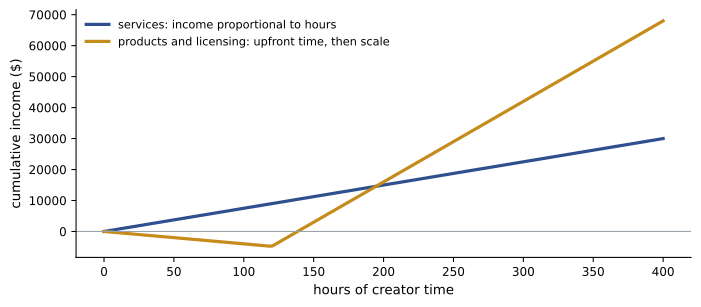
Services and speaking provide valuable income, especially early in a creator's career or during slow periods for other streams, but they compete directly with time for making content. Some creators keep service work to a fixed number of days a week; others raise prices steadily to reduce volume while keeping income; others gradually shift from services to products as their audience grows. Licensing, by contrast, can earn from existing work with little extra time, so it is worth setting up for any creator whose footage, photos or music have value to others. A balanced creator business might use services for stability, licensing for passive income, and speaking for authority and connections.
Finding clients
Clients for creator services come from the creator's own content, referrals, networking, online portfolios and freelance marketplaces. A creator's channel is itself a portfolio: a business looking for a video editor or social media strategist can see the quality of the work and the results it achieves. Case studies that describe a client's problem, the work done and measurable outcomes are persuasive. Specializing, for example in editing for educational YouTube channels or producing podcasts for professional services firms, makes it easier to be found and to charge higher rates than a generalist.
Retainers and productized services
Retainers provide predictable income, which is valuable alongside volatile streams. A productized service packages a service into a fixed offer at a fixed price, such as "four edited videos a month for $2,400" or "a channel audit with a written report for $750". Productized services are easier to sell, quicker to deliver and easier to delegate to assistants than custom projects. They also make income easier to forecast.
Worked problem
Retainer capacity
A creator offers an editing retainer of four videos a month for $2,400. Each video takes 6 hours to edit and 1 hour of communication and revisions. If they limit service work to 60 hours a month, how many retainer clients can they serve and what is the effective hourly rate?
Show solution
- Hours per client: 4 × (6 + 1) = 28 hours a month.
- Clients: 60 / 28 ≈ 2.1, so 2 clients using 56 hours.
- Income: 2 × $2,400 = $4,800; hourly: $4,800 / 56 ≈ $85.71.
Answer: Two clients, earning $4,800 a month at about $86 an hour.
Licensing and agencies for footage
Creators who regularly capture valuable footage, such as storm chasers, wildlife filmmakers, drone pilots or people who film unusual events, can benefit from working with licensing agencies, which have relationships with media buyers. Before signing, creators should check the share of revenue, whether the agreement is exclusive, its duration and how to end it, whether the agency can file copyright claims on the creator's own channel, and how often payments and reports are provided. Keeping original, high-resolution files and recording where and when footage was shot makes licensing easier.
Speaking: building a reputation
Speaking engagements usually grow from visibility and reputation. Creators can begin with local events, podcasts, webinars and industry meetups, then use recordings to approach larger conferences. A speaker page on the creator's website, with topics, a short biography, video clips and testimonials from organizers, helps event planners decide. Speakers should agree in writing on fees, travel and accommodation, recording rights, and whether the talk may be published.
Invoicing and collecting payment are part of running a service business. Invoices should show the creator's business name, the client's details, a description of the work, the amount, any applicable sales tax, the payment terms and how to pay. Following up promptly and politely on overdue invoices, and pausing further work for clients who do not pay, protects cash flow.
Common mistakes
MistakePricing services from working hours rather than billable hours.
InsteadUse realistic billable hours, often 50–70 %.
MistakeStarting projects without defined scope and revisions.
InsteadAgree scope, revisions and deposits in writing.
MistakeSigning exclusive perpetual licences casually.
InsteadCheck scope, term and exclusivity before signing.
MistakeAccepting work-for-hire terms at normal rates.
InsteadPrice full ownership transfers higher.
MistakeLetting services crowd out content.
InsteadLimit service days or raise prices.
Summary and key terms
- Services sell a creator's production and strategy skills to clients.
- Minimum rate = (target income + costs) ÷ billable hours.
- Hourly, project, retainer and value-based pricing suit different work.
- Licensing earns from existing content while keeping ownership.
- Licence terms define media, territory, duration and exclusivity.
- Speaking and live events build income, authority and connections.
- Services compete with content time; licensing scales beyond it.
- Freelance services
- Work done for clients on a project or time basis.
- Billable hours
- Hours that can be charged to clients.
- Retainer
- A recurring monthly fee for ongoing work.
- UGC
- Content made for brands to post on their own channels.
- Licence
- Permission to use content under defined terms.
- Exclusive licence
- A licence that excludes all other licensees.
- Footage licensing
- Selling rights to use video clips.
- Sync licensing
- Licensing music for use with visual media.
- Work for hire
- Arrangement in which the client owns the work.
- Speaking fee
- Payment for a talk or appearance.
Practice problems
Work each problem on paper first, then reveal the answer to check.
Name four creator services.
Show answer
Production, strategy consulting, social management, UGC, training.
Minimum rate for $60,000 income, $8,000 costs, 1,000 billable hours?
Show answer
$68 an hour.
Why are billable hours fewer than working hours?
Show answer
Admin, sales, revisions, gaps and holidays.
Typical project deposit?
Show answer
30–50 % upfront.
What is UGC priced on?
Show answer
Production and usage rights, not audience size.
Name four terms in a licence.
Show answer
Media, territory, duration, exclusivity, edits.
Why are exclusive licences priced higher?
Show answer
They prevent all other licensing.
Break-even tickets for $6,000 costs and $40 per attendee?
Show answer
150.
What should work-for-hire terms cost?
Show answer
More, because the client owns everything.
Which streams scale beyond the creator's time?
Show answer
Licensing and products.
Lesson quiz · 5 questions
Score 60% or more to complete this lesson.
Create a free account to save your progress, take quizzes and earn a certificate.