
CRE-302 · Lesson 12 of 12 · 28 min
Building a diversified business model and capstone
The previous lessons examined each revenue stream on its own. A real creator business combines them, and the combination matters as much as any single stream: which streams support each other, how concentrated income is, how volatile it is from month to month, and whether the creator has the time to run everything. This final lesson brings the course together. It covers how to measure revenue concentration and diversification, how streams reinforce or conflict with each other, how to stress-test a business against shocks, how to manage cash flow and reserves in an irregular income, and how to plan which streams to add next. It ends with a capstone project: a monetization plan for a real or hypothetical creator business, with forecasts, unit economics and a risk review.
Measuring concentration
A business is concentrated when most of its income comes from a few sources. Two simple measures are the share of the largest stream and the Herfindahl–Hirschman index (HHI), the sum of the squared shares of all streams.
With shares expressed as fractions, the HHI ranges from just above 0, for income spread across very many streams, to 1, for a single stream. The reciprocal, \(1/\text{HHI}\), gives the effective number of streams: the number of equal-sized streams that would produce the same concentration.
Worked problem
Concentration of two creator businesses
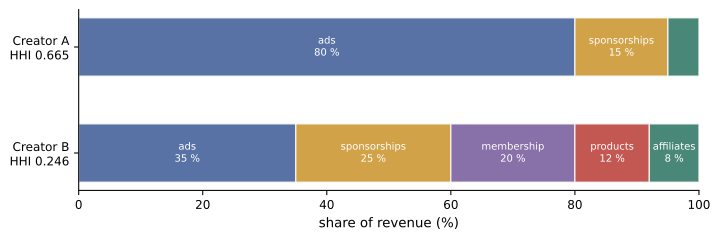
Creator A earns 80 % from platform ads, 15 % from sponsorships and 5 % from affiliates. Creator B earns 35 % from ads, 25 % from sponsorships, 20 % from a membership, 12 % from digital products and 8 % from affiliates. Calculate each HHI and effective number of streams.
Show solution
- Creator A: \(0.80^2 + 0.15^2 + 0.05^2 = 0.64 + 0.0225 + 0.0025 = 0.665\); effective streams \(1/0.665 \approx 1.5\).
- Creator B: \(0.35^2 + 0.25^2 + 0.20^2 + 0.12^2 + 0.08^2 = 0.1225 + 0.0625 + 0.04 + 0.0144 + 0.0064 = 0.2458\); effective streams \(1/0.2458 \approx 4.1\).
Answer: Creator A is highly concentrated, with an HHI of 0.665 and about 1.5 effective streams; Creator B, with 0.246 and about 4.1, is much more diversified.
Concentration also exists within streams. A creator with five sponsors where one provides 70 % of sponsorship income, or a membership on a single platform, is more concentrated than the headline figures suggest. Concentration by platform matters too: ads, memberships, shopping and tips on the same platform all depend on one company's decisions and one account staying in good standing.
Diversification that makes sense
Diversification is not simply adding more streams. Streams that rely on the same thing, such as ads, Shorts bonuses and platform shopping on one platform, fail together; streams with different drivers, such as ad revenue, a membership paid through a separate platform, and a course sold through an email list, are more independent. Useful diversification spreads income across:
- Drivers: breadth-driven streams (ads, sponsorships) and depth-driven streams (memberships, products).
- Platforms: no single company controls most of the income or the audience relationship.
- Customers: no single sponsor, client or licensee provides an outsized share.
- Timing: recurring streams that smooth the lumpy income from launches and deals.
- Effort: some streams that earn from existing work, such as licensing, evergreen products and affiliates, alongside those that require new time.
At the same time, too many streams can dilute focus, overwhelm the creator and confuse the audience. Most successful creator businesses concentrate effort on three to five well-run streams that fit together, rather than a dozen that each earn a little.
How streams reinforce each other
The strongest creator businesses are designed so that streams feed each other. Free content grows the audience, which raises ad revenue and sponsorship value; an email list captures interested viewers; a membership deepens the relationship with the most engaged; members provide feedback and buy products first; product launches create content; services and speaking build authority that raises prices elsewhere. Conflicts also occur: a sponsor may compete with the creator's own product, too many calls to action can annoy viewers, and service work can crowd out content. Mapping the connections between streams shows where to invest and where to set boundaries.
| Stream | Feeds | Can conflict with |
|---|---|---|
| Free content and ads | All other streams through audience growth | Long sponsor segments, heavy CTAs |
| Email list | Products, courses, memberships, launches | Over-promotion causing unsubscribes |
| Membership | Product feedback, first buyers, stability | Time for content if perks are heavy |
| Digital products and courses | Authority, affiliate programs for others | Competing sponsors |
| Sponsorships | Cash for production | Own products, audience trust if poor fit |
| Services and speaking | Authority, cash, contacts | Content time |
Stress testing
A stress test asks what happens to income if something goes wrong: a platform cuts revenue sharing, an algorithm change halves views, a major sponsor leaves, a launch underperforms, or the creator is ill for a month. For each scenario, the creator estimates the effect on each stream and on total income.
Worked problem
A platform shock
Creator B from the earlier example earns $10,000 a month: ads $3,500, sponsorships $2,500, membership (on a separate platform) $2,000, digital products $1,200 and affiliates $800. A platform algorithm change cuts views by 40 %, reducing ads, sponsorship value and affiliate income by 40 %, membership by 5 % and products by 15 %. What is the new monthly income?
Show solution
- Ads: $3,500 × 0.60 = $2,100; sponsorships: $2,500 × 0.60 = $1,500; affiliates: $800 × 0.60 = $480.
- Membership: $2,000 × 0.95 = $1,900; products: $1,200 × 0.85 = $1,020.
- Total: $2,100 + $1,500 + $480 + $1,900 + $1,020 = $7,000.
Answer: Income falls by 30 % to $7,000. Creator A, with 80 % from ads, would lose close to 40 %, and depth-based streams cushion Creator B.
Stress tests should lead to actions: building reserves, reducing dependence on the most exposed stream, or preparing responses such as a planned product launch that could be brought forward.
Cash flow and reserves
Creator income is irregular: sponsorship payments arrive 30 to 60 days after delivery, launches produce spikes, ad revenue follows the seasons, and taxes are due in large sums. Good financial habits include separating business and personal accounts, paying a regular salary to oneself from the business account, setting aside a percentage of every payment for taxes, keeping an emergency reserve, and forecasting cash flow month by month for the year ahead. A common guideline is a reserve of three to six months of essential expenses, or more for highly volatile incomes.
Canadian self-employed creators generally pay income tax and both the employee and employer portions of Canada Pension Plan contributions (or Quebec Pension Plan contributions in Quebec) on net business income, and may need to make quarterly tax instalments once their tax owing exceeds thresholds. Setting aside a fixed share of income, often 25 to 35 % depending on income level and province, and any GST/HST collected, avoids surprises. CRE-330 covers creator taxes and business structures.
Choosing what to add next
When deciding which stream to add, creators can compare candidates on expected contribution, time required, upfront cost, risk, fit with the audience and content, and how much they diversify the business. A simple scoring table, rating each candidate from 1 to 5 on these factors with weights that reflect the creator's priorities, makes the trade-offs visible. A low-cost test, such as a waiting list, a beta cohort, a POD design or a single affiliate partnership, should come before a large commitment. Each new stream should be reviewed after three to six months against its forecast, then kept, improved or dropped.
Here \(w_k\) are weights that sum to one and \(r_k\) are the ratings for each factor.
Capstone: a monetization plan
The capstone brings the course together in a written monetization plan for a real channel or a realistic hypothetical one. The plan should include:
- Creator profile: niche, platforms, audience size, breadth and depth, audience location and current revenue, if any.
- Current revenue mix: each stream with monthly revenue, direct costs and contribution, plus overheads and profit (Lesson 1).
- Platform programs: eligibility status, current and announced rules, and expected RPM with seasonal pattern (Lessons 2 and 3).
- Affiliate and sponsorship plan: programs, EPC estimates, a sponsorship rate estimate and disclosure practices for the creator's country (Lessons 4 and 5).
- Direct support: a membership design with tiers, MRR, churn and LTV estimates, and a fan-funding or crowdfunding plan if relevant (Lessons 6 and 7).
- Products and education: at least one digital product or course with validation plan, pricing, contribution and break-even (Lessons 8 and 9).
- Physical products and services: merchandise model and break-even, or service and licensing offers with pricing (Lessons 10 and 11).
- Diversification and risk: current and target HHI, stress tests for at least two scenarios, cash reserve plan and tax set-aside (this lesson).
- Legal and compliance checklist: disclosure, subscription rules, sales tax registration questions and contracts to review, with pointers to CRE-310 and CRE-330.
- Twelve-month roadmap: which streams to test, launch or drop, in what order, with forecasts as a range and review dates.
A strong plan is honest about uncertainty, uses the creator's own data where possible, counts time as a cost, protects audience trust and leaves room to adapt as platforms change.
A worked monetization plan
Consider a hypothetical Canadian woodworking channel with 180,000 subscribers, 900,000 monthly views, 70 % of viewers in Canada and the United States, an email list of 15,000 and current monthly revenue of $9,000: ads $4,500 (50 %), sponsorships $3,000 (33 %) and affiliates $1,500 (17 %). Its HHI is \(0.50^2 + 0.33^2 + 0.17^2 \approx 0.39\), about 2.6 effective streams, all of them breadth-driven and dependent on views.
A twelve-month plan might add three depth-driven streams. First, a set of woodworking plans as digital products, validated by a waiting list and priced at $25 to $45. Second, a membership on a separate platform with monthly project plans and a members' live session, aiming for 600 members at $8 a month within a year. Third, a weekend course for beginners, launched to the email list after a beta cohort. Merchandise would be tested with print-on-demand before any inventory run.
Worked problem
Projected mix after twelve months
If the channel ends the year with ads $4,800, sponsorships $3,200, affiliates $1,600, plans $1,400, membership $4,200 and course sales averaging $1,800 a month, what is total monthly revenue and the new HHI?
Show solution
- Total: $4,800 + $3,200 + $1,600 + $1,400 + $4,200 + $1,800 = $17,000.
- Shares: 0.282, 0.188, 0.094, 0.082, 0.247, 0.106.
- HHI: 0.0795 + 0.0353 + 0.0088 + 0.0068 + 0.0610 + 0.0112 ≈ 0.203; effective streams ≈ 4.9.
Answer: About $17,000 a month with an HHI of about 0.20 and nearly five effective streams, a much more resilient business.
Reviewing and adapting the plan
A monetization plan is a living document. Monthly reviews compare actual revenue, contribution and time spent with the forecast; quarterly reviews ask whether each stream is meeting its goals and whether platform or market changes require adjustments; annual reviews revisit the creator's goals, workload and the overall mix. Signs that a stream should be changed or dropped include contribution below forecast for several months, a poor return on time, complaints from the audience, or conflict with the creator's values. Signs that a stream deserves more investment include strong demand, high contribution per hour and positive feedback.
Sustainability and the creator's wellbeing
A diversified business can still fail if the creator burns out. Each stream adds obligations: perks to deliver, products to support, clients to serve and campaigns to run. Building a business that the creator can sustain, by limiting the number of streams, delegating tasks, batching work, scheduling breaks and keeping some streams that earn without constant attention, protects both the business and the person running it. The most valuable asset in a creator business is still the creator, and a plan that ignores their time and health is not a sound plan.
Above all, the plan should serve the creator's goals, whether that is a full-time income, a sustainable side business or the freedom to make ambitious work.
Common mistakes
MistakeCounting streams on one platform as diversification.
InsteadSpread income across platforms, drivers and customers.
MistakeAdding many small streams at once.
InsteadRun three to five streams that fit together well.
MistakeSpending launch income as it arrives.
InsteadPay a regular salary and keep reserves.
MistakeForgetting to set aside tax.
InsteadReserve a share of every payment for taxes.
MistakeNever reviewing streams after launch.
InsteadReview against forecasts and keep, improve or drop.
Summary and key terms
- A creator business combines streams that should reinforce each other.
- HHI measures concentration; 1/HHI gives effective streams.
- Diversify across drivers, platforms, customers, timing and effort.
- Stress tests show how income responds to shocks.
- Irregular income needs separate accounts, salaries, reserves and tax set-asides.
- Score candidate streams and test before committing.
- The capstone plan brings revenue, risk and compliance together.
- Revenue concentration
- Dependence of income on a few sources.
- HHI
- Sum of squared revenue shares.
- Effective number of streams
- The reciprocal of the HHI.
- Diversification
- Spreading income across independent sources.
- Stress test
- Estimating income under adverse scenarios.
- Cash flow
- The timing of money in and out.
- Runway
- Months reserves last at current spending.
- Tax set-aside
- A share of income reserved for taxes.
- Weighted score
- Ratings combined using factor weights.
- Monetization plan
- A written plan for a creator's revenue streams.
Practice problems
Work each problem on paper first, then reveal the answer to check.
HHI for shares of 0.5 and 0.5?
Show answer
0.5.
Effective streams for HHI 0.25?
Show answer
4.
HHI for shares 0.6, 0.3, 0.1?
Show answer
0.46.
Name three dimensions of diversification.
Show answer
Drivers, platforms, customers, timing, effort.
Why are streams on one platform linked?
Show answer
They depend on one company and account.
Income after a 30 % cut to $4,000 of ads within $10,000 total?
Show answer
$8,800.
Runway for $18,000 reserves, $5,000 expenses, $2,000 guaranteed income?
Show answer
6 months.
Common reserve guideline?
Show answer
Three to six months of essential expenses.
How long before reviewing a new stream?
Show answer
About three to six months.
Name four parts of the capstone plan.
Show answer
Profile, mix, products, risk, compliance, roadmap.
Lesson quiz · 5 questions
Score 60% or more to complete this lesson.
Create a free account to save your progress, take quizzes and earn a certificate.