
CRE-302 · Lesson 5 of 12 · 27 min
Sponsorships and brand deals: an overview
For many creators, sponsorships are the largest single source of income. A brand pays the creator to feature, mention or integrate a product or message, and because the creator sets the price and negotiates the terms, a single deal can be worth more than months of platform revenue. CRE-310 is a full course on brand partnerships, covering prospecting, pitching, negotiation, campaign delivery and long-term relationships; CRE-330 covers contracts and legal terms. This lesson places sponsorships within the revenue mix: the main deal types, how sponsorship prices are estimated, how sponsorships interact with other streams, the risks and costs involved, and the disclosure obligations that apply. The aim is to understand sponsorships well enough to plan them as part of a business model, not to master every step of a deal.
Deal types
Sponsorships take many forms:
- Integrations: a segment within a video, podcast or stream, usually 30 to 90 seconds, in which the creator presents the product in their own style.
- Dedicated content: a whole video, post or episode about the brand's product.
- Social posts and stories: sponsored posts, stories or short videos on platforms such as Instagram and TikTok.
- Usage rights and whitelisting: the brand pays to use the creator's content in its own advertising, or to run ads through the creator's account, sometimes called creator licensing or spark ads.
- Ambassadorships: longer-term relationships with several pieces of content over months, sometimes with exclusivity.
- Affiliate-hybrid deals: a smaller flat fee plus commission on sales, sharing risk between creator and brand.
- Product seeding and gifting: free products with no guaranteed content; any resulting mention still requires disclosure.
- Event and live sponsorships: sponsored streams, appearances or events.
Each type has a different value to the brand and a different cost to the creator, which is reflected in price.
Estimating a sponsorship price
There is no fixed price list for sponsorships, but common starting points relate the price to the expected audience reached. One widely used approach estimates a price from expected views and an effective CPM for sponsored content.
Sponsorship CPMs for integrations are typically far higher than platform ad RPMs, because a creator's endorsement is more persuasive than a standard ad and the audience is targeted. Figures discussed in the industry often range from about $15 to $50 per thousand expected views for YouTube integrations, varying by niche, audience, country and format, with dedicated videos and usage rights priced higher. These are rough reference points, not standards: experienced creators adjust for the factors below and their own data from past campaigns. Expected views should be based on the median, not the best, performance of recent comparable content, often over the first 30 days.
Factors that raise the price include a specialized or high-value audience, strong engagement, proven conversion results from past campaigns, exclusivity that prevents working with competitors, usage rights, tight deadlines, extra deliverables and additional production costs. Factors that lower it include a broad audience with low purchase intent, uncertain views and requests for performance-only payment.
Worked problem
Pricing an integration
A creator's recent videos have a median of 60,000 views in the first 30 days. They use a sponsorship CPM of $25 for a 60-second integration, add 30 % for 30-day paid usage rights, and pay a 15 % manager commission. What should they quote, and what do they keep?
Show solution
- Base fee: 60,000 / 1000 × $25 = $1,500.
- Usage rights: $1,500 × 0.30 = $450; quote $1,500 + $450 = $1,950.
- Manager commission: $1,950 × 0.15 = $292.50; the creator keeps $1,657.50 before production costs and tax.
Answer: Quote about $1,950 and keep about $1,657.50 after commission.
Valuing deals against the alternative
A sponsorship occupies space in content that could otherwise hold something else. A 60-second integration may reduce retention a little, displace an affiliate recommendation, or compete with the creator's own product. A dedicated sponsored video may receive fewer views than usual. When assessing a deal, creators should consider the opportunity cost: what the same content time or audience attention would earn from their own products, memberships or affiliate links. A brand deal at a low fee that occupies prime space before a product launch may cost more than it earns. CRE-310 discusses how to build a rate card and negotiate around these trade-offs.
Fit, exclusivity and creative control
The best sponsorships fit the audience and content so naturally that viewers welcome them. Poor fit, such as a product the audience does not need or that conflicts with the creator's values, damages trust and performs badly, which then hurts future deals. Key terms to watch, even at an overview level, include:
- Exclusivity: a promise not to work with competitors for a period, which should be paid for and limited in scope.
- Creative control: who approves scripts and edits, and how many rounds of revisions are included.
- Usage rights: whether and how long the brand may reuse the content, and in which channels.
- Payment terms: deposits, payment dates (often 30 to 60 days after delivery) and late-payment terms.
- Morality and termination clauses: what happens if either party's conduct creates a reputational problem.
These are contract matters covered fully in CRE-330; a simple rule is never to sign a deal the creator does not understand, and to get the agreement in writing.
| Deal element | Effect on price | Note |
|---|---|---|
| Integration (30–90 s) | Base | Priced from expected views |
| Dedicated video | Higher than integration | Whole piece about the product |
| Paid usage rights | Adds a percentage per period | Brand reuses content in ads |
| Exclusivity | Adds a premium | Limit category and duration |
| Extra revisions | Adds time costs | Agree number in advance |
| Affiliate hybrid | Lower flat fee plus commission | Shares performance risk |
Sponsorships alongside other streams
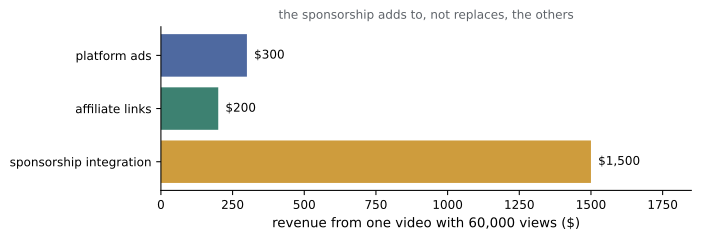
Sponsorships interact with the rest of the revenue mix. They add to the revenue from each piece of content without reducing platform ad revenue, since the integration sits inside the content. They can conflict with affiliate links or products if the sponsor competes with them. Long-term ambassadorships provide predictable income that smooths out the volatility of ad revenue, while one-off deals are lumpy. Sponsors also value audience data, such as demographics, retention and past campaign results, which CRE-202 covered under media kits and reporting. Because sponsorship prices follow the same seasonal calendar as ads (Lesson 3), fourth-quarter deals are often worth more and easier to find, and January budgets may be tight.
Agencies, managers and marketplaces
Creators find sponsors in several ways: brands approach them directly, they pitch brands themselves, they work through talent managers or agencies, or they use influencer marketplaces and platform-run programs such as YouTube BrandConnect or the TikTok One creator marketplace. Managers and agencies typically take 10 to 20 % of deals, sometimes more, in return for finding deals, negotiating and handling administration. Marketplaces may charge fees or take a share. Whether representation is worthwhile depends on deal volume and the creator's willingness to handle sales; CRE-310 covers these choices.
Disclosure for sponsored content
Sponsored content must be disclosed clearly, just like affiliate links. Platforms provide paid-partnership labels, such as YouTube's "includes paid promotion" setting and Instagram's paid partnership tag, which should be used in addition to clear disclosure in the content itself. Disclosure should be made at the start of the sponsored segment or post, in plain words, in the same language as the content, and spoken as well as written in video.
In Canada, the Competition Bureau's guidance on influencer marketing and Ad Standards' Influencer Marketing Disclosure Guidelines require clear and prominent disclosure of payments, free products and other material connections; brands and agencies are also responsible for ensuring their influencers disclose.
Costs and risks
Sponsorship revenue comes with costs: time spent on outreach, negotiation and revisions; production costs for travel or props; manager commissions; and occasional unpaid invoices. Risks include late or missed payments, brands that change requirements after work has started, conflicts between sponsors, and damage to trust from poor-fit deals. Good practices include written agreements, deposits for new clients, clear scope and revision limits, and a list of categories the creator will not promote. Revenue from sponsorships is also typically received as business income, with sales tax considerations covered in CRE-330.
Planning sponsorship income
For planning, creators can estimate sponsorship revenue from the number of deals they expect per month and an average fee, adjusted for seasonality. A creator who aims for two integrations a month at an average of $1,800 would plan for about $3,600 a month, perhaps more in the fourth quarter and less in January. Tracking win rates on pitches, average fees and payment times makes forecasts more reliable over time. The rest of the detail, from pitch decks to negotiation scripts, belongs in CRE-310.
Performance-based and hybrid deals
Some brands prefer to pay for results rather than reach, offering commission on sales, a fee per install or sign-up, or a small flat fee plus commission. Performance deals shift risk to the creator: if the audience does not buy, the creator earns little for the same production work. They can be attractive when the creator has strong evidence that their audience converts, or when a lower flat fee is acceptable in return for a generous commission. A useful way to assess an offer is to estimate the expected value of the performance component from past results and compare the total with a flat-fee quote.
Worked problem
Flat fee or hybrid?
A brand offers either a $2,000 flat fee or $800 plus 15 % commission on sales. The creator expects 50,000 views, a 1.5 % click-through rate, a 4 % conversion rate and a $90 average order. Which offer has the higher expected value?
Show solution
- Clicks: 50,000 × 0.015 = 750; purchases: 750 × 0.04 = 30.
- Sales: 30 × $90 = $2,700; commission: $2,700 × 0.15 = $405.
- Hybrid total: $800 + $405 = $1,205.
Answer: The $2,000 flat fee has the higher expected value; the hybrid would only match it with sales of about $8,000.
Measuring sponsorship results
Brands increasingly ask creators to report results: views, watch time on the sponsored segment, clicks, code uses, sign-ups and sales. Providing clear reports, as discussed in CRE-202, builds long-term relationships and justifies higher fees on renewal. Creators can also use results to set prices: if past campaigns in a niche consistently delivered a certain cost per acquisition for brands, the creator can show that their fee represents good value. Tracking which sponsors renew, and why others do not, is useful business data.
Brand safety and values
Brands worry about brand safety, the risk that their product appears next to content that could embarrass them. Creators, in turn, should consider creator safety: whether a sponsor's products, practices or reputation could embarrass them or harm their audience. Many creators keep a list of categories they will not promote, such as gambling, certain financial products, unproven health supplements or products unsuitable for a young audience. Regulated categories, such as alcohol, cannabis, gambling, financial services and health products, carry additional advertising rules in both countries, including age restrictions and limits on claims, and should be checked carefully before accepting a deal.
Sponsorships and young audiences
Creators whose audiences include many children or teenagers face stricter expectations. Advertising directed at children is restricted in both countries: Quebec's Consumer Protection Act prohibits most commercial advertising directed at children under 13, the Broadcast Code for Advertising to Children applies to broadcast advertising in the rest of Canada, and in the United States the Children's Online Privacy Protection Act (COPPA) and FTC guidance shape how content made for children can be monetized and advertised. Creators with young audiences should be especially careful about which sponsors they accept and how sponsored content is presented.
A simple sponsorship record, listing each deal's brand, fee, deliverables, dates, payment status and results, makes it easy to see average fees, payment delays and renewal rates over time.
Common mistakes
MistakePricing deals from your best-performing video.
InsteadBase prices on median recent views.
MistakeGranting exclusivity or usage rights for free.
InsteadCharge for them and limit their scope.
MistakeAccepting poor-fit sponsors for the fee.
InsteadProtect trust by choosing sponsors that fit.
MistakeRelying on the platform label alone.
InsteadDisclose clearly in the content as well.
MistakeWorking without a written agreement.
InsteadGet terms in writing; see CRE-330.
Summary and key terms
- Sponsorships are often a creator's largest single income source.
- Deal types include integrations, dedicated content, usage rights and ambassadorships.
- Prices are often estimated from expected views and a sponsorship CPM.
- Usage rights, exclusivity and extra work add to price.
- Consider opportunity cost and fit with other streams.
- Disclose sponsorships clearly under Canadian and US rules.
- CRE-310 covers brand partnerships in depth; CRE-330 covers contracts.
- Integration
- A sponsored segment within content.
- Dedicated content
- A whole piece about a sponsor's product.
- Usage rights
- Permission for a brand to reuse creator content.
- Whitelisting
- A brand running ads through a creator's account.
- Ambassadorship
- A long-term sponsorship with repeated content.
- Sponsorship CPM
- Price per thousand expected views for sponsored content.
- Exclusivity
- Agreement not to work with competitors for a period.
- Opportunity cost
- Value of the best alternative use of the same space.
- Paid partnership label
- A platform tag marking sponsored content.
- Rate card
- A creator's list of standard prices.
Practice problems
Work each problem on paper first, then reveal the answer to check.
Name four sponsorship deal types.
Show answer
Integration, dedicated, social posts, usage rights, ambassadorship, hybrid.
Fee for 40,000 expected views at $30 CPM?
Show answer
$1,200.
Why use median rather than best views?
Show answer
It gives a realistic, deliverable estimate.
Typical manager commission?
Show answer
10–20 %.
What is opportunity cost in a sponsorship?
Show answer
The value of using the same space for something else.
Name two contract terms to watch.
Show answer
Exclusivity, creative control, usage rights, payment, termination.
When should sponsored segments be disclosed?
Show answer
At the start, in plain words, spoken and written.
Why are Q4 deals often worth more?
Show answer
Advertiser budgets peak.
Name a platform sponsorship marketplace.
Show answer
YouTube BrandConnect or TikTok One.
Which course covers brand partnerships in depth?
Show answer
CRE-310.
Lesson quiz · 5 questions
Score 60% or more to complete this lesson.
Create a free account to save your progress, take quizzes and earn a certificate.