
CRE-302 · Lesson 7 of 12 · 29 min
Fan funding, tips and crowdfunding
Some fans want to support a creator directly, without committing to a monthly membership: a one-off tip after a helpful video, a paid message during a premiere, a contribution to fund a documentary, or a pledge to back a new board game or album. Fan funding covers these one-off and project-based forms of direct support. It is the most direct expression of an audience's goodwill, and it can fund projects that no sponsor or platform would pay for. This lesson covers tips and one-off payments, in-platform fan funding features, crowdfunding campaigns for specific projects, the economics of reward-based crowdfunding including fulfilment costs, and the legal and tax considerations. Live-stream gifts, Bits and Super Chat during live broadcasts were covered in CRE-250, so they are mentioned here only in passing.
Tips and one-off support
Tipping tools let fans send a one-off payment, often framed as "buy me a coffee". Options include:
- Dedicated tip pages, such as Ko-fi and Buy Me a Coffee, which also offer memberships and small shops. Fees vary by plan; some charge no platform fee on one-off tips beyond payment processing, while others take a small percentage.
- Payment links through services such as PayPal or Stripe, placed on a creator's website.
- In-platform features on recorded content, such as YouTube Super Thanks, where viewers pay to highlight a comment on a video, and similar tipping features on other platforms.
- Live stream features, such as Super Chat, Twitch Bits and TikTok LIVE gifts (CRE-250).
Tips tend to be small and irregular, but they cost little to set up and give fans an easy way to say thank you. They often spike after especially helpful or emotional content, when a creator shares a milestone, or when they explain what support pays for. A simple, sincere call to action, such as "if this video saved you a trip to the repair shop, you can support the channel here", usually works better than repeated requests.
| Type | Example | Frequency | Typical use |
|---|---|---|---|
| Tip page | Ko-fi, Buy Me a Coffee | One-off | Thank-you payments |
| Comment tip | YouTube Super Thanks | One-off | Highlighted thanks on a video |
| Live gifts | Super Chat, Bits, LIVE gifts | During streams | Interaction in real time |
| Crowdfunding | Kickstarter, Indiegogo | Per project | Funding a defined project |
| Membership | Patreon, channel memberships | Recurring | Ongoing support (Lesson 6) |
How much fan funding to expect
Fan funding revenue depends on the share of the audience that ever pays and the average amount. A rough model multiplies active viewers by the share who tip in a period and the average tip.
Tipping rates are usually a small fraction of a per cent of viewers, but they vary greatly with the closeness of the community. A tutorial creator with 50,000 monthly viewers, a tipping rate of 0.2 % and an average tip of $6, after 8 % fees, would receive roughly 100 tips and about $550 a month. That is useful supplementary income, and it signals how many people might join a membership or back a project.
Crowdfunding
Crowdfunding raises money for a defined project from many backers, usually through a campaign with a goal, deadline and rewards. The main types are:
- Reward-based crowdfunding: backers receive a product or reward, such as a copy of the album, game or book, in return for their pledge. Kickstarter and Indiegogo are the best-known platforms.
- Donation-based crowdfunding: supporters contribute without expecting a reward, through platforms such as GoFundMe. For creators this suits personal or community causes more than commercial projects.
- Equity crowdfunding: backers receive shares in a business. This is regulated securities activity, with specific exemptions and platform requirements in Canada and the United States, and it is outside the scope of this course.
Kickstarter uses an all-or-nothing model: if the goal is not reached by the deadline, no one is charged. Indiegogo offers fixed funding, which is all-or-nothing, and flexible funding, where the creator keeps whatever is raised. At the time of writing, Kickstarter charges a 5 % platform fee on successfully funded projects plus payment processing fees of roughly 3 to 5 %; other platforms charge similar amounts. Creators should check current fees, since they affect the goal calculation.
Setting a crowdfunding goal
A crowdfunding goal must cover the full cost of delivering every reward, plus fees and a contingency for problems. A common error is setting a goal equal to the production cost, forgetting platform fees, shipping, taxes and the cost of fulfilling rewards for every backer.
Worked problem
Calculating a realistic goal
A creator plans a photo book. Design and printing for 1,000 copies cost $14,000; packaging and shipping average $9 per copy for an expected 800 backers; they add a 10 % contingency on these costs; combined platform and processing fees are 9 %. What goal should they set?
Show solution
- Shipping: 800 × $9 = $7,200; costs before contingency: $14,000 + $7,200 = $21,200.
- Contingency: $21,200 × 0.10 = $2,120; total costs: $23,320.
- Goal: $23,320 / (1 − 0.09) ≈ $25,626; round to $26,000.
Answer: Set a goal of about $26,000, not $14,000; the printing cost alone covers barely half of what delivery will really cost.
Reward tiers and pricing
Rewards should be priced so that each tier is profitable after its own costs. Lower tiers, such as a digital download or a thank-you credit, cost almost nothing to fulfil and can be priced low. Physical rewards must cover manufacturing, packaging, shipping and fees for each unit. Stretch goals, extra features unlocked when funding passes certain levels, can boost a campaign but also add costs; each stretch goal should be costed before it is announced. International shipping costs and customs duties vary widely and can surprise creators; many campaigns charge shipping separately by region.
Worked problem
Contribution per tier
A $45 tier includes the book; the book costs $14 to print, $9 to pack and ship, and fees are 9 % of the pledge. What is the contribution per backer?
Show solution
- Fees: $45 × 0.09 = $4.05.
- Costs: $14 + $9 + $4.05 = $27.05.
- Contribution: $45 − $27.05 = $17.95.
Answer: About $17.95 per backer towards design costs and profit.
Running a campaign
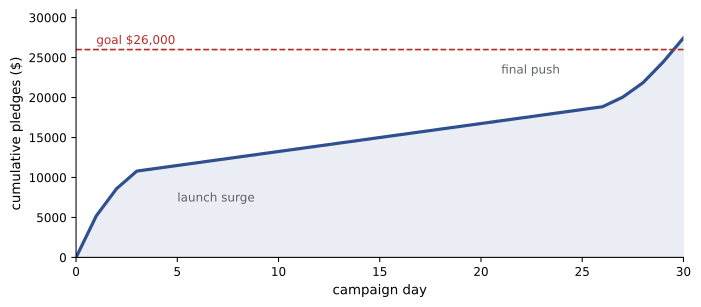
Successful campaigns are usually built before they launch. The creator builds an interest list, often an email list of people who want to be notified at launch, tests the idea with the audience, prepares a clear campaign page with video, rewards and a realistic timeline, and plans content to promote the campaign throughout. Campaigns typically receive a large share of their funding in the first and last few days, so a strong launch to an already interested audience matters. During and after the campaign, regular updates to backers maintain trust. Delays are common in crowdfunded projects, especially for physical goods; honest, frequent communication about problems prevents a delay from becoming a reputational crisis.
Risks of crowdfunding
Crowdfunding shifts financial risk from the creator to backers, but it also creates obligations. Backers are customers, not donors, in a reward-based campaign. Common risks include underestimating costs, manufacturing delays, shipping problems, currency changes, and running out of money before all rewards are delivered. Failure to deliver can lead to refund demands, complaints to consumer protection authorities and lasting reputational harm. Platforms' terms usually require creators to fulfil rewards or offer refunds if they cannot. A creator should not launch a campaign for a physical product until they have a prototype, quotes from suppliers and a realistic production plan.
Legal and tax considerations
Money received through tips and crowdfunding is generally taxable income for creators, even when supporters think of it as a gift. Rewards sent to backers are usually treated as sales, which may bring sales tax obligations, while unconditional tips may be treated differently depending on the facts. Creators are not charities, so they cannot issue tax receipts for donations, and they should avoid describing support as tax-deductible. Disclosure of how funds will be used should be honest; raising money for one purpose and spending it on another can mislead backers.
In Canada, tips and crowdfunding received in the course of a creator business are generally business income for tax purposes. Reward-based pledges are usually consideration for a supply, so a creator registered for GST/HST, or who exceeds the $30,000 small supplier threshold, may need to charge GST/HST, and QST in Quebec, on rewards delivered to Canadian backers. Only registered charities can issue official donation receipts. CRE-330 covers these rules.
Fan funding in the revenue mix
Fan funding works best as a complement to other streams. Tips reward helpful work and indicate audience goodwill; crowdfunding can finance ambitious projects, such as a documentary, a book or a product line, without investors or sponsors, and the campaign itself is a form of marketing that proves demand before production. A successful campaign often leads to ongoing product sales after the rewards are delivered. Because both depend on the audience's trust, honesty about how money is used and reliable delivery are essential.
Explaining what support pays for
Fans are more willing to support a creator when they understand how their money is used. Simple, honest explanations, such as "support pays for our editor and the archive footage licences in this series", connect contributions to visible results. Some creators share a funding goal for a specific purpose, such as a new camera, a research trip or translating videos into another language, and report back when it is reached. Transparency should never become pressure: guilt-based appeals, constant reminders and comparisons with other viewers who have paid tend to alienate the audience that does not pay, which is most of it.
Crowdfunding beyond products
Crowdfunding is not limited to physical products. Creators have funded documentaries, albums, books, games, comics, tours, festivals and community projects. For creative work without a physical product, rewards can be digital copies, credits, behind-the-scenes access, signed items or experiences. Rewards that require the creator's time, such as personal video messages or calls, should be limited in number and priced to reflect the time involved. Donation-based campaigns for personal emergencies or community causes are different in character; they should be clearly described, and money should be used as stated.
Worked problem
Funding a short documentary
A creator plans a documentary costing $18,000 to produce. Rewards are mostly digital, costing about $1,200 in total to fulfil, plus $800 for a small number of physical posters and shipping. They add a 10 % contingency on all costs, and fees are 9 %. What goal should they set?
Show solution
- Costs: $18,000 + $1,200 + $800 = $20,000.
- With contingency: $20,000 × 1.10 = $22,000.
- Goal: $22,000 / 0.91 ≈ $24,176; round to about $24,500.
Answer: A goal of about $24,500, which covers production, rewards, contingency and fees.
After the campaign
A successful campaign is the beginning of a project, not the end. After funding, the creator must manage production, keep backers informed with regular updates, collect shipping addresses and survey responses, handle changes of address and failed payments, and deliver rewards. Platforms and backer management tools help with surveys and fulfilment. Once rewards are delivered, many creators continue to sell the product through a store or pre-order page, turning a one-time campaign into an ongoing stream. Others run regular campaigns for new projects, building a loyal backer base that returns each time.
Late pledges and slacker backers
Some platforms and tools allow late pledges after the campaign ends, often at a slightly higher price, which captures demand from people who missed the campaign. Payment failures are common at the end of all-or-nothing campaigns, as some backers' cards are declined, so creators should expect a few per cent of pledges to fail and include that in their planning.
Common mistakes
MistakeSetting a crowdfunding goal equal to production cost.
InsteadInclude shipping, fees, rewards and contingency.
MistakeAnnouncing stretch goals before costing them.
InsteadCost every stretch goal first.
MistakeLaunching a physical product campaign without a prototype.
InsteadPrototype and get supplier quotes first.
MistakeCalling tips tax-deductible donations.
InsteadOnly registered charities or nonprofits can offer that.
MistakeStaying silent when a project is delayed.
InsteadUpdate backers honestly and often.
Summary and key terms
- Fan funding includes tips, one-off payments and crowdfunding.
- Tips are small and irregular but easy to set up.
- Reward-based crowdfunding funds defined projects with rewards for backers.
- Goals must cover production, rewards, shipping, fees and contingency.
- Each reward tier should make a positive contribution.
- Campaigns are built before launch and need honest updates.
- Tips and pledges are generally taxable; rewards may attract sales tax.
- Fan funding
- Direct one-off or project support from fans.
- Tip
- A voluntary one-off payment to a creator.
- Super Thanks
- A paid highlighted comment on a YouTube video.
- Crowdfunding
- Raising money for a project from many backers.
- All-or-nothing
- Funding collected only if the goal is met.
- Flexible funding
- Creator keeps funds even if the goal is missed.
- Reward tier
- A pledge level with a specified reward.
- Stretch goal
- An extra unlocked when funding passes a level.
- Fulfilment
- Producing and delivering rewards to backers.
- Contingency
- Extra budget for unexpected costs.
Practice problems
Work each problem on paper first, then reveal the answer to check.
Name three tipping tools.
Show answer
Ko-fi, Buy Me a Coffee, Super Thanks, PayPal or Stripe links.
Tips from 40,000 viewers at 0.25 % and $8, before fees?
Show answer
$800.
What is all-or-nothing funding?
Show answer
Backers are charged only if the goal is met.
Goal for $18,200 total costs with 9 % fees?
Show answer
About $20,000.
Contribution for a $30 tier costing $12 plus 9 % fees?
Show answer
About $15.30.
Why build an interest list before launch?
Show answer
Early funding drives momentum.
When should stretch goals be costed?
Show answer
Before they are announced.
Are tips generally taxable for creators?
Show answer
Yes, as business income.
Can creators issue donation receipts?
Show answer
No, only registered charities or qualifying nonprofits.
Where are live gifts covered?
Show answer
CRE-250.
Lesson quiz · 5 questions
Score 60% or more to complete this lesson.
Create a free account to save your progress, take quizzes and earn a certificate.