
CRE-310 · Lesson 1 of 12 · 27 min
The influencer marketing industry
Brand partnerships are the commercial meeting point between creators and companies. A brand wants to reach people who trust a particular creator; the creator wants to earn from the audience they have built without betraying that trust. When the match is right, both sides win and the audience gets a recommendation it finds useful. When it is wrong, the brand wastes money, the creator loses credibility and the audience feels used. This course is about making the match right and running the business side well: understanding how brands buy, positioning yourself, building a media kit, pricing, pitching, negotiating, working to briefs, understanding the main contract terms, disclosing properly, reporting results and turning one-off deals into long-term relationships.
CRE-302 placed sponsorships within a creator's overall revenue mix and showed a simple way to estimate a fee from expected views. This course goes much deeper into how deals are actually found, priced, negotiated and delivered. Two other courses sit alongside it: CRE-320 covers advertising disclosure, misleading claims and ethics in detail, and CRE-330 covers contracts, business structures and tax. Where this course touches law, it stays at an overview level and points to those courses.
What influencer marketing is
Influencer marketing is a form of marketing in which a brand pays or otherwise rewards a person with an audience to promote a product, service or message to that audience. The reward may be money, free products, travel, commissions on sales or access to events. The defining feature is that the message comes from, or appears to come from, a person the audience follows by choice rather than from the brand directly.
The industry uses several overlapping terms. Influencer usually means a person whose recommendations affect followers' buying decisions. Creator is broader and emphasizes making content, whether or not the person sells anything. Brand partnership, sponsorship, brand deal and paid collaboration all describe the commercial arrangement. Marketers also talk about user-generated content (UGC), which today often means content a creator makes for a brand to post on the brand's own channels or in ads, rather than on the creator's account. UGC work is priced differently because the creator supplies production skill but not audience reach.
How big the industry is
Estimates of the size of the influencer marketing industry vary widely because researchers define it differently. Some count only what brands pay creators; others include agency fees, software platforms and paid amplification of creator content. Influencer Marketing Hub, which publishes an annual benchmark report, estimated global spending at roughly $24 billion (US) in 2024 and about $32.6 billion in 2025, up from under $2 billion in 2016. Other research firms give figures from about $30 billion to over $40 billion for 2025 and 2026 depending on scope. Goldman Sachs Research estimated in 2023 that the broader creator economy, including platform payouts and direct fan revenue, could approach $480 billion by 2027.
The exact figure matters less than the trend. Brand budgets have shifted steadily from traditional advertising toward creators because audiences spend more time with creators, ad-blocking and ad fatigue reduce the reach of traditional digital ads, and short-form video has made creator content central to discovery and shopping. Surveys of marketers consistently report that most plan to keep or increase their influencer budgets; Influencer Marketing Hub's 2026 survey found that about 87 % of respondents expected their influencer budget to rise.
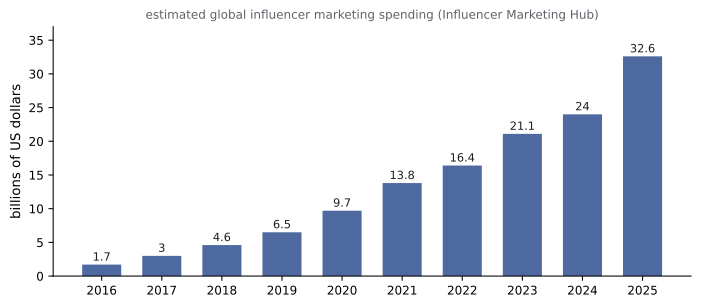
Treat any single industry figure with caution. Market-size numbers are often produced by companies that sell influencer software or services, and they are estimates built from surveys and assumptions rather than audited totals. When you quote a figure to a brand, quote the source and year.
Who is involved
A typical brand partnership involves more parties than the creator and the brand. Understanding who does what helps you know whom to pitch, who has authority to approve a fee and why a deal takes the time it does.
- The brand: the company paying for the campaign. Inside it, the brand manager or marketing manager owns the product's marketing plan, and an influencer or social media manager often runs creator programs day to day. Legal, finance and procurement teams may be involved for larger deals.
- Agencies: many brands hire a specialist influencer agency, or their general advertising or public relations agency, to plan campaigns, find creators, negotiate and manage delivery. The agency is usually paid by the brand, but it negotiates with you on the brand's behalf.
- Talent managers and talent agencies: these represent creators, finding deals, negotiating and handling admin in return for a commission, commonly 10 % to 20 % of deal value and sometimes more for full management.
- Networks and marketplaces: platforms such as YouTube BrandConnect, TikTok One (which replaced TikTok Creator Marketplace), Instagram's creator marketplace and independent marketplaces connect brands with creators, sometimes taking a fee.
- Software providers: brands use influencer marketing platforms to search for creators, check audience data, manage contracts and payments and measure results.
- Platforms: the social platforms themselves set rules on branded content, provide paid partnership labels and sell ad products that let brands amplify creator posts.
Creator tiers
Brands commonly group creators into tiers by audience size. The boundaries vary between agencies and platforms, but a widely used scheme is shown in the table. Tiers matter because they affect price, the type of work brands expect and how campaigns are built: a campaign may use one macro creator for reach or fifty nano creators for authenticity and local relevance.
| Tier | Typical followers | Typical strengths |
|---|---|---|
| Nano | 1,000–10,000 | High trust, close community, low cost, often local |
| Micro | 10,000–100,000 | Strong niche authority, good engagement, affordable |
| Mid-tier | 100,000–500,000 | Balance of reach and niche credibility |
| Macro | 500,000–1 million | Broad reach, professional production |
| Mega and celebrity | Over 1 million | Mass awareness, high cost, lower engagement rates |
Engagement rates usually fall as audiences grow, because a larger share of followers are casual. That is one reason many brands have shifted spending toward nano and micro creators: in the 2026 benchmark survey, more respondents planned to expand work with nano and micro creators than with macro creators. For an emerging creator, this is good news. You do not need a huge audience to earn from brand partnerships if your audience is clearly defined and engaged.
Why brands buy creator content
Brands pay creators for several distinct reasons, and knowing which one applies to a deal helps you pitch and price it.
- Reach and awareness: putting a product in front of a relevant audience, especially for launches.
- Trust and persuasion: a creator's recommendation is often more persuasive than a brand's own ad, because the audience trusts the creator's judgment.
- Content: creators produce high-performing native content more cheaply and quickly than traditional production, and brands reuse it in their own ads.
- Conversions: some campaigns are judged directly on sales, sign-ups or app installs.
- Credibility in a niche: a respected creator's endorsement can position a product within a community, such as climbers, home bakers or software developers.
- Insight: creators know their audience and can tell brands what resonates.
In practice most campaigns mix several goals, but one usually dominates. A launch campaign is mostly about awareness; a holiday promotion with a discount code is mostly about conversions; a request for raw footage and usage rights is mostly about content.
Worked problem
Estimating a brand's cost per thousand impressions
A brand pays $4,000 for a sponsored short video that receives 160,000 views, and is comparing it with platform ads that cost $12 per thousand impressions. What was the effective CPM of the sponsored video, and how does it compare?
Show solution
- Effective CPM = cost ÷ (views ÷ 1,000) = $4,000 ÷ 160 = $25.
- The creator content cost about twice as much per thousand views as standard ads.
- The brand would justify the premium if the creator's recommendation converts better, if it can reuse the content, or if the audience is hard to reach through ads.
Answer: The effective CPM was $25, about double the $12 ad CPM, so the deal must deliver trust, content or conversions that ads do not.
How creators fit into a brand's marketing plan
For the brand, creator partnerships compete for budget with search ads, social ads, television, retail promotions and public relations. Marketers increasingly talk about paid, owned and earned media. Paid media is advertising the brand buys; owned media is the brand's own website, email and social accounts; earned media is publicity and word of mouth the brand does not pay for directly. Creator partnerships sit across all three: the brand pays the creator, the content often ends up on the brand's owned channels, and the creator's endorsement behaves like earned word of mouth. This flexibility is a reason for their growth, but it also means brands judge creator deals against several kinds of alternative, and you should be ready to explain which kind of value you offer.
The creator's view of the market
From the creator's side, brand partnerships are a business with real costs and risks. Production time, revisions, contract review, invoicing and chasing late payments all take hours. A deal also uses up audience attention: too many sponsored posts, or poorly matched ones, reduce trust and engagement and eventually lower what brands will pay. The most successful creators treat brand work as a product line with standards: a clear sense of which brands they will work with, a consistent price structure, a professional process and a commitment to the audience's interests first.
Worked problem
How much of a deal's value does the creator keep?
A creator accepts a $3,000 deal through a talent manager who takes 20 %. Production costs (a props budget and an editor) are $350, and the creator spends 14 hours on the job. What is the creator's effective hourly earning before tax?
Show solution
- Commission: $3,000 × 0.20 = $600.
- Net after commission and costs: $3,000 − $600 − $350 = $2,050.
- Hourly: $2,050 ÷ 14 ≈ $146 per hour before tax.
Answer: About $2,050 net, or roughly $146 per hour before tax.
Platforms and formats
Each platform has its own sponsorship culture. YouTube is known for integrations within longer videos and for dedicated reviews; sponsored segments of 30 to 90 seconds are common. Instagram and TikTok favour short videos, stories and carousels, often in bundles. Podcasts sell host-read ads priced per thousand downloads. Twitch and other live platforms use sponsored streams and on-screen branding. Newsletters and blogs sell sponsored issues, placements and reviews, often with strong conversion. LinkedIn creators and B2B newsletters attract brands selling to professionals, frequently at high prices per thousand because each reader is valuable. Knowing the norms of your platform helps you set expectations and price correctly.
A short history of creator partnerships
Paying well-known people to recommend products is not new. Celebrity endorsements were common in print, radio and television advertising throughout the twentieth century. What changed with social media was scale and closeness: ordinary people built audiences of thousands or millions without traditional media gatekeepers, and audiences felt a personal relationship with them. Early blog and YouTube sponsorships in the late 2000s were often informal, with free products and little disclosure. As spending grew through the 2010s, regulators in both countries issued guidance, platforms added paid partnership tools, and agencies and software built a professional market. Today brand partnerships are a mature industry with established practices, which is why understanding those practices is a competitive advantage.
Common mistakes
MistakeQuoting industry size figures as hard facts.
InsteadCite the source and year; estimates vary by scope.
MistakeAssuming only large creators can earn from brands.
InsteadNano and micro creators with clear niches are in demand.
MistakeTreating the agency as your representative.
InsteadA brand's agency negotiates for the brand, not for you.
MistakeCounting the gross fee as income.
InsteadSubtract commission, costs and time to see real earnings.
MistakePitching without knowing the brand's goal.
InsteadIdentify whether the deal is about reach, trust, content or sales.
Summary and key terms
- Influencer marketing pays people with audiences to promote products to those audiences.
- Global spending was estimated at about $32.6 billion in 2025, with estimates varying by scope.
- Brands, agencies, talent managers, marketplaces and platforms all play roles.
- Creators are grouped into tiers from nano to mega, with engagement usually falling as size grows.
- Brands buy reach, trust, content, conversions, niche credibility and insight.
- Creator deals compete with paid, owned and earned media for budget.
- Brand work is a business: account for commission, costs, time and audience trust.
- Influencer marketing
- Rewarding a person with an audience to promote something to it.
- Brand partnership
- A commercial arrangement between a creator and a brand.
- UGC
- Content a creator makes for use on a brand's own channels or ads.
- Talent manager
- A representative who finds and negotiates deals for creators.
- Influencer agency
- A firm that plans and runs creator campaigns for brands.
- Creator marketplace
- A platform that connects brands with creators.
- Nano creator
- A creator with roughly 1,000 to 10,000 followers.
- Micro creator
- A creator with roughly 10,000 to 100,000 followers.
- Effective CPM
- Campaign cost per thousand views or impressions.
- Earned media
- Publicity and word of mouth a brand does not buy directly.
Practice problems
Work each problem on paper first, then reveal the answer to check.
Why do market-size estimates for influencer marketing differ?
Show answer
They use different scopes and methods.
Name four parties often involved in a brand deal.
Show answer
Brand, agency, talent manager, marketplace, platform, software provider.
Typical talent manager commission range?
Show answer
About 10–20 %.
What follower range is usually called micro?
Show answer
About 10,000 to 100,000.
Effective CPM of $2,500 for 100,000 views?
Show answer
$25.
How does UGC work differ from a sponsored post?
Show answer
The brand posts the content; the creator supplies production, not reach.
Name three reasons brands buy creator content.
Show answer
Reach, trust, content, conversions, niche credibility, insight.
Net from a $2,000 deal with 15 % commission and $200 costs?
Show answer
$1,500.
Which course covers disclosure law in detail?
Show answer
CRE-320.
What happens to engagement rates as audiences grow?
Show answer
They usually fall.
Lesson quiz · 5 questions
Score 60% or more to complete this lesson.
Create a free account to save your progress, take quizzes and earn a certificate.