
CRE-310 · Lesson 7 of 12 · 29 min
Negotiation: anchors, BATNA and trade-offs
Almost every brand deal involves some negotiation, even if it is only a short exchange about dates or deliverables. Creators often feel uncomfortable negotiating, worrying that pushing back will lose the deal. In practice, brands and agencies expect it, and a calm, well-prepared negotiation usually leads to a better deal for both sides, with clearer terms and fewer surprises. This lesson introduces the core ideas of negotiation, including BATNA, reservation price, the zone of possible agreement and anchoring, and applies them to the common points of discussion in creator deals: fee, deliverables, rights, exclusivity, timing and payment.
Negotiation as problem solving
A negotiation is a conversation in which two parties with different interests try to reach an agreement that is better for both than no agreement. In a brand deal, the brand wants effective content at a cost its budget allows, with the rights it needs and minimal risk; the creator wants fair pay, creative control, manageable workload and terms that protect the audience relationship. Some interests conflict, such as the fee; others are shared, such as wanting the campaign to succeed. Good negotiators focus on interests rather than positions: instead of arguing "I want $3,000" against "we can pay $2,000", they ask why each side wants what it wants and look for trades that satisfy both.
BATNA and reservation price
Your BATNA, or best alternative to a negotiated agreement, is what you will do if this deal does not happen. For a creator, it might be another brand deal for the same slot, an affiliate post, promoting your own product, or simply making organic content that grows the channel. Knowing your BATNA tells you how much the deal is worth to you and gives you confidence to walk away from a bad offer.
Your reservation price, or walk-away point, is the least you will accept. It should be at least your price floor from Lesson 5 and at least the value of your BATNA. The brand also has a BATNA, such as hiring another creator or spending the budget on ads, and a reservation price, the most it will pay. You rarely know the brand's numbers, but thinking about them helps you judge how much room exists.
Worked problem
Valuing a BATNA
A creator is negotiating a sponsored video. If the deal falls through, they would instead feature an affiliate product in the same slot, expecting 70,000 views, 1 % click-through, 5 % conversion, an average order of $80 and 10 % commission. Their price floor is $900. What is their BATNA worth, and what should their reservation price be?
Show solution
- Clicks: 70,000 × 0.01 = 700; sales: 700 × 0.05 = 35.
- Affiliate commission: 35 × $80 × 0.10 = $280.
- Reservation price: the higher of the floor ($900) and the BATNA ($280), so $900.
Answer: The BATNA is worth about $280, so the reservation price is set by the $900 floor.
The zone of possible agreement
If the creator's reservation price is below the brand's, there is a zone of possible agreement (ZOPA): any fee within that range is better for both sides than no deal. If the creator's minimum is above the brand's maximum, there is no ZOPA on fee alone, and the only way to a deal is to change something else, such as reducing deliverables or rights.
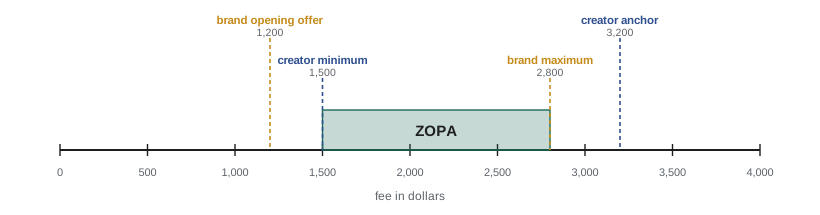
Where in the ZOPA the deal lands depends on information, preparation and negotiation skill. A creator who knows the market rate, has strong results and has a good BATNA tends to land closer to the brand's maximum.
Anchoring
The first number mentioned in a negotiation, the anchor, has a strong psychological effect on the final result. Research on negotiation consistently finds that first offers pull outcomes toward them. For creators, this means it is usually better to present your rate first, based on your rate card, rather than asking the brand to name a figure and then trying to move it up. An ambitious but justifiable anchor, supported by your metrics and past results, leaves room to make concessions while still landing at a good price.
If the brand anchors first with a low offer, do not let it set the frame. Acknowledge it, then re-anchor with your own figure and the reasoning behind it: "Thanks for the offer. For a dedicated video with 30 days of paid usage, my rate is $3,200, based on median views of 85,000 and past partners' results." An unreasonable anchor should not be met halfway; it should be replaced.
Worked problem
Anchors and concessions
A creator anchors at $3,200. The brand counters at $1,800. The creator plans to make two concessions of decreasing size, ending no lower than $2,600. What might the sequence look like?
Show solution
- First concession: from $3,200 to $2,900 (−$300), perhaps in exchange for reducing usage from 60 to 30 days.
- Second concession: from $2,900 to $2,700 (−$200), in exchange for the brand paying 50 % upfront.
- Decreasing steps signal that the creator is approaching their limit; final agreement near $2,700 sits above the $2,600 target.
Answer: A sequence such as $3,200 → $2,900 → $2,700, each concession traded for something, signals the limit and lands above target.
Trading, not conceding
Every concession should get something in return. If you lower your fee, reduce what you give: fewer deliverables, shorter usage, narrower exclusivity, more creative freedom or better payment terms. This keeps your price consistent and teaches the brand that your rates are based on scope, not on how hard they push. Useful tradeable items include:
- Deliverables: number and length of posts, platforms and formats.
- Rights: usage duration, channels, territories, whitelisting and raw footage.
- Exclusivity: category breadth and duration.
- Timing: posting dates, turnaround time and rush fees.
- Process: number of revision rounds and approval deadlines.
- Payment: deposits, payment terms and late fees.
- Extras: product supply, affiliate commission on top of a fee, renewal options.
| If the brand asks for… | Possible trade |
|---|---|
| A lower fee | Fewer deliverables or shorter usage |
| Longer usage | Higher usage fee or shorter exclusivity |
| Broad exclusivity | Narrow category, shorter term or higher fee |
| Faster delivery | Rush fee or simpler format |
| More revisions | Fee per extra round or earlier brief sign-off |
| Payment in 90 days | Deposit upfront or a higher fee |
Payment terms are part of price
Brands, especially large ones, often propose payment 45, 60 or even 90 days after delivery or invoice. Late payment has a real cost: money you cannot use, and risk that you may not be paid at all. Negotiate for a deposit before work begins, commonly 25 % to 50 %, and payment within 30 days of delivery for the balance. If the brand insists on long terms, it is reasonable to factor this into the price.
Worked problem
The cost of slow payment
A creator is offered $4,000 paid 90 days after posting or $3,850 paid 30 days after posting. The creator values money at 1 % per month (for example, because they carry a balance on a line of credit). Which offer is better?
Show solution
- The extra wait for the first offer is 60 days, about 2 months.
- Approximate cost of waiting: $4,000 × 0.01 × 2 = $80, making it worth about $3,920 at the 30-day point.
- Compare: $3,920 versus $3,850; the first offer is still slightly better, but carries more risk of non-payment.
Answer: The $4,000 offer is worth about $3,920 in 30-day terms, slightly better, but the creator might reasonably prefer the faster payment for lower risk.
Preparing for a negotiation
Preparation is the biggest driver of a good outcome. Before negotiating, write down: your rate card price for the requested scope, your reservation price and BATNA, your best guess at the brand's budget and BATNA, the items you are willing to trade and in what order, and the items you will not concede, such as honest opinion or audience safety. Prepare the evidence that supports your price: median views, engagement, audience match, case studies and testimonials.
Communication tactics
Most creator negotiations happen by email, which gives time to think. Some practical tactics help:
- Be warm and appreciative; negotiation is not conflict, and the relationship matters for future deals.
- Justify numbers with data rather than feelings: "my median views are…" rather than "I deserve…".
- Ask open questions to learn the brand's interests: "What would make this campaign a success for you?"
- Offer options rather than a single take-it-or-leave-it quote, such as three packages at different prices.
- Use silence and time: you do not have to reply immediately to a low offer.
- Summarize agreements in writing after any call.
Agencies often say the budget is fixed. Sometimes it is; often there is some flexibility, or the agency can change scope to fit. Asking "what can we adjust to make this work within your budget?" opens a constructive discussion.
Walking away
Being willing to walk away is what gives your reservation price meaning. If the brand cannot meet your minimum, even after changes in scope, decline politely and leave the door open: "I understand this budget is fixed for now. I would love to work together when the scope or budget allows; please keep me in mind for future campaigns." Brands often return later with better offers, especially if they see your results with other partners.
Negotiating with agencies
Agencies often negotiate differently from brands. They may work to fixed budgets per creator, use standard contracts and juggle many creators at once. They may also be judged on how cheaply they secure creators. This does not mean they are adversaries; a good agency wants the campaign to succeed and will return to creators who deliver. Practical approaches include asking what flexibility exists in deliverables or rights rather than fee alone, offering packages that fit their budget by adjusting scope, and building a reputation for reliability that makes the agency want to secure you for future work.
Common negotiation scripts
Having a few prepared phrases makes negotiation easier. To ask about budget: "Could you share the budget range for this campaign so I can propose the best package?" To respond to a low offer: "Thank you. My rate for this scope is $2,800; if the budget is fixed at $1,800, I could offer one Reel with 30 days of organic posting instead of the full package." To trade: "I can accept that payment term if we add a 30 % deposit on signing." To close: "To confirm, we have agreed on… I will send a summary for your approval." Practise these so that they feel natural.
Multi-issue negotiation
Negotiating several issues together, such as fee, usage and payment terms, usually produces better results than settling them one at a time. When issues are packaged, each side can concede on what matters less to it and gain on what matters more. A brand may care most about usage, while you care most about upfront payment; trading one for the other leaves both better off. Settling the fee first and then discussing everything else removes this flexibility.
Keeping emotions in check
Low offers can feel insulting, especially when you have worked hard to build your audience. Remember that a low offer is usually a starting point or a reflection of the brand's budget, not a judgment of your worth. Wait before replying if you feel annoyed, keep the tone professional and focus on the facts that support your price. Calm, consistent responses build a reputation that serves you in every future negotiation.
After every negotiation, note what you asked for, what the brand offered and what you agreed. These notes reveal patterns over time, such as which concessions brands value most, and make each negotiation easier than the last.
Common mistakes
MistakeLetting the brand name the first number every time.
InsteadAnchor with your justified rate first.
MistakeMeeting a low offer halfway.
InsteadRe-anchor with your rate and reasoning.
MistakeLowering the fee without changing scope.
InsteadTrade every concession for something.
MistakeIgnoring payment terms.
InsteadTreat deposits and payment timing as part of price.
MistakeNegotiating without a walk-away point.
InsteadSet your reservation price and BATNA before talking.
Summary and key terms
- Negotiation seeks an agreement better for both sides than no deal.
- BATNA is your best alternative; reservation price is your walk-away point.
- A ZOPA exists when your minimum is below the brand's maximum.
- First offers anchor outcomes; anchor high but justifiably.
- Trade concessions for scope changes rather than simply conceding.
- Payment timing and deposits are part of the price.
- Prepare thoroughly, communicate warmly and be willing to walk away.
- BATNA
- Best alternative to a negotiated agreement.
- Reservation price
- The least a seller will accept or the most a buyer will pay.
- ZOPA
- Zone of possible agreement between the two reservation prices.
- Anchor
- The first number that frames a negotiation.
- Concession
- A move toward the other side's position.
- Interests
- The underlying needs behind a position.
- Position
- The specific demand a party states.
- Deposit
- Part of the fee paid before work begins.
- Payment terms
- When and how payment is due.
- Re-anchoring
- Replacing the other side's anchor with your own justified figure.
Practice problems
Work each problem on paper first, then reveal the answer to check.
Define BATNA.
Show answer
Best alternative to a negotiated agreement.
Creator minimum $1,200, brand maximum $2,000: is there a ZOPA?
Show answer
Yes, from $1,200 to $2,000.
Creator minimum $2,500, brand maximum $2,000: what now?
Show answer
Change scope or walk away.
Why anchor first?
Show answer
First offers pull outcomes toward them.
Give a trade for a lower fee.
Show answer
Fewer deliverables or shorter usage.
Typical deposit range?
Show answer
25–50 %.
Cost of waiting 3 months for $3,000 at 1 % a month?
Show answer
About $90.
Why make decreasing concessions?
Show answer
They signal you are near your limit.
Name two things to prepare before negotiating.
Show answer
Rate, reservation price, BATNA, trades, evidence.
How should you decline when there is no ZOPA?
Show answer
Politely, leaving the door open for future work.
Lesson quiz · 5 questions
Score 60% or more to complete this lesson.
Create a free account to save your progress, take quizzes and earn a certificate.