
CRE-310 · Lesson 5 of 12 · 33 min
Pricing and rate cards
Pricing is where many creators lose the most money, usually by charging too little, giving away valuable rights for free or quoting inconsistently. CRE-302 introduced a simple way to estimate an integration fee from expected views. This lesson builds a complete pricing system: the main pricing methods, how to set a base rate, how to price usage rights, whitelisting, exclusivity and other add-ons, how to build bundles, how to set a floor below which you will not work, and how to turn all of this into a rate card you can use consistently.
Pricing methods
There is no official price list for creator work, so creators and brands rely on several overlapping methods. Understanding each helps you set a defensible price and respond when a brand uses a different method.
- CPM-based pricing: the fee is set from expected views or impressions multiplied by a price per thousand. It suits awareness campaigns and is the most common starting point.
- Engagement-based pricing: the fee is set from expected engagements multiplied by a price per engagement. It rewards creators with highly engaged audiences.
- Follower-based rules of thumb: for example, a set number of dollars per thousand followers. These are widely quoted but crude, because followers do not equal views.
- Cost-plus pricing: the creator's time and costs plus a margin. This sets a floor but ignores the value to the brand.
- Value-based pricing: the fee reflects the value the brand expects, such as customers acquired multiplied by their worth. It can justify higher prices when results are proven.
- Performance pricing: payment per click, sale or install, often combined with a flat fee.
Experienced creators usually calculate a price two or three ways and then choose a figure supported by the strongest evidence. For example, CPM-based pricing gives a starting point, cost-plus confirms it is above the floor, and past conversion data may justify going higher.
Setting a base rate from views
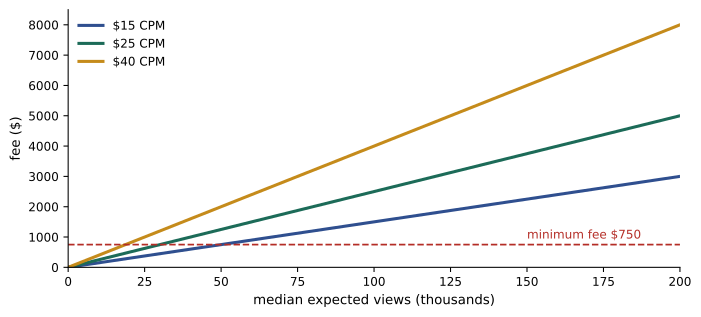
The base rate is the fee for a standard deliverable, such as one sponsored short video or one 60-second integration, with organic posting only and no extra rights. A common formula uses median expected views and a sponsorship CPM:
Sponsorship CPMs vary widely by platform, niche, audience location, format and demand. Long-form YouTube integrations in valuable niches often command higher CPMs than short-form posts; audiences in Canada and the United States are typically priced higher than audiences in lower-income markets; and dedicated content commands more than a short mention. Rather than relying on a single industry figure, start with a range drawn from your own past deals, peers you trust and offers you have received, and refine it as you collect data.
Worked problem
Base fee from median views
A creator's last 12 short videos had median views of 38,000 and their usual sponsorship CPM is $30. What is the base fee for one sponsored short video?
Show solution
- Thousands of views: 38,000 ÷ 1,000 = 38.
- Base fee: 38 × $30 = $1,140.
- Round to a clean figure for the rate card: $1,150.
Answer: About $1,150 for one sponsored short video, before add-ons.
Engagement-based pricing
For creators whose engagement is unusually strong relative to their views, an engagement-based price can be more favourable. Brands that run consideration campaigns often think in cost per engagement (CPE).
Worked problem
Comparing CPM and CPE pricing
A creator expects 25,000 views and an engagement rate by views of 8 % on a sponsored post. A brand is willing to pay $0.50 per engagement. The creator's CPM-based price at $30 would be $750. Which method gives the higher fee?
Show solution
- Expected engagements: 25,000 × 0.08 = 2,000.
- CPE-based fee: 2,000 × $0.50 = $1,000.
- CPM-based fee: 25 × $30 = $750.
Answer: The CPE-based fee of $1,000 is higher, so a highly engaged creator may prefer to frame the price in engagement terms.
Your price floor
Every creator should know their minimum acceptable fee, the price below which a deal is not worth doing. The floor reflects your time, costs, opportunity cost and the trust withdrawal each sponsored post represents. Calculate it from the hours a typical deal takes, including communication, revisions, admin and reporting, multiplied by the hourly rate you need, plus direct costs and any commission.
Worked problem
Calculating a minimum fee
A typical sponsored post takes the creator 10 hours in total. They want to earn at least $80 an hour, direct costs average $100, and their manager takes 15 % of the gross fee. What is the minimum gross fee?
Show solution
- Required net before commission: 10 × $80 + $100 = $900.
- Gross fee so that 85 % covers $900: $900 ÷ 0.85 ≈ $1,059.
- Round up to a floor of $1,100.
Answer: A minimum fee of about $1,100; offers below this should be declined or restructured.
Usage rights
Organic posting means the content appears on your own channels. Usage rights allow the brand to reuse your content elsewhere: on its own social accounts, website, email, in-store screens or in paid ads. Paid usage is especially valuable because the brand can spend heavily to show your content to millions of people, far beyond your audience. Usage rights should always be priced, and limited by duration, channels and territory.
A common approach is to charge a percentage of the base fee per period of usage, with higher percentages for paid advertising than for organic reposting. Percentages vary widely in practice; many creators and agencies use figures such as 20 % to 50 % of the base fee per month of paid usage, or a separate quote for longer periods. Perpetual or unlimited usage, sometimes called a buyout, should command a large premium, often several times the base fee, because the brand could use the content indefinitely.
Whitelisting and partnership ads
Whitelisting, also called creator licensing, allows the brand to run ads through your account, so the ad appears with your name and profile rather than the brand's. Platforms offer specific tools: TikTok Spark Ads use an authorization code from the creator to boost a creator post, and Meta's partnership ads let brands run ads on Instagram and Facebook that show both the creator and the brand. These ads typically perform better than brand-handle ads because they look native and carry the creator's credibility.
Because whitelisted ads use your identity and can affect how your audience sees you, they deserve a separate fee, a defined duration, approval of the ads and an agreed scope of targeting. You should be able to see and approve which posts are boosted and to end access when the term ends.
Exclusivity
Exclusivity prevents you from working with competitors for a period. It has a real cost: the deals you cannot accept during that time. Price it based on the income you are likely to give up, and keep the scope narrow: a defined product category, not an entire industry; a limited duration, such as 30 to 90 days around the campaign; and specific platforms if appropriate.
Worked problem
Pricing exclusivity from forgone income
A creator usually earns $2,400 a month from sponsors in the skincare category. A skincare brand asks for 60 days of category exclusivity around a campaign. The creator estimates they would lose about 70 % of that category income during the period. What should exclusivity cost?
Show solution
- Category income over 60 days: $2,400 × 2 = $4,800.
- Expected loss: $4,800 × 0.70 = $3,360.
- Charge at least the expected loss: about $3,400 for exclusivity, or negotiate a narrower scope.
Answer: At least about $3,400 for 60 days of category exclusivity.
Building a price from add-ons
A complete quote stacks the base fee with add-ons for rights and extra work. Add-ons are often expressed as multipliers or percentages of the base fee, which keeps pricing consistent across deals of different sizes.
| Component | Typical pricing approach | Notes |
|---|---|---|
| Base deliverable | Expected views × CPM, or engagements × CPE | Organic posting only |
| Paid usage | Percentage of base per month, e.g. 20–50 % | Limit channels and territory |
| Whitelisting or partnership ads | Percentage of base per month or flat monthly fee | Approve ads and set an end date |
| Exclusivity | Based on forgone income | Narrow category and duration |
| Rush delivery | 25–50 % premium | For short turnarounds |
| Extra revisions | Per round beyond those included | Define included rounds |
| Raw footage | Flat fee or percentage | Valuable for brand editing |
| Buyout | Several times base | Avoid unless well paid |
Worked problem
A full quote
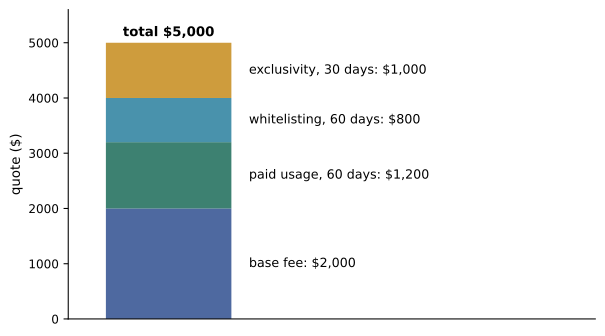
A creator's base fee for a dedicated short video is $2,000. The brand wants 60 days of paid usage (30 % of base per month), whitelisting for the same 60 days (20 % of base per month) and 30 days of category exclusivity, which the creator prices at $1,000. What is the total quote?
Show solution
- Paid usage: $2,000 × 0.30 × 2 = $1,200.
- Whitelisting: $2,000 × 0.20 × 2 = $800.
- Total: $2,000 + $1,200 + $800 + $1,000 = $5,000.
Answer: A total quote of $5,000, two and a half times the base fee.
Bundles and packages
Brands often want several deliverables across platforms. Bundling, for example one YouTube integration, three short videos and two story sets, simplifies buying and can justify a modest discount because production is shared and the brand commits to more. Discounts of 10 % to 20 % on bundles are common, but avoid discounting rights such as usage and exclusivity, which have their own logic. Present packages at three levels (for example basic, standard and premium) so brands can choose without negotiating every element.
The rate card
A rate card turns your pricing system into a document. It lists your main deliverables with starting prices, the add-ons with their pricing rules, what is included (such as one round of revisions and organic posting for a stated period), and terms such as payment timing. Label prices as "starting at" to leave room for scope, and review the card at least quarterly as your audience and results change. Keep a private version with your floor and the calculations behind each price.
Currency and tax
Canadian creators working with US brands should quote in a stated currency, usually US dollars for US clients, and allow for exchange-rate movements and conversion fees. Creators registered for GST/HST must apply the rules on whether to charge tax; services supplied to non-resident businesses may in some cases be zero-rated, so get advice. CRE-330 covers tax in detail.
Common pricing traps
Several traps catch creators repeatedly. One is the free trial: agreeing to a low price for a first campaign on the promise of better-paid work later, which often never comes. Another is the vague add-on: a brand asks for "a few stories as well" or "permission to share on our page" after the price is agreed, and the extras are given away. A third is pricing in the wrong currency, or forgetting to include sales tax and payment fees. A fourth is matching a rate a peer mentioned without considering differences in audience, niche and results. A clear rate card, a written scope and a habit of pricing every extra protect against all four.
When to raise prices
Review your prices whenever your median views, engagement or audience value change significantly, when you are consistently booked out, or when brands accept your first quote without negotiation, which suggests you may be underpriced. Raising prices gradually, for example 10 % to 20 % at a time, and applying new rates to new deals rather than existing agreements, keeps relationships smooth.
Finally, keep a simple log of every quote you send, whether it was accepted and at what price. Over time this log shows your real acceptance rate and tells you when your prices are too low or too high.
Common mistakes
MistakePricing only from follower count.
InsteadPrice from expected views or engagements and check against your floor.
MistakeGiving usage rights or whitelisting for free.
InsteadPrice rights separately by duration, channel and territory.
MistakeAccepting broad, long exclusivity for a small fee.
InsteadPrice exclusivity from forgone income and narrow it.
MistakeQuoting a different price every time.
InsteadUse a consistent rate card with clear add-on rules.
MistakeDiscounting everything in a bundle.
InsteadDiscount production, not rights.
Summary and key terms
- Common pricing methods are CPM-based, engagement-based, cost-plus, value-based and performance pricing.
- A base fee for organic posting equals median expected views ÷ 1,000 × sponsorship CPM.
- Engagement-based pricing can favour highly engaged creators.
- Your floor covers time, costs and commission; decline offers below it.
- Usage, whitelisting and exclusivity are separate, priced rights with limits.
- Bundles can carry modest discounts on production, not on rights.
- A rate card makes pricing consistent and should be reviewed quarterly.
- Base fee
- The price for a standard deliverable with organic posting only.
- Sponsorship CPM
- Price per thousand expected views for sponsored content.
- CPE
- Cost per engagement.
- Price floor
- The minimum fee a creator will accept.
- Usage rights
- Permission for the brand to reuse content.
- Whitelisting
- A brand running ads through a creator's account.
- Spark Ads
- TikTok ads that boost a creator's post with authorization.
- Partnership ads
- Meta ads that show both creator and brand.
- Buyout
- Unlimited or perpetual rights to content.
- Bundle
- A package of several deliverables sold together.
Practice problems
Work each problem on paper first, then reveal the answer to check.
Base fee for 45,000 median views at $25 CPM?
Show answer
$1,125.
Fee for 1,500 expected engagements at $0.60 CPE?
Show answer
$900.
Floor for 8 hours at $75, $60 costs, 20 % commission?
Show answer
$660 ÷ 0.8 = $825.
Paid usage at 25 % of a $1,600 base for 3 months?
Show answer
$1,200.
How should exclusivity be priced?
Show answer
From expected forgone income.
What does a Spark Ads authorization code do?
Show answer
Lets a brand boost the creator's TikTok post.
Name three add-ons that should be priced.
Show answer
Usage, whitelisting, exclusivity, rush, revisions, raw footage.
Typical bundle discount range?
Show answer
About 10–20 % on production.
Why label prices "starting at"?
Show answer
To leave room for scope and rights.
How often should a rate card be reviewed?
Show answer
At least quarterly.
Lesson quiz · 5 questions
Score 60% or more to complete this lesson.
Create a free account to save your progress, take quizzes and earn a certificate.