
CRE-310 · Lesson 12 of 12 · 29 min
Ambassadorships, hybrid deals and capstone
One-off sponsored posts are the most common brand deal, but many of the most valuable partnerships are long term. Ambassadorships, retainers and hybrid deals that combine fees with commission give creators steadier income and give brands a consistent, credible voice. They also carry more risk and commitment on both sides. This final lesson covers how long-term partnerships work, how to price and structure them, how to evaluate hybrid and performance offers, how to manage a portfolio of partners, and then brings the whole course together in a capstone partnership plan.
Why long-term partnerships work
Audiences are more persuaded by repeated, consistent use of a product than by a single mention. When a creator uses the same running shoes, editing software or coffee brand over months, the endorsement becomes part of their life and content, which builds credibility. Brands benefit from lower costs per post, deeper integration, better content as the creator learns the product, and fewer negotiations. Creators benefit from predictable income, deeper relationships and the chance to shape products or campaigns.
Long-term relationships also reduce workload. Each new brand requires research, pitching, negotiation, onboarding and learning a new approval process; a continuing partner requires none of this. For many full-time creators, a small number of long-term partners provides a stable base, with one-off deals adding variety and extra income.
Types of long-term partnership
- Ambassadorship: an ongoing relationship, often three to twelve months, with a set number of posts, appearances or other activities, frequently with category exclusivity.
- Retainer: a fixed monthly fee for a defined amount of content or availability.
- Series sponsorship: a brand sponsors a recurring series or show for a season.
- Affiliate or commission partnership: ongoing commission on sales, sometimes with a higher rate than standard affiliate programs.
- Hybrid deal: a flat fee plus commission or performance bonuses.
- Equity or co-creation: rarely, creators receive shares in a company or co-design a product, with royalties.
Each type distributes risk differently. Retainers and ambassadorships put more risk on the brand; commission deals put more risk on the creator; hybrids share it.
Structuring an ambassadorship
An ambassadorship agreement should specify the term, the deliverables per month or quarter, the fee and payment schedule, exclusivity scope, usage and whitelisting rights, product supply, events or appearances, performance reporting, renewal options and how either party can end the relationship. Because ambassadorships usually include exclusivity, the fee must compensate for lost opportunities in the category over the whole term.
Worked problem
Pricing a six-month ambassadorship
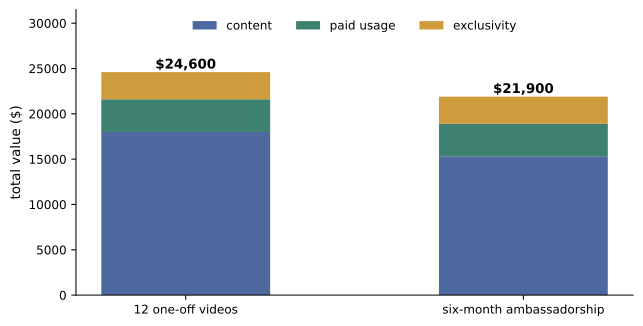
A creator's one-off rate for a sponsored short video is $1,500. A brand proposes a six-month ambassadorship with two short videos a month, 90-day rolling paid usage at 20 % of base per month, and category exclusivity the creator values at $500 a month. The creator offers a 15 % discount on content because of the long commitment. What is the total and monthly fee?
Show solution
- Content: 2 × 6 = 12 videos × $1,500 = $18,000; after 15 % discount: $15,300.
- Usage: $1,500 × 0.20 × 2 videos × 6 months = $3,600; exclusivity: $500 × 6 = $3,000.
- Total: $15,300 + $3,600 + $3,000 = $21,900, or $3,650 a month.
Answer: About $21,900 in total, or $3,650 a month, with the discount applied only to content, not to rights.
Hybrid and performance deals
Hybrid deals combine a guaranteed fee with performance pay, such as commission on sales, a fee per sign-up, or bonuses for hitting targets. Brands like them because they share risk; creators can benefit if their audience converts well. To evaluate a hybrid offer, estimate the expected performance pay from your past data and compare the total with your normal flat fee. Consider also the variability: performance pay may be high in some campaigns and low in others.
Worked problem
Break-even sales for a hybrid
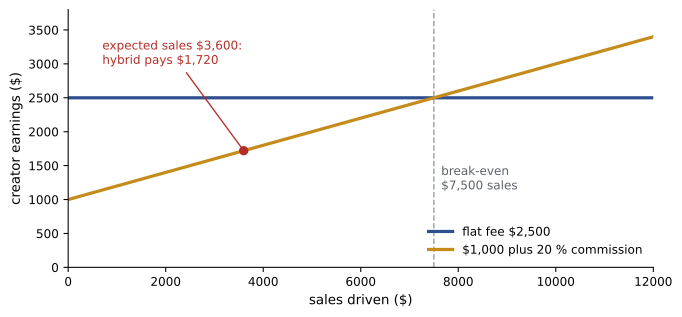
A creator's flat fee is $2,500. A brand offers $1,000 plus 20 % commission on sales. What level of sales would make the hybrid equal to the flat fee, and how likely is it if past campaigns generated about 40 sales at an average order of $90?
Show solution
- Commission needed to match: $2,500 − $1,000 = $1,500.
- Sales needed: $1,500 ÷ 0.20 = $7,500.
- Expected sales: 40 × $90 = $3,600, giving commission of $720 and a total of $1,720, well below $2,500.
Answer: Sales of $7,500 would be needed to match the flat fee; with expected sales of $3,600, the hybrid is worth about $1,720, so the creator should negotiate a higher base or commission.
Tracking is critical in performance deals. Agree how sales will be attributed (link, code or both), the attribution window, how returns and cancellations are handled, how often you receive reports and how you can verify them. Without trustworthy tracking, performance pay is a gamble.
Managing a partner portfolio
As partnerships grow, think of them as a portfolio. Aim for a mix of long-term anchors and one-off deals, partners across complementary categories, and a balance between flat-fee and performance income. Avoid depending heavily on a single partner: if one brand provides more than about a third of your income, losing it would be a serious shock. Track concentration and renewal dates, and start renewal discussions well before contracts end.
| Partner | Type | Annual value | Share | Renewal |
|---|---|---|---|---|
| Running shoe brand | Ambassadorship | $21,900 | 38 % | March |
| Sports watch | Series sponsorship | $12,000 | 21 % | June |
| Hydration product | Hybrid | $8,000 | 14 % | Rolling |
| One-off deals | Various | $15,500 | 27 % | Not applicable |
Portfolio thinking also guards your audience's trust. Too many partners, or partners that conflict, make recommendations seem less credible. Long-term partners chosen carefully reinforce your position.
Ending partnerships well
Partnerships end for many reasons: the brand changes strategy, the fit weakens, results fall or a better opportunity appears. End professionally: follow the contract's notice terms, complete outstanding deliverables, return products or equipment as agreed, and thank the brand. If you are switching to a competitor after exclusivity ends, consider a gap so that your audience does not see an abrupt change of loyalty, which can look insincere.
Capstone: a brand partnership plan
The capstone brings together everything in this course. Build a brand partnership plan for your own channel, or for a realistic sample creator, with the following parts:
- Position: a positioning statement, content pillars and red-line categories (Lesson 3).
- Market: the types of brands and campaigns that fit your audience and when they buy (Lessons 1 and 2).
- Media kit: one page with honest, dated metrics, audience data and case studies (Lesson 4).
- Pricing: a rate card with base rates, add-on rules, bundles and your floor (Lesson 5).
- Prospecting: a list of 20 prospects, routes into each, a sample pitch and pipeline targets (Lesson 6).
- Negotiation: your BATNA, reservation price and planned trades for a sample deal (Lesson 7).
- Delivery: a brief checklist, approval timeline and pre-posting checklist (Lesson 8).
- Contracts: a list of clauses to check and your preferred positions on each (Lesson 9).
- Disclosure: your standard disclosures for each format and situation (Lesson 10).
- Reporting: a report template and renewal approach (Lesson 11).
- Long-term growth: targets for ambassadorships, portfolio balance and concentration (Lesson 12).
Worked problem
Capstone income target
A creator wants $60,000 a year from brand partnerships. They plan one ambassadorship worth $21,900 and one series sponsorship worth $12,000. Their average one-off deal is $1,800, and their pipeline converts 6 % of pitches to deals. How many one-off deals and pitches per month are needed?
Show solution
- Remaining from one-off deals: $60,000 − $21,900 − $12,000 = $26,100.
- One-off deals: $26,100 ÷ $1,800 = 14.5, so about 15 deals a year.
- Pitches: 15 ÷ 0.06 = 250 a year, about 21 a month, minus any inbound deals.
Answer: About 15 one-off deals a year, needing roughly 21 researched pitches a month if no inbound deals arrive.
Review the plan quarterly. Compare actual results with targets, adjust prices as your audience and results change, and refine your positioning as you learn which partnerships serve your audience best. A partnership business built on fit, honesty and professional delivery grows in value over time, because every successful campaign makes the next one easier to win.
Retainers in practice
Retainers suit creators who provide ongoing services beyond single posts, such as regular content for a brand's own channels, product feedback, community appearances or consulting. Define what the retainer covers each month, how unused work is handled (does it roll over or expire?), how extra work is charged and how often the arrangement is reviewed. Without clear limits, retainers can expand far beyond what the fee covers.
Co-created products and royalties
Some creators collaborate with brands on co-branded products, such as a signature colour of a product, a recipe line or a gear collection. These deals often pay a royalty, a percentage of each sale, sometimes with an upfront advance against future royalties. Key terms include the royalty rate and what it applies to (retail price or wholesale revenue), minimum guarantees, approval rights over product quality and marketing, how long the brand can use your name, and what happens to unsold inventory. Because your name is on the product, quality control matters greatly: a poor product damages your reputation directly.
Equity deals
Occasionally, start-ups offer creators shares in the company instead of, or as well as, cash. Equity can be valuable if the company succeeds, but most start-ups fail, and shares in a private company cannot easily be sold. Treat equity as a speculative bonus rather than a replacement for fair cash payment, understand the share terms, and get professional advice before accepting.
Evaluating the capstone plan
When you complete the capstone plan, check it against a few questions. Is the positioning clear enough that a brand manager would understand it in one sentence? Are the prices consistent with the media kit and the evidence? Is the pitching target realistic given the time available? Are disclosure standards and red lines written down? Does the plan reduce dependence on any single partner over time? A plan that answers these questions well is a practical tool you can use and update every quarter.
Learning from each partnership
After every partnership, take a few minutes to record what you learned. Which formats performed best for the brand? How long did approvals actually take compared with the plan? Were your prices accepted easily, or did you have to concede more than expected? Did the audience respond well to the product, and did any comments suggest concerns? These notes feed directly into your rate card, your pitching and your choice of future partners. Over a year, a creator who reviews every partnership in this way builds a far stronger business than one who simply moves from deal to deal, because each campaign improves the next. Share the useful lessons with your partners too: brands value creators who help them improve their programs.
Negotiating renewals of long-term deals
Renewing an ambassadorship is a negotiation in its own right. Prepare with a summary of results over the whole term, changes in your audience, the value of exclusivity you provided and ideas for the next term. Start discussions two to three months before the agreement ends, so that neither side is rushed and you have time to approach other brands if the renewal does not proceed. A renewal may also be the moment to adjust deliverables, add new platforms or change the balance between fee and performance pay based on what the data showed.
Protecting your independence
Long-term partners can come to feel like employers, but you remain an independent creator. Keep editorial independence in non-sponsored content, continue to give honest opinions, and do not let a single partner shape your channel beyond what the agreement covers. Audiences can tell when a creator's content starts to revolve around one sponsor, and that perception erodes the trust that made the partnership valuable in the first place.
Common mistakes
MistakeDiscounting rights along with content in long-term deals.
InsteadDiscount content for commitment; price rights fully.
MistakeAccepting hybrid offers without estimating performance pay.
InsteadCompare expected hybrid value with your flat fee.
MistakeAgreeing to performance pay without clear tracking.
InsteadDefine attribution, windows, returns and reporting.
MistakeRelying on one partner for most income.
InsteadKeep any single partner below about a third.
MistakeSwitching abruptly to a competitor.
InsteadEnd professionally and leave a gap before switching.
Summary and key terms
- Long-term partnerships build credibility and stable income.
- Types include ambassadorships, retainers, series sponsorships, commission and hybrid deals.
- Ambassadorships price content, usage and exclusivity over the term.
- Evaluate hybrids by comparing expected value and break-even sales with your flat fee.
- Performance deals need trustworthy tracking terms.
- Manage partners as a portfolio and watch concentration.
- A complete partnership plan ties positioning, pricing, pitching, delivery and reporting together.
- Ambassadorship
- An ongoing brand relationship with repeated content.
- Retainer
- A fixed monthly fee for defined content or availability.
- Series sponsorship
- A brand sponsoring a recurring series for a season.
- Hybrid deal
- A flat fee plus performance pay.
- Performance bonus
- Extra pay for meeting agreed targets.
- Break-even sales
- Sales at which hybrid pay equals the flat fee.
- Attribution window
- The period after a click in which a sale counts.
- Concentration risk
- Dependence on a single partner for much of income.
- Partner portfolio
- The set of brands a creator works with.
- Partnership plan
- A document setting out a creator's brand strategy and targets.
Practice problems
Work each problem on paper first, then reveal the answer to check.
Why do long-term partnerships persuade audiences?
Show answer
Repeated, consistent use builds credibility.
Which partnership type puts most risk on the creator?
Show answer
Commission-only deals.
Six months of exclusivity at $400 a month?
Show answer
$2,400.
Break-even sales for $2,000 flat versus $800 plus 15 %?
Show answer
$8,000.
Expected hybrid value: $500 plus 10 % of $4,000 sales?
Show answer
$900.
Name three tracking terms to agree in a performance deal.
Show answer
Attribution method, window, returns, reporting, verification.
Share of income above which one partner is a concentration risk?
Show answer
About a third.
Name four parts of the capstone plan.
Show answer
Position, media kit, pricing, prospecting, negotiation, delivery, contracts, disclosure, reporting.
Deals needed for $18,000 at $1,500 each?
Show answer
12.
How often should the partnership plan be reviewed?
Show answer
Quarterly.
Lesson quiz · 5 questions
Score 60% or more to complete this lesson.
Create a free account to save your progress, take quizzes and earn a certificate.