
CRE-310 · Lesson 8 of 12 · 29 min
Briefs, creative freedom and approvals
Once a deal is agreed in principle, the work moves from negotiation to production. The brief, the creative concept and the approval process determine whether the content succeeds for the brand, feels authentic to the audience and gets delivered without endless revisions. This lesson covers how to read and question a brief, how to balance brand requirements with creative freedom, how to present concepts and scripts, how approval processes work and how to manage feedback and revisions professionally.
What a brief contains
A creative brief is the brand's written description of what it wants from the content. Briefs range from a short email to a detailed document, but good ones usually include:
- Background: the brand, the product and the campaign context.
- Objective and KPI: what the content should achieve and how it will be measured.
- Target audience: who the brand wants to reach.
- Key messages: the two or three points the content must communicate, sometimes called talking points.
- Mandatories: things that must be included, such as product shots, a link, a discount code, specific wording or a hashtag.
- Restrictions: things to avoid, such as competitor products, certain claims, swearing or particular topics.
- Deliverables and specifications: formats, lengths, platforms, aspect ratios and number of pieces.
- Timeline: draft, approval and posting dates.
- Disclosure requirements: how the partnership will be disclosed.
- Approval process: who reviews, how many rounds, and how long reviews take.
Reading the brief critically
Read every brief carefully before starting work, and ask questions about anything unclear. Typical questions include: Which of the key messages matters most? Can the product claims be supported, and can the brand provide evidence? Are the mandatories compatible with the format, for example, can five talking points fit in a 30-second video? Is the timeline realistic given shipping and approval times? Does the brief match what was agreed in the contract, particularly on deliverables, usage and exclusivity?
Pay close attention to claims. If a brief asks you to say that a product "cures acne", "guarantees weight loss" or "is the best on the market", you need to be confident the claim is truthful and supported. Advertising law in both countries prohibits false or misleading claims, and a creator who repeats an unsupported claim may share responsibility. Ask the brand to confirm that claims are substantiated, and refuse wording you cannot honestly say. CRE-320 covers misleading claims in detail.
Worked problem
Checking that mandatories fit
A brief for a 45-second short video requires a 5-second product reveal, three talking points of about 8 seconds each, a 5-second call to action with discount code and a 3-second disclosure at the start. How much time is left for the creator's own hook and storytelling?
Show solution
- Mandatory time: 5 + 3 × 8 + 5 + 3 = 37 seconds.
- Remaining: 45 − 37 = 8 seconds.
- Eight seconds is too little for a strong hook and natural story; propose cutting to two talking points (saving 8 seconds) or extending to 60 seconds.
Answer: Only 8 seconds remain, so the creator should negotiate fewer talking points or a longer video.
Creative freedom versus brand control
Brands hire creators because their content resonates with an audience the brand cannot reach as well on its own. Yet brands also need to protect their image and get their messages across. The tension between creative freedom and brand control is the most common source of friction in partnerships.
Content that feels like a traditional advertisement usually performs worse on creator channels: audiences skip it, engagement falls and the creator's credibility suffers. Experienced brands know this and give creators room to present the product in their own voice. Less experienced brands may try to script every word. Your job is to show how your approach serves the brand's objectives. Evidence helps: retention graphs showing that scripted segments lose viewers, or past campaign results from content made in your own style.
A practical model is to agree on what must be said (key messages and mandatories) and leave how it is said to the creator. Many brands accept this when the creator explains it clearly early in the process.
Concepts, scripts and storyboards
Most campaigns involve presenting a concept before filming. A concept is a short description of the idea: the story, the setting, how the product appears and how the key messages are delivered. For video, it may be followed by a script or a beat sheet listing the main moments, and sometimes a rough storyboard.
Present concepts in a format that is easy to approve: a one-page outline with the hook, the structure, the product moments, the talking points in your own words, the call to action and the disclosure. Offering two concepts, one safer and one more creative, gives the brand a choice and often leads to approval of the stronger idea.
| Stage | What the creator provides | What the brand checks |
|---|---|---|
| Concept | One-page idea and structure | Fit with objectives, key messages, brand image |
| Script or beat sheet | Wording of key moments | Claims, mandatories, tone |
| Draft content | Edited video or post before publishing | Accuracy, product display, disclosure, quality |
| Final | Corrected version and caption | Fixes made, links and codes correct |
| Live check | Published link and screenshots | Posted on time with correct disclosure |
Approval processes and timelines
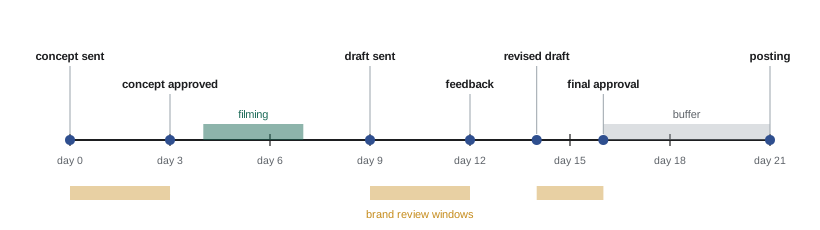
Approval processes vary from a single person giving quick feedback to several layers of review by marketing, legal and regulatory teams. Find out early who approves and how long reviews take, and build this into your timeline. A contract or statement of work should state the number of revision rounds included and how quickly the brand must respond.
Worked problem
Planning back from a posting date
A video must post on 20 November. The brand needs 3 business days for each review, the creator needs 5 days to film and edit and 2 days for each revision, and there are two review rounds plus a concept approval. Ignoring weekends for simplicity, what is the latest date to submit the concept, allowing a 2-day buffer?
Show solution
- Working back: buffer 2 days, final review 3, revision 2, first review 3, filming and editing 5, concept review 3.
- Total: 2 + 3 + 2 + 3 + 5 + 3 = 18 days.
- 20 November minus 18 days is 2 November.
Answer: The concept should be submitted by about 2 November.
Late approvals are common. If a brand misses its review deadline, the posting date may need to move; your contract should allow this without penalty to you. Record dates of submissions and responses so that delays are clearly documented.
Managing feedback and revisions
Feedback is part of the process, but it can easily expand beyond what was agreed. Define revision rounds clearly: a round is one consolidated set of feedback from the brand, followed by one revised version from the creator. Ask for consolidated feedback rather than piecemeal comments from several people. Distinguish between corrections (factual errors, missing mandatories, inaccurate product use), which you should fix, and new requests (a different concept, extra messages, a new setting), which are changes in scope and may justify additional fees or a new timeline.
Respond to feedback professionally, even when you disagree. Explain your reasoning with evidence, propose alternatives and remember that the brand is paying for the work. If a request would make the content misleading or harm your audience's trust, it is reasonable to refuse, explaining why.
Product handling and accuracy
Show the product accurately and use it correctly. Brands may provide specific instructions on product display, packaging, logos and safety. Check the product works as claimed before filming; if it does not, tell the brand promptly rather than posting a misleading endorsement. Look after any loaned equipment and agree in advance whether products must be returned.
Captions, links, codes and posting
Before posting, check every detail: the caption wording, the disclosure, tags of the brand's account, the correct link and tracking parameters, the discount code, hashtags and any platform paid-partnership label. A wrong code or broken link can ruin a performance campaign and is one of the most common, and most avoidable, delivery errors. Many creators use a pre-posting checklist for every sponsored post.
Worked problem
The cost of a broken link
A sponsored post receives 50,000 views in its first 48 hours, when 70 % of its total clicks normally occur. The expected click-through rate is 1.2 %. The tracking link was broken for the first 48 hours. Roughly how many clicks were lost?
Show solution
- Expected total clicks if all views were in the first 48 hours: 50,000 × 0.012 = 600.
- These 600 clicks represent the 70 % of total clicks that occur in the first 48 hours.
- Lost clicks: about 600, out of a total of about 600 ÷ 0.70 ≈ 857 expected.
Answer: About 600 of roughly 857 expected clicks were lost, which is why links must be tested before posting.
After posting
Once content is live, send the brand the link and screenshots promptly, monitor comments for questions about the product and respond where appropriate, and leave the content up for the agreed period. Do not edit or delete sponsored content within the agreed period without discussion. Comments may raise concerns about the product or disclosure; respond honestly and pass serious issues to the brand.
Working with brand guidelines
Many brands provide brand guidelines covering how their logo, product, colours and name should appear, and sometimes tone of voice. Follow them where they relate to accuracy and legal requirements, such as correct product names and trademark use, but discuss guidelines that would make the content feel unnatural on your channel. Brands generally accept reasonable adaptations when the creator explains how they will improve performance.
Briefs for different formats
Briefs should be adapted to the format. A brief for a YouTube integration might focus on the segment's placement in the video, its length and the talking points; a brief for TikTok might emphasize the hook in the first two seconds and trending formats; a brief for a podcast host read might give key facts and leave delivery to the host. If a brand sends a brief written for a different platform, suggest adjustments that suit the format you are delivering.
Documenting decisions
Record every approval and decision in writing. When a brand approves a concept by phone or video call, follow up with a short email summarizing what was approved. This protects both sides if people change roles, if feedback later contradicts earlier approvals, or if there is a dispute about whether the delivered content matches what was agreed.
Health, safety and practical considerations
Some product demonstrations involve physical risk, such as fitness equipment, power tools, food preparation or outdoor activities. Follow the manufacturer's safety instructions, do not demonstrate unsafe use even for effect, and consider whether your audience might copy what they see. If the brand asks for a stunt or demonstration you consider unsafe, explain why and propose a safer alternative.
Handling disagreements over content
If you and the brand disagree about the content, try to resolve it by returning to the brief and the agreed objectives. Ask what concern lies behind the feedback: a legal worry, a brand image issue or a personal preference. Many disagreements dissolve once the underlying concern is clear and you can propose a change that addresses it without weakening the content.
Think of the brief as a map: the objective and key messages show the destination, the mandatories and restrictions mark the boundaries, and the timeline and approval process set the route. The creator's concept is the journey within those limits, and the best concepts reach the destination in a way only that creator could.
Common mistakes
MistakeStarting production without questioning an unclear brief.
InsteadClarify objectives, claims and mandatories first.
MistakeRepeating claims you cannot verify.
InsteadAsk for substantiation and refuse unsupported wording.
MistakeAccepting unlimited revisions.
InsteadDefine rounds and treat new requests as scope changes.
MistakeLeaving no buffer before posting dates.
InsteadPlan back from the date with review times and a buffer.
MistakePosting without checking links and codes.
InsteadUse a pre-posting checklist for every sponsored post.
Summary and key terms
- A brief sets out objectives, audience, messages, mandatories, restrictions, deliverables, timing and approvals.
- Read briefs critically, especially claims and whether mandatories fit the format.
- Agree what must be said; leave how it is said to the creator.
- Present clear concepts, often with two options.
- Plan back from posting dates with review windows and a buffer.
- Separate corrections from new requests that change scope.
- Check links, codes, disclosure and tags before posting, and report promptly.
- Creative brief
- The brand's written description of what it wants.
- Key messages
- The main points content must communicate.
- Mandatories
- Elements that must appear in the content.
- Restrictions
- Things the content must avoid.
- Concept
- A short description of the content idea.
- Beat sheet
- A list of the main moments in a video.
- Revision round
- One consolidated set of feedback and one revised version.
- Scope change
- A new request beyond what was agreed.
- Substantiation
- Evidence that supports a claim.
- Pre-posting checklist
- A list of details to verify before publishing.
Practice problems
Work each problem on paper first, then reveal the answer to check.
Name five parts of a creative brief.
Show answer
Objective, audience, key messages, mandatories, restrictions, deliverables, timeline.
Time left in a 30-second video with 22 seconds of mandatories?
Show answer
8 seconds.
What should you do with a claim you cannot verify?
Show answer
Ask for substantiation or refuse the wording.
What is a revision round?
Show answer
One consolidated feedback set and one revised version.
Is a new concept request a correction or a scope change?
Show answer
A scope change.
Why offer two concepts?
Show answer
It gives the brand a choice and can win approval for the stronger idea.
Latest concept date for a 15-day process before a 30 May posting?
Show answer
15 May.
Name three items on a pre-posting checklist.
Show answer
Disclosure, link, code, tags, caption, paid partnership label.
What should you send after posting?
Show answer
The link and screenshots.
What model balances freedom and control?
Show answer
Agree what must be said; creator decides how.
Lesson quiz · 5 questions
Score 60% or more to complete this lesson.
Create a free account to save your progress, take quizzes and earn a certificate.