
HSE-394 · Lesson 11 of 12 · 22 min
Lasers and MRI safety
▶ Video coming soon A video version of this lesson is on the way.
Lasers and MRI scanners use non-ionizing energy, so they do not cause the cancer risk of X-rays, and nobody needs a dosimeter to work near them. They are still among the most dangerous pieces of equipment in a hospital, because their hazards are immediate and severe. A surgical laser beam reflected off a steel instrument can burn a retina in a fraction of a second. An MRI magnet can pull an oxygen cylinder across a room with enough force to kill. Both hazards depend on strict access control and training for everyone who enters the area, including porters, cleaners, maintenance workers and firefighters. This lesson covers both.
How medical lasers are used
A laser produces a narrow, intense beam of light of a single wavelength. Different wavelengths are absorbed by different tissues, which lets surgeons cut, vaporize, coagulate or reshape tissue very precisely. Lasers are used in many specialties: carbon dioxide lasers in ear, nose and throat surgery and gynecology; holmium lasers to break up kidney stones; argon and other lasers in eye clinics; diode and Nd:YAG lasers in many procedures; and a range of lasers and intense pulsed light devices in dermatology and cosmetic clinics. Low-power lasers are also used in physiotherapy and in some measuring and alignment devices.
Laser classes
Lasers are classified by how much harm their beam can do. The classes, from the international standard used in both Canada and the United States, are:
| Class | Hazard | Examples in healthcare |
|---|---|---|
| 1 and 1M | Safe under normal use (1M is safe unless viewed with magnifying optics) | Enclosed laser printers, some measuring devices |
| 2 and 2M | Visible beams; eye protected by the blink reflex for brief exposure | Aiming beams, some alignment lasers |
| 3R | Low risk, but direct viewing should be avoided | Some pointers and aiming devices |
| 3B | Direct beam and specular reflections can injure the eye | Some therapy and ophthalmic lasers |
| 4 | Direct beam, reflections and even diffuse reflections can injure eyes and skin; can start fires; can produce hazardous plume | Most surgical lasers |
Most surgical and many dermatology lasers are Class 4, the most hazardous class, and these are the focus of a laser safety program.
The hazards of Class 3B and 4 lasers
- Eye injury: the eye is the organ most at risk. Visible and near-infrared lasers are focused by the lens onto the retina, where they can burn a permanent blind spot in an instant. Far-infrared lasers, such as carbon dioxide lasers, and ultraviolet lasers injure the cornea and lens at the front of the eye. Many surgical laser beams are invisible, so a worker may not know a beam has hit their eye.
- Skin burns from the direct beam or close reflections.
- Fire: a Class 4 beam can ignite drapes, gauze, alcohol-based skin preparations and hair. In the airway, where oxygen-rich gas flows, a laser can ignite an endotracheal tube, causing a devastating airway fire.
- Laser plume or surgical smoke: when a laser vaporizes tissue, it produces smoke containing chemicals such as benzene and formaldehyde, fine particles, and sometimes viral DNA and viable cells. Electrosurgery (cautery) produces similar smoke.
- Electrical hazards: lasers use high voltages internally, a hazard mainly for service technicians.
Laser safety controls
The CSA standard Z386, Safe use of lasers in health care, sets out a laser safety program for Canadian facilities, and the CSA standard Z305.13 covers plume scavenging. Regulation 67/93 procedures and the general duty under the OHSA make these standards the benchmark for Ontario hospitals.
A laser safety program, in either country, includes:
- A laser safety officer (LSO), with authority to oversee all laser use, approve procedures, train staff and investigate incidents, and a laser safety committee in larger hospitals.
- A nominal hazard zone (NHZ): the area around the laser within which the beam or its reflections could exceed the safe exposure level. For most surgical lasers in an operating room, the whole room is the NHZ.
- Controlled access: warning signs at every entrance showing the laser type and the eyewear needed, doors closed during use, windows covered if the beam could pass through them, and a person assigned to control the laser.
- Laser eyewear for everyone in the NHZ, matched to the wavelength of the laser in use, with the right optical density (OD), labelled on the frame. Patients' eyes are protected too, with eyewear or moist pads.
- Key control, so that only trained users can switch a laser on, and standby mode whenever the laser is not being fired.
- Fire prevention: non-reflective or matte instruments, moist drapes and sponges near the site, letting alcohol skin preparations dry fully, laser-resistant airway tubes, low oxygen concentrations near the airway, and water and a fire extinguisher at hand.
- Smoke evacuation: a smoke evacuator with its capture device within a few centimetres of the site, with filters handled as contaminated waste, plus general room ventilation.
- Training and audits for surgeons, nurses, technicians and anyone who works in laser areas.
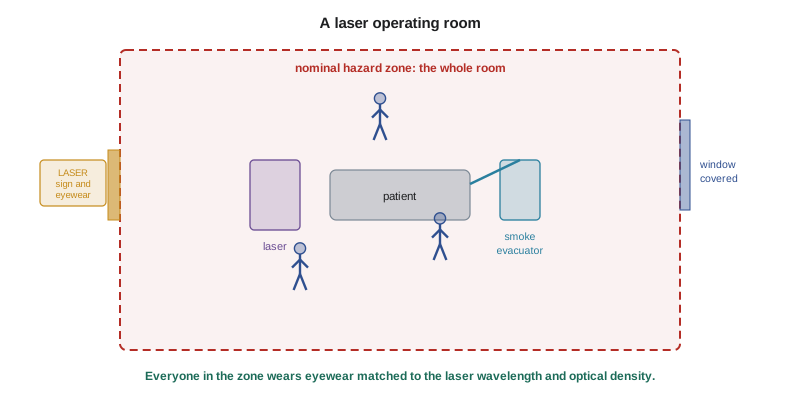
Eyewear is often the weakest point. An operating room may have several lasers with different wavelengths, and eyewear for one gives no protection against another. The optical density needed depends on the laser's power and the safe exposure level at that wavelength: each unit of OD reduces the light by a factor of ten. The LSO calculates the OD needed for each laser and buys eyewear to match.
# Optical density (OD) needed for laser eyewear
# OD = log10(worst-case exposure / maximum permissible exposure)
import math

lasers = [
    # (name, wavelength in nm, worst-case irradiance at the eye W/cm2, MPE W/cm2)
    ("CO2 surgical", 10600, 1000.0, 0.1),
    ("Nd:YAG", 1064, 500.0, 0.005),
    ("holmium", 2100, 400.0, 0.1),
    ("diode", 980, 200.0, 0.004),
]

for name, wl, exposure, mpe in lasers:
    od = math.log10(exposure / mpe)
print(f"{name:14}{wl:6} nm OD needed: {od:4.1f} buy OD {math.ceil(od)} or higher at {wl} nm")CO2 surgical 10600 nm OD needed: 4.0 buy OD 4 or higher at 10600 nm Nd:YAG 1064 nm OD needed: 5.0 buy OD 5 or higher at 1064 nm holmium 2100 nm OD needed: 3.6 buy OD 4 or higher at 2100 nm diode 980 nm OD needed: 4.7 buy OD 5 or higher at 980 nm
The numbers in the script are illustrative, not values to use; the LSO works from the laser's specifications and the standard. The point is the pattern: each laser needs eyewear rated for its own wavelength, and an OD 4 rating at one wavelength may be worthless at another. At Northbridge, eyewear is stored on a rack outside each laser room, labelled with the laser it goes with, and the circulating nurse checks that everyone entering is wearing the right pair.
MRI: how the hazards arise
Magnetic resonance imaging uses a very strong magnetic field, radio waves and rapidly switching magnetic fields to produce detailed images without ionizing radiation. The magnet in most hospital scanners is superconducting, kept extremely cold by liquid helium, and its field is always on, day and night, whether or not a patient is being scanned. Typical clinical scanners have fields of 1.5 or 3 tesla, tens of thousands of times stronger than the Earth's field.
The main hazards are:
- The projectile effect: ferromagnetic objects, such as oxygen cylinders, IV poles, wheelchairs, floor polishers, scissors, pens, keys and tools, are pulled toward the magnet with great force and speed. People have been seriously injured and killed by objects flying into a scanner. The force increases very steeply close to the magnet, so an object that feels only a slight tug at the door can become uncontrollable a few steps later.
- Implants and devices: some pacemakers, defibrillators, aneurysm clips, neurostimulators, cochlear implants and drug pumps can be moved, heated or made to malfunction. Many modern devices are labelled MR conditional, safe only under specific conditions.
- Heating and burns from the radio waves, especially where wires, monitoring leads or skin-to-skin contact form loops.
- Noise: the switching gradient fields make loud knocking sounds, so patients and anyone in the room during scanning need hearing protection.
- Quench: if the magnet suddenly loses its superconductivity, the liquid helium boils off rapidly. The helium is meant to vent outside through a quench pipe; if it leaks into the room, it can displace oxygen and cause asphyxiation and cold burns.
- Effects on staff moving near the magnet, such as dizziness, nausea and a metallic taste, which are temporary.
MRI safety zones and screening
The most widely used approach to MRI safety divides the MRI area into four zones, from the guidance of the American College of Radiology, which is used in Canada as well as the United States:
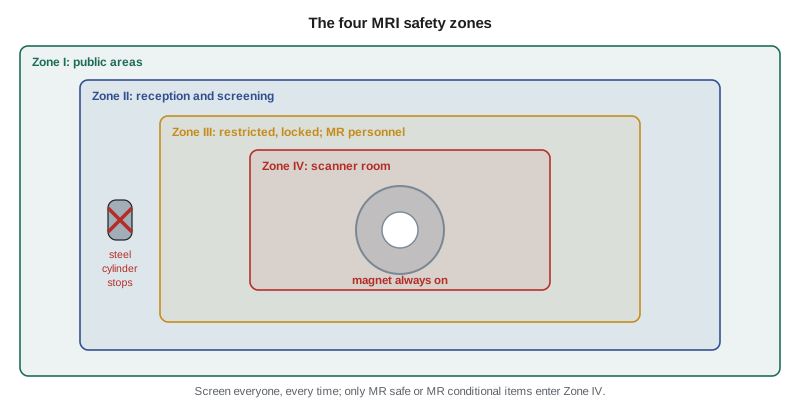
- Zone I: public areas outside the MRI suite.
- Zone II: the reception and changing area, where patients are screened.
- Zone III: the restricted area around the control room, locked and entered only by trained MR personnel or by screened people under their supervision.
- Zone IV: the scanner room itself, entered only under direct supervision of trained MR personnel.
Everyone who enters Zone III or IV must be screened for implants and metal, every time, including staff. Patients and visitors complete a written screening form, change into hospital clothing and have it reviewed by an MR technologist. Staff who work in the area receive MR safety training and are designated MR personnel; those who only occasionally need to enter, such as porters, cleaners, security and maintenance staff, need training too, or must be escorted.
Equipment entering Zone IV must be labelled MR safe, or MR conditional for the conditions of that scanner. Nothing unlabelled goes in. Hospitals keep MR-conditional stretchers, wheelchairs, IV poles, oxygen cylinders and fire extinguishers dedicated to the MRI suite, and many use ferromagnetic detectors at the Zone IV door as an extra check. In an emergency, such as a patient in cardiac arrest, the patient is moved out of Zone IV for resuscitation, rather than bringing a crash cart into the room. Firefighters are told in advance that the magnet is always on, even during a fire or power failure.
A near miss at Northbridge
One evening, an environmental services worker covering for a colleague started to push a floor polisher toward the open door of the MRI scanner room after the last patient had left. A technologist still finishing paperwork in the control room saw her through the window, shouted, and stopped her at the door. The polisher was steel, and it would almost certainly have been pulled into the magnet.
The JHSC review found that the regular evening cleaner had been trained and knew the rules, but the replacement had never been told; the door to Zone IV had been propped open for ventilation; and there was no sign at the Zone III entrance saying the magnet is always on. The fixes were a locked Zone III door with badge access only for trained staff, a sign on every door, an MR-conditional cleaning kit kept in the suite, a rule that nobody cleans Zone IV without a technologist present, and MRI awareness training for every environmental services worker, not just those regularly assigned.
Worked problem
The oxygen cylinder
A patient on 4 West needs an urgent MRI. Kevin Tran is asked to take the patient down on a stretcher with a portable steel oxygen cylinder. What should happen when he reaches the MRI suite?
Show solution
- Kevin stops in Zone II and tells the MR technologist that the patient is on oxygen from a steel cylinder.
- The technologist switches the patient to the MR-conditional oxygen supply kept in the suite, or to the wall oxygen in Zone III, and the steel cylinder stays outside Zone III.
- The patient is moved onto the MR-conditional stretcher; the 4 West stretcher, IV pole and pump stay outside.
- Kevin is screened before he enters Zone III, removing his pager, keys and pens. He does not enter Zone IV unless the technologist asks and supervises.
- If Kevin had not been trained, the locked Zone III door and the technologist's screening should still have stopped the cylinder.
Answer: Stop in Zone II, switch the patient to MR-conditional oxygen and transport equipment, leave all steel items outside, and enter restricted zones only after screening and with the technologist.
Common mistakes
MistakeUsing any laser eyewear available in the room.
InsteadUse eyewear labelled for the wavelength and OD of the laser in use.
MistakeFiring a laser near alcohol skin preparation that is still wet.
InsteadLet preparations dry, use moist drapes and keep oxygen low near the airway.
MistakeHolding the smoke evacuator nozzle far from the site.
InsteadKeep the capture device within a few centimetres of the site.
MistakeAssuming the MRI magnet is off when no patient is being scanned.
InsteadRemember the magnet is always on.
MistakeBringing a crash cart into the scanner room during an arrest.
InsteadMove the patient out of Zone IV for resuscitation.
Summary and key terms
- Lasers and MRI use non-ionizing energy, but their hazards are immediate and severe.
- Most surgical lasers are Class 4: they can injure eyes and skin, start fires and produce hazardous plume.
- CSA Z386 sets out laser safety programs and CSA Z305.13 covers plume scavenging.
- Key laser controls are a laser safety officer, a nominal hazard zone, signs, wavelength-specific eyewear, fire prevention and smoke evacuation.
- The MRI magnet is always on; ferromagnetic objects become projectiles, and implants can be affected.
- Four MRI zones, screening of everyone, and MR safe or MR conditional equipment keep people safe.
- Everyone who may enter the MRI suite, including cleaners and porters, needs training or an escort.
- Laser class
- A rating of a laser's hazard, from Class 1 (safe) to Class 4 (most hazardous).
- Laser safety officer (LSO)
- The person responsible for overseeing laser safety.
- Nominal hazard zone (NHZ)
- The area where laser exposure could exceed safe levels.
- Optical density (OD)
- A measure of how much laser eyewear reduces light at a given wavelength; each unit is a factor of ten.
- Surgical plume
- Smoke produced when lasers or electrosurgery vaporize tissue.
- Projectile effect
- The pull of an MRI magnet on ferromagnetic objects.
- MR conditional
- An item shown to be safe in the MRI environment under specified conditions.
- Quench
- Sudden loss of superconductivity in an MRI magnet, releasing helium gas.
Practice problems
Work each problem on paper first, then reveal the answer to check.
Why are Class 4 lasers a fire hazard?
Show answer
Their beams can ignite drapes, gauze, alcohol preparations, hair and airway tubes, especially where oxygen is present.
What does an OD of 4 mean?
Show answer
The eyewear reduces light at that wavelength by a factor of 10,000.
What is in laser plume?
Show answer
Chemicals such as benzene and formaldehyde, fine particles, and sometimes viral DNA and viable cells.
Name three ferromagnetic objects that could become projectiles in MRI.
Show answer
Any three of steel oxygen cylinders, IV poles, wheelchairs, floor polishers, scissors, keys, pens, tools.
What are the four MRI zones?
Show answer
Zone I public, Zone II screening, Zone III restricted, Zone IV scanner room.
What went wrong in the Northbridge floor polisher near miss?
Show answer
An untrained replacement cleaner, a propped-open Zone IV door and no sign that the magnet is always on.
Lesson quiz · 5 questions
Score 60% or more to complete this lesson.
Create a free account to save your progress, take quizzes and earn a certificate.