
HSE-394 · Lesson 4 of 12 · 23 min
Hazardous drug spills and waste
▶ Video coming soon A video version of this lesson is on the way.
Every place that handles hazardous drugs will have spills. A bag is punctured by the spike, a connection is not fully tightened, a vial slips off a counter, a patient vomits on the floor an hour after a dose. A spill turns a controlled, enclosed drug into an open liquid or powder, and the people who respond to it are often the most exposed workers in the whole system. Waste, too, is a quieter version of the same problem: every glove, gown, empty bag and tubing set that has touched a hazardous drug carries residue, and it must be handled all the way to its destruction. This lesson covers both.
Being ready for a spill
A spill response is only as good as its preparation. Every area where hazardous drugs are received, stored, prepared, carried or given needs:
- A spill kit, checked regularly and replaced after use, kept where staff can reach it in seconds.
- Staff who have been trained, and have practised, how to use it.
- A written procedure, posted or easily found, that says who cleans up which spills.
- A way to call for help: in most hospitals, environmental services or a pharmacy-led team responds to larger spills.
A typical hazardous drug spill kit contains two pairs of chemotherapy gloves and a heavier utility pair, a gown that resists permeation, shoe covers, goggles and a face shield, a fit-tested N95 respirator or a reference to where one is kept, absorbent pads and pillows or a gelling powder for liquids, damp wipes for powders, a scoop and scraper for broken glass, a puncture-resistant container for glass, heavy sealable waste bags, a hazardous drug waste label, warning signs to keep others away, and an incident form.
Small and large spills
Many procedures separate spills by size, because the size decides who responds and how much protection is needed. A common dividing line is about 5 mL of liquid, or the contents of one small vial or syringe, or 5 g of powder. Spills smaller than that, such as a few drops at a connection or a small leak from a syringe tip, are cleaned up by the trained worker on the spot. Larger spills, spills of powder, spills involving broken glass over a wide area, and any spill outside a cabinet in a public area call for a trained spill team.
Spills inside a biological safety cabinet are cleaned by the compounding staff with the cabinet running, using the cabinet's own spill kit. If the HEPA filter is contaminated, for example by a large spill that soaks the work surface into the grille, the cabinet is taken out of service and decontaminated by a qualified technician before it is used again.
The spill steps
Northbridge's procedure for a spill outside a cabinet follows the same steps whatever the size. Only the scale changes.
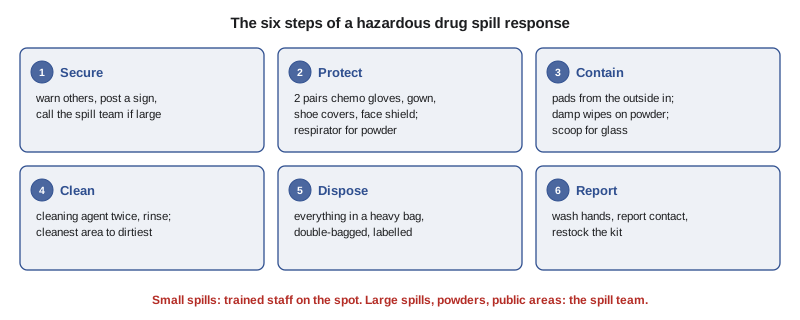
1. Secure the area. Warn people nearby, keep them away, and put out a warning sign. If the spill is large, call the spill team. Anyone whose skin or clothing has been splashed is attended to first. 2. Protect yourself. Put on two pairs of chemotherapy gloves, a gown, shoe covers and goggles with a face shield. Add a respirator for powder spills, for large liquid spills, and for any spill where aerosols may have formed. 3. Contain the spill. Cover liquids gently with absorbent pads, working from the outside edge inward so the spill does not spread. Cover powders with damp absorbent wipes to stop them blowing around; never sweep or brush a dry powder. Pick up broken glass with a scoop and scraper, never with hands, and put it in a puncture-resistant container. 4. Clean. Remove the absorbed material, then clean the area with a cleaning agent and water at least twice, working from the least contaminated part to the most, then rinse. Hard surfaces are cleaned a third time after the rest of the room. 5. Dispose. Put all materials, including the outer gloves, gown and shoe covers, into a heavy bag, seal it, place it in a second bag, label it as hazardous drug waste and take it to the hazardous drug waste container. 6. Report. Remove the remaining PPE, wash hands with soap and water, report the spill on an incident form, and restock the kit. Report any skin or eye contact to the supervisor and the Occupational Health and Safety office.
First aid for skin and eye contact
If a hazardous drug touches skin, remove contaminated gloves or clothing at once and wash the skin with soap and plenty of water for at least 15 minutes. Do not scrub hard or use alcohol, which can increase absorption. For eye contact, flush the eye at an eyewash station or with saline for at least 15 minutes, holding the eyelid open. In either case, report the exposure, check the safety data sheet for drug-specific advice, and see occupational health or the emergency department as the procedure requires. Every exposure is recorded in the worker's file, because the record of cumulative exposures matters for medical surveillance.
Deactivate, decontaminate, clean, disinfect
Cleaning hazardous drug areas is described in four steps. Deactivation makes a drug less hazardous, for example with an oxidizing agent such as sodium hypochlorite, though no single agent works for all drugs. Decontamination removes drug residue from surfaces, often with water, detergent or alcohol wipes. Cleaning removes dirt and organic material. Disinfection kills germs, which matters most in sterile compounding areas. NAPRA's standards and Canadian cancer agency guidance describe these steps, and products are chosen to suit the drugs and the surfaces.
The order matters for environmental services staff, who might otherwise assume that their usual disinfectant handles a drug spill. Many hospital disinfectants kill germs well but do nothing to remove drug residue, and spraying a disinfectant on a drug spill can spread it. Marta Kowalski's spill training now covers this directly: absorb first, then remove the residue with the cleaning agent in the kit, and only then disinfect.
Hazardous drug waste
Waste from hazardous drug handling falls into two broad groups, and they are treated differently.
- Trace or cytotoxic waste: items that have touched a hazardous drug but contain only residue, such as empty vials and bags, tubing, syringes, gloves, gowns and pads. In Canada these are treated as cytotoxic waste under CSA Z317.10 and provincial environmental rules, placed in rigid or heavy containers labelled with the cytotoxic symbol, and destroyed by high-temperature incineration.
- Bulk waste: partly used vials and bags, expired or unused drugs, and spill cleanup materials with more than residual drug. These are handled as hazardous pharmaceutical or chemical waste, collected by a licensed hauler and incinerated. Under Ontario's waste rules, the hospital tracks shipments of this waste from its loading dock to its destruction.
In both countries, hazardous drug waste is never put in the regular garbage, never flushed or poured down a sink, and never mixed with sharps containers meant for infectious waste unless the container is approved for both. Waste containers are kept closed, placed where they are needed so nobody carries contaminated items across a room, and handled with gloves.
When the Northbridge JHSC reviewed waste handling after the register, Marta found three problems: cytotoxic waste bins on the oncology day unit without lids, regular garbage bags being used to line them, and a full bin left beside the elevator for a shift because the holding room was locked. The fixes were simple and cheap: foot-pedal lidded bins, a stock of the correct heavy liners on the unit, and a key for the holding room on the environmental services night lead's ring.
Learning from spill reports
Every spill report is a chance to learn. Joanne asked pharmacy and the oncology day unit to pull a year of spill reports to see where and how spills happened.
# A year of hazardous drug spill reports at Northbridge
spills = [
    # (place, cause, volume in mL, skin or eye contact)
    ("day unit", "connection leak", 2, False),
    ("day unit", "connection leak", 3, False),
    ("day unit", "bag punctured by spike", 40, False),
    ("day unit", "patient vomit", 0, True),
    ("pharmacy", "vial dropped", 10, False),
    ("pharmacy", "inside cabinet", 5, False),
    ("pharmacy", "inside cabinet", 1, False),
    ("4 West", "connection leak", 1, False),
    ("4 West", "patient urine", 0, True),
    ("transport", "container dropped", 0, False),
    ("day unit", "connection leak", 4, False),
    ("day unit", "pump door opened", 15, True),
]
from collections import Counter
by_cause = Counter(c for _, c, _, _ in spills)
print("spills by cause:")
for cause, n in by_cause.most_common():
    print(f"  {cause:24}{n}")
large = [s for s in spills if s[2] > 5]
contact = [s for s in spills if s[3]]
print(f"large spills (over 5 mL): {len(large)} of {len(spills)}")
print(f"spills with skin or eye contact: {len(contact)}")
for place, cause, vol, _ in contact:
print(f" {place}: {cause}")spills by cause: connection leak 4 inside cabinet 2 bag punctured by spike 1 patient vomit 1 vial dropped 1 patient urine 1 container dropped 1 pump door opened 1 large spills (over 5 mL): 3 of 12 spills with skin or eye contact: 3 day unit: patient vomit 4 West: patient urine day unit: pump door opened
Connection leaks were the most common cause, mostly small and all on the day unit or 4 West. The pump door spill, in which a nurse opened the door of an infusion pump while the line was still unclamped, caused the only drug splash to skin, and the two body fluid contacts happened while staff helped patients in the 48 hours after a dose without full PPE. The committee responded with three changes: a check of every connection with the second nurse before opening clamps, a pump door sticker that says "clamp before opening", and a laminated card in each patient bathroom on the day unit and 4 West reminding staff of the 48-hour PPE rule.
Worked problem
Vomit in the day unit bathroom
An hour after his chemotherapy, a patient on the oncology day unit vomits on the floor of the unit bathroom. A volunteer is about to clean it up with paper towels. What should happen?
Show solution
- Stop the volunteer. Vomit within 48 hours of a dose is treated as hazardous drug contaminated, and the volunteer has no training or PPE.
- A nurse secures the bathroom, puts out a sign and helps the patient, wearing double chemotherapy gloves and a gown, with face protection if needed.
- The spill is cleaned using the unit spill kit: absorbent pads from the outside in, then cleaning agent twice, then disinfection, because vomit also carries germs.
- All materials go into hazardous drug waste, double-bagged and labelled. The nurse removes PPE, washes hands and completes a spill report.
- The volunteer program coordinator is told, and volunteer orientation is updated to say: never clean up body fluids on the day unit; call a nurse.
Answer: Treat the vomit as a hazardous drug spill: trained staff with PPE and the spill kit clean it, the waste goes to hazardous drug waste, and the gap in volunteer training is closed.
Practising spill response
A procedure on paper does not make a worker ready. Spills are rare enough for any one nurse or cleaner that the steps fade between events, and the first real spill is a bad time to discover that the kit is missing a respirator or that nobody knows who calls the spill team. Northbridge now runs a short spill drill twice a year on the oncology day unit, in pharmacy and with each environmental services shift.
The drill uses a harmless coloured liquid in an IV bag, punctured on the floor of a patient bay, or a small pile of coloured powder on a counter. A trainer times the response and watches each step: who secures the area, whether the right PPE goes on in the right order, how the spill is covered, whether the cleaning goes from the edge inward, whether the waste is double-bagged and labelled, and whether the PPE comes off without spreading the colour onto skin or clothing. Afterward the team looks at where the colour ended up. Traces on a sleeve, a shoe, a door handle or the outside of the waste bag show exactly where real drug would have gone.
The first drills found useful problems. One kit had an expired respirator that had never been fit tested for the person on shift. Another kit was in a locked cupboard. On nights, environmental services staff knew where the kit was but had never opened one. Each drill ends with the kit restocked, a note of anything that failed, and a short discussion of what to change. Over a year, the median time from the spill to the spill being covered fell from about six minutes to under three.
Drills also give a chance to practise the parts that cannot be learned from a poster: talking to a frightened patient or visitor while keeping them away from the spill, and calling for help clearly with the location and the drug involved.
Common mistakes
MistakeSweeping up a spilled hazardous drug powder.
InsteadCover it with damp absorbent wipes and lift it without raising dust.
MistakeSpraying the usual disinfectant on a drug spill.
InsteadAbsorb, remove residue with a cleaning agent, then disinfect.
MistakePutting contaminated gloves and gowns in the regular garbage.
InsteadPut them in the labelled hazardous drug waste container.
MistakePouring leftover drug down the sink.
InsteadDispose of bulk drug as hazardous waste; never down a drain.
MistakeWashing skin contamination with alcohol.
InsteadWash with soap and plenty of water for at least 15 minutes.
Summary and key terms
- Keep a checked spill kit, a written procedure and trained staff wherever hazardous drugs are handled.
- Small spills (about 5 mL or less) are cleaned on the spot by trained staff; larger spills, powders and public areas call for a spill team.
- The steps are secure, protect, contain, clean, dispose and report.
- Wash skin with soap and water and flush eyes for at least 15 minutes, and report every exposure.
- Cleaning means deactivation, decontamination, cleaning and disinfection; a disinfectant alone does not remove drug.
- Cytotoxic waste goes to labelled containers for high-temperature incineration; bulk drug is hazardous waste.
- Spill kit
- A ready-made set of PPE, absorbents, tools, bags and labels for cleaning a hazardous drug spill.
- Deactivation
- Making a hazardous drug less hazardous, usually by chemical reaction.
- Decontamination
- Removing hazardous drug residue from a surface.
- Trace waste
- Waste that contains only residue of a hazardous drug, such as empty bags, tubing and used PPE.
- Bulk waste
- Waste that contains more than residue, such as partly used vials and spill materials.
- High-temperature incineration
- Burning waste at very high temperatures to destroy hazardous drugs, the usual treatment for hazardous drug waste.
Practice problems
Work each problem on paper first, then reveal the answer to check.
What is the usual dividing line between a small and a large spill?
Show answer
About 5 mL of liquid or 5 g of powder.
List the six steps of a spill response.
Show answer
Secure, protect, contain, clean, dispose, report.
Why should powders never be swept?
Show answer
Sweeping raises the powder into the air where it can be breathed in and spread.
What first aid is given for a hazardous drug splash to the skin?
Show answer
Remove contaminated clothing, wash with soap and plenty of water for at least 15 minutes, and report.
What were the three waste problems on the day unit?
Show answer
Bins without lids, regular garbage liners, and a full bin left by the elevator because the holding room was locked.
What caused the only drug splash to skin in the year of reports?
Show answer
A nurse opened a pump door while the line was unclamped.
Lesson quiz · 5 questions
Score 60% or more to complete this lesson.
Create a free account to save your progress, take quizzes and earn a certificate.