
HSE-394 · Lesson 5 of 12 · 22 min
Disinfectants and sterilants
▶ Video coming soon A video version of this lesson is on the way.
Hospitals kill germs all day long, and they do it with chemicals strong enough to destroy bacteria, viruses and spores. Those same chemicals can burn skin and eyes, inflame the airways, cause asthma and allergic reactions, and in a few cases cause cancer. The workers most exposed are the ones who use them most: environmental services staff, who clean every room and bathroom; medical device reprocessing staff, who clean and sterilize surgical instruments; and endoscopy staff, who disinfect flexible scopes between patients. This lesson covers the main products, their hazards, and the controls that let them do their job without harming the people who use them.
Cleaning, disinfection and sterilization
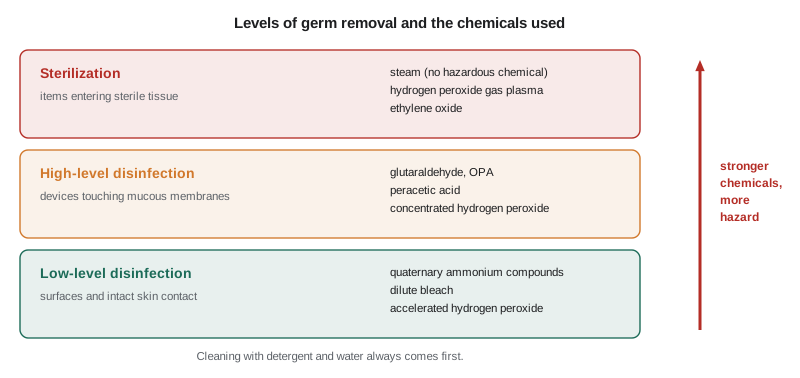
It helps to separate three levels of germ removal, because the level decides which chemical is used and how strong it is.
- Cleaning removes dirt, blood and organic matter with water, detergent and friction. It is always the first step, because disinfectants do not work well through dirt.
- Disinfection kills most germs on a surface or device. Low-level disinfectants, used on floors, bed rails and other surfaces that touch intact skin, include quaternary ammonium compounds and dilute bleach. High-level disinfection, used for devices that touch mucous membranes, such as flexible endoscopes, kills all germs except large numbers of bacterial spores.
- Sterilization kills all forms of life, including spores. It is needed for anything that enters sterile tissue or the bloodstream, such as surgical instruments. Most instruments are steam sterilized, which uses no hazardous chemicals; heat-sensitive devices need low-temperature methods such as hydrogen peroxide gas plasma or ethylene oxide.
Everyday disinfectants
Environmental services and nursing staff use low-level disinfectants many times a shift, usually as ready-to-use wipes or a diluted solution from a dispensing system.
- Quaternary ammonium compounds (quats) are the most common surface disinfectants. They irritate skin and eyes, and studies of cleaners and nurses link them to asthma and to worsening of existing asthma.
- Sodium hypochlorite (bleach) is used for blood spills and for rooms of patients with C. difficile and norovirus, because it kills spores and tough viruses. It irritates skin, eyes and airways, and releases toxic gases if mixed with acids or ammonia-based cleaners.
- Hydrogen peroxide products, including accelerated hydrogen peroxide, are used as surface disinfectants and are less irritating at use strength, though concentrated forms are corrosive.
- Alcohols, such as the isopropyl alcohol in wipes and hand rubs, dry the skin and are flammable.
Most harm from these products comes from three habits: using them stronger than needed, spraying them into the air, and using them without gloves. A product mixed at twice the labelled strength does not clean better, but it irritates more. Spraying puts mist into the breathing zone of the worker and everyone nearby; wiping with a soaked cloth or a ready-made wipe does the same job without the mist. Gloves suited to the product prevent the cracked, inflamed hands that are common among cleaners.
Getting the strength right depends on dilution. Bleach is a good example, because the strength needed differs by task. Marta Kowalski's team mixes it with a small calculator printed on the wall of the environmental services room, and the same arithmetic works in code.
# Mixing bleach to the strength each task needs
STOCK_PPM = 52500   # typical household-strength bleach, about 52,500 ppm

tasks = {
    "routine surface (if used)": 1000,
    "C. difficile room": 5000,
    "blood spill (large)": 5000,
    "food contact surface": 200,
}

def mix(target_ppm, total_ml):
    bleach = total_ml * target_ppm / STOCK_PPM
    return round(bleach), round(total_ml - bleach)

print(f"{'task':28}{'ppm':>6}{'bleach mL':>11}{'water mL':>10}  (for 1000 mL)")
for task, ppm in tasks.items():
    b, w = mix(ppm, 1000)
    print(f"{task:28}{ppm:6}{b:11}{w:10}")
print("ratio for 5000 ppm: about 1 part bleach to", round(STOCK_PPM / 5000) - 1, "parts water")task ppm bleach mL water mL (for 1000 mL) routine surface (if used) 1000 19 981 C. difficile room 5000 95 905 blood spill (large) 5000 95 905 food contact surface 200 4 996 ratio for 5000 ppm: about 1 part bleach to 9 parts water
Two practical points follow from the numbers. First, diluted bleach loses strength over time, so it is mixed fresh each day and the container is labelled with the strength and the time it was made. Second, the same product used at 5,000 ppm for a C. difficile room is ten times stronger than the food-surface solution, so the PPE and ventilation needed differ by task. Many hospitals now buy premixed bleach wipes at a fixed strength to avoid mixing altogether, which is a good example of substitution.
High-level disinfectants
Flexible endoscopes, ultrasound probes and similar devices are too delicate for steam, so they are cleaned by hand and then disinfected in a high-level disinfectant, usually in an automated endoscope reprocessor (AER).
- Glutaraldehyde was for many years the standard high-level disinfectant. It is a strong irritant and a sensitizer: it causes skin rashes, nosebleeds, headaches, and occupational asthma that can persist after exposure ends. The ACGIH sets a ceiling value of 0.05 ppm, a level low enough that people may smell it before they reach the limit, and Ontario's Regulation 833 sets a ceiling for it as well.
- Ortho-phthalaldehyde (OPA) replaced glutaraldehyde in many hospitals because it works faster and has a weaker odour, but it stains skin and surfaces grey and is also a sensitizer; rare allergic reactions have occurred in patients when devices were not rinsed well.
- Peracetic acid, often mixed with hydrogen peroxide, is used in many AERs. It has a sharp vinegar smell, irritates eyes and airways, and is corrosive in concentrated form.
- Concentrated hydrogen peroxide is used in some systems and is corrosive to skin and eyes.
Controls for high-level disinfectants start with enclosure: an AER with a sealed lid and its own exhaust keeps vapour out of the room, and a covered soaking tray is far better than an open basin. The room needs good general ventilation, and the soaking and rinsing station should have local exhaust that draws vapour away from the worker's face. Workers wear chemical-resistant gloves (nitrile or butyl, not latex, which glutaraldehyde passes through), a fluid-resistant gown, and goggles or a face shield when pouring, changing solutions or opening equipment. Solutions are changed according to the manufacturer's instructions, with the AER doing as much of the pouring as possible, and spills are cleaned up with a kit that includes a neutralizer.
When the Northbridge endoscopy unit replaced its last open glutaraldehyde tray with an enclosed AER using peracetic acid, staff complaints of headaches and sore eyes dropped from several a month to almost none. The unit kept one glutaraldehyde spill kit, because a small amount was still used for one device, and air monitoring was repeated to confirm the change.
Ethylene oxide
Ethylene oxide (EtO) is a gas used to sterilize heat- and moisture-sensitive devices. It works at low temperatures and penetrates packaging well, but it is a known human carcinogen, a reproductive hazard, an irritant and highly flammable. Exposure has been linked to leukemia and breast cancer in sterilizer workers.
In Ontario, ethylene oxide is one of the eleven designated substances. Its regulation requires an assessment of exposure, a written control program developed with the JHSC where workers are likely to be exposed, air monitoring, medical surveillance in some cases, and an exposure limit that must not be exceeded.
Most hospitals have reduced or eliminated EtO by switching to hydrogen peroxide gas plasma or vapour sterilizers, which break down into water and oxygen, and by sending the few devices that still need EtO to a central sterilization contractor. Where EtO is still used, the sterilizer and aerator are in a separate, ventilated room with continuous monitoring and alarms, the cycle includes aeration so that devices are not handled until the gas has dispersed, and staff never open the door early.
Room disinfection systems
Some hospitals disinfect rooms after discharge of patients with resistant organisms using ultraviolet light or hydrogen peroxide vapour, as HSE-390 mentioned. Hydrogen peroxide vapour systems fill a sealed room with peroxide mist, so the room must be empty, the doors and vents sealed and the area posted, and the room is not re-entered until sensors show the level has fallen to a safe value. Ultraviolet (UV-C) devices can burn skin and eyes, so they run only in empty rooms with motion sensors that switch them off if someone enters.
Worked problem
The new spray bottle on 4 West
Environmental services on 4 West switches to a new disinfectant concentrate, mixed in spray bottles. Within two weeks, Marta and two nurses report coughing and tight chests after cleaning bathrooms, and one nurse with asthma needs her inhaler on every shift. What should the JHSC look at?
Show solution
- Check the safety data sheet: the new product is a quaternary ammonium compound with an added fragrance, known to irritate airways, and the label calls for application by wiping, not spraying.
- Check the mixing: the dispensing station was set up wrong, producing a solution about twice the labelled strength.
- Check the method: staff were spraying it into small, poorly ventilated bathrooms, putting mist straight into their breathing zone.
- Fix: correct the dispenser, switch from spray bottles to pre-soaked microfibre cloths or wipes, run bathroom exhaust fans during cleaning, and consider a fragrance-free product.
- Follow up: ask the affected workers to see the Occupational Health and Safety office, record the cases, and recheck symptoms in a month. The nurse with asthma should be assessed for work-related asthma.
Answer: The symptoms came from a strong, sprayed product used in small rooms; fix the dilution, stop spraying, ventilate, consider a gentler product and follow up the affected workers.
Choosing safer products
The cheapest control for a hazardous disinfectant is to stop needing it. Substitution has a long track record in this area: steam replaced chemical sterilization for most instruments decades ago, enclosed reprocessors replaced open soaking basins, hydrogen peroxide gas plasma replaced most ethylene oxide, and many hospitals have replaced quats with accelerated hydrogen peroxide products that irritate less at use strength. Each change had to be checked against what the product needs to do. A disinfectant that is gentler on staff but does not kill C. difficile spores, or that damages the plastic of a monitor, is not a real alternative.
Northbridge now runs every new cleaning or disinfecting product through a short review before it is bought. Infection prevention confirms it kills the germs that matter and is compatible with the surfaces and devices it will touch. The Occupational Health and Safety office and an environmental services worker review the safety data sheet for irritants, sensitizers, carcinogens and fragrance, and check the PPE it needs. Purchasing confirms that ready-to-use or premixed forms are available, so staff do not have to dilute concentrate. Only products that pass all three reviews go on the approved list, and environmental services keeps a binder of their safety data sheets on every cart.
Monitoring and health follow-up
Air monitoring tells the hospital whether controls are working. For glutaraldehyde, peracetic acid and ethylene oxide, a trained person samples the air in the worker's breathing zone during the tasks with the highest exposure, such as changing the solution in a reprocessor or unloading a sterilizer, and compares the results with the exposure limits. Monitoring is repeated after any change of product, equipment or ventilation, and whenever workers report symptoms. Ethylene oxide areas also have continuous monitors that sound an alarm at a set level.
Health follow-up matters because the most serious effects of these chemicals, such as asthma and allergy, develop over time. Workers who use high-level disinfectants or sterilants are asked about skin and breathing symptoms when they start the job and at regular intervals. Anyone who develops symptoms that improve on days off and worsen at work should be assessed for work-related asthma or dermatitis early, because the outlook is much better when exposure is reduced soon after symptoms begin. Cases are recorded and reported as occupational illnesses, and the JHSC reviews them for patterns, as the 4 West example shows.
Common mistakes
MistakeMixing disinfectant stronger than the label says to make it work better.
InsteadUse the labelled strength; stronger solutions irritate more without cleaning better.
MistakeSpraying disinfectant into small rooms.
InsteadWipe with a soaked cloth or ready-made wipe to avoid mist.
MistakeWearing latex gloves for glutaraldehyde.
InsteadUse nitrile or butyl gloves suited to the chemical.
MistakeLeaving high-level disinfectant in an open tray.
InsteadUse enclosed reprocessors or covered trays with local exhaust.
MistakeOpening an ethylene oxide sterilizer before the cycle and aeration finish.
InsteadWait for the full cycle and aeration, and use the monitoring and alarms.
Summary and key terms
- Cleaning removes dirt; disinfection kills most germs; sterilization kills all forms of life.
- Quats, bleach, hydrogen peroxide and alcohols are common low-level disinfectants with irritant and asthma risks.
- Use the labelled strength, wipe instead of spray, and wear suitable gloves.
- Glutaraldehyde, OPA and peracetic acid are high-level disinfectants that need enclosure, local exhaust and chemical PPE.
- Ethylene oxide is a carcinogen and an Ontario designated substance; most hospitals have replaced it.
- Room disinfection systems with hydrogen peroxide vapour or UV-C run only in empty, sealed rooms.
- High-level disinfection
- A process that kills all germs except large numbers of bacterial spores, used for devices touching mucous membranes.
- Sterilization
- A process that kills all forms of life, including spores.
- Quaternary ammonium compound
- A common surface disinfectant linked to skin irritation and asthma.
- Glutaraldehyde
- A high-level disinfectant that is a strong irritant and sensitizer.
- Automated endoscope reprocessor (AER)
- An enclosed machine that disinfects flexible endoscopes.
- Ethylene oxide
- A sterilant gas that is a known human carcinogen.
- Sensitizer
- A substance that can cause an allergic reaction after repeated exposure.
Practice problems
Work each problem on paper first, then reveal the answer to check.
What is the difference between disinfection and sterilization?
Show answer
Disinfection kills most germs; sterilization kills all forms of life, including spores.
How much household-strength bleach makes 1,000 mL of a 5,000 ppm solution?
Show answer
About 95 mL of bleach with about 905 mL of water.
Why should diluted bleach be mixed fresh each day?
Show answer
It loses strength over time.
Name two controls that reduce glutaraldehyde exposure.
Show answer
Any two of an enclosed AER, covered trays, local exhaust, good ventilation, nitrile or butyl gloves, eye protection.
Why have most hospitals moved away from ethylene oxide?
Show answer
It is a carcinogen and reproductive hazard, and safer low-temperature methods such as hydrogen peroxide gas plasma are available.
What caused the coughing on 4 West after the new disinfectant arrived?
Show answer
A strong, sprayed product, mixed too strong, used in small poorly ventilated bathrooms.
Lesson quiz · 5 questions
Score 60% or more to complete this lesson.
Create a free account to save your progress, take quizzes and earn a certificate.