
LES-102 · Lesson 10 of 12 · 26 min
Opportunity and victims: routine activities, crime patterns and repeat victimization
▶ Video coming soon A video version of this lesson is on the way.
Professor Desjardins opens the tenth class with a story from his patrol years. One autumn, thefts from cars in the parking garage beside the Port Ardent hospital tripled in six weeks. Nothing about the city's young people had changed in those six weeks, and no new gang had arrived. What had changed was the garage. A broken barrier arm had not been repaired, the attendant's booth had been closed to save money and two lights on the third level had burned out. The thieves had not become more motivated. The opportunity had become easier, and they had noticed. Most of the theories in this course ask why some people become offenders. This lesson asks a different question: given that some people are willing to offend, why does crime happen at particular places, times and targets, and why do the same victims suffer again and again?
This branch of criminology is often called environmental criminology or opportunity theory. It grew from the rational choice perspective you studied in lesson 3 and from the patterns of crime you studied in lesson 9. Its great practical value is that it points to things police and communities can change quickly: the design of a place, the routines of guardians, the attractiveness of targets and the protection given to people who have just been victimized. Linh Tran, who hopes to become a crime analyst, calls this the lesson she has been waiting for, because it is the part of criminology that analysts use every day.
Routine activity theory
In 1979 the American sociologists Lawrence Cohen and Marcus Felson asked why crime had risen so sharply in the United States after 1960, a period of rising incomes, falling poverty and expanding education, when most theories predicted crime should fall. Their answer was routine activity theory. A direct-contact predatory crime, they argued, requires three things to come together in time and space: a likely offender, a suitable target and the absence of a capable guardian. Remove any one of the three and the crime does not happen. Crime rates therefore depend not only on how many people are motivated to offend but on how the routine activities of everyday life bring the three elements together.
Cohen and Felson pointed to two changes in routine activities after the Second World War. More women entered paid work and more people lived alone, so more homes stood empty during the day with nobody to guard them. At the same time, valuable goods became lighter and more portable. Televisions, stereos and later laptops and phones were worth a great deal and easy to carry. The result, they argued, was a rise in daytime residential burglary that no change in offender motivation was needed to explain. Their data supported the prediction: burglary rates rose fastest where households were empty most of the day.
A capable guardian is anyone whose presence discourages crime, not only a police officer. Residents at home, neighbours watching the street, shop staff, security guards, bus drivers and passers-by all act as guardians, usually without thinking about it. Felson stressed that most guardianship is informal and that police are only a small part of it. The theory also explains why crime is so concentrated in time. The bar closing peak you saw in lesson 9 brings together many likely offenders, many suitable targets and relatively few capable guardians at one moment.
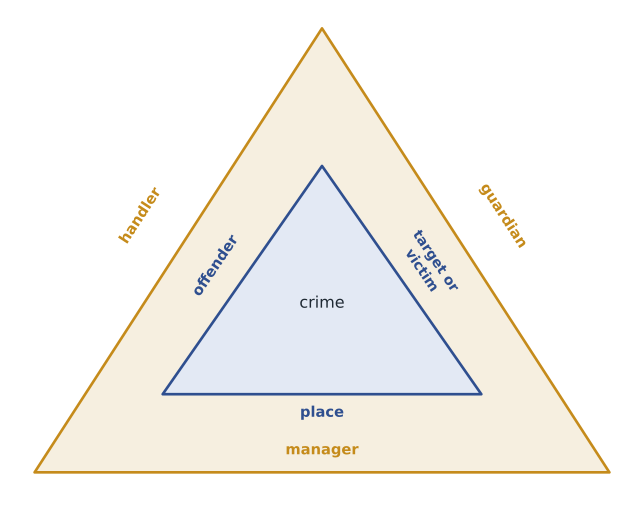
John Eck later turned the idea into the problem analysis triangle, which police services around the world use in problem-oriented policing. The inner triangle shows the three elements of a crime: an offender, a target or victim, and a place where they meet. The outer triangle shows the three kinds of controller who can prevent it. Handlers are people with an emotional or formal tie to the offender, such as parents, coaches, employers or probation officers. Guardians protect targets. Managers are responsible for places, such as landlords, bar owners, store managers and transit staff. When a crime problem persists, analysts ask which controllers are absent or ineffective. In the hospital garage, the manager, the hospital's facilities department, had removed the attendant and stopped maintaining the barrier and lights.
Lifestyle-exposure theory and the victim-offender overlap
A closely related theory focuses on victims. In 1978 Michael Hindelang, Michael Gottfredson and James Garofalo proposed lifestyle-exposure theory to explain why victimization surveys showed such large differences in risk between groups. People whose daily lives bring them into frequent contact with likely offenders, at times and places where guardians are scarce, face higher risk. Young people who go out at night, people who spend time in bars, people who use public transit late and people who live alone in high-crime areas are all more exposed. The theory does not blame victims; it describes how ordinary routines shape exposure to risk.
One of the most consistent findings in this research is the victim-offender overlap. People who commit crimes, especially violent crimes, are far more likely than others to be victims of crime themselves, and many victims of violence have also offended. The overlap is strongest among young men involved in street life, where retaliation, unpaid debts and disputes among acquaintances drive much of the violence. For police, the overlap has two practical implications. First, a shooting victim who will not cooperate with an investigation may also be at high risk of retaliating or of being shot again, so violence reduction programs often work with victims in hospital. Second, treating everyone with a criminal record purely as a suspect can mean overlooking serious harm done to them.
Victimization is not spread evenly across the population. Statistics Canada's surveys show that young people, people with disabilities, Indigenous people, LGBTQ2+ people and people who are homeless face markedly higher risks of violent victimization than other Canadians. Indigenous women are several times more likely than non-Indigenous women to be victims of violence, a finding at the centre of the National Inquiry into Missing and Murdered Indigenous Women and Girls. Jesse Morningstar notes that this is the other side of the overrepresentation of his community in the justice system: the same communities are overrepresented among victims, and their needs as victims have often been ignored.
Crime pattern theory
Two Canadian criminologists, Paul and Patricia Brantingham of Simon Fraser University, developed crime pattern theory, which explains where offenders find their targets. Like everyone else, offenders spend most of their time at a few nodes, such as home, school, work and places of entertainment, and travel between them along familiar paths. The area they know well from these routines is their awareness space. Most offenders commit most of their crimes within or near their awareness space, because that is where they notice opportunities and feel confident. A burglar seldom drives across the city to an unknown neighbourhood when there are suitable targets near the route he walks every day.
The theory also explains the distinction between crime generators and crime attractors you met in lesson 9. Generators, such as shopping centres, transit stations and stadiums, bring large numbers of people into an area for legitimate reasons, and some of them notice opportunities. Attractors, such as an open-air drug market or a bar known for fights, draw people who come specifically because of the criminal opportunities. Edges, the boundaries between different kinds of land use, such as where a residential area meets a commercial strip, also tend to have more crime, because strangers mix there and nobody feels responsible. Crime pattern theory is the basis of geographic profiling, a technique developed by the Canadian detective Kim Rossmo that uses the locations of a series of crimes to estimate where an offender is most likely to live.
| Theory | Key authors | Central idea | Practical use |
|---|---|---|---|
| Routine activity | Cohen and Felson, 1979 | Crime needs a likely offender, a suitable target and no capable guardian | Strengthen guardians, handlers and place managers |
| Lifestyle-exposure | Hindelang, Gottfredson and Garofalo, 1978 | Daily routines shape how often people meet offenders without protection | Target prevention advice and services to high-risk groups |
| Crime pattern | Paul and Patricia Brantingham | Offenders find targets within their awareness space of nodes and paths | Hot spot analysis and geographic profiling |
| Rational choice | Cornish and Clarke | Offenders make bounded, crime-specific decisions about risk and reward | Situational crime prevention |
What makes a target suitable
Some targets are stolen far more often than others. Ronald Clarke summarized the features of hot products with the acronym CRAVED: concealable, removable, available, valuable, enjoyable and disposable. Smartphones fit every part of the acronym, which is why they became the most stolen item in many cities in the 2000s and early 2010s. When manufacturers introduced activation locks that made stolen phones hard to reuse, phone robberies fell in several cities, an example of reducing crime by making a target less valuable to a thief. Cash, alcohol, razor blades, designer clothing and certain car models have all been hot products at different times.
Vehicles show the idea clearly. For decades, cars with weak locks and no immobilizers were stolen in large numbers for joyriding. Canada made electronic immobilizers mandatory on new vehicles in 2007, and vehicle theft fell sharply over the following decade. More recently, thieves have used relay devices and stolen key fob signals to take high-value vehicles for export, and thefts rose again in several regions until manufacturers, insurers, ports and police responded. Priya Sandhu points out that this is the same pattern she saw with fraud: each security improvement reduced the crime it targeted until offenders found a new weakness, which is why prevention has to be continuous.
Repeat and near-repeat victimization
One of the most useful discoveries in modern criminology is that being victimized is the best single predictor of being victimized again. A small share of people, households and businesses experience a large share of all crime. In British victimization surveys, a small fraction of respondents account for a large share of all incidents reported. Repeat victimization is especially common in domestic violence, where the same victim may be assaulted many times, but it is also found in burglary, vandalism, shoplifting, robbery of businesses and racial harassment.
Repeats also tend to happen soon. After a home is broken into, the risk of another break-in at the same address is highest in the following days and weeks and then declines. The pattern has two explanations. The boost explanation says the first crime teaches the offender about the target: what can be taken, how to get in and how likely he is to be seen. Many repeat burglaries are committed by the same offender returning for goods he left behind or for replacement goods bought with the insurance money. The flag explanation says that some targets are simply more attractive or exposed than others, so they keep drawing offenders. Both play a part.
Research has also found near-repeat victimization: after a burglary, the risk rises not only for the victimized home but for nearby homes, especially those on the same side of the street, for a few weeks. Offenders who succeed in one place return to the area where similar homes offer similar opportunities. Near-repeat patterns have been found for burglary, thefts from vehicles and some shootings. They form the basis of some prediction tools and of simple prevention practices, such as notifying neighbours after a burglary.
Linh has the Port Ardent records for residential break-ins in 2024 and 2025. She wants to know how concentrated the victimization was and how quickly repeats followed. The code below counts how many addresses were broken into once, twice or more, and how soon the second break-in came.
# Port Ardent residential break-ins, 2024-2025
# victimized addresses by number of break-ins at that address
by_count = {1: 512, 2: 46, 3: 11, 4: 4}
addresses = sum(by_count.values())
incidents = sum(k * n for k, n in by_count.items())
repeat_addresses = addresses - by_count[1]
repeat_incidents = incidents - addresses   # every break-in after the first
print(f"victimized addresses: {addresses}, break-ins: {incidents}")
print(f"addresses hit more than once: {repeat_addresses} ({repeat_addresses / addresses:.1%})")
print(f"break-ins that were repeats: {repeat_incidents} ({repeat_incidents / incidents:.1%})")
# days from the first to the second break-in at the 61 repeat addresses
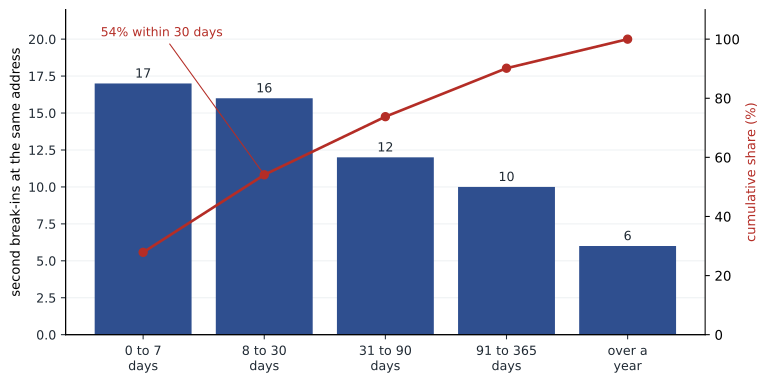
gaps = {"0-7 days": 17, "8-30 days": 16, "31-90 days": 12, "91-365 days": 10, "over a year": 6}
running = 0
for band, n in gaps.items():
    running += n
print(f" {band:12s} {n:3d} cumulative {running / repeat_addresses:6.1%}")victimized addresses: 573, break-ins: 653 addresses hit more than once: 61 (10.6%) break-ins that were repeats: 80 (12.3%) 0-7 days 17 cumulative 27.9% 8-30 days 16 cumulative 54.1% 31-90 days 12 cumulative 73.8% 91-365 days 10 cumulative 90.2% over a year 6 cumulative 100.0%
The results show the pattern found in research elsewhere. About one victimized address in ten was hit again, and repeats made up about one break-in in eight. More than half of the second break-ins came within a month of the first, and more than a quarter within a week. This has a direct practical lesson. The days after a break-in are the period of highest risk, which is exactly when a visit from police, a lock upgrade and a word with the neighbours are most valuable. Prevention aimed at recent victims protects the people most likely to be harmed next, and it uses resources efficiently because the group is small and easy to identify.
The best-known demonstration of this idea is the Kirkholt project in Rochdale, England, in the late 1980s. On a housing estate with a very high burglary rate, police and partners focused on homes that had just been burgled. They removed coin-operated meters that were a common target, upgraded locks, and organized small groups of neighbours, called cocoons, to watch the victimized home and the homes around it. Repeat burglaries fell sharply and overall burglary on the estate fell by well over half within a few years. Later programs in other countries found that the approach works best when the protection is delivered quickly, within days of the first crime.
Victims and the justice system
The study of victims, called victimology, began in the 1940s with Hans von Hentig and Benjamin Mendelsohn, who classified victims by how they might have contributed to their own victimization. That early approach is now widely rejected for its tendency to blame victims. Modern victimology studies the risks people face, the harm crime causes and how victims are treated by the justice system. The harm can be physical, financial and psychological. Many victims of violence experience fear, sleeplessness, anxiety and symptoms of post-traumatic stress, and some lose work, housing or relationships as a result.
For most of the twentieth century, victims were largely spectators in criminal cases, which are prosecuted in the name of the state. The victims' rights movement since the 1970s has changed that. The Canadian Victims Bill of Rights, in force since 2015, gives victims rights to information about the investigation and prosecution, to protection, to participation, including by presenting a victim impact statement at sentencing, and to seek restitution. Every province funds victim services, and many police services, including Port Ardent's, have a victim services unit that contacts victims after serious incidents. Restorative justice programs, which bring victims and offenders together with a trained facilitator, also give victims a voice, and research finds that victims who take part are generally more satisfied than those who go through court alone.
Police are usually the first official contact a victim has with the justice system, and that contact shapes whether victims report future crimes and cooperate with investigations. Research on procedural justice, which you studied in the first course, applies strongly to victims. They want to be listened to, believed, kept informed and treated with respect, even when an offender is never caught. Professor Desjardins says that the single most common complaint he received from victims was not that a case went unsolved, but that nobody called them back.
Worked problem
Applying the problem analysis triangle
Over three months, the Port Ardent hospital parking garage recorded 42 thefts from vehicles, up from 12 in the same period the year before. Most occurred on the third level between 6 p.m. and 2 a.m. Officers arrested one young man who admitted to about a third of the thefts; he said friends had told him the garage was easy. Use the problem analysis triangle to suggest responses.
Show solution
- Offender and handler: one known offender, and word has spread among his friends. Handlers include his probation officer, if he is on probation, and his family; the arrest itself removes one offender but not the opportunity.
- Target and guardian: cars left with valuables visible, at night, with no attendant on duty. Guardians can be restored with an attendant, security patrols at irregular times or staff walking through on their way to shift change.
- Place and manager: the hospital facilities department is the manager. The broken barrier, the closed booth and the burned-out lights on level 3 all fall under its control.
- Choose responses for each side of the triangle, and decide how to measure success: count thefts on each level for the next three months and compare with the year before.
Answer: The most effective responses fall on the place and guardian sides: repair the barrier, restore the lighting, add camera coverage and an attendant or regular security rounds during evening hours, and post signs reminding drivers to remove valuables. Officers should ask the hospital, as the place manager, to make these changes, and should notify staff whose cars were targeted. The arrest helps, but without changes to the garage, other offenders who have heard it is easy are likely to take his place.
Common mistakes
MistakeCrime rises mainly because more people become motivated to offend.
InsteadCrime also rises when routines create more suitable targets and fewer capable guardians, even if motivation does not change.
MistakeA capable guardian means a police officer.
InsteadMost guardians are ordinary people, such as residents, staff and passers-by, whose presence discourages crime.
MistakeOnce a home has been burgled, it is safe, because lightning does not strike twice.
InsteadRisk of another break-in is highest in the days and weeks after the first, and nearby homes also face higher risk.
MistakeStudying victims' routines means blaming them for crime.
InsteadModern victimology describes how routines shape exposure to risk so that protection can be offered; responsibility for a crime lies with the offender.
Summary and key terms
- Routine activity theory: a direct-contact crime needs a likely offender, a suitable target and the absence of a capable guardian at the same time and place.
- The problem analysis triangle adds three controllers: handlers of offenders, guardians of targets and managers of places.
- Lifestyle-exposure theory explains differences in victimization by how routines bring people into contact with offenders; offenders and victims often overlap.
- Crime pattern theory: offenders find targets within their awareness space of nodes, paths and edges; it underpins hot spot analysis and geographic profiling.
- Hot products are concealable, removable, available, valuable, enjoyable and disposable (CRAVED).
- Prior victimization is the best predictor of future victimization; repeats come soon, so protection should be delivered quickly to recent victims and their neighbours.
- Routine activity theory
- The theory that crime occurs when a likely offender and a suitable target meet in the absence of a capable guardian.
- Capable guardian
- Any person whose presence discourages crime against a target.
- Place manager
- A person responsible for a place, such as a landlord, store manager or bar owner.
- Awareness space
- The area an offender knows from daily routines, where most of his or her crimes occur.
- Repeat victimization
- The victimization of the same person, household or business more than once.
- Near-repeat victimization
- Raised risk of crime for targets near a recent crime, for a short period.
- Victimology
- The study of victims, the risks they face and how they are treated.
Practice problems
Work each problem on paper first, then reveal the answer to check.
Name the three elements of a crime in routine activity theory.
Show answer
A likely offender, a suitable target and the absence of a capable guardian.
Who are the three controllers in the problem analysis triangle?
Show answer
Handlers, who control offenders; guardians, who protect targets; and managers, who look after places.
What does CRAVED stand for?
Show answer
Concealable, removable, available, valuable, enjoyable and disposable.
A neighbourhood has 600 break-ins at 520 addresses, and every address was hit once or twice. How many addresses were hit twice?
Show answer
80, because the 80 extra break-ins each mark a second break-in at a different address.
Why should prevention after a burglary be delivered within days rather than months?
Show answer
Because the risk of a repeat break-in is highest soon after the first and falls over time.
Lesson quiz · 5 questions
Score 60% or more to complete this lesson.
Create a free account to save your progress, take quizzes and earn a certificate.