
LES-102 · Lesson 3 of 12 · 21 min
Classical and rational choice theories: deterrence and decisions
▶ Video coming soon A video version of this lesson is on the way.
Marco DiSanto opens the third class with the belief he wrote on his card in week one: harsher punishment deters crime. In the army, he says, discipline worked because everyone knew that breaking the rules meant consequences, and fast. Professor Desjardins says Marco has just stated, almost word for word, a theory first set out in 1764 by a 26-year-old Italian nobleman named Cesare Beccaria. It is the oldest scientific theory of crime still in use, it underlies criminal law in both countries, and research has shown that it is partly right and partly wrong in a very specific way. The class is going to find out which part is which.
The classical school: Beccaria and Bentham
In the eighteenth century, punishment in Europe was often arbitrary and brutal. Judges had wide discretion, torture was used to obtain confessions, the death penalty applied to hundreds of offences including minor thefts, and punishments varied with the status of the accused. Beccaria's short book On Crimes and Punishments argued that this system was both cruel and ineffective. People, he said, are rational beings who seek pleasure and avoid pain. Laws should be clear and published so that everyone knows what is forbidden. Punishment should be just severe enough to outweigh the gain from crime, no more, and it should be certain and prompt. He opposed torture and the death penalty, arguing that a certain, moderate punishment deters better than a severe but unlikely one.
The English philosopher Jeremy Bentham developed these ideas into a broader theory of utilitarianism: the right action is the one that produces the greatest happiness for the greatest number. Punishment is itself a harm, so it is justified only if it prevents more harm than it causes. Bentham tried to design a calculus of pleasure and pain and proposed the Panopticon, a prison in which inmates could always be watched. Together, Beccaria and Bentham founded the classical school of criminology. Its ideas shaped the French penal code of 1791 and, through English and American law, the principles that offences must be defined in advance, that penalties should be proportionate and that like cases should be treated alike.
These principles live on in the Criminal Code. Section 718.1 states that a sentence must be proportionate to the gravity of the offence and the degree of responsibility of the offender, and deterrence and denunciation are listed among the objectives of sentencing in section 718. When a judge tells a convicted person that the sentence must send a message to others, the judge is speaking the language of Beccaria.
Deterrence: certainty, severity and swiftness
Deterrence theory identifies three properties of punishment. Certainty is the likelihood of being caught and punished. Severity is how harsh the punishment is. Celerity, or swiftness, is how quickly punishment follows the offence. Criminologists also distinguish general deterrence, the effect of punishment in discouraging the public at large, from specific deterrence, the effect of punishment on the person punished. A third related effect, incapacitation, is not deterrence at all: a person in prison cannot commit crimes in the community, whatever he or she thinks.
Decades of research have produced a consistent pattern. The certainty of being caught has a meaningful deterrent effect. The severity of punishment has a much smaller effect than most people believe, and beyond a certain point almost none. The criminologist Daniel Nagin, reviewing the evidence, concluded that the certainty of apprehension is a far more effective deterrent than the severity of the resulting punishment. Long prison sentences, in particular, have little deterrent value, partly because most offenders do not know the penalties for specific crimes, partly because they do not expect to be caught, and partly because many offend while intoxicated, angry or under pressure from peers, when long-term consequences are far from their minds.
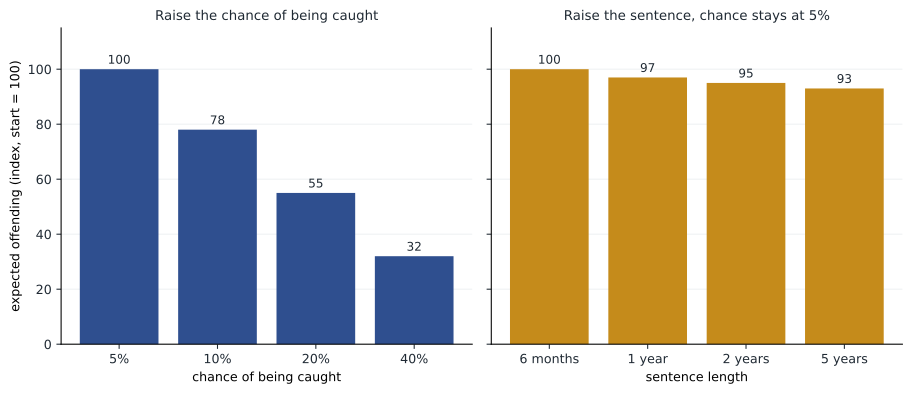
The research on specific deterrence is even more striking. If punishment deterred the punished, people who receive harsher sentences should reoffend less. Studies comparing similar offenders who received prison or community sentences generally find that prison does not reduce reoffending, and in some studies slightly increases it. Prison can weaken ties to family and work, expose people to other offenders and make it harder to find a job, all of which raise the risk of future crime. This does not mean prison has no role, but it does mean that the case for long sentences rests mainly on incapacitation and on justice, not on deterrence.
The death penalty offers a case study. Canada abolished capital punishment for murder in 1976, and the homicide rate continued the gradual decline it had begun before abolition. Comparisons between American states that do and do not use the death penalty show no consistent evidence that it deters murder more than long imprisonment. In 2012 the National Research Council in the United States concluded that studies claiming a deterrent effect were fundamentally flawed and should not be used to inform policy. Professor Desjardins notes that people who support the death penalty usually do so on grounds of justice, and that debate is a moral one that deterrence research cannot settle.
Why certainty works: the evidence from policing
If certainty matters most, the most effective deterrent is a visible chance of being caught. This is the logic behind several well-tested police strategies. Impaired driving checkpoints, known in Ontario as RIDE programs, work mainly by making drivers believe they could be stopped at any time. Hot spots policing concentrates patrols in the small areas where crime clusters, raising the perceived risk exactly where offending happens. Focused deterrence strategies, first used in Boston in the 1990s to reduce youth gun violence, tell a small group of high-risk people directly that violence will bring a swift, certain response from police and prosecutors, while offering them help with jobs, housing and treatment.
Swiftness also matters, although the evidence is more mixed. Hawaii's HOPE probation program, launched in 2004, imposed short, immediate jail stays for every violation of probation, such as a failed drug test, instead of the delayed and severe response of the old system. Early results showed large reductions in drug use and new arrests, but later replications in other states found smaller effects. The lesson criminologists draw is that consequences that are certain, quick and fair can change behaviour, but that programs must be carefully implemented and evaluated rather than assumed to work.
Perceptions matter more than reality. Deterrence works through what people believe their chances of being caught are, not through the actual odds. Research on perceptual deterrence shows that people who have committed crimes without being caught tend to lower their estimate of the risk, a process called the resetting effect, while those who are caught raise it. This helps explain why visible, unpredictable enforcement can have effects out of proportion to the number of arrests it produces, and why a single well-publicized case can change behaviour briefly before people return to their old estimates.
Rational choice theory
In the 1960s and 1970s, after a period in which criminology focused on the social and psychological causes of crime, the classical idea of the reasoning offender returned in a new form. The economist Gary Becker argued in 1968 that people commit crimes when the expected benefits exceed the expected costs, just as they make other economic decisions. Derek Cornish and Ronald Clarke developed rational choice theory in the 1980s with a more realistic picture. Offenders, they said, are not perfectly rational calculators. They make quick decisions with limited information, under time pressure, often after drinking or with friends. Their reasoning is bounded, but it is reasoning, and it responds to the opportunities in front of them.
Cornish and Clarke distinguished involvement decisions, such as becoming involved in crime, continuing or stopping, from event decisions, such as which house to break into, at what time and how. Event decisions are highly specific to the type of crime. A burglar weighs whether a house is occupied, whether neighbours can see the door, how easy the lock is and how quickly he can get away. Interviews with burglars in several countries support this picture: most avoid houses that look occupied, prefer homes with cover from view and choose targets close to routes they already know. This crime-specific reasoning is the basis for situational crime prevention, which you will study in lesson 11.
Priya recognizes the pattern from her bank work. Most of the employees she caught committing fraud had a pressing financial need, a belief that they would not be caught and a way of telling themselves it was acceptable. The criminologist Donald Cressey called this the fraud triangle: pressure, opportunity and rationalization. When the bank added a second approval step for large transfers and audited unusual transactions, the opportunity shrank and fraud fell, even though nobody's character had changed.
The limits of rational choice
Rational choice theory fits some crimes better than others. It describes planned property crimes, fraud and organized crime well, because these involve deliberate choices about targets and methods. It fits impulsive violence, crimes committed under heavy intoxication and crimes driven by addiction or serious mental illness less well. A person in the grip of rage during a bar fight is not weighing sentencing guidelines. Even here, though, situational factors matter: a bar that serves fewer people to the point of intoxication, closes in stages and keeps crowds from spilling into the same street at the same time sees fewer fights, because it shapes the situations in which quick decisions are made.
Age matters too. Research on adolescent brain development, discussed in the next lesson, shows that teenagers weigh immediate rewards heavily, are more influenced by peers and are less able to stop and consider consequences when emotions run high. This is one reason youth justice laws in both countries treat young people differently and favour responses that are quick, proportionate and aimed at learning rather than long punishments whose deterrent value for a 15-year-old is close to zero. Marco admits that his army example involved adults in a structured setting with almost certain detection, which is exactly the condition under which deterrence works best.
Modelling a decision
Rational choice can be expressed as a simple expected value. A potential offender compares the gain from a crime with the expected cost, which is the probability of being caught multiplied by the cost of punishment, plus other costs such as shame, effort and risk of injury. People also discount future costs: a penalty that will come in a year weighs less than one that comes tomorrow. The code below models a would-be shoplifter in Port Ardent who values an item at 200 dollars and asks how changes in the chance of being caught, the size of the penalty and the delay before it arrives change the expected cost.
# Expected cost of a theft under different enforcement settings (illustrative)
gain = 200            # value of the item to the offender
def expected_cost(p_caught, penalty, months_delay, monthly_discount=0.10):
    # a cost that comes later feels smaller: discount it for each month of delay
    felt = penalty / (1 + monthly_discount) ** months_delay
    return p_caught * felt
settings = [
    ("baseline", 0.05, 1500, 9),
    ("double the penalty", 0.05, 3000, 9),
    ("double the chance of being caught", 0.10, 1500, 9),
    ("same penalty, delivered within a month", 0.05, 1500, 1),
    ("visible staff and cameras: chance 0.25", 0.25, 1500, 9),
    ("visible staff, cameras and fast court", 0.25, 1500, 1),
]
for name, p, pen, d in settings:
    c = expected_cost(p, pen, d)
    verdict = "crime pays" if c < gain else "crime does not pay"
print(f"{name:40s} expected cost {c:6.0f} {verdict}")baseline expected cost 32 crime pays double the penalty expected cost 64 crime pays double the chance of being caught expected cost 64 crime pays same penalty, delivered within a month expected cost 68 crime pays visible staff and cameras: chance 0.25 expected cost 159 crime pays visible staff, cameras and fast court expected cost 341 crime does not pay
In this simplified model, doubling the penalty has the same effect on expected cost as doubling the chance of being caught, because the two are multiplied. Real offenders, however, do not weigh them equally. They largely ignore the size of distant penalties they may not know, while being sensitive to the visible risk in front of them, such as a store employee watching or a camera over the door. The model also shows why delay weakens deterrence: the same penalty delivered within a month carries a much larger expected cost than one delivered nine months later. Raising the visible risk to one in four raises the expected cost far more than doubling the penalty, and only when that visible risk is combined with fast processing does the crime stop paying in the model. That combination of certainty and swiftness is exactly what the research points to.
Worked problem
Choosing a response to a spike in thefts
Shoplifting at Port Ardent's main shopping plaza has risen sharply. One council member proposes asking Parliament for longer sentences for repeat shoplifters. A store association proposes more staff on the floor, better sight lines and a fast-track process so that offenders caught in the act appear in court within weeks. Using deterrence research, which proposal is more promising and why?
Show solution
- Identify the elements each proposal changes: the first changes severity; the second changes certainty and swiftness.
- Apply the research: certainty of apprehension has a substantial effect, severity a small one, especially for offences people commit on impulse.
- Consider awareness: most shoplifters do not know the sentencing law, but they can see whether staff are watching.
- Consider side effects: longer sentences are costly and may increase reoffending; visible staff and fast processing are cheaper and treat offenders proportionately.
Answer: The store association's proposal is more promising, because it increases the perceived certainty and speed of consequences, the elements research shows deter most. Longer sentences would cost more, would be largely unknown to offenders at the moment of decision and might increase reoffending among those imprisoned.
Common mistakes
MistakeHarsher punishments are the most effective way to deter crime.
InsteadResearch shows that the certainty of being caught deters far more than the severity of punishment, and long sentences add little deterrence.
MistakePrison deters the people who are sent there.
InsteadStudies of similar offenders generally find prison does not reduce reoffending compared with community sentences, and sometimes increases it.
MistakeRational choice theory says offenders calculate like economists.
InsteadModern rational choice theory sees offenders' reasoning as bounded, quick and crime-specific, shaped by visible opportunities.
MistakeDeterrence depends on the actual chance of being caught.
InsteadDeterrence depends on perceived risk, which visible enforcement and recent experiences shape.
Summary and key terms
- The classical school, founded by Beccaria and Bentham, saw people as rational and called for clear laws and punishments that are certain, prompt and proportionate.
- Deterrence depends on certainty, severity and celerity; general deterrence affects the public and specific deterrence affects the person punished.
- Research consistently finds that certainty of apprehension deters far more than severity of punishment.
- Imprisonment does not generally reduce reoffending, and deterrence research gives no consistent support for the death penalty.
- Rational choice theory describes bounded, crime-specific decisions that respond to visible opportunities and risks.
- Visible, swift and certain consequences, such as checkpoints, hot spots patrols and focused deterrence, apply these findings.
- Deterrence
- The prevention of crime through fear of the consequences.
- General deterrence
- The effect of punishment in discouraging the public from offending.
- Specific deterrence
- The effect of punishment in discouraging the person punished from reoffending.
- Celerity
- The swiftness with which punishment follows an offence.
- Incapacitation
- Preventing crime by physically restricting an offender, for example through imprisonment.
- Rational choice theory
- The view that offenders make bounded decisions weighing the perceived costs and benefits of specific crimes.
Practice problems
Work each problem on paper first, then reveal the answer to check.
Name the three properties of punishment in deterrence theory, and say which has the strongest evidence.
Show answer
Certainty, severity and celerity; certainty has the strongest evidence.
A penalty of 2,000 dollars comes with a 0.08 chance of being caught. What is the expected cost, ignoring delay?
Show answer
0.08 × 2,000 = 160 dollars.
Why might prison increase reoffending?
Show answer
It can weaken family and work ties, expose people to other offenders and make employment harder.
What are Cressey's three elements of the fraud triangle?
Show answer
Pressure, opportunity and rationalization.
Lesson quiz · 5 questions
Score 60% or more to complete this lesson.
Create a free account to save your progress, take quizzes and earn a certificate.